

Comet 3I/Atlas and the Nibiru - three video's with transcripts, one without, plus links at the bottom - Will it be a hit?

There are three videos with transcripts from three different people, and one without transcript from the last author. Comet 3I/Atlas is moving against gravity into the inner solar system. And according to Jesus, it will be directed to Earth, fulfilling the prophecy given to the Puerto Rican pastor Ephrain Rodriguez by Lord Jehovah: “My Father and I will direct this comet to Earth” (‘Prepare for Impact’, 07/30/2025).
While the researchers, even the scientists who monitor 3I/Atlas, omit any mention of the Nibiru, it should be remembered that the Nibiru is coming from the direction of Sagittarius. The 1977 “WOW signal”, mentioned in the last video and the origin of current Comet 3I/Atlas, are all from the same direction of Sagittarius – which is the center of our galaxy. You will be impressed by the way this comet is being directed – nudged ever closer to the inner solar system, the ecliptic plane and ultimately to the Earth. A far more elegant and precise guidance than any earth science will deliver. If Nibiru is being utilized in this guidance, we can see in this NASA image from 2006, the Nibiru CAN BEND the light of stars. Use the magnifier on your computer or a magnifying glass to see the star over the image of the Nibiru. And all the stars in a line curving up and to the left of that star were moved as well. Light refracted or pulled in.
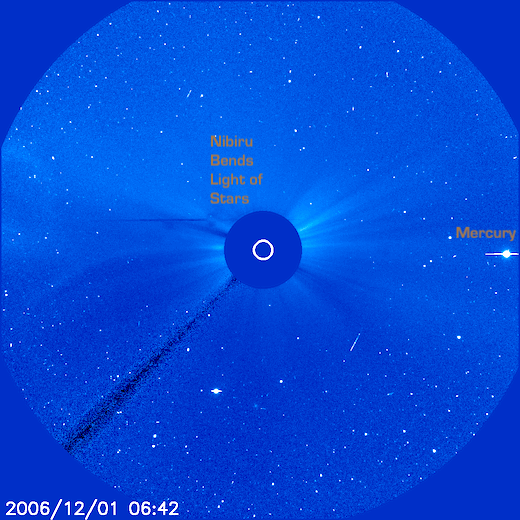 Nibiru entered the solar system in 2006- crossed the heliopause, although it appeared by the sun and pulled the light of stars.
Josh Sullivan Space
11/28/2025
We really need to do something about this object because we just got probably the clearest 3I/Atlas images yet and the details coming out of these observations are once again breaking some fundamental rules of comet physics. Also, Harvard astrophysicist Avi Loeb just published a new analysis and he’s revealing some more weird stuff that science can’t seem to explain. We’re seeing tail structures that probably shouldn’t exist at this distance from the sun. We’re measuring brightness levels that contradict every prediction. And the geometry of what is happening is revealing significant problems with the standard heat physics model. So in this video I’ll explain what is actually happening with 3I/Atlas and why it’s also weird to be happening.
Right now 3I/Atlas is sitting at about 186 million miles from Earth. That is exactly twice the distance between Earth and the Sun [93 million miles]. Before we talk about the mass loss and brightness problems, let’s talk about something in these images that is breaking the fundamental physics of how comets are supposed to work. So, this recent image was captured by an amateur astronomer on November 22nd using a half-meter telescope, which is a telescope that collects significantly more light than smaller telescopes, allowing it to see fainter and more distant objects. The image shows a bright glowing coma around the nucleus with two distinct structures extending outward. These structures are the comet’s tails. This tail stretches away from the sun for about 3 million miles. And the other tail, which points toward the sun, is about 600,000 m long. Both tails are remarkably narrow and focused.
This image is from November 24th. Even though the object is only 15° above the horizon, which makes it very hard to observe, the same basic structures appeared. Multiple independent observers are seeing the same thing, which confirms these are real features and not imaging artifacts. What’s strange here is how tight these jets appear. Normal comet tails spread out and get fuzzy as they extend into space. These are staying columnated like laser beams across millions of miles. So why is one tail five times longer than the other? Well, the normal away from sun tail has help. Solar radiation pressure and the solar wind are both pushing in that direction, but the toward sun tail has to fight against those same forces. Every particle in that anti-tail is pushing directly into the solar wind. Kind of like swimming against the waves. So to create a 600,000 m long tail fighting against the solar wind, the material has to be incredibly dense.
Loeb calculated that the mass density in the anti-tail needs to be about 1 million times greater than the density of the solar wind itself. That is not typical comet outgassing density. That is something else entirely. And this 5:1 ratio is not changing. Earlier images showed the same proportions. Whatever mechanism is creating these jets, it is maintaining consistent physics across hundreds of millions of miles through space. We have never seen a comet maintain this kind of stable asymmetric jet structure for this long. Usually, comet activity fluctuates wildly as different ice deposits get exposed to sunlight during rotation. But 3I/Atlas is once again breaking the rules of physics.
Now before we talk about the brightness anomaly here, let’s first talk about the mass loss problem. So these tails are made of stuff evaporating from the comet due to the sun’s heat. This process is called sublimation. At 186 million miles from the sun, the surface of 3I/Atlas should be extremely cold. Let’s go through the actual numbers. The sun puts out a certain amount of energy per square meter at any given distance. For perspective, the sun delivers more energy to Earth in 1 hour than all of humanity uses in an entire year. At Earth’s distance [93 million miles], that energy is about 1,300 watts per square meter. At 180 million miles, that drops to roughly 300 watts per square meter. That is the total solar energy hitting the surface. But here’s the key detail about comets. Not all of that energy goes into heating ice. Much of it reflects off the surface. Much of it radiates back out as infrared heat. Only a fraction actually goes into sublimating ice from solid directly to gas.
For carbon dioxide ice, which is the main volatile on 3I/Atlas, the sublimation temperature is around -78° C. At the solar energy levels present at 186 million miles, you can calculate exactly how much ice should be sublimating per square meter per second. Well, Avi Loeb did the calculation and to produce the mass loss rate we are observing in these November images, you would need about 620 square miles of active surface area, all sublimating at maximum efficiency. But NASA just released an image from the Mars Reconnaissance Orbiter captured in early October showing 3I/Atlas as a soft glowing white ball. The image shows the cloud of dust and gas around it measuring approximately 932 miles in diameter. But the actual solid material doing the sublimating is way smaller. Based on earlier measurements, the nucleus is only a few miles wide, which gives it maybe 30 to 40 square miles of total surface area. Even if we assume the solid nucleus inside takes up a significant portion of that coma, the actual icy surface doing the sublimating is far smaller than 620 square miles needed to explain the mass loss. The math does not work. You cannot get this much material from heat driven ice sublimation with the available surface area. Science says that this would make sense if the object has broken into fragments, which often happens as comet s hit their closest point to the sun. More fragments means more total surface area. But images from November 11th showed one single intact nucleus, no fragments, no debris cloud, just one solid body.
Okay, so the surface area does not add up. But th e most recent images reveal yet another strange anomaly. 3I/Atlas is way brighter than it should be at this distance after passing the sun. Now, comets follow predictable brightness curves. As they approach the sun, they heat up and get brighter. After passing perihelion, they move away from the sun and cool down. The brightness drops off in a predictable way based on distance. 3I/Atlas has been moving away for over a month now. At 180 million miles distance, the solar heating has dropped significantly. Activity should be declining and therefore the brightness should be fading. But the November images show strong sustained brightness. The coma is still glowing intensely. The tail structures are still prominent and well- defined. There is no sign of the expected dimming.
Harvard scientist Avi Loeb calculated that to maintain this brightness level, the object has to be losing about 200 tons of material per second. That is an enormous ongoing mass loss rate for an object that should be cooling down and quieting down. If 3I/Atlas has been losing 200 tons per second since perihelion, that adds up to billions of tons of total mass lost. For an object estimated at 33 billion tons, this represents roughly 10% of its entire mass shed in just 2 months. A natural comet losing that much mass that quickly should show dramatic changes. The nucleus should be shrinking visibly. The activity should be sputtering and fluctuating as internal structure fails. But none of those things are happening. Let me know your thoughts and theories in the comments. And please drop me a like and hype if you appreciate my effort.
Beyond Space Atlas
11/27/2025
So listen, NASA just raised the alert flag on this thing called 3I/Atlas. And honestly, what happened today shouldn’t even be possible. Like scientifically speaking, this breaks the rules we’ve had in place for decades. For weeks now, scientists have been watching this comet and saying, “Okay, yeah, it’s acting a little strange, but we can still explain it. The models still work. We’re good.” But after what came through in today’s data, those same models are failing in real time, right in front of everyone’s eyes. And I need you to understand something. This isn’t just unusual. This is the kind of thing that makes veteran astronomers stop what they’re doing, pull up the data again, and go, “Wait, that can’t be right.”
Let me explain what was supposed to happen here. When a comet makes its closest approach to the sun, what we call perihelion, it goes through hell. The ice heats up. Material explodes off the surface. You get these massive jets of gas and dust shooting out into space. It’s violent. It’s chaotic. But then as the comet moves away from the sun and heads back out into the cold darkness of space, things are supposed to calm down. That’s just basic physics. The heat source is getting farther away. So, the activity drops. The brightness fades. The jets slow down. Everything gets quieter and quieter until eventually the comet goes dormant again.
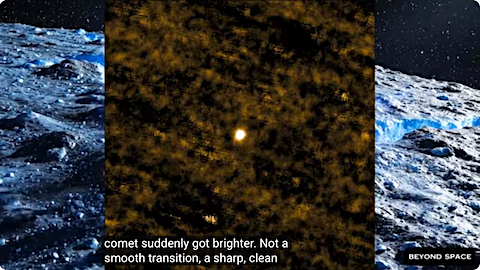
That’s what every comet we’ve ever studied does. Every single one. Except 3I/Atlas just did the complete opposite. In the images NASA processed today, this comet is now farther from the sun than it was just a few days ago. It should be calming down, but instead its activity has ramped up. And I’m not talking about a small increase. I’m talking about a jump so significant that teams are going back and checking every single calibration on their instruments because they think something must be broken. The first warning sign came from the brightness measurements for days. The light curve, which is basically a graph showing how bright the comet is over time, was behaving normally. Small variations, nothing crazy. Standard comet behavior. But today’s curve looks like someone literally flipped a switch. Instead of gradually fading like it should be, the comet suddenly got brighter. Not a smooth transition, a sharp, clean jump in brightness that happened almost instantaneously.
 .
.
That alone would be enough to raise eyebrows. But then the imaging teams did something routine. They overlaid the new images on top of the old ones to track changes. And that’s when things got really weird. The coma, which is that fuzzy cloud of gas and dust surrounding the comet’s nucleus, hasn’t just gotten brighter. It’s changed shape in a way that completely defies the basic logic of “Get farther from the sun, activity goes down”. In the earlier images, the coma looked exactly like what you’d expect from a classic comet. Bright in the center, gradually fading out in all directions, forming this nice symmetrical glow. Pretty standard stuff. But in today’s data, there’s this razor sharp, almost laser-like structure cutting straight through it. It looks like a beam of light with fainter ghostly material wrapped around the edges. The best way I can describe it is this. Imagine you’re looking at fog at night. Yesterday, it was just fog, diffuse and soft everywhere. Today, it’s fog with a visible beam slicing through it, like someone’s shining a high-powered flashlight from inside. That’s what we’re seeing in these images. And that beam is causing major problems.
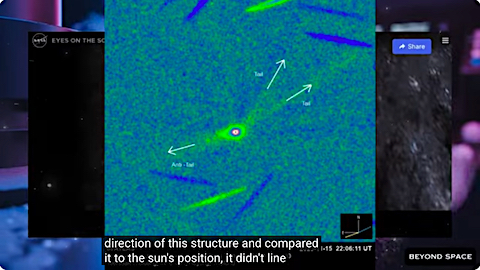
When the teams mapped out the direction of this structure and compared it to the sun’s position, it didn’t line up with what a natural jet should be doing at this point in the comet’s journey. In fact, the jet is pointing almost exactly where it shouldn’t be pointing. It’s offset from the direction the comet is moving. It’s misaligned with the line connecting the sun and the comet. And yet across all of today’s exposures taken over several hours, this structure stays stable. It’s not moving. It’s not shifting. It’s just there, locked in this wrong orientation. Now, if this were just a random burst of material, it would smear out as the nucleus spins. Comets rotate sometimes quite fast, so jets tend to spiral or fan out over time. But this one isn’t doing that. And if this were just dust being pushed by solar radiation pressure, it would gradually align itself with the main dust tail pointing away from the sun. That’s just what solar wind does to dust particles. But again, this structure is holding its shape in a direction that doesn’t make sense.
It gets even stranger when you look at the orbital mechanics. See, scientists track where these objects are in space incredibly precisely. They use gravity calculations combined with models of how outgassing affects the orbit. When a comet vents gas and dust, it acts like a tiny rocket thruster.. That push, even though it’s small, changes the orbit slightly. So, the models account for these non-gravitational forces by measuring the jets and calculating which direction they’re pushing the comet. For weeks, these models have been predicting three Atlas’s position to within a few hundred km. That’s absurdly accurate when you’re talking about something millions of kilometers away moving at tens of thousands of kilometers per hour. But after today’s outburst, when they updated the model with the new brightness data and this massive new jet, something broke. The calculated position of the comet jumped, but not in the direction the jet is pointing. Let me say that again because this is the part that has people using words like “impossible”. The comet is being pushed by some force. The tracking data clearly shows that. But the direction of that push doesn’t match the direction of the giant jet we can see in the images.
In normal comets, this is straightforward. You see a jet on one side, you know the comet is getting pushed in the opposite direction. Newton’s third law, action-reaction. You can calculate the thrust, plug it into your orbit model, and everything lines up beautifully. It always works. For 3I/Atlas today, the thrust vector implied by the actual orbit changes doesn’t match the jet vector visible in the images. Those two things should line up. They always line up, but they don’t. So either our interpretation of what we’re seeing in those images is completely wrong, or there are hidden jets somewhere on the comet that we can’t see, doing the real pushing while this visible jet is just for show; or something about the internal structure and physics of this object is operating in a way we have literally never encountered before.
And just when you think it can’t get any weirder, there’s another layer to this. Spectroscopy data taken at almost the exact same time as these images shows a shift in the chemical composition of the gas around the comet. Earlier this week, the coma was showing familiar signatures: carbon dioxide, water vapor, some carbon monoxide, the usual suspects you see in comets. But in today’s spectra, one of those gas components has dropped significantly while the overall brightness has actually gone up. Less gas, more light. That strongly suggests that this new activity is dust dominated. We’re talking about large dust grains, maybe even solid chunks of ice and rock reflecting sunlight far more efficiently than the gas cloud from before. But these chunks aren’t sublimating. They’re not contributing much to the gas signature. They’re just there, glinting in the sunlight, making the comet look brighter without actually producing more vapor.
So, let me sum up what just happened today. The comet got brighter as it moved away from the sun when it should be getting dimmer. It developed a sharp beam-like structure that’s pointing in the wrong direction. The thrust force acting on the comet doesn’t match the direction of the visible jet. And the brightness increases coming from dust while the gas output has actually decreased. Any one of those things on its own would be difficult to explain. All of them happening simultaneously right now in the same object. That’s why teams are internally calling this “the impossible day”.
So what are the theories? What are people actually thinking might be going on here? One possibility is that 3I/Atlas has a highly layered interior structure. Picture it like an onion, but with different types of ice at different depths. As the comet moves away from the sun, the outer layers, which are made of more volatile ices, freeze up and stop venting. But deeper inside, there are pockets of material that are more insulated, more protected. Those deeper layers might just now be hitting their peak temperature because heat takes time to conduct inward through the layers. So even though the surface is cooling down, there could be internal reservoirs that are just now getting hot enough to burst, driving these localized vents that are focused through narrow cracks and fractures in the outer crust, that could create a focused beam of material. And if the internal geometry is complicated enough, if these vents are angled weird or connected through twisted channels, the thrust direction might not line up with what we see on the surface. It’s possible. It’s weird, but it’s physically possible.
Another idea is that 3I/Atlas is in what’s called ‘a complex rotation state’. Most objects in space spin around a single axis, like a top, but some tumble chaotically, rotating around multiple axis at once. If this comet is tumbling, then the jet we’re seeing in today’s images might only appear misaligned because we’re catching it at a specific moment in its tumble. Over a complete rotation cycle, the average thrust direction might actually balance out and make sense. But we need continuous observations over many hours to confirm that. And right now, we only have snapshots. But here’s the thing. Even the scientists proposing these explanations are admitting that we don’t have a clean, satisfying model yet. Nothing fits perfectly. Every explanation requires you to assume something unusual about this comet structure or behavior. And that’s uncomfortable for scientists because our models are usually really, really good.
And that brings us to why NASA issued an alert. Now, let me be very clear about something. NASA’s tracking centers did not issue this alert, because 3I/Atlas is dangerous to Earth. It’s not. It’s nowhere near us. Its orbit is stable and well understood, and it’s staying far, far away. This isn’t a doomsday scenario. This isn’t some Hollywood movie setup. They issued an alert internally within the scientific community because when a model that has always worked suddenly stops working, you need more data and you need it fast. You need every telescope that can point at this thing to start collecting observations. You need spectroscopy, photometry, imaging, all of it as continuously as possible, because right now three Atlas is moving through a phase of its journey that we’ve never watched an interstellar object go through with this level of detailed coverage. We’ve never had this many instruments trained on something like this at this exact moment in its orbit.
It’s cooling down, but it’s acting like it’s heating up. It’s venting dust in directions that don’t match the forces we’re measuring. It’s getting visually louder and more active. While according to every model we’ve ever built, it should be going quiet and calm. Is it still a natural comet? Almost certainly, yes. There’s no reason to think this is anything artificial or alien or anything like that. But is it behaving like the nice, predictable interstellar visitor we thought we were dealing with a week ago? Absolutely not. Not even close. So, what happens next? If the next round of images coming in over the next few days shows that beam breaking up or fragmenting or if the coma suddenly splits into multiple distinct brightness peaks that might point to fragmentation, meaning the nucleus itself is breaking apart. Pieces are pulling away from each other, each one potentially forming its own little jets and coma. That would explain a lot of the weirdness we’re seeing. It wouldn’t be unprecedented. We’ve seen comets fragment before.
But if this impossible thrust direction keeps showing up image after image, day after day, then we’re looking at something deeper. We’re looking at a completely new kind of internal structure. Something about how ancient radiation-baked ice from another star system behaves when it warms up. Something our current theories just didn’t account for. And honestly, either way, this is not the last alert you’re going to hear about 3I/Atlas. This story is just getting started. So keep your eyes on this. We are watching in real time as an interstellar visitor does things that our best equations built on decades of comet observations didn’t predict. We’re watching the models fail. We’re watching scientists scramble to explain what should be impossible. And as each new piece of data comes down from the telescopes, as each new image gets processed, as each new spectrum gets analyzed, I’ll be here walking you through it, breaking it down, making sense of what’s happening out there in the darkness beyond our world.
This is history being written. This is science at the edge of the unknown. Stay curious, stay tuned, and I’ll see you in the next
Voyager Space
11/05/2025
Avi Loeb: “..natural object like a comet or an asteroid and then is a definitely technological object that maneuvers, broadcasts a signal or transmits.”
Host: What if the universe just broke its own rule? In late 2025, astronomers watched in disbelief as 3I/Atlas, an interstellar object drifting through our solar system, suddenly surged forward, accelerating faster than gravity should ever allow. Telescopes caught it changing speed, shifting direction, and defying every known law of motion. NASA called it an anomaly. Others called it a warning, because whatever was driving 3I/Atlas wasn’t natural. It was deliberate. And now that mysterious force is bringing it closer to Earth.
The night the data changed everything.
For weeks, the space tracking stations had been following 3I/Atlas on its predicted route. a slow, steady descent toward the sun. Ordinary, calculated, and quiet. Then, without warning, the numbers began to shift. In the middle of an otherwise routine night in late October, the monitoring screens inside NASA’s Jet Propulsion Laboratory flashed red. Velocity readings climbed far beyond the limits of known physics. Analysts thought it was a glitch. But as more observatories across the world confirmed the same data, disbelief turned into silence. Something out there had just accelerated on its own.
Normally, every celestial body in space obeys the same fundamental rule. Gravity pulls and resistance slows. Asteroids, comets, and even spacecraft all follow this cosmic rhythm. Yet, 3I/Atlas broke that rhythm completely. Instead of decelerating as it moved farther from gravitational influence, it surged forward, increasing speed by over 200% in a span of just a few hours. The trajectory wasn’t chaotic either. It was deliberate, perfectly aligned, as though guided by a force scientists couldn’t name.. The unnatural acceleration. When NASA released the preliminary findings, the data sounded impossible, even to seasoned astrophysicists. 3I/Atlas had accelerated against gravity, not once, but multiple times in short bursts that followed a strange rhythm.
Each surge occurred at precise intervals like a heartbeat pulsing through space. No natural force behaved this way. Comets gain speed when gases trapped beneath their icy crust ignite under sunlight. But this wasn’t that. The direction of the acceleration didn’t align with sunlight. It pushed sideways, even slightly upward, as though the object were adjusting its own course. Engineers reviewed every possible technical cause. They blamed software errors, tracking misalignments, and even cosmic dust interfering with instruments, but every fix produced the same reading. The acceleration remained. The consistency of the data left only one conclusion. Something about the 3U/Atlas was generating propulsion from within, not reacting to external forces.
That idea sent shock waves through the global scientific community. The most unsettling part wasn’t just how it sped up. It was how smooth the change appeared. No violent fluctuations, no bursts of debris or energy trail, just a steady climb in velocity as though the object were following invisible instructions. Observers noticed its light curve flickered in perfect cycles during these moments, suggesting rotation, orientation shifts, or some internal mechanism redistributing its momentum. What made it stranger still was the precision. Every pulse matched previous velocity patterns recorded weeks earlier, almost as if it had been calculated in advance. There was intent behind the motion, or at least coordination, something nature rarely shows in the cold mechanics of space.
As the hours passed, one chilling realization settled in among the researchers watching live telemetry feeds. This wasn’t a random acceleration. It was control. 3I/Atlas wasn’t obeying gravity anymore. It was mastering it, bending the rules of motion that everything else in the universe must follow. Something or someone was guiding its path. The signals beneath the noise. After the acceleration report spread, deep space antennas worldwide were turned toward 3I/Atlas. The goal was simple. Listen.
For years, the object had emitted nothing beyond background radiation and reflected sunlight. But as its speed grew, something new began to whisper through the static, a faint pulse buried in the noise. At first, it seemed random, like cosmic interference. Then the rhythm emerged. The intervals repeated. The amplitude shifted with the object’s rotation, and the signal began to look intentional. Radio observatories in Chile, Spain, and California all detected the same pattern. The pulses were narrowband, precise, and evenly spaced. Nature rarely produces signals that clean. When researchers overlaid the data, they discovered something stranger. The frequency of the pulses matched the acceleration bursts. Every time 3I/Atlas increased speed, the pulse followed synchronized, deliberate, like a clock keeping perfect time with its own propulsion. NASA’s deep space network analysts ran checks for known sources of interference: satellite reflections, solar bursts, and even instrument feedback. Everything came back negative. The signal wasn’t coming from Earth, and it wasn’t bouncing off anything nearby. It originated directly from the three 3I/Atlas itself.
For weeks, the world’s brightest minds tried to decode it. The pulse pattern repeated in symmetrical sequences, mathematical in design. One long, three short, one long again, repeating endlessly before resetting. Some thought it might be a natural harmonic resonance, perhaps an internal oscillation within the comet’s body, but others, the ones who stared longer at the data, saw something different. Order. That order didn’t belong to a chaotic mass of dust and ice drifting through interstellar space. It belonged to a system, a structure perhaps, or even a process responding to something unseen. The discovery was never publicly announced. Only fragments of the data were quietly released. But those who analyzed it in private reached the same haunting conclusion. The signal wasn’t random, and it wasn’t background noise. It was communication. Something that only began when 3I/Atlas started to accelerate.
The geometry hidden in light.
When the James Web Space Telescope was directed toward 3I/Atlas once again, scientists expected to see a slightly brighter comet. Instead, they saw something that made their skin crawl. The glow surrounding it wasn’t chaotic like the dust clouds of other comets. It was symmetrical, perfectly symmetrical. The light intensity formed repeating rings evenly spaced, expanding outward like ripples from a deliberate motion. Nature doesn’t make patterns that clean. Something was shaping the emission.
Infrared imaging revealed even more unsettling detail. The heat wasn’t distributed randomly. It formed geometric zones. Three triangular hot points aligned in a pattern that rotated with each pulse of acceleration. Those triangles shifted position over time, syncing precisely with the same 20 hour interval that had shown up in earlier data. The repetition was too exact to be a coincidence. At first, NASA described it as ‘anotropic outgassing’, a technical way of saying the comet might be venting gases unevenly, but further analysis proved that the explanation was impossible. The geometry held firm even as its angle to the sun changed. That shouldn’t happen if sunlight were driving the release. The glow looked engineered, controlled by something deeper beneath the surface, as if 3I/Atlas had structured layers of symmetry that no natural object could maintain.
Spectral readings only deepened the mystery. Certain wavelengths appeared brighter than they should have, particularly those connected to carbon dioxide emissions. When plotted, those wavelengths formed harmonic ratios, mathematically perfect intervals like those found in sound frequencies, architecture, or even code. To some researchers, it looked like an energy distribution. To others, it resembled a pattern with an embedded geometric message carved in light. Whatever it was, it moved with intelligence. Every new frame from James Web strengthened that eerie suspicion. 3I/Atlas wasn’t just accelerating. It was performing, rotating, pulsing, and illuminating space with a precision that felt less like physics and more like design.
The forbidden composition.
When scientists finally broke down the spectral data from James Webb’s readings, the chemistry of 3I/Atlas shattered every rule they thought they understood. Most comets are mixtures of frozen water, dust, and simple organic molecules. But 3I/Atlas was nothing like that. It was dominated by carbon dioxide, eight times more abundant than water vapor and laced with elements that don’t occur together naturally. The deeper they analyzed, the more contradictions appeared. The first red flag was the nickel concentration. Metallic nickel rarely exists in vapor form in space. It’s too heavy, too stubborn to escape a comet’s surface. Yet, there it was, shimmering in the infrared data mixed with trace amounts of elements like cobalt and iridium. These metals are found in meteorites that have undergone extreme heat, usually the kind seen inside planets, not frozen rocks drifting through space.
That suggested one disturbing possibility. 3I/Atlas had once been part of something larger. Perhaps a planet, moon, or artificial structure. Even stranger was how stable those metals appeared. Radiation, solar winds, and interstellar travel should have stripped away their volatile compounds long ago. Instead, 3I/Atlas carried them intact, embedded in a shell that seemed resistant to erosion. The ratios didn’t just defy nature. They looked intentional, like alloys forged rather than formed. The next shock came from isotope ratio. Measurements hinted that the oxygen isotopes inside the 3I/Atlas didn’t match anything in our solar system. They were alien, literally foreign to our star’s chemical fingerprint. If true, that meant the object wasn’t just from another system. It came from an entirely different kind of stellar environment. When the findings reached NASA’s planetary science division, internal reports quietly used a new term, ‘engineered stability’. It was never shared with the public.
The phrase described an object whose composition preserved order against time and chaos. Something made to survive. Whatever 3I/Atlas was, it didn’t behave like a comet, and it didn’t decay like one either. It seemed built for endurance, as if it were carrying something precious through the void across billions of years straight towards us.
The rotation that shouldn’t be possible.
When NASA plotted the rotational data of 3I/Atlas, what they found broke every physical expectation. Most comets spin erratically, wobbling, as jets of gas burst from uneven surfaces. But this one rotated with precision. Every 20 hours on the dot, it completed a perfect turn, never slowing, never speeding up, never drifting off balance. The stability was absolute, as though some unseen mechanism kept it in control. Tracking data from the James Web and ground-based observatories confirmed the same rhythm, steady, synchronized, and unnaturally clean. There were no micro variations, no thermal distortions, nothing that hinted at natural instability. In physics, that kind of motion doesn’t happen by accident. A body that small with active gas jets and outgassing vents should gradually lose balance. Yet 3I/Atlas moved as though it were gyrostabilized. Locked in orientation, resisting every external force acting upon it.
The consistency became even more alarming once NASA correlated it with light curve patterns. Every full rotation, the object emitted a pulse, a flash of energy so faint it almost disappeared into the background radiation, but timed with such accuracy that it matched down to the millisecond. The rhythm was perfect, repeating for weeks without variation. Astronomers compared it to the behavior of pulsars – rapidly spinning neutron stars that beam radiation with clockwork precision. But 3I/Atlas wasn’t a star. It wasn’t even large enough to generate magnetic fields strong enough to sustain that kind of emission. The only logical explanation was that something internal was maintaining its spin and output simultaneously. The rotation wasn’t chaotic. It was programmed.
That idea spread quietly among those reviewing the data. A handful of independent researchers noted that its rotational stability and acceleration pattern resembled controlled flight more than free motion. In other words, 3I/Atlas wasn’t drifting through space. It was navigating it. Every spin, every pulse, every course correction appeared calculated like a machine following its trajectory with precision honed over millennia.
The light that changed everything.
It began as a faint anomaly in the infrared spectrum. Just a flicker at first, so subtle most dismissed it as sensory. But when astronomers enhanced the data, the truth emerged. 3I/Atlas wasn’t just reflecting sunlight. It was emitting its own light. Not thermal radiation, not solar reflection, but structured pulses of energy patterns too precise, too rhythmic to be natural. When plotted over time, the pulses formed a repeating sequence. Each flash was separated by the same interval, like a heartbeat echoing across the dark. At first, scientists thought it might be ‘rotational reflection’ – light bouncing off certain patches of ice or metal as the object turned, but the brightness curve didn’t match. Instead of fading as it rotated away, the pulses intensified, perfectly synchronized with the acceleration bursts recorded earlier. Then came the most chilling realization. The wavelengths of those pulses weren’t random. They followed mathematical ratios found in harmonics, geometry, and even biological patterns.
The Fibonacci sequence, golden proportions, symmetrical spacing, and all are embedded in light coming from an object millions of kilometers away. Every attempt to find a natural explanation failed. No gas vent, dust reflection, or magnetic fluctuation could produce that precision. It was as if the object was broadcasting a structured deliberate emission. The more data they collected, the clearer the pattern became. The brightness wasn’t constant. It modulated slightly, encoding subtle variations like binary intervals. The discovery sent ripples through research centers worldwide. Was 3I/Atlas communicating? Or was this something more primal, a mechanism, a beacon, or an ancient remnant still performing the task it was built for?
As days passed, the light remained steady, unwavering, indifferent to speculation. Whatever its source, it was undeniable. 3I/Atlas wasn’t passive anymore. It was active. It was doing something, and it seemed aware of the fact that someone was watching the movement toward Earth. By late November, 3I/Atlas had already passed Mars. Its path should have curved gently away from the inner solar system, slipping back into the void like most interstellar wanderers do. But it didn’t. Instead, its course began to change subtly at first. Then, unmistakably, the orbital projections started bending inward, aligning with Earth’s position.
At NASA’s Jet Propulsion Laboratory, tracking teams rechecked their data dozens of time. No known gravitational influence could explain the shift. The object wasn’t being pulled. It was steering. Every adjustment to its trajectory happened in small, precise increments as though it were correcting its aim. The most unsettling part was how smooth the motion was. Normally, any natural deflection would show random variation. A nudge from solar wind, a tug from Jupiter’s gravity tie, but 3I/Atlas’s curve was flawless, almost guided. The change in velocity was slight, but the direction was clear. It was coming closer to Earth’s orbital path.
Publicly, NASA downplayed the anomaly, referring to it as “a standard orbital refinement”, but leaked telemetry told another story. The acceleration continued in controlled bursts, perfectly timed with the same 20 hour pulse pattern. The object wasn’t drifting randomly through space. It was moving with intention. Ground based telescopes began picking up a brighter signature each night. What was once a distant smudge now shimmered faintly, even in smaller observatories. Scientists noticed that as it approached, the structured light emissions intensified. The frequency of the pulses shortened slightly, almost as if the object was compensating for its proximity, adapting. When plotted on simulation models, its path intersected Earth’s orbit in early March 2026. It wouldn’t collide, but it would come dangerously close, closer than any interstellar object in history. No one dared say it out loud, but every researcher tracking 3I/Atlas felt the same chill. This wasn’t a coincidence anymore. The object had changed direction. Something out there had seen us. And now it was coming.
The data NASA tried to hide behind closed doors. The data coming from NASA’s deep space monitors told a story the public would never hear. In early October, an encrypted report labeled ‘DSN priority transmission’ circulated through internal channels. It described continuous energy emissions from 3I/Atlas that matched no known cometary activity. The readings were consistent, sustained, and intelligent in rhythm. The signal strength was rising, not fading, as the object approached Earth’s orbital range. Technicians within the deep space network reported something even more unsettling. During signal decoding tests, the emissions began to mirror back the same carrier frequencies NASA was using to track it. In other words, three Atlas was responding. It wasn’t just broadcasting, it was echoing what was sent, delayed by a fraction of a second as if acknowledging the connection. That discovery caused panic within the communication division. Protocol demanded silence. The order was clear. Stop transmitting. Stop pinging. Stop trying to contact it.
For a short time, NASA went dark toward 3I/Atlas, fearing that every signal they sent might be answered in ways they couldn’t control. Then came a second anomaly. On October 17th, the Goldstone Deep Space antenna detected low-frequency modulations beneath the main signal. A subcarrier pulse oscillating at exactly 7.83 hertz. That number wasn’t random. It matched Earth’s own Schuman resonance, the electromagnetic heartbeat of our planet’s atmosphere. The finding was quietly buried in an internal memo marked for analysis only. When a few researchers leaked portions of the data, their access was revoked. One of them later claimed the signal wasn’t just interference, it was mimickry. 3I/Atlas was copying Earth’s natural frequency almost as if tuning itself to us.
The approach and the silence.
By January 2026, three IA Atlas had crossed the orbit of Mars and was speeding toward the inner solar system faster than any recorded object of its size. Observatories around the world were locked onto it. Yet, something strange began to happen. Its signal started to fade. The steady pulses that had been constant for months grew erratic, weaker, and then vanished entirely. Within days, the object went dark. NASA’s official statement called it “signal saturation and data loss”. But astronomers who had followed it from the beginning knew better. You don’t lose a signal that’s strong all at once. You lose it when something wants to disappear. Visual data showed the object still glowing faintly, its reflective surface intact, but no longer emitting any measurable energy patterns. Some speculated it was shutting down, entering a dormant phase before reaching its next trajectory point. Others believed the opposite, that the silence meant it was preparing for something.
Then came the most unnerving update of all. Trajectory simulations no longer matched realtime tracking. 3I/Atlas wasn’t where it was supposed to be. Its position data began to fluctuate as though it were distorting light around itself. Radar pings bounced back seconds later than expected, delayed in ways no natural object could cause. For a moment, it appeared to flicker visible, then gone, then visible again, like it was phasing through the darkness. Thanks for watching another episode. While you are still here, make sure to click the video on your screen for more quality content.
Update
Links-
‘We Seriously need to do something about 3I/Atlas’
Josh Sullivan Space
11/28/2025
https://www.youtube.com/watch?v=syFj9GpAkvI
‘NASA ALERT TODAY — 3I/ATLAS JUST DID THE IMPOSSIBLE’
Beyond Space Atlas
11/27/2025
https://www.youtube.com/watch?v=ylCP9syiUFg
‘3I/ATLAS Just Accelerated Rapidly Against Gravity…’
Voyager Space
11/05/2025
https://www.youtube.com/watch?v=lBEFbIzSJWk
‘3I/ATLAS Has Begun Shaking Violently, Then THIS Happened…’
Voyager Space
11/30/2025
https://www.youtube.com/watch?v=5SosB8EszwE
‘Comet 3I/Atlas came from Nibiru; there’s nothing like it’
Dr Sam
10/31/2025
/spirit/2025/11/nibiru-dr-sam-comet-3iatlas-came-from-nibiru-theres-nothing-like-it-given-october-31st-2025-2525349.html
‘Comet 3i Atlas – United Nations PLANETARY DEFENSE TARGET – I took a PICTURE’
Ray’s Astrophotography
11/28/2025
https://www.youtube.com/watch?v=QDT9cnf-nPw
“from November 27th 2025 to January 27th, 2026”
‘Why Have All the Birds Suddenly Disappeared?’
Ouachita Mountain Living
11/25/2025
https://www.youtube.com/watch?v=S3lMlpGgNBw
The Ouachita Mountains are in western Arkansas and s/eastern Oklahoma, not far from the New Madrid fault in eastern Arkansas and western Tennessee
Mary’s Messages
/spirit/2020/05/marys-messages-to-help-us-during-tribulation-period-2517355.html
Anyone can join.
Anyone can contribute.
Anyone can become informed about their world.
"United We Stand" Click Here To Create Your Personal Citizen Journalist Account Today, Be Sure To Invite Your Friends.
Before It’s News® is a community of individuals who report on what’s going on around them, from all around the world. Anyone can join. Anyone can contribute. Anyone can become informed about their world. "United We Stand" Click Here To Create Your Personal Citizen Journalist Account Today, Be Sure To Invite Your Friends.
LION'S MANE PRODUCT
Try Our Lion’s Mane WHOLE MIND Nootropic Blend 60 Capsules
Mushrooms are having a moment. One fabulous fungus in particular, lion’s mane, may help improve memory, depression and anxiety symptoms. They are also an excellent source of nutrients that show promise as a therapy for dementia, and other neurodegenerative diseases. If you’re living with anxiety or depression, you may be curious about all the therapy options out there — including the natural ones.Our Lion’s Mane WHOLE MIND Nootropic Blend has been formulated to utilize the potency of Lion’s mane but also include the benefits of four other Highly Beneficial Mushrooms. Synergistically, they work together to Build your health through improving cognitive function and immunity regardless of your age. Our Nootropic not only improves your Cognitive Function and Activates your Immune System, but it benefits growth of Essential Gut Flora, further enhancing your Vitality.

Our Formula includes: Lion’s Mane Mushrooms which Increase Brain Power through nerve growth, lessen anxiety, reduce depression, and improve concentration. Its an excellent adaptogen, promotes sleep and improves immunity. Shiitake Mushrooms which Fight cancer cells and infectious disease, boost the immune system, promotes brain function, and serves as a source of B vitamins. Maitake Mushrooms which regulate blood sugar levels of diabetics, reduce hypertension and boosts the immune system. Reishi Mushrooms which Fight inflammation, liver disease, fatigue, tumor growth and cancer. They Improve skin disorders and soothes digestive problems, stomach ulcers and leaky gut syndrome. Chaga Mushrooms which have anti-aging effects, boost immune function, improve stamina and athletic performance, even act as a natural aphrodisiac, fighting diabetes and improving liver function. Try Our Lion’s Mane WHOLE MIND Nootropic Blend 60 Capsules Today. Be 100% Satisfied or Receive a Full Money Back Guarantee. Order Yours Today by Following This Link.


| Visits: | 1,760,178,215 |
| Stories: | 8,552,417 |
Whistler Blowers, Insiders

