

Mastering Golf Emotional Control: The Mental Architecture of Lower Scores

Research suggests that at the elite level, up to 90% of golf performance is mental, yet the average player spends nearly all their energy on swing mechanics. You likely recognize the pattern: a smooth, confident warm-up followed by a total collapse of focus after the first double bogey. It’s a common frustration to feel your physical talent vanish the moment performance anxiety creates tension in your hands. This “spiral” effect, where one bad shot inevitably leads to three more, is not a failure of your swing; it’s a gap in your internal architecture.
You can bridge this gap by mastering golf emotional control. True mastery is not about suppressing your feelings, but about building a professional-grade system of emotional regulation that separates your identity from your outcome. In this article, you’ll learn how to develop a disciplined pre-shot and post-shot routine that fosters resilience. We’ll explore the mental shifts required to stay present for all 18 holes and provide the tools to recover instantly from technical errors, ensuring your score finally reflects your true potential.
- Understand how the “Amygdala Hijack” disrupts fine motor skills and why maintaining a functional performance state is critical for lower scores.
- Transition from a reactive to a proactive mindset by anchoring your golf emotional control to your internal process rather than your last result.
- Construct a professional-grade routine using sensory-based “See, Feel, Do” steps to create a mental sanctuary under high pressure.
- Implement immediate physiological resets like Box Breathing and the “Five Senses” drill to clear cortisol and maintain presence during the round.
- Recognize that emotional resilience is a trainable skill that can be mastered through structured systems and consistent practice.
The Science of Golf Emotional Control: Why Your Brain Sabotages Your Swing
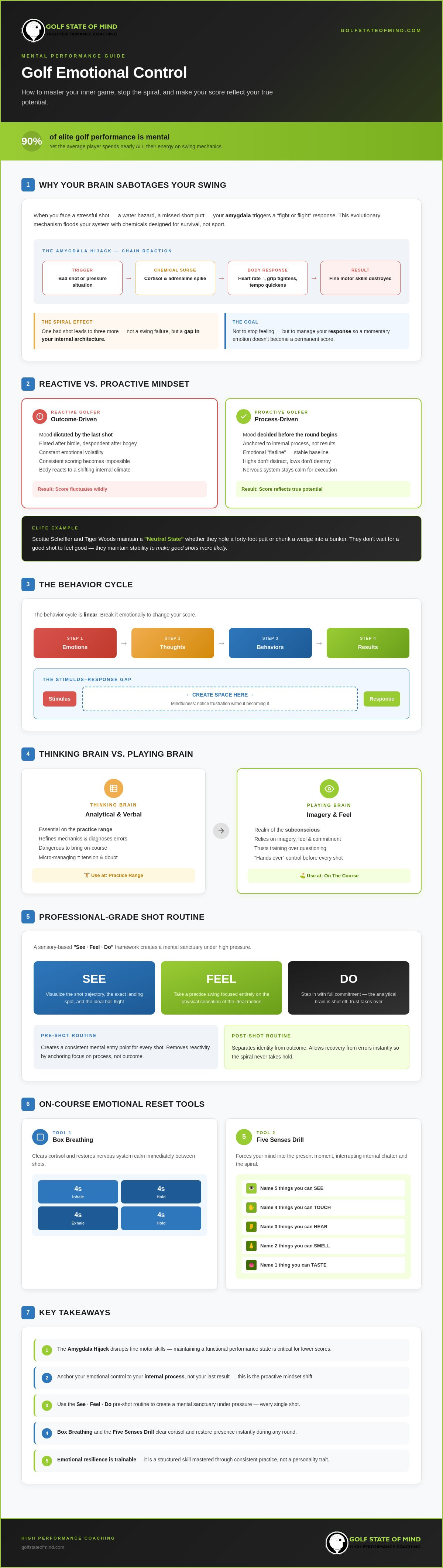
Golf is played in the narrow space between your ears. While many players obsess over launch angles and clubhead speed, the most critical variable in any round is your golf emotional control. This skill is not the ability to eliminate frustration entirely. Instead, think of it as the capacity to maintain a functional performance state regardless of the results on the scorecard. When you lose this control, your brain begins to actively sabotage your physical ability through a process known as the Amygdala Hijack.
When you face a stressful situation, such as a water hazard or a missed short putt, your amygdala triggers a “fight or flight” response. This evolutionary survival mechanism is designed for life-threatening dangers, not a sport of millimeters. It floods your system with chemicals that prioritize large muscle groups for running or fighting. For a golfer, this is catastrophic. It ruins the fine motor skills required for a delicate chip or a precise drive. You’ll often notice this as a sudden increase in grip pressure. Your body is preparing for a physical struggle, and that tension destroys your natural timing. The goal is never to “stop feeling” on the course. You’re human, and emotions are inevitable. The objective is to manage your response so that a momentary feeling doesn’t become a permanent score.
The Physiology of a Blow-up Hole
During a blow-up hole, your body is under chemical siege. Cortisol and adrenaline spike, causing your heart rate to climb and your tempo to quicken. You start moving faster and breathing shallower. In this state, your “Thinking Brain” attempts to micro-manage your swing mechanics to “fix” the problem, which only increases tension. A performance state is a balance of physiological calm and mental alertness.
The Stimulus-Response Gap
George Mumford emphasizes “creating space” between a stimulus and your response. In golf, mindfulness allows you to notice frustration without becoming it. This awareness is foundational to the science of the flow state, where internal chatter quiets and your talent takes over. The behavior cycle is linear: emotions drive thoughts, which dictate behaviors and produce results. Break the cycle emotionally to change your score.
Reactive vs. Proactive Mindsets: Choosing Your Performance State
The distinction between a high-handicapper and an elite performer often boils down to one factor: where they anchor their mood. The “Reactive Golfer” allows their emotional state to be dictated by the outcome of the last shot. If they birdie, they’re elated. If they double-bogey, they’re despondent. This volatility makes consistent scoring impossible because the body is constantly reacting to a shifting internal climate. Conversely, the “Proactive Golfer” decides their performance state before the round begins. Their mood depends on their adherence to an internal process, not the fluctuations of the scorecard. Mastering golf emotional control requires you to choose this proactive stance deliberately, regardless of how the ball is flying.
Elite players like Scottie Scheffler or Tiger Woods are masters of the emotional “flatline.” Whether they hole a forty-foot putt or chunk a wedge into a bunker, their physiological response remains remarkably consistent. They aim for a “Neutral State,” an emotional baseline that prevents the highs from becoming distracting and the lows from becoming destructive. This stability isn’t a personality trait; it’s a practiced discipline. By maintaining this flatline, they ensure that their nervous system remains calm enough to execute the next shot with total precision. They don’t wait for a good shot to feel good; they maintain a stable state to make good shots more likely.
The Thinking Brain vs. The Playing Brain
You must understand the division of labor within your mind. The “Thinking Brain” is analytical and verbal. It’s essential for the practice range where you’re refining mechanics and diagnosing errors. However, bringing this analytical voice onto the course is a primary cause of frustration. To train your golf brain effectively, you must learn to switch to the “Playing Brain” during your round. This is the realm of the subconscious, which relies on imagery, feel, and commitment. When you micro-manage your swing mid-round, you invite tension and doubt. You must learn to “hand over” control to the subconscious before every shot, trusting your training rather than questioning it.
Identifying Your Personal Triggers
Every golfer has specific events that threaten their composure. Common triggers include slow play, “unfair” bounces, or missing short putts. These are emotional leaks that drain your mental energy. To plug them, you need a system of post-round reflection. Don’t just tally your strokes. Create a “Mental Scorecard” to track your golf emotional control. Rate yourself on a scale of one to ten for each hole based on how well you stayed in your process. If you find yourself struggling to establish this baseline early in the day, utilizing a tool like the 30 Minute Pre-Round Confidence Booster can help you set a proactive tone before you ever reach the first tee.
The Mental Architecture of a Professional Routine
A professional routine is more than a series of physical habits. It is a psychological fortress designed to protect your performance state from the chaos of the course. In moments of high pressure, your routine acts as a reliable anchor; it grounds your nervous system and provides a sense of safety. By consistently repeating the same sequence of sensory-based steps, you reinforce your golf emotional control, ensuring that your focus remains on the process rather than the potential score. This structure creates a predictable environment for your brain, even when the external situation is volatile.
The architecture of a great shot relies on a simple, sensory-based framework that bypasses the analytical mind:
- See: Visualize the ball flight and the target with high-definition clarity.
- Feel: Use a practice swing to connect with the physical sensation required for the shot.
- Do: Step into the ball and execute without further technical thought.
The Pre-Shot Anchor
Visualization is not just about seeing a line; it is about creating a positive emotional blueprint. By practicing mindfulness exercises for emotional control, you can learn to quiet the analytical mind and enter a state of calm focus. The most critical part of this process is the Commitment Line. This is a physical or imaginary line behind the ball. Before you cross it, you analyze the wind, the lie, and the distance. Once you step over it, the analysis ends. You use a trigger word, perhaps “smooth” or “target,” to signal your subconscious to take over. This final filter ensures you are 100% committed, which is the only way to swing with total freedom.
The Post-Shot Neutralization
Emotional containment is just as important as shot preparation. Most amateurs allow the frustration of a poor result to follow them to the next tee, creating a cumulative weight that eventually breaks their composure. To prevent this, implement the 10-Second Rule. You have exactly ten seconds to feel whatever emotion the shot produced, whether it is anger or joy. Once those ten seconds pass, you must let it go. The “Club in the Bag” ritual is the physical manifestation of this mental release. As you slide your club back into its slot, you mentally end your connection to that specific shot. A disciplined post-shot routine acts as a firebreak, stopping the spread of frustration before it can ruin your entire round.
On-Course Drills for Instant Emotional Resilience
Mastering golf emotional control requires more than just a theoretical understanding of the mind. It demands a toolkit of physical interventions that you can deploy the moment you feel your composure slipping. These drills serve as circuit breakers, stopping the physiological cascade of stress before it ruins your tempo. By practicing these techniques, you train your nervous system to return to a neutral baseline quickly, ensuring that a single mistake doesn’t dictate the remainder of your round.
One of the most effective tools for immediate regulation is Box Breathing. This 4-count technique involves inhaling for four seconds, holding for four, exhaling for four, and holding again for four. This rhythmic pattern signals the parasympathetic nervous system to lower your heart rate and clear the cortisol that accumulates after a stressful shot. It’s a simple yet powerful way to regain your center while walking to your ball.
Before you commit to your next shot, use the “Red Light, Green Light” drill to assess your readiness. If you feel calm and focused on your target, you have a green light. If you feel uncertain or slightly rushed, you’re at a yellow light. If you’re angry, tense, or dwelling on a past error, you have a red light. You must never swing on a red light. Step away, reset your breath, and don’t step back in until you’ve moved back to green. For those looking to deepen this skill, our Ultimate Mental Game Training System provides a structured framework for these assessments.
Tactical Breathing for Pressure
Your breath is the bridge between your analytical mind and your athletic subconscious. To maintain golf emotional control under pressure, try the “Exhale on the Hit” technique. By starting a slow, steady exhale just before you begin your takeaway, you release hidden tension in your jaw and shoulders. It’s also important to distinguish between calming breaths, which are slow and deep, and energizing breaths, which are slightly sharper and used when you feel your focus becoming sluggish or “flat.”
Sensory Grounding and Presence
Anxiety is almost always rooted in the future, while frustration is rooted in the past. To stay in the present, use the “Five Senses” grounding drill. Identify three things you can see, two things you can hear, and one thing you can feel, such as the texture of your grip or the wind on your face. This sensory focus pulls you out of your head and back into your body. Learning how to focus during a golf round is about these small, intentional moments of presence. If you’ve just hit a poor shot, use the “Memory Replacement” drill: briefly visualize the correct swing and ball flight to overwrite the negative image before moving on. To support your on-course resilience, consider using our Mental Game Audios to reinforce these habits between rounds.
Mastering the Inner Game: Your Path to Long-Term Consistency
Long-term consistency on the course is rarely a result of finding the perfect swing. It’s the byproduct of a deliberate, structured approach to your internal state. You must accept that golf emotional control is a skill that requires as much practice as your short game. It isn’t a personality trait you’re born with; it’s a mental architecture you build through repetition and discipline. Just as you wouldn’t expect to master a flop shot without hitting hundreds of balls, you can’t expect to stay calm under pressure without training your mind to do so.
For players ready to commit to this process, The Ultimate Mental Game Training System provides the structured roadmap needed for sustainable improvement. While digital systems offer the foundation, 1:1 Mental Coaching can help identify the specific “blind spots” in your emotional makeup that you might miss on your own. Often, a third party can see the subtle triggers and reactive patterns that cause your scores to spiral. To reinforce these habits between sessions, utilizing Mental Game Audios during your commute to the course can prime your brain for the performance state discussed in earlier sections.
The 30-Minute Confidence Reset
Your emotional baseline for the day is often set long before you reach the first tee. Many golfers use their warmup to hunt for technical fixes, which only heightens anxiety if the ball flight isn’t perfect. Instead, use the 30 Minute Pre-Round Confidence Booster to shift your focus toward feel and presence. The range should be a place where you cultivate a “quiet mind” and emotional stability. By the time you step onto the first tee, your technical analysis should be silenced, replaced by the proactive mindset required for 18 holes of focused play.
Building a Mental Training Schedule
Treat your mental drills with the same discipline you apply to your putting or chipping practice. A prepared mind doesn’t happen by accident; it’s the result of a consistent training schedule. Use the Golf State of Mind coaching app to track your progress and stay accountable to your routines. When you begin to measure your success by your golf emotional control rather than just your birdies, you’ll find that the lower scores follow naturally as a result of your improved process. It’s time to stop leaving your performance to chance and start building a system that lasts.
Transform your mental game with The Ultimate Mental Game Training System.
Secure Your Mental Foundation
Mastering golf emotional control transforms the game from a reactive struggle into a proactive discipline. You’ve learned that the “Amygdala Hijack” is a physiological hurdle, not a character flaw; it can be managed through structured routines and sensory grounding. By shifting your focus from the outcome of the last shot to the integrity of your current process, you protect your performance state from the volatility of the scorecard. This mental architecture is a skill that requires consistent training and a dedicated system to maintain.
Start your journey to mental mastery with The Ultimate Mental Game Training System. Expertly designed by mental coach David MacKenzie, this program has been trusted by thousands of golfers worldwide. It offers proven systems for curing the yips and building the deep confidence necessary for peak performance. Don’t leave your scores to chance; instead, invest in the tools that separate the elite from the average. Stay committed to the process. Your talent is already there. Now, give it the steady hand it deserves to finally show up on the scorecard.
Frequently Asked Questions How do I stop getting angry after a bad golf shot?
Stop anger by implementing a structured post-shot routine that provides a specific window for emotional release. Use the 10-second rule to vent your frustration, then physically signal the end of that emotion by putting your club back in the bag. Anger stems from a gap between your expectations and reality; by narrowing your focus to the next task, you shorten the duration of the emotional spike.
What is the best way to stay calm under pressure in golf?
Staying calm is achieved through physiological regulation, specifically by controlling your heart rate with Box Breathing. When you feel the pressure of a tight match or a difficult hazard, your body’s “fight or flight” response triggers tension. Deep, rhythmic breathing signals your parasympathetic nervous system to remain neutral, allowing you to maintain your natural tempo and rhythm throughout the entire round.
Can sports psychology actually lower my golf handicap?
Sports psychology lowers your handicap by closing the gap between your physical potential and your actual scorecard. Research suggests that up to 90% of elite performance is mental, and improving your golf emotional control directly reduces the “waste shots” caused by frustration. By eliminating blow-up holes and maintaining a functional performance state, most players see an immediate and sustainable drop in their scores.
What is the 10-second rule in golf mental game?
The 10-second rule creates a “containment zone” for your emotions after a shot is completed. You allow yourself exactly ten seconds to feel whatever emotion the result produced, whether it’s anger or elation. Once those ten seconds pass, you must mentally file the shot away and return to a neutral state. This prevents a single bad result from turning into a multi-hole emotional spiral.
How do I stop overthinking my swing during a round?
Stop overthinking by establishing a clear “Commitment Line” that separates analysis from execution. Before you cross this line, you’re allowed to think about wind, lie, and yardage in your “Thinking Brain.” Once you step over the line, you must switch to your “Playing Brain,” focusing purely on target and feel. Use a trigger word to signal your subconscious that it’s time to trust your training.
Is there a difference between golf anxiety and golf frustration?
Anxiety and frustration differ in their temporal focus; anxiety looks forward with fear, while frustration looks backward with regret. Anxiety creates physical tension and a faster heart rate before you even swing, whereas frustration ruins your composure after a perceived mistake. Both states disrupt golf emotional control and require specific physiological resets, such as sensory grounding, to bring your focus back to the present moment.
How can I recover from a double bogey and stay focused?
Recover from a double bogey by using a physical “reset” ritual to prevent emotional spillover into the next hole. Treat the double bogey as a single data point rather than a reflection of your skill. As you walk to the next tee, engage in a grounding drill like the “Five Senses” technique to reclaim your presence. Focus on the process of the next shot rather than the damage to your scorecard.
What mental drills can I do on the golf course?
Effective on-course drills include sensory grounding and tactical breathing patterns to maintain presence between shots. Practice the “Red Light, Green Light” drill to assess your emotional readiness before stepping into the ball. If you’ve just hit a poor shot, use the “Memory Replacement” drill to briefly visualize the correct swing and ball flight, overwriting the negative image before you move to the next location.
The post Mastering Golf Emotional Control: The Mental Architecture of Lower Scores appeared first on Instruction For The Mental Game of Golf.
Source: https://golfstateofmind.com/mastering-golf-emotional-control-the-mental-architecture-of-lower-scores/
Anyone can join.
Anyone can contribute.
Anyone can become informed about their world.
"United We Stand" Click Here To Create Your Personal Citizen Journalist Account Today, Be Sure To Invite Your Friends.
Before It’s News® is a community of individuals who report on what’s going on around them, from all around the world. Anyone can join. Anyone can contribute. Anyone can become informed about their world. "United We Stand" Click Here To Create Your Personal Citizen Journalist Account Today, Be Sure To Invite Your Friends.
LION'S MANE PRODUCT
Try Our Lion’s Mane WHOLE MIND Nootropic Blend 60 Capsules
Mushrooms are having a moment. One fabulous fungus in particular, lion’s mane, may help improve memory, depression and anxiety symptoms. They are also an excellent source of nutrients that show promise as a therapy for dementia, and other neurodegenerative diseases. If you’re living with anxiety or depression, you may be curious about all the therapy options out there — including the natural ones.Our Lion’s Mane WHOLE MIND Nootropic Blend has been formulated to utilize the potency of Lion’s mane but also include the benefits of four other Highly Beneficial Mushrooms. Synergistically, they work together to Build your health through improving cognitive function and immunity regardless of your age. Our Nootropic not only improves your Cognitive Function and Activates your Immune System, but it benefits growth of Essential Gut Flora, further enhancing your Vitality.

Our Formula includes: Lion’s Mane Mushrooms which Increase Brain Power through nerve growth, lessen anxiety, reduce depression, and improve concentration. Its an excellent adaptogen, promotes sleep and improves immunity. Shiitake Mushrooms which Fight cancer cells and infectious disease, boost the immune system, promotes brain function, and serves as a source of B vitamins. Maitake Mushrooms which regulate blood sugar levels of diabetics, reduce hypertension and boosts the immune system. Reishi Mushrooms which Fight inflammation, liver disease, fatigue, tumor growth and cancer. They Improve skin disorders and soothes digestive problems, stomach ulcers and leaky gut syndrome. Chaga Mushrooms which have anti-aging effects, boost immune function, improve stamina and athletic performance, even act as a natural aphrodisiac, fighting diabetes and improving liver function. Try Our Lion’s Mane WHOLE MIND Nootropic Blend 60 Capsules Today. Be 100% Satisfied or Receive a Full Money Back Guarantee. Order Yours Today by Following This Link.


| Visits: | 1,823,584,776 |
| Stories: | 8,677,156 |
Whistler Blowers, Insiders

