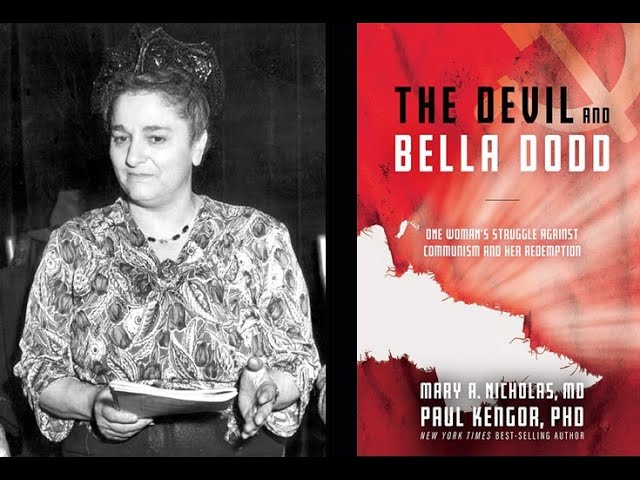
Bella Dodd is a genuine American heroine, equivalent to Jean D’Arc in France.
You will never see a movie about her because the US has been Communist for a long time.
Most Jews are Communists. Masonic Jews run the US and much of the world.
Judaism is Communism as Rabbi Stephen Wise proclaimed. The aim of Judaism is to monopolize all wealth, power and thought and enslave all those who refuse their tyranny, including assimilated Jews like myself. This is what CBDC’s are all about.
Zionist Jews like Trump are anti-Communist but this is a Left-Right charade: Conflict between two branches of Jewish Freemasonry used to control discourse and events. Demonrats and GOP are colluding to cause chaos and bring down the West.
I repost this review in order to put our present travails in perspective. Judaism is a satanic cult masquerading as a religion. We can’t see it because we are part of it. We are satanically possessed.
“As head of the party’s New York operations, Bella Dodd orchestrated massive infiltration campaigns, placing Communist sympathizers in labor unions, government agencies, schools, Hollywood, and–most controversially–the Catholic priesthood. Dodd later claimed responsibility for inserting over 1,000 “plants” into U.S. seminaries to subvert the Church from within, a tactic she viewed as part of communism’s war on religion.”
by GROK 4
(henrymakow.com)
The Devil and Bella Dodd: One Woman’s Struggle Against Communism and Her Redemption, written by Mary Nicholas with a foreword by Paul Kengor and published by TAN Books in 2022, is a biography that recounts the dramatic life of Bella Visono Dodd (1904-1969), an Italian-American intellectual and high-ranking member of the Communist Party USA (CPUSA).
Drawing heavily from Dodd’s own 1954 memoir School of Darkness, the book frames her story as an epic spiritual and ideological battle: a descent into the “satanic scourge” of atheistic communism–described by Dodd as a “school of darkness” and “school of hate”–followed by her courageous defection, conversion to Catholicism, and lifelong mission to expose communist infiltration in America.
Key Plot and Themes
The narrative unfolds in three main acts:
Rise in the Communist Underworld (1920s-1940s): Born to immigrant parents in Italy and raised in poverty in New York, Dodd, a brilliant scholar with a PhD in economics from Columbia University, was drawn to socialism amid the Great Depression.
She joined the CPUSA in the 1930s, quickly ascending to leadership roles as a propagandist, organizer, and legal counsel.
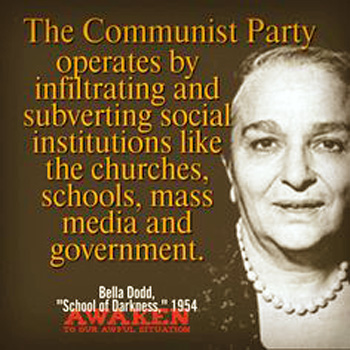
As head of the party’s New York operations, she orchestrated massive infiltration campaigns, placing communist sympathizers in labor unions, government agencies, schools, Hollywood, and–most controversially–the Catholic priesthood. Dodd later claimed responsibility for inserting over 1,000 “plants” into U.S. seminaries to subvert the Church from within, a tactic she viewed as part of communism’s war on religion.
The book vividly depicts her moral compromise, quoting Dodd’s haunting reflection: “Step by step, I retreated from God and went forth to meet the world, the flesh, and the devil… I’d join the devil himself… There is no doubt that I traveled with him at my side and that he extorted a great price for his company.”
This phase highlights themes of ideological seduction, the dehumanizing effects of totalitarianism, and communism’s deliberate strategy to erode faith and freedom.
Defection and Persecution (Late 1940s): Disillusioned by Stalin’s purges, the party’s internal betrayals, and her own personal tragedies (including a failed marriage and the loss of a child), Dodd broke with the CPUSA in 1948. Her testimony before the House Un-American Activities Committee (HUAC) in 1952 exposed the party’s networks, earning her death threats and vilification from former allies, who labeled her a “fascist” and “racist”–smears the book notes echo in modern political discourse.
Amid this isolation, Dodd grappled with profound spiritual emptiness, setting the stage for her redemption.

Redemption and Penance (1950s-1969): The turning point came through the ministry of Archbishop Fulton J. Sheen, the charismatic Catholic televangelist whose Life Is Worth Living series reached millions. Sheen guided Dodd through her conversion to Catholicism in 1952, baptizing her and becoming a lifelong spiritual advisor.
Transformed, Dodd embraced a “special penance”: lecturing across the U.S., advising anti-communist efforts, and warning of the ideology’s lingering threats. She collaborated with figures like J. Edgar Hoover and testified repeatedly on infiltration tactics.
The book portrays her final years as a triumph of grace over evil, with Dodd dying in 1969 as a devout Catholic, her story a testament to the Church’s redemptive power.
Style and Significance
Nicholas, a retired physician and Dodd’s longtime friend who conducted extensive interviews with those who knew her, blends Dodd’s firsthand accounts with archival research and Kengor’s historical analysis. The result is a gripping, faith-infused narrative that reads like a thriller, interspersed with theological reflections on sin, conversion, and spiritual warfare. Endorsements praise its timeliness amid resurgent socialism: historian Sebastian Gorka calls Dodd “a seminal figure of the Cold War” who “should not be forgotten,” while author Carrie Gress hails it as “a beautiful testament to the peace and love offered… by Christ and his Church.”
Ultimately, the book argues that in the contest “between the devil and Bella Dodd, Bella and her Church won,” offering hope that even the deepest darkness can yield to divine light. It’s recommended for readers interested in Cold War history, Catholic conversion stories, or the spiritual dimensions of political evil.
-