

A Thanksgiving Reminder For Folks Who Believe In Hard Work And God’s Provision

Every November, we set a table big enough to make the legs complain, bow our heads for a minute, and call it Thanksgiving. Then the gravy starts moving, the football comes on, and gratitude can get shoved aside before the first slice of pie.
Meanwhile, the God who carried us through the other 364 days gets squeezed between “pass the rolls” and kickoff. That ought to give us pause. A full plate doesn’t necessarily mean a thankful heart.
So before you carve the bird this year, consider a question that reaches farther than the dining room: What spirit is running your Thanksgiving?
Because the answer will still matter when the company leaves, the weather turns ugly, and the truck refuses to start.
When Saying Grace Feels Like Passing a Hot Potato
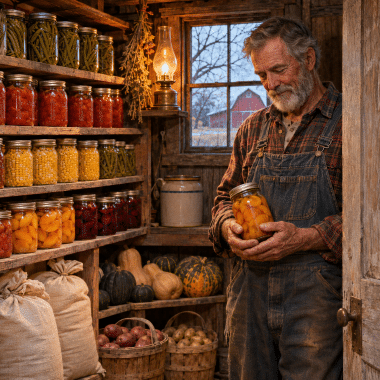
Picture the scene. Steam curls off the mashed potatoes, somebody’s watching the clock, and everyone suddenly becomes interested in who should pray. Eventually, the job lands with the relative who goes to church most often.
Now, there’s nothing wrong with asking that person to lead. But there’s something troubling about treating gratitude like a household chore that belongs to the family specialist. You wouldn’t expect one person to eat everybody else’s dinner, yet sometimes we act as though one person can do everybody else’s thanking.
Worse, the awkwardness can expose what we’ve neglected all year. We’ve received rain, groceries, answered prayers, another sunrise, and help we couldn’t have arranged ourselves. Still, thanking the Giver can expose a glaring blind spot.
Thanksgiving dinner didn’t create that problem. It just pulled out a chair and sat it where everybody could see.
Your Woodpile Has Something to Teach Your Theology
Out in the country, dependence has a way of introducing itself without an appointment. A frozen water line, a sick calf, or three sunless days with a struggling battery bank can shatter the illusion that you’ve got everything under control.
Sure, you planned ahead. You stacked the wood, filled the pantry, and checked the generator. Those are good things, and Scripture doesn’t ask you to trade diligence for wishful thinking.
Frankly, you didn’t invent sunlight, command the rain, or put breath in your lungs. You can prepare the soil and still spend the summer looking toward heaven. Self-reliance becomes foolishness the moment it forgets who makes life possible.
That’s where off-the-grid theology gets practical. Disconnecting from a utility company doesn’t disconnect you from your Creator. In fact, the farther you get from convenient switches and automatic deliveries, the harder it becomes to overlook His daily provision.
Yet comfortable seasons can lull us into false confidence. Once the water’s running and the pantry shelves are full, we start mistaking a gift for something we’re owed. That’s precisely why the Bible ties gratitude to the way we walk every day.
The Holiday Spirit That Never Came in a Bottle
In Ephesians 5:15–21, the instruction begins with careful living. Walk wisely, make good use of the time, and understand the Lord’s will. Then comes the command: “Be not drunk with wine, wherein is excess; but be filled with the Spirit.”
Notice what follows. There are psalms, hymns, songs from the heart, thanksgiving to the Father, and humility toward one another. The passage carries us from what fills a person to what comes out of that person’s mouth and shows up in that person’s relationships.
Put plainly, that’s a crucial test for the holidays. Are we becoming more thankful, more willing to serve, and more ready to encourage the people around us? Or are we just trying to get through another gathering without anybody touching a sore spot?
After all, Christmas lights don’t repair a lonely heart. A crowded kitchen doesn’t automatically heal a marriage, and an empty chair can make a familiar room feel painfully different. Some folks arrive at Thanksgiving wounded by loss or worn down by constant dread, carrying burdens heavier than the casserole dish.
Of course, the lure is understandable: Find something that will take the edge off. Still, temporary escape can’t carry the weight that belongs in God’s hands.
A Good Gift Still Needs a Good Fence
Let’s be clear about alcohol. Psalm 104:14–15 includes wine among God’s provisions and speaks of its making the heart glad. Likewise, 1 Timothy 5:23 recommends a little wine for Timothy’s stomach and frequent illnesses.
Those passages don’t support calling every glass of wine a sin. Neither do they require a Christian to drink. A person who abstains can give thanks with a glass of water just as honestly as somebody holding a modest serving of wine.
On the other hand, Scripture’s warnings about drunkenness aren’t vague. Proverbs 23:29–35 paints an ugly picture of drink taking command: sorrow, quarrels, wounds, distorted judgment, and the craving to do it all again. That warning can clear away the fog before the first refill.
Moreover, Christian freedom comes with responsibility. Romans 14:21 puts a brother’s welfare ahead of exercising the freedom to drink, while 1 Corinthians 6:12 rejects being brought under anything’s power. If alcohol has become your master, come clean about it. Defending the bottle isn’t defending liberty.
A good gift needs a good fence. And for some households, the wisest fence is leaving alcohol entirely outside the gate.
The Morning the Mockers Got It Wrong
The Bible gives us another striking scene in Acts 2:1–21. At Pentecost, the Holy Spirit filled the believers, and people from different nations heard God’s mighty works proclaimed in their own languages. Some observers responded with wonder; others mocked and accused the believers of drinking.
But the explanation wasn’t intoxication. It was God’s promised Spirit being poured out, as the passage goes on to explain. The mockers had stumbled over a work of God because they couldn’t see past their own assumptions.
Nor does that scene tell us to imitate drunken behavior and call it spiritual. The same Spirit produces love, joy, peace, patience, and self-control. His work reaches deeper than a burst of excitement.
Here’s where it gets up close and personal: Being filled with the Spirit belongs in ordinary life, too. It matters while you’re splitting kindling, washing the breakfast dishes, answering a difficult phone call, or helping a neighbor whose fence came down overnight. Sunday’s singing ought to follow you into Monday’s chores.
You can’t store up a year’s obedience in one holiday prayer. Daily dependence needs daily attention, much like a fire that won’t stay banked simply because you tended it last Thanksgiving.
When Trouble Hits Gratitude Gets Personal
Then comes the line that can stop us cold: “Giving thanks always for all things.” It’s easy to read over that sentence when the house is warm and everybody’s healthy. But unexpected trouble puts those words to the test when you turn the key and hear one lonely click.
What about the bill you can’t pay? What about the diagnosis, the strained relationship, or the funeral that came too soon? Does thanksgiving mean pretending those things don’t hurt?
No. Biblical gratitude doesn’t require calling evil good, laughing at sorrow, or thanking God for somebody’s cruelty as though cruelty were a virtue. The Psalms give us plenty of room to cry out honestly in distress.
At the same time, 1 Thessalonians 5:16–18 tells believers to give thanks in every circumstance. We can grieve what has happened while thanking God that He hasn’t abandoned us. Tears and trust can sit at the same kitchen table.
Furthermore, Romans 8:28–29 points believers toward God’s work for their good, including their being conformed to Christ. That promise doesn’t say every trouble will turn into a bigger bank account or a quick recovery. It gives us something sturdier: Our suffering doesn’t place us beyond our Father’s care and purpose.
Don’t Let a Full Pantry Make You Forgetful
Still, hardship isn’t the only threat to gratitude. Plenty can spoil it, too. A man may pray earnestly over an empty cupboard and then forget to pray once he’s got three shelves of canned beef.
Imagine feeding a hungry traveler who turns up at your door. On the first evening, he can hardly thank you enough for a bowl of soup and a warm place to sleep. After a few comfortable weeks, however, he might start wondering why you keep serving beans.
Nothing about the food got worse. His expectations got bigger.
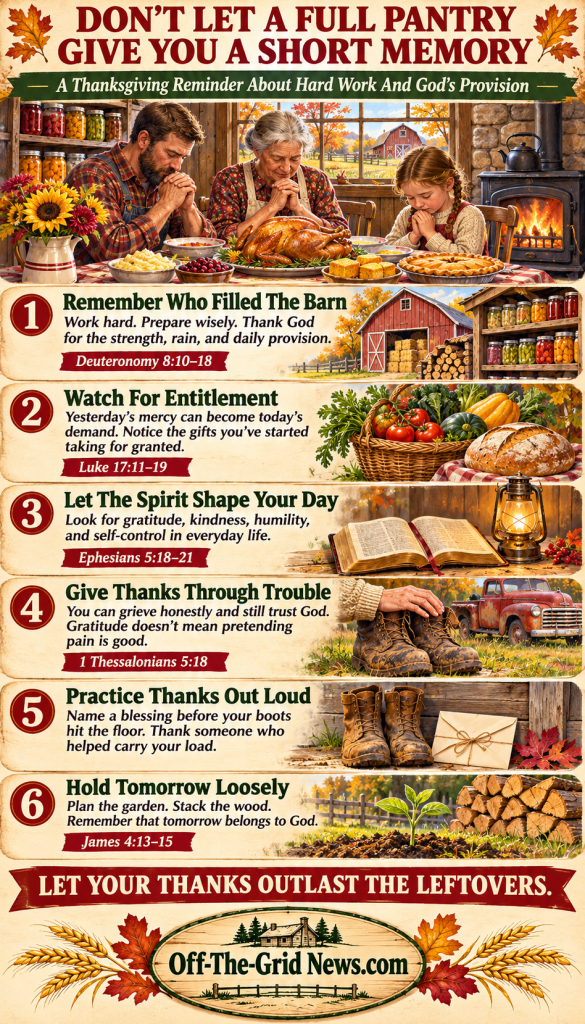
That’s the trap: Entitlement sneaks in while nobody’s watching. Yesterday’s mercy becomes today’s minimum requirement, and tomorrow we demand an upgrade. Before long, we can name every inconvenience in the house while walking straight past a hundred kindnesses.
Jesus exposed that very problem when ten men with leprosy were cleansed and only one returned to give thanks. The returning man was a Samaritan, an outsider, yet he recognized the mercy he’d received. His gratitude brought him back to the Giver.
Remember Who Filled the Barn
Long before that encounter, Deuteronomy 8:10–18 warned God’s people about the spiritual danger of being well fed and comfortably housed. Once their herds, silver, and gold increased, they could begin congratulating themselves and forgetting the Lord. The temptation was to say their own strength had produced their wealth.
Now, that warning doesn’t belittle honest work. The man who hauled hay all afternoon really did work hard, and the woman who put up the harvest really did spend hours over a hot stove. Gratitude simply remembers that the strength to work was itself a gift.
Similarly, Hosea 13:6 describes people becoming full, proud, and forgetful. It’s a short road, and nobody has to put up a sign inviting us onto it. We drift there easily enough on our own.
So don’t let those mercies stay buried. Look backward deliberately. Remember the person who helped when you were stuck, the provision that arrived at the right time, and the forgiveness you didn’t earn. Tell your children those stories while you’re driving, stacking wood, or clearing the supper dishes.
Also, remember the troubles you escaped and the requests that weren’t granted. You don’t know every danger God has spared you, and you shouldn’t pretend to know why every disappointment happened. But you can acknowledge that your own judgment has never been wise enough to run the whole farm, much less the whole future.
Say Grace Before Your Boots Hit the Floor
Next, bring gratitude right down to the kitchen table. Before you climb out of bed, name something you can thank God for. It might be another day, someone you love, forgiveness in Christ, or simply the strength to get up and face the work.
Then carry that habit through the house. Thank Him when the tap runs, when the soup warms, and when a familiar voice answers the phone. Ordinary mercies look different once you stop treating them as background noise.
That doesn’t mean you need to turn every chore into a little ceremony. It means refusing to ignore what’s right in front of you. A grateful heart can offer a plain “Thank You, Lord” while pulling on gloves or shutting the chicken coop for the night.
Meanwhile, pay attention to whatever is choking that habit. Ephesians 4:30–32 connects the warning against grieving the Spirit with putting away bitterness, anger, and malice, and practicing kindness and forgiveness. Gratitude has trouble growing in a heart that keeps feeding a grudge.
So confront what needs confessing and make right what you can. Ask for help where obedience has become a struggle. You don’t have to manufacture a sunny mood; you do need to stop making excuses for the weeds.
Give Somebody Their Flowers While They Can Still Smell Them
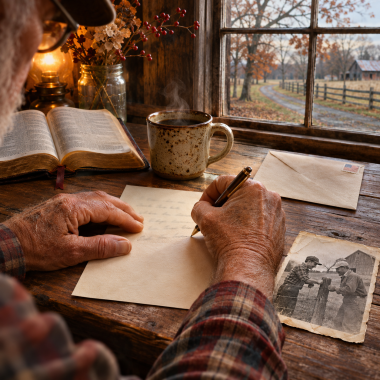
After that, let thanksgiving reach another person. Think of the teacher who took you seriously, the neighbor who brought a chainsaw, or the relative who kept showing up during a hard season. Chances are, somebody helped carry a load you’ve almost forgotten.
Now tell them. Write the letter, make the call, or walk across the lane. Be specific about what they did and why it mattered, because a real thank-you is more than a polite noise at the end of a conversation.
Sadly, we neglect that simple kindness and save our best words for a funeral. Then we stand beside a beautiful arrangement and say things the person would have loved to hear over a cup of coffee. There’s no good reason to keep putting that off.
Besides, spoken gratitude helps the whole household. Children learn what to notice by hearing what their parents praise and what their parents complain about. If every meal comes with a serving of grievances, they’ll learn that recipe, too.
Your Plans Need Room for the Lord
Finally, look ahead. In John 14:1–3, Jesus comforts His disciples with the promise of His Father’s house and His return. Christian hope reaches beyond whatever this winter holds.
Meanwhile, James 4:13–15 reminds us that life is a vapor and that our plans belong under the words “If the Lord will.” Go ahead and plan the garden, service the equipment, and put something aside for next year. Just remember that tomorrow isn’t property you’ve already purchased. That makes today’s gifts more precious. You can hold your plans firmly enough to work and loosely enough to trust. The future is uncertain to you, but it isn’t a surprise to God.
So this Thanksgiving, enjoy the turkey. Pass the potatoes, laugh with the children, and welcome the person who needs a place at the table. God’s kindness gives you plenty to celebrate.
But let your thanks outlast the leftovers.
When the house grows quiet and the dishes are finally done, ask God to make you thankful in the life that’s waiting beyond the holiday. Then, before another good intention gets buried under the next day’s chores, write that letter.
Source: https://www.offthegridnews.com/religion/a-thanksgiving-reminder-for-folks-who-believe-in-hard-work-and-gods-provision/
Anyone can join.
Anyone can contribute.
Anyone can become informed about their world.
"United We Stand" Click Here To Create Your Personal Citizen Journalist Account Today, Be Sure To Invite Your Friends.
Before It’s News® is a community of individuals who report on what’s going on around them, from all around the world. Anyone can join. Anyone can contribute. Anyone can become informed about their world. "United We Stand" Click Here To Create Your Personal Citizen Journalist Account Today, Be Sure To Invite Your Friends.
LION'S MANE PRODUCT
Try Our Lion’s Mane WHOLE MIND Nootropic Blend 60 Capsules
Mushrooms are having a moment. One fabulous fungus in particular, lion’s mane, may help improve memory, depression and anxiety symptoms. They are also an excellent source of nutrients that show promise as a therapy for dementia, and other neurodegenerative diseases. If you’re living with anxiety or depression, you may be curious about all the therapy options out there — including the natural ones.Our Lion’s Mane WHOLE MIND Nootropic Blend has been formulated to utilize the potency of Lion’s mane but also include the benefits of four other Highly Beneficial Mushrooms. Synergistically, they work together to Build your health through improving cognitive function and immunity regardless of your age. Our Nootropic not only improves your Cognitive Function and Activates your Immune System, but it benefits growth of Essential Gut Flora, further enhancing your Vitality.

Our Formula includes: Lion’s Mane Mushrooms which Increase Brain Power through nerve growth, lessen anxiety, reduce depression, and improve concentration. Its an excellent adaptogen, promotes sleep and improves immunity. Shiitake Mushrooms which Fight cancer cells and infectious disease, boost the immune system, promotes brain function, and serves as a source of B vitamins. Maitake Mushrooms which regulate blood sugar levels of diabetics, reduce hypertension and boosts the immune system. Reishi Mushrooms which Fight inflammation, liver disease, fatigue, tumor growth and cancer. They Improve skin disorders and soothes digestive problems, stomach ulcers and leaky gut syndrome. Chaga Mushrooms which have anti-aging effects, boost immune function, improve stamina and athletic performance, even act as a natural aphrodisiac, fighting diabetes and improving liver function. Try Our Lion’s Mane WHOLE MIND Nootropic Blend 60 Capsules Today. Be 100% Satisfied or Receive a Full Money Back Guarantee. Order Yours Today by Following This Link.


| Visits: | 1,839,810,007 |
| Stories: | 8,744,376 |
Whistler Blowers, Insiders

