

Davos 2026: Acknowledging The End Of Pax Americana

Authored by Ret. Admiral Cem Gürdeniz via Michel Chossudovsky’s substack,
The end of the Pax Americana established after 1945 was officially acknowledged by both the leaders of finance capital and the elected leaders in Davos 26.
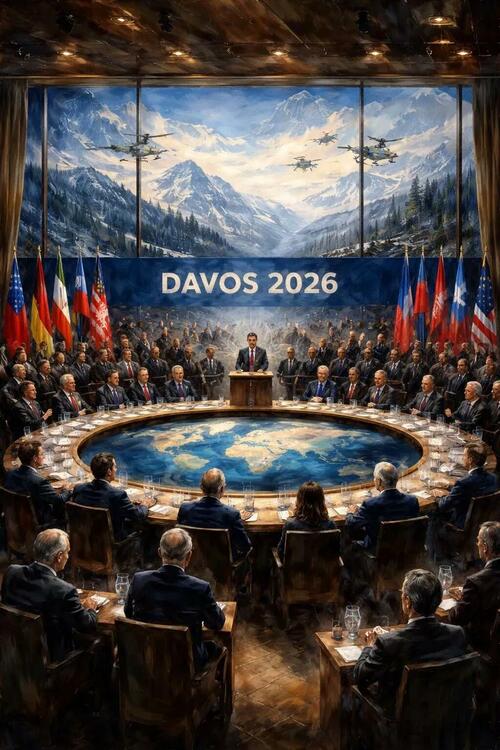
The World Economic Forum (WEF) 2026 in Davos, which has served as the vision and doctrine center of global capitalism for half a century, was held between January 19–23 under the theme “A Spirit of Dialogue.”
At what was arguably the most significant meeting in its history, the end of the Pax Americana established after 1945 was officially acknowledged by both the leaders of finance capital and the elected leaders of states inheriting Europe’s colonial-imperial legacy, notably France, Germany, and the United Kingdom.
Another point openly recognized was the end of globalization and neoliberalism.
Representatives of finance capital emphasized that political and economic elites had lost public trust and conceded that the neoliberal order had reached the stage of collapse due to the unsustainability of income inequality.
Politicians, for their part, admitted that law has increasingly been replaced by force and that the so‑called rules‑based international order is partly a fiction, as great powers suspend rules whenever it suits their interests. Among these statements, perhaps the most unsettling for Donald Trump came from Canada.
The Canadian Prime Minister, whom Trump had explicitly included within the Western Hemisphere in his revised national security doctrine and openly threatened, acknowledged that the narrative of a rules‑based order is fictional. He stated that finance, trade, energy, and supply chains no longer function as mechanisms of mutual benefit but as tools of pressure and weaponization, and that the Western world is not undergoing a transition but an open rupture. This was, in fact, an inevitable outcome of geopolitical realities and the interests of finance capital.
The Forced Acceptance of U.S. Withdrawal is Now Evident
The United States no longer possesses the geopolitical capacity to shape the entire globe. Its parity with China in military, technological, and industrial indicators, and in some areas its lagging position, demonstrates a structural break that makes the continuation of unipolar hegemony impossible. Trump has already been compelled to retract some of his threats. In the Greenland case, for example, he initially suggested the use of military force but later abandoned this option after nearly 800 billion dollars were wiped off U.S. stock markets on the eve of Davos.
In reality, the United States is attempting to reposition itself within a new world order. Its effort to bind the Western Hemisphere unconditionally to itself through a revival of the Monroe Doctrine is itself an admission of declining global capacity. Even within this framework, Washington cannot prevent Canada or Brazil from expanding relations with China, nor can it stop Argentina from maintaining comprehensive economic ties with Beijing. These cases, alongside BRICS and other Global South countries, demonstrate how a policy based on pressure and threats is counterproductive.
States increasingly seek balance with China, whose trade, infrastructure financing, and mutual‑benefit model creates attraction precisely because it does not rely on coercion. At Davos, China was discussed through the lens of controlled uncertainty rather than open rupture. While the United States draws a sharp line of systemic competition, European countries attempt to balance economic realities with geopolitical pressures. On one hand, they seek to maintain trade, investment, and market access with China; on the other, they pursue distancing in technology, security, and critical infrastructure. This reflects a European policy characterized by tactical flexibility rather than strategic clarity.
By contrast, the United States’ coercive approach generates rupture rather than loyalty. For Washington, multipolarity is no longer a strategic choice but the symptomatic outcome of weakening power and the forced acceptance of reality. The open acknowledgment by allies such as France, the United Kingdom, Germany, Canada, and Saudi Arabia that the U.S.‑centered order has ended is a direct result of this erosion. If this trajectory continues, the United States will eventually face the necessity of returning to a policy of peaceful coexistence with China, reminiscent of Cold War‑era coexistence with the Soviet Union. The alternative, of course, is war.
The End of the Rules-Based Order
The most evident common denominator of Davos 2026 was the recognition that the global order is undergoing a rupture rather than an evolution. For decades, the discourse of a rules‑based international system functioned as a narrative that concealed arbitrary exemptions and asymmetric practices by great powers. In Davos, this curtain was openly lifted. Selective application of law, the bending of trade rules in favor of the powerful, and the transformation of security into a bargaining instrument were no longer denied. The most striking political statement on this issue came from Canada’s Prime Minister, former financier Mark Carney. He stressed that finance, trade, energy, and supply chains have become instruments of pressure and coercion. By declaring that he no longer shared belief in the rules‑based order, Carney effectively dissolved the ideological legitimacy of the U.S.‑led liberal system. His declaration can be regarded as epoch‑making, signaling the collapse of the ideological foundation of the Western order sustained since the Cold War.
Yet this moment of truth also exposes hypocrisy: states that have supported imperial interventions from Libya to Iraq, and from Syria to Gaza, confront reality only when threats are directed at themselves, such as in the case of Greenland and Denmark.
Confrontation Against the Replacement of Law by Power
Participants at Davos 2026 broadly agreed that the world is rapidly drifting toward an order in which law recedes and power prevails. Although German Chancellor Friedrich Merz, French President Emmanuel Macron, and British Prime Minister Keir Starmer approached this development from different angles, the resulting picture was the same. These leaders, who had remained largely silent in the face of legal violations in Gaza, Israel’s attacks on Iran, the abduction of Venezuela’s president by the United States, or the harassment of civilian merchant vessels under the pretext of a “shadow fleet,” suddenly discovered the dangers of a world governed by raw power. Those now warning that even great powers become insecure when rules collapse were themselves active participants in power politics against weaker states only a year earlier. The outcome of their speeches revealed a clear confrontation between two camps: those who view power as the sole source of legitimacy, and those who seek to restrain power through law.
Trade is Now a Weapon
Nearly every economic discussion at Davos underscored that trade is no longer a neutral vehicle of prosperity. Tariffs have become negotiating tools, sanctions geopolitical punishment mechanisms, and supply chains zones of vulnerability. The efficiencies of global integration have evolved into advantages used by great powers to suppress competitors. Consequently, the concept of commercial security has moved to the forefront, particularly in middle and advanced economies, where free trade is increasingly replaced by selective, controlled, and politicized exchange. Davos also highlighted that the structural distance between the United States and Europe is no longer a temporary tension. Trade deficits, automotive and industrial exports, regulatory conflicts, and defense spending have become focal points of divergence. Washington views Europe as a bloc that benefits economically while failing to share security burdens, whereas Europe perceives the United States as unpredictable, unilateral, and cost‑imposing. The transatlantic relationship has shifted from a shared‑values partnership to a hard bargaining arena.
Breaking the Security-Economy Connection
Although NATO was not discussed explicitly at Davos, it loomed large in the background. The U.S. share of alliance defense spending is increasingly wielded as an economic and political lever. The United States accounts for roughly two‑thirds of NATO defense expenditures and about 16 percent of its annual budget. Trump’s longstanding criticism of Europe’s strategic complacency has evolved into a broader attempt to monetize the U.S. security umbrella through trade, energy, and strategic concessions. European states, however, increasingly interpret this as an assault on sovereignty and autonomy, thereby eroding the traditional balance between security and economics within NATO. Trump’s insistence that Greenland is vital to U.S. security, rather than NATO’s collective defense, further undermined alliance cohesion and symbolized a deeper crisis of trust.
The New Geopolitical Conjuncture and the Rise of the Middle Powers
The Davos 2026 process also strengthened the self‑confidence of medium powers such as Türkiye. Intensifying great‑power competition creates both risks and opportunities for states that avoid rigid alignment or outright rupture. Countries capable of building resilience in energy, food, critical minerals, finance, and diplomacy can redefine cooperation in a fragmenting global system. Europe’s gradual rapprochement with China, mirroring Russia’s earlier turn eastward, suggests a future in which the United States consolidates the Western Hemisphere while Europe increasingly recognizes itself as Eurasia’s western peninsula. Internal fragmentation within the United States, driven by competing interests among MAGA factions, neoconservatives, lobbies, the arms industry, finance capital, and think tanks, further undermines Washington’s strategic coherence.
Türkiye Lessons
For Türkiye, Davos 2026 offers stark lessons. No global order narrative is permanent. Concepts such as a rules‑based order, strategic partnership, or alliance solidarity can be suspended whenever they conflict with great‑power interests. Türkiye must therefore ground its security, economy, and foreign policy in concrete capabilities, deterrence, and multidimensional relations rather than abstract norms. Trade, energy, and finance have become security issues, making self‑sufficiency, diversification, and resilience imperative. Agriculture, water management, and critical resources demand urgent strategic reassessment. Security architecture can no longer rely on a single‑axis alliance logic; it must rest on national capacity, a robust defense industry, and layered deterrence.
Multipolarity, while risky, also expands room for maneuver. Türkiye’s path lies in flexible, principled, interest‑based balance rather than alignment or isolation. The harshest lesson of Davos is that in a world where power overrides law, those who truly need law are those capable of defending it. International law must be treated not as abstract morality but as a framework safeguarding sovereignty and national interest. Ultimately, the sources of security, prosperity, and prestige are internal capacity and strategic intelligence, not external references. In this new era, survival belongs to states that combine strong governance, productive economies, independent defense, and multifaceted diplomacy.
This is Türkiye’s lesson from Davos.
Views expressed in this article are opinions of the author and do not necessarily reflect the views of ZeroHedge.
Tyler Durden Thu, 01/29/2026 – 23:25
Source: https://freedombunker.com/2026/01/29/davos-2026-acknowledging-the-end-of-pax-americana/
Anyone can join.
Anyone can contribute.
Anyone can become informed about their world.
"United We Stand" Click Here To Create Your Personal Citizen Journalist Account Today, Be Sure To Invite Your Friends.
Before It’s News® is a community of individuals who report on what’s going on around them, from all around the world. Anyone can join. Anyone can contribute. Anyone can become informed about their world. "United We Stand" Click Here To Create Your Personal Citizen Journalist Account Today, Be Sure To Invite Your Friends.
LION'S MANE PRODUCT
Try Our Lion’s Mane WHOLE MIND Nootropic Blend 60 Capsules
Mushrooms are having a moment. One fabulous fungus in particular, lion’s mane, may help improve memory, depression and anxiety symptoms. They are also an excellent source of nutrients that show promise as a therapy for dementia, and other neurodegenerative diseases. If you’re living with anxiety or depression, you may be curious about all the therapy options out there — including the natural ones.Our Lion’s Mane WHOLE MIND Nootropic Blend has been formulated to utilize the potency of Lion’s mane but also include the benefits of four other Highly Beneficial Mushrooms. Synergistically, they work together to Build your health through improving cognitive function and immunity regardless of your age. Our Nootropic not only improves your Cognitive Function and Activates your Immune System, but it benefits growth of Essential Gut Flora, further enhancing your Vitality.

Our Formula includes: Lion’s Mane Mushrooms which Increase Brain Power through nerve growth, lessen anxiety, reduce depression, and improve concentration. Its an excellent adaptogen, promotes sleep and improves immunity. Shiitake Mushrooms which Fight cancer cells and infectious disease, boost the immune system, promotes brain function, and serves as a source of B vitamins. Maitake Mushrooms which regulate blood sugar levels of diabetics, reduce hypertension and boosts the immune system. Reishi Mushrooms which Fight inflammation, liver disease, fatigue, tumor growth and cancer. They Improve skin disorders and soothes digestive problems, stomach ulcers and leaky gut syndrome. Chaga Mushrooms which have anti-aging effects, boost immune function, improve stamina and athletic performance, even act as a natural aphrodisiac, fighting diabetes and improving liver function. Try Our Lion’s Mane WHOLE MIND Nootropic Blend 60 Capsules Today. Be 100% Satisfied or Receive a Full Money Back Guarantee. Order Yours Today by Following This Link.


| Visits: | 1,773,718,431 |
| Stories: | 8,577,402 |
Whistler Blowers, Insiders

