

Decline Rewritten: The Changing Face Of American Shopping Malls

Authored by Panos Mourdoukoutas via The Epoch Times (emphasis ours),
Shopping malls, long an economic and cultural fixture of American life, are facing sustained pressure but are not disappearing altogether.
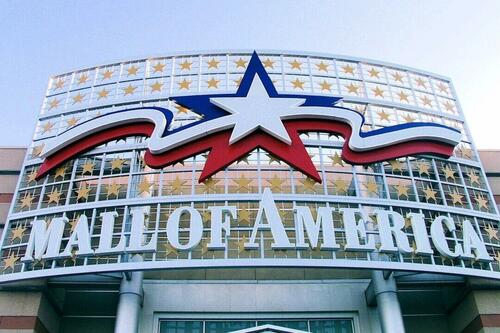
Instead, the sector is undergoing creative destruction, as traditional mall formats give way to new concepts that reflect shifting consumer behavior and market conditions, according to recent industry data.
A research report by Capital One Shopping (COS) outlines the magnitude of the challenge facing the mall sector, citing rising mall closures that remain vacant for an average of nearly four years, as well as vacancy rates that are 112 percent higher than the overall retail vacancy rate.
COS also estimates that as many as 87 percent of large shopping malls could close over the next decade.
Adaptation Over Terminal Decline
At the same time, COS data indicate a reversal of earlier trends. From 2021 through 2025, mall openings exceeded mall closures, suggesting adaptation rather than terminal decline. In 2025 alone, 9,410 new mall stores opened, nearly double the number that closed.
Additional evidence of revival appears in a recent article published by Growth Factor. Author Clyde Christian Anderson reported that indoor mall foot traffic in March 2024 rose 9.7 percent year over year, open-air shopping center traffic increased 10.1 percent, and outlet mall traffic climbed 10.7 percent—each exceeding pre-COVID-19 pandemic levels.
“The numbers don’t lie. After years of decline, shopping malls are experiencing their strongest performance since before the pandemic. This isn’t some temporary holiday bump or seasonal fluke. We’re looking at sustained growth that’s reshaping how we think about physical retail spaces,” Anderson wrote.
Anderson also noted a structural shift in traffic patterns between 2019 and 2022, with increased weekday visits reflecting changes in work habits and consumer routines.
“The data tells a compelling story of adaptation rather than decline. Malls are evolving into experiential destinations that blend shopping, dining, entertainment, and community spaces. The rise of work-from-home culture has shifted traffic patterns, with more visitors arriving during weekdays and earlier in the day,” he said.
A Key Feature
Retail expert Amrita Bhasin points to one feature that drives traffic to shopping malls and retail centers: private clubs.
“Private clubs typically appeal to younger people seeking opportunities to socialize and dine in person,” she told The Epoch Times.
“By bringing them to a mall, these people have to pass by stores and may be more likely to shop as a result. Young people are especially interested in wellness, fitness, and health-related private clubs, as this is a growing trend.”
According to research from the Federal Reserve Bank of Richmond, the origins of the American shopping mall date back to 1907, when Baltimore’s Roland Park Business Block introduced a small cluster of shops in a planned suburban setting.
By the 1930s, malls expanded to include multiple stores under one roof and ample parking, becoming convenient destinations for suburban consumers.
The model gained momentum in the 1950s and 1960s, as department stores and restaurant chains joined mall developments, turning them into central commercial and social hubs.
Early examples include Southdale Center in Edina, Minnesota; Big Town Mall in Glen Burnie, Maryland; and Randhurst Center in Mount Prospect, Illinois.
As malls multiplied, competition intensified, and profit margins narrowed, pushing weaker retailers out. The situation deteriorated further during the stagflation of the early 1980s and accelerated with the rise of eCommerce in the early 2000s, as online retailers increasingly displaced brick-and-mortar stores.
The Great Recession of 2008–2009 and the COVID-19 pandemic marked a turning point, triggering widespread department store closures that reduced mall traffic and forced many properties to shut down. Some malls never reopened, while others were converted into warehouses or logistics hubs, leaving only about one-third still operating as retail centers.
An Evolving Concept
The mall concept continues to evolve, as outlined by the Tourism and Society Think Tank, which describes a broad transformation driven by eCommerce, changing consumer preferences, and declining department store appeal.
“The traditional image of shopping malls in the United States, a symbol of the boom in mass consumption in the twentieth century, is undergoing a profound transformation that is redefining their role in both the economy and community life,” it said.
“This shift—driven by structural forces such as the rise of eCommerce, changing consumer habits, and the declining appeal of department stores—is giving rise to new models that seek to ensure the viability of these spaces in an increasingly competitive, technology-driven environment.”
Redevelopment projects illustrate this shift. Burnsville Center in Minnesota is adding a skate park, an Asian-themed food hall, and a small zoo, while Lakeside Mall in Sterling Heights, Michigan, is being redeveloped into Lakeside Town Center, a mixed-use destination with residences, offices, parks, restaurants, and retail.
“Malls aren’t back across the board, but the best located ones are showing evidence of a strong and durable rebound while weaker ones are being remade,” Ilir Salihi, founder and senior editor of IncomeInsider.com, told The Epoch Times.
Salihi cited rising traffic and occupancy rates in 2025, with some top mall owners reporting occupancy near 96 percent and higher sales per square foot. He pointed to Boise Towne Square, which posted 12.2 percent year-over-year growth after adding a high-traffic anchor tenant, generating a halo effect that attracted new retailers.
“Top-tier malls in strong locations are reinventing themselves, while many mid-market indoor malls are being repurposed entirely,” Salihi said.
“In places like Maryland, Lakeforest Mall has been approved for demolition and redevelopment into a mixed-use ‘mini city.’ Others are being replaced by grocery stores or apartment buildings. The result is a reshaped mall landscape rather than a uniform comeback.”
Tyler Durden Thu, 01/29/2026 – 07:20
Source: https://freedombunker.com/2026/01/29/decline-rewritten-the-changing-face-of-american-shopping-malls/
Anyone can join.
Anyone can contribute.
Anyone can become informed about their world.
"United We Stand" Click Here To Create Your Personal Citizen Journalist Account Today, Be Sure To Invite Your Friends.
Before It’s News® is a community of individuals who report on what’s going on around them, from all around the world. Anyone can join. Anyone can contribute. Anyone can become informed about their world. "United We Stand" Click Here To Create Your Personal Citizen Journalist Account Today, Be Sure To Invite Your Friends.
LION'S MANE PRODUCT
Try Our Lion’s Mane WHOLE MIND Nootropic Blend 60 Capsules
Mushrooms are having a moment. One fabulous fungus in particular, lion’s mane, may help improve memory, depression and anxiety symptoms. They are also an excellent source of nutrients that show promise as a therapy for dementia, and other neurodegenerative diseases. If you’re living with anxiety or depression, you may be curious about all the therapy options out there — including the natural ones.Our Lion’s Mane WHOLE MIND Nootropic Blend has been formulated to utilize the potency of Lion’s mane but also include the benefits of four other Highly Beneficial Mushrooms. Synergistically, they work together to Build your health through improving cognitive function and immunity regardless of your age. Our Nootropic not only improves your Cognitive Function and Activates your Immune System, but it benefits growth of Essential Gut Flora, further enhancing your Vitality.

Our Formula includes: Lion’s Mane Mushrooms which Increase Brain Power through nerve growth, lessen anxiety, reduce depression, and improve concentration. Its an excellent adaptogen, promotes sleep and improves immunity. Shiitake Mushrooms which Fight cancer cells and infectious disease, boost the immune system, promotes brain function, and serves as a source of B vitamins. Maitake Mushrooms which regulate blood sugar levels of diabetics, reduce hypertension and boosts the immune system. Reishi Mushrooms which Fight inflammation, liver disease, fatigue, tumor growth and cancer. They Improve skin disorders and soothes digestive problems, stomach ulcers and leaky gut syndrome. Chaga Mushrooms which have anti-aging effects, boost immune function, improve stamina and athletic performance, even act as a natural aphrodisiac, fighting diabetes and improving liver function. Try Our Lion’s Mane WHOLE MIND Nootropic Blend 60 Capsules Today. Be 100% Satisfied or Receive a Full Money Back Guarantee. Order Yours Today by Following This Link.


| Visits: | 1,773,664,421 |
| Stories: | 8,577,314 |
Whistler Blowers, Insiders

