

Energy Shock Threatens Fertilizer Supplies As Echoes Of 2022 Food Price Spike Return

The speed of the energy shock is already feeding into agricultural markets, with food inflation risks likely to build as secondary effects ripple through commodity markets following chaos in the Middle East. Soaring input costs, including diesel fuel for tractors and machinery and natural gas as a key fertilizer feedstock, suggest global food prices may be poised for another sharp move higher, echoing the food price spike in the early days of Russia’s invasion of Ukraine.
“The speed of the move [energy shock] pushed volatility sharply higher, with energy once again becoming the primary transmission channel for geopolitical risk into broader macro pricing,” UBS analyst Claudio Martucci wrote in a note to clients on Monday.
Claudio pointed out, “Agricultural markets reacted more indirectly to the energy shock via higher fertilizer costs, and higher input and biofuel costs lifted soybean oil to two-year highs, while wheat experienced elevated volatility and some profit-taking late in the week despite an otherwise supportive commodity backdrop.”
The energy shock that sent Brent and WTI futures to nearly $120 per barrel early in the week has now subsided, as the IEA and world leaders prepare to release a record amount from strategic petroleum reserves, helping cap energy prices for now, with Brent trading around $92/bbl and WTI around $87/bbl.
But the surge in oil and natural gas prices, as the Strait of Hormuz energy chokepoint remains heavily disrupted into the 12th day of Operation Epic Fury, will likely feed through broader energy markets and into agriculture, potentially pushing the UN FAO World Food Price Index higher in the coming months if energy prices remain elevated, much as it did after Russia’s invasion of Ukraine in the first half of 2022.
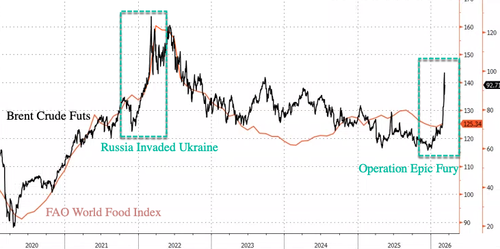
Bloomberg macro strategist Simon White warned, “But food prices are likely to be as troublesome for second-round inflationary effects. Less well-known is that the shock to food prices was worse than the oil price shocks in the 1970s, after the Arab oil embargo and the Iranian revolution. Food inflation in the US was already rising before both shocks, and contributed more to headline CPI than energy through almost all of the 70s.”

Unbeknownst to some, the Strait of Hormuz region is also a critical maritime route for roughly a third of global fertilizer trade. Security threats remained elevated on Wednesday, with three vessels reportedly hit by IRGC projectiles, insurance costs in some cases rising twelvefold in the recent week, and transit through the waterway remaining partially paralyzed.
Urea prices have already jumped sharply, with broader stress spreading into ammonia, sulphur, and phosphate markets.
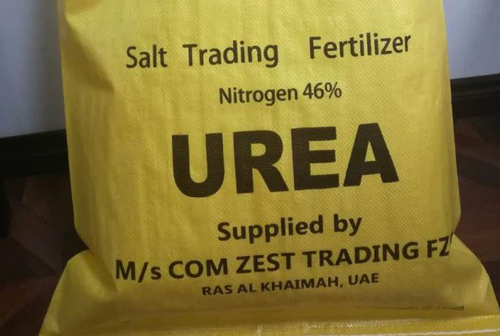
Wall Street analysts already warn that the timing is especially bad because many farmers are entering key fertilizer application periods, so any shortage or price spike could hurt crop yields and raise food production costs.
“The timing of the crisis is particularly worrying for the agricultural sector. Farmers in several countries are about to begin applying fertilizer for upcoming crop cycles, meaning any supply shock could directly affect crop yields,” said Chris Vlachopoulos from Independent Commodity Intelligence Services.
Vlachopoulos said, “The fertilizer market was already under pressure before the Middle East crisis due to gas shortages, export restrictions, and geopolitical tensions affecting key suppliers. The latest conflict could intensify those strains.”
“The uncertainty is also rippling across ammonia, sulphur, and phosphates markets, where trade has slowed, prices are firming, and logistical constraints are forcing buyers to seek alternative suppliers while freight costs and shipping risks continue to rise,” added Vlachopoulos.
Jeff Peterson with Heartland Farm Partners told farm publication Brownfield that the fertilizer price spike may prompt some farmers to reconsider their crop rotations this year.
Nebraska farmer Clay Govier told the publication that he doesn’t expect changing his crop rotation this spring growing season but will reduce his nutrient plan.
“You can’t even buy fertilizer right now and I think that’s the bigger concern for this coming crop in terms of what we’re going to do for fertility options,” Govier said.
Even if the Hormuz chokepoint reopens next week, the restart time for crude and gas plants could take weeks, and potentially even at least a month. This only suggests the fertilizer market will remain tight for some time. All of this is happening at one of the worst possible times, as the Northern Hemisphere spring growing season kicks off in the coming weeks.
Our read is that the key signal to watch is the FAO World Food Price Index relative to Brent crude (or WTI), which increasingly suggests a 2022-echo price spike may be forming. In other words, readers should begin thinking more seriously about what if Jared Cohen, President of Global Affairs and Co-Head of the Goldman Sachs Global Institute, is right about worst-case spillover risks.
If that scenario materializes, further disruption across energy markets could quickly amplify the inflationary shock.
It is important to get ahead of the potential chaos that may be approaching if the Hormuz chokepoint remains closed for an extended period, and to start thinking about a backyard garden to weather the storm. And yes, chickens would be a great idea.
Tyler Durden Wed, 03/11/2026 – 14:30
Source: https://freedombunker.com/2026/03/11/energy-shock-threatens-fertilizer-supplies-as-echoes-of-2022-food-price-spike-return/
Anyone can join.
Anyone can contribute.
Anyone can become informed about their world.
"United We Stand" Click Here To Create Your Personal Citizen Journalist Account Today, Be Sure To Invite Your Friends.
Before It’s News® is a community of individuals who report on what’s going on around them, from all around the world. Anyone can join. Anyone can contribute. Anyone can become informed about their world. "United We Stand" Click Here To Create Your Personal Citizen Journalist Account Today, Be Sure To Invite Your Friends.
LION'S MANE PRODUCT
Try Our Lion’s Mane WHOLE MIND Nootropic Blend 60 Capsules
Mushrooms are having a moment. One fabulous fungus in particular, lion’s mane, may help improve memory, depression and anxiety symptoms. They are also an excellent source of nutrients that show promise as a therapy for dementia, and other neurodegenerative diseases. If you’re living with anxiety or depression, you may be curious about all the therapy options out there — including the natural ones.Our Lion’s Mane WHOLE MIND Nootropic Blend has been formulated to utilize the potency of Lion’s mane but also include the benefits of four other Highly Beneficial Mushrooms. Synergistically, they work together to Build your health through improving cognitive function and immunity regardless of your age. Our Nootropic not only improves your Cognitive Function and Activates your Immune System, but it benefits growth of Essential Gut Flora, further enhancing your Vitality.

Our Formula includes: Lion’s Mane Mushrooms which Increase Brain Power through nerve growth, lessen anxiety, reduce depression, and improve concentration. Its an excellent adaptogen, promotes sleep and improves immunity. Shiitake Mushrooms which Fight cancer cells and infectious disease, boost the immune system, promotes brain function, and serves as a source of B vitamins. Maitake Mushrooms which regulate blood sugar levels of diabetics, reduce hypertension and boosts the immune system. Reishi Mushrooms which Fight inflammation, liver disease, fatigue, tumor growth and cancer. They Improve skin disorders and soothes digestive problems, stomach ulcers and leaky gut syndrome. Chaga Mushrooms which have anti-aging effects, boost immune function, improve stamina and athletic performance, even act as a natural aphrodisiac, fighting diabetes and improving liver function. Try Our Lion’s Mane WHOLE MIND Nootropic Blend 60 Capsules Today. Be 100% Satisfied or Receive a Full Money Back Guarantee. Order Yours Today by Following This Link.


| Visits: | 1,785,959,004 |
| Stories: | 8,601,118 |
Whistler Blowers, Insiders

