

In Charts: US Does Not Rely On Strait Of Hormuz Oil While Asia Stands To Lose

Authored by Sylvia Xu via The Epoch Times (emphasis ours),
The Strait of Hormuz has been called the jugular vein of the world’s oil supply, and as Operation Epic Fury continues, Iran continues to have a chokehold on the critical supply route.
About one-fifth of the world’s oil and gas is typically shipped through the narrow waterway connecting the Persian Gulf to the Arabian Sea.
But Iran’s attacks on commercial vessels have brought traffic through the strait to a virtual standstill since the start of the conflict on Feb. 28.
In March, just 220 vessels transited the strait, according to data from maritime analytics platform Marine Traffic. Prior to the war, thousands of ships traversed the waterway each month.
These actions have caused oil and gas prices to surge. Brent, a global benchmark for oil prices, has risen firmly above $100 a barrel overseas. The average gas price in the United States has surged past $4 per gallon.
Here’s a look at how much oil travels through the Strait of Hormuz and where it goes.
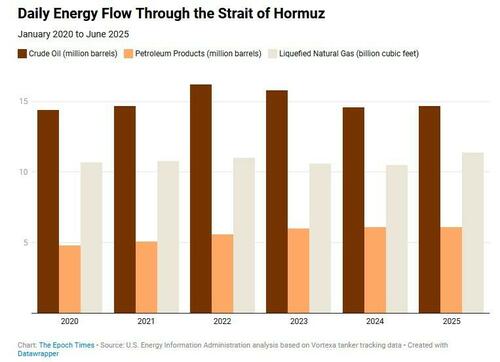
An average of 20 million barrels of oil and refined products flowed through the narrow gateway between the Arabian Peninsula and Iran each day in 2025. That’s roughly 25 percent of the world’s sea-borne oil trade, according to a February analysis from the International Energy Agency.
The strait is only 21 miles wide at its narrowest point, with shipping lanes just two miles wide in each direction.
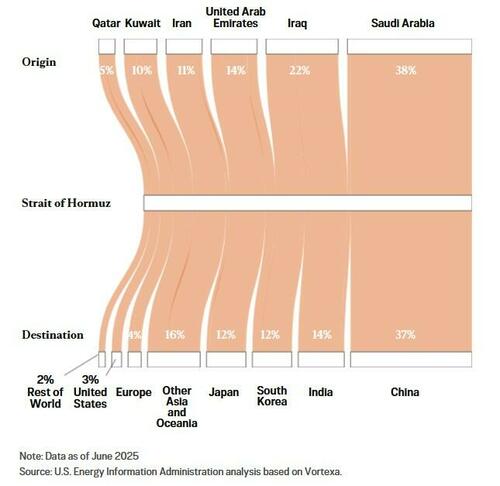
The vast majority of crude oil and condensate—a natural gas byproduct—went to Asia (91 percent), according to a U.S. Energy Information Administration analysis based on Vortexa tanker-tracking data from the first half of 2025.
Of those Asian nations, China and India absorbed about half of the crude moving through the strait—37 percent and 14 percent, respectively—followed by Japan and South Korea at 12 percent each. Sixteen percent went to other countries in Asia and Oceania.
The United States and Europe remained marginal buyers, receiving just 3 percent and 4 percent, respectively.
Roughly three-quarters of crude oil travel by tanker ship through the strait came from Saudi Arabia (38 percent), Iraq (22 percent), and the United Arab Emirates (14 percent). Iran shipped just 11 percent.
Crude Oil Exports Transiting the Strait of Hormuz, 2025
Additionally, the strait accounts for nearly 20 percent of the global liquefied natural gas trade. Qatar, the world’s largest gas exporter after the United States, represents 93 percent of that volume.
In 2025, Asia received almost 90 percent of the liquefied natural gas flowing through the strait. Europe received just over 10 percent.
Of Asian countries, Bangladesh, India, and Pakistan sourced almost two-thirds of their total liquefied natural gas supplies via the Strait of Hormuz last year.

Dependency on Gulf Nations
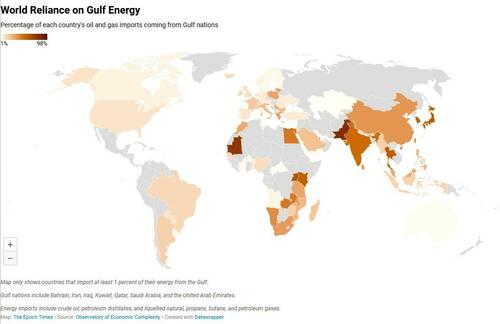
Japan (57 percent), South Korea (55 percent), and India (50 percent) relied on the Gulf nations for at least half of their oil and gas imports in 2024. China sourced roughly 35 percent of its supplies from the region.
Additionally, Taiwan imported 40 percent of its oil and gas from the region in 2024, while Pakistan sourced more than 81 percent of its oil and gas imports from the Gulf area.
Some African countries, such as Mauritania (76 percent), Uganda (61 percent), and Kenya (55 percent), relied on the Gulf for more than half of their fuel.
Meanwhile, nearly 96 percent of Iranian oil and gas exports through the route in 2024 were designated for one destination: Pakistan.
In Europe, roughly one-third of the energy imports for Greece (35 percent), Lithuania (32 percent), and Poland (30 percent) originated from Gulf countries.
North American reliance on Gulf energy remains minimal, however. The United States received 10 percent of its imports from Gulf nations, and Canada received 5 percent.
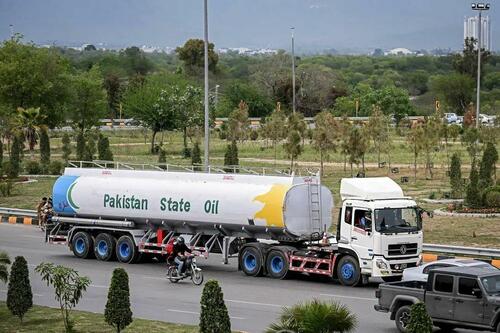
While regional producers have sought alternatives to the Strait of Hormuz, these options have struggled to serve as adequate replacements.
Saudi Arabia, for example, maintains an east-west pipeline that can move approximately 5 million barrels of oil a day to the Red Sea. However, the Abqaiq–Yanbu pipeline system has a maximum capacity of 7 million barrels. This terminal is already heavily used and cannot replace the strait.
The United Arab Emirates has an oil pipeline that bypasses the strait—the Abu Dhabi Crude Oil Pipeline—but it has a capacity of only 1.5 million barrels per day.
As for Qatar’s liquefied natural gas, there is no alternative route.
The strait is effectively a single point of failure for Gulf exporters, as no alternative pipeline routes can replace the volumes that move by sea.

Tyler Durden Sat, 04/04/2026 – 21:35
Source: https://freedombunker.com/2026/04/04/in-charts-us-does-not-rely-on-strait-of-hormuz-oil-while-asia-stands-to-lose/
Anyone can join.
Anyone can contribute.
Anyone can become informed about their world.
"United We Stand" Click Here To Create Your Personal Citizen Journalist Account Today, Be Sure To Invite Your Friends.
Before It’s News® is a community of individuals who report on what’s going on around them, from all around the world. Anyone can join. Anyone can contribute. Anyone can become informed about their world. "United We Stand" Click Here To Create Your Personal Citizen Journalist Account Today, Be Sure To Invite Your Friends.
LION'S MANE PRODUCT
Try Our Lion’s Mane WHOLE MIND Nootropic Blend 60 Capsules
Mushrooms are having a moment. One fabulous fungus in particular, lion’s mane, may help improve memory, depression and anxiety symptoms. They are also an excellent source of nutrients that show promise as a therapy for dementia, and other neurodegenerative diseases. If you’re living with anxiety or depression, you may be curious about all the therapy options out there — including the natural ones.Our Lion’s Mane WHOLE MIND Nootropic Blend has been formulated to utilize the potency of Lion’s mane but also include the benefits of four other Highly Beneficial Mushrooms. Synergistically, they work together to Build your health through improving cognitive function and immunity regardless of your age. Our Nootropic not only improves your Cognitive Function and Activates your Immune System, but it benefits growth of Essential Gut Flora, further enhancing your Vitality.

Our Formula includes: Lion’s Mane Mushrooms which Increase Brain Power through nerve growth, lessen anxiety, reduce depression, and improve concentration. Its an excellent adaptogen, promotes sleep and improves immunity. Shiitake Mushrooms which Fight cancer cells and infectious disease, boost the immune system, promotes brain function, and serves as a source of B vitamins. Maitake Mushrooms which regulate blood sugar levels of diabetics, reduce hypertension and boosts the immune system. Reishi Mushrooms which Fight inflammation, liver disease, fatigue, tumor growth and cancer. They Improve skin disorders and soothes digestive problems, stomach ulcers and leaky gut syndrome. Chaga Mushrooms which have anti-aging effects, boost immune function, improve stamina and athletic performance, even act as a natural aphrodisiac, fighting diabetes and improving liver function. Try Our Lion’s Mane WHOLE MIND Nootropic Blend 60 Capsules Today. Be 100% Satisfied or Receive a Full Money Back Guarantee. Order Yours Today by Following This Link.


| Visits: | 1,801,174,668 |
| Stories: | 8,631,231 |
Whistler Blowers, Insiders

