

Is America On The Verge Of A Nuclear Renaissance?

Authored by Duggan Flanakin via WattsUpWithThat.com,
It has been more than seven years since President Donald Trump signed the Nuclear Energy Innovation and Modernization Act (NEIMA) into law – and it has taken all seven years (including four during the Biden Administration) for the Nuclear Regulatory Commission to issue a final rule implementing its provisions.
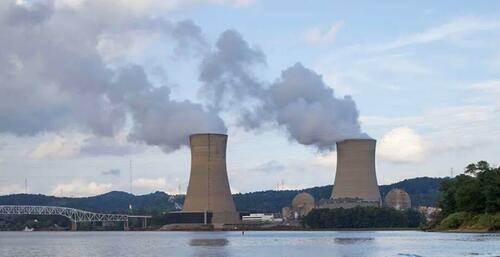
Even the Washington Post admits that the new Part 53 rules, intended to reduce review times from decades to 18 months or less, will make President Trump’s goal of revitalizing the U.S. nuclear energy industry more competitive – “to everyone’s benefit,” says the Post.
The old NRC permitting review process was built around light-water-cooled reactors (like the Westinghouse AP1000) and included prescriptive safety requirements specific to those designs – not the advanced reactors of all sizes being planned and built today.
Many nuclear companies are designing reactors that use liquid metals (like molten salt) or gases as coolants, enabling them to operate at higher temperatures. These reactors are ultimately safer than the (still very safe) water-cooled reactors, as they rely on natural forces like gravity or convection rather than pumps and motors to automatically stop the reactor in case of an incident.
The NRC says its final rule responds to NEIMA by creating an alternative, technology-inclusive regulatory framework that can accommodate licensing of future commercial nuclear plants, including advanced reactor designs that may not employ light-water technology. The new rules will hopefully expedite permitting of small modular reactors, microreactors, and even full-size reactors already under development.
The NRC says its alternative requirements and implementing guidance incorporate technology-inclusive approaches and risk-informed and performance-based techniques to ensure an equivalent level of safety to that of operating commercial nuclear plants. Part 53 is designed to provide optionality and flexibility for licensing and regulating a variety of technologies and designs for commercial nuclear reactors.
Not everyone is convinced that an agency with a lifelong track record of thwarting nuclear reactor permits has fully reformed. Noting that the real timeframe for the Part 53 rules is decades (not just 7 years), nuclear energy advocate Steven Curtis says “It’s hard to imagine the NRC being objective enough to lessen the burden for licensing, even for safer SMRs. The NRC sees its mortality in simplifying their process, so what is their incentive?”
NANO Nuclear Energy CEO James Walker calls the new Part 53 rules “a bridge to fleet deployment,” in that it does not fully eliminate site-specific licensing, environmental review installation review, or lifecycle issues around refurbishment, refueling, decommissioning, and relocation,” all needed for the microreactor industry. The NRC is reportedly developing guidance and another round of rulemaking – suggesting that Part 53 is foundational, not final.
The proof of a reformed NRC, if indeed it is now eager to move permits forward, will soon be made evident. Previous Presidents waited in vain. Trump waited 7 years for Part 53 regulations; the real microreactor rules have yet to be formally proposed.
More evidence that the Trump Administration is serious about a nuclear energy revival comes from the National Reactor Innovation Center (NRIC), which announced last week that its Demonstration of Microreactor Experiments (DOME) test bed is now complete. This first-of-its-kind facility, located at Idaho National Laboratory (INL), will enable the rapid development, testing, and demonstration of privately developed advanced nuclear reactors.
The Department of Energy says DOME is an actual 100-foot-tall dome that is 80 feet in diameter – large enough to provide a safe environment to test experimental reactor concepts and gather performance data for use in informing future commercial licensing applications. Its completion dovetails with the new Part 53 NRC rules – as the U.S. seeks to accelerate the development and demonstration of advanced nuclear technologies.
Built from the repurposed Experimental Breeder Reactor-II containment structure, DOME will help reactor developers accelerate testing timelines – saving money and reducing project risk – and hopefully deployment timelines.
These microreactors are designed to be factory-built and portable, able to be placed in remote communities or to respond to natural disasters but perhaps primarily to serve independent microgrids (such as data centers), field-level military operations, and even space travel.
DOME is the only test bed in the world specifically designed to host fueled microreactor experiments that can generate up to 20 megawatts of thermal energy that can be used as heat or converted to electric power. [This is comparable in size to the reactors that have powered America’s nuclear submarines ever since the USS Nautilus was deployed in 1954.]
DOE Deputy Assistant Secretary for Nuclear Reactors Dr. Rian Bahran says the DOME is a vital component of reestablishing U.S. leadership in advance nuclear technologies – yet one wonders how many decades ago such a facility could have been built. Nuclear submarines can operate for 20 to 30 years without refueling, whereas conventional subs need refueling several times a year.
Better late than never – the DOME has already started a scheduled year-long test of Radiant Industries’ Kaleidos Demonstration Unit, a microreactor that uses TRISO fuel and is cooled by helium to produce 1 MW of electrical power or 3.5 MWt of thermal power. The U.S. Air Force is but one entity awaiting authorization for deploying Kaleidos. Other companies are queuing up to test their designs in DOME.
With the DOE envisioning nuclear megacities for such activities as uranium enrichment and fuel fabrication, at least four states have announced their willingness to serve as hosts even if managing high-level nuclear waste is part of the commitment.
Idaho and Tennessee have long-term experience in nuclear energy, while Utah and Nebraska are looking at the jobs and revenues to be gleaned from joining the nuclear community.
By contrast, Nevada has fought against managing nuclear waste and Texas and New Mexico have also objected to private interim nuclear waste storage (despite Texas’ push for nuclear energy development).
Meanwhile, the U.S. continues its ban on reusing nuclear waste to power reactors designed to burn (and thus dramatically reduce the volume of) nuclear waste by 95% and dramatically lower the cost of nuclear energy generation while virtually eliminating the controversial issue of nuclear waste storage.
Of course, a major increase in the number of nuclear powerplants in the U.S. will necessitate a major increase in the supply of nuclear fuel – and there is good news on that front as well. Newly launched FluxPoint Energy announced it is developing what would be the first new uranium conversion facility in the U.S. in 70 years.
FluxPoint says its mission is to “establish a fully American, vertically integrated nuclear fuel capability – supporting energy independence, enabling advanced reactor development, and strengthening national security.” Development of the facility, which will convert uranium oxide (U3O8) into gaseous uranium hexafluoride (UF6) that can be enriched in fissile uranium-235 for use as nuclear fuel, is “well under way.”
For that matter, these and other developments – and a reinvigorated nuclear energy industry – are signs that the U.S. is “well under way” to restoring its faith in a future and a renaissance already signified by the highly successful and warmly received Artemis II mission to the moon, another area of American excellence that was put into mothballs for decades.
Duggan Flanakin is a senior policy analyst at the Committee For A Constructive Tomorrow who writes on a wide variety of public policy issues.
Tyler Durden Fri, 04/17/2026 – 19:15
Source: https://freedombunker.com/2026/04/17/is-america-on-the-verge-of-a-nuclear-renaissance/
Anyone can join.
Anyone can contribute.
Anyone can become informed about their world.
"United We Stand" Click Here To Create Your Personal Citizen Journalist Account Today, Be Sure To Invite Your Friends.
Before It’s News® is a community of individuals who report on what’s going on around them, from all around the world. Anyone can join. Anyone can contribute. Anyone can become informed about their world. "United We Stand" Click Here To Create Your Personal Citizen Journalist Account Today, Be Sure To Invite Your Friends.
LION'S MANE PRODUCT
Try Our Lion’s Mane WHOLE MIND Nootropic Blend 60 Capsules
Mushrooms are having a moment. One fabulous fungus in particular, lion’s mane, may help improve memory, depression and anxiety symptoms. They are also an excellent source of nutrients that show promise as a therapy for dementia, and other neurodegenerative diseases. If you’re living with anxiety or depression, you may be curious about all the therapy options out there — including the natural ones.Our Lion’s Mane WHOLE MIND Nootropic Blend has been formulated to utilize the potency of Lion’s mane but also include the benefits of four other Highly Beneficial Mushrooms. Synergistically, they work together to Build your health through improving cognitive function and immunity regardless of your age. Our Nootropic not only improves your Cognitive Function and Activates your Immune System, but it benefits growth of Essential Gut Flora, further enhancing your Vitality.

Our Formula includes: Lion’s Mane Mushrooms which Increase Brain Power through nerve growth, lessen anxiety, reduce depression, and improve concentration. Its an excellent adaptogen, promotes sleep and improves immunity. Shiitake Mushrooms which Fight cancer cells and infectious disease, boost the immune system, promotes brain function, and serves as a source of B vitamins. Maitake Mushrooms which regulate blood sugar levels of diabetics, reduce hypertension and boosts the immune system. Reishi Mushrooms which Fight inflammation, liver disease, fatigue, tumor growth and cancer. They Improve skin disorders and soothes digestive problems, stomach ulcers and leaky gut syndrome. Chaga Mushrooms which have anti-aging effects, boost immune function, improve stamina and athletic performance, even act as a natural aphrodisiac, fighting diabetes and improving liver function. Try Our Lion’s Mane WHOLE MIND Nootropic Blend 60 Capsules Today. Be 100% Satisfied or Receive a Full Money Back Guarantee. Order Yours Today by Following This Link.


| Visits: | 1,807,071,468 |
| Stories: | 8,644,091 |
Whistler Blowers, Insiders

