

The End Of Digital Trust: How Quantum Computing Could Upend Security, Business, & Global Stability

Authored by Julio Rivera via American Greatness,
The scariest technology threats are usually the boring ones. Not the giant killer robots. Not the science fiction stuff. Not the dramatic movie scenes where somebody in sunglasses launches cyberattacks from a glowing underground bunker while alarms blare in the background. The truly dangerous threats arrive quietly. Q-Day falls squarely into that category.
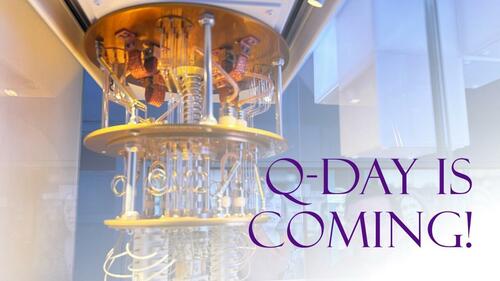
To most people, the phrase sounds like something Netflix would slap on a conspiracy thriller thumbnail. In reality, it refers to the moment quantum computers become powerful enough to break the encryption systems that protect modern digital life. And when cybersecurity experts talk about this possibility, they don’t sound excited. No, they sound exhausted—because they know how unprepared much of the world still is.
Encryption is the invisible architecture underneath almost everything people interact with daily. Online banking. Cloud storage. Corporate systems. Government communications. Military operations. Healthcare records. Financial transactions. Satellites. Power infrastructure. Nearly every digital system that matters relies on cryptographic protections developed for a pre-quantum world.
That world is running out of time. Experts increasingly warn that quantum computing breakthroughs are advancing faster than expected, while organizations remain painfully slow to adapt. And corporate leadership still doesn’t fully grasp the seriousness of what’s coming.
A lot of companies approach cybersecurity the way people approach oil changes. They know they’re supposed to deal with it eventually, but they’d rather postpone the expense until smoke starts coming out of something important. Meanwhile, cybercriminals and hostile governments are operating several moves ahead.
The phrase “harvest now, decrypt later” has become one of the most alarming concepts in modern cybersecurity. Adversaries are already stealing encrypted information today with the expectation that future quantum systems will eventually crack the protections surrounding it.
That means the threat isn’t waiting for some future technological milestone. The threat has already started. And the scope of what’s potentially vulnerable is staggering. Intellectual property. Trade secrets. Proprietary AI systems. Pharmaceutical research. Defense communications. Infrastructure schematics. Diplomatic cables. Financial data. Internal corporate strategy. Decades of archived encrypted communications that organizations assumed would remain secure indefinitely.
A lot of executives still imagine cyberattacks as noisy smash-and-grab operations. Ransom notes. Locked systems. Flashing warnings. But some of the most effective compromises are almost embarrassingly subtle.
“Stealer” malware remains devastatingly efficient in the current cyber landscape, quietly extracting passwords, session cookies, authentication credentials, browser data, crypto wallets, and sensitive company access without triggering major alarms. Fake file deletion warnings and fraudulent system compromise messages still trick countless ordinary users into handing over access voluntarily. Some of the oldest scams in the book continue working because panic overrides common sense faster than any firewall can react.
Quantum computing doesn’t replace those existing threats; it magnifies them. And the implications extend far beyond corporate cybersecurity budgets.
If hostile governments achieve practical quantum decryption capabilities before widespread migration to post-quantum cryptography occurs, global security dynamics could shift dramatically overnight. Military communications, intelligence systems, satellite infrastructure, weapons logistics, and secure diplomatic channels all potentially become vulnerable in ways modern governments have never fully experienced before.
That kind of uncertainty changes how nations behave. Secure communications aren’t just a convenience for modern governments; they are foundational to deterrence, alliances, military coordination, intelligence operations, and geopolitical stability itself. Once nations begin doubting the integrity of those systems, mistrust escalates rapidly.
Which is why the recent diplomatic summit between China and the United States should have produced far more discussion about continuing to modernize the increasingly outdated 1979 science and technology agreement between the two countries. That framework belongs to an era before cyber warfare, before AI competition, before semiconductor dependency battles, and certainly before the looming quantum race currently shaping long-term national security strategy.
The technological relationship between global superpowers is no longer some side issue tucked away in academic policy circles. It is the policy circle.
And while governments maneuver strategically, private industry continues lagging dangerously behind. Many companies still rely on fragmented security practices, aging infrastructure, weak endpoint protection, and reactive cyber strategies designed for a threat environment that no longer exists. The time to improve cyber resilience started long ago.
The timeline problem makes everything worse. Migrating critical systems toward quantum-resistant cryptography takes years. Large enterprises often don’t even have complete inventories of where vulnerable encryption exists across their networks.
So, while the public still treats quantum computing like futuristic science fiction, cybersecurity professionals are staring at calendars.
Because unlike Y2K, there may not be one dramatic moment where everybody suddenly realizes the danger has arrived.
Instead, the erosion could happen gradually.
Silent infiltration. Invisible interception.
Archived communications quietly unlocked years later. Competitive advantages disappearing without obvious explanation. State actors obtaining access to sensitive information nobody ever imagined could be exposed.
That’s the nightmare scenario. Not chaos. Not collapse. Simply the slow realization that the digital locks humanity built around its most sensitive information no longer work the way everyone assumed they did.
Views expressed in this article are opinions of the author and do not necessarily reflect the views of ZeroHedge.
Tyler Durden Sun, 05/31/2026 – 18:40
Source: https://freedombunker.com/2026/05/31/the-end-of-digital-trust-how-quantum-computing-could-upend-security-business-global-stability/
Anyone can join.
Anyone can contribute.
Anyone can become informed about their world.
"United We Stand" Click Here To Create Your Personal Citizen Journalist Account Today, Be Sure To Invite Your Friends.
Before It’s News® is a community of individuals who report on what’s going on around them, from all around the world. Anyone can join. Anyone can contribute. Anyone can become informed about their world. "United We Stand" Click Here To Create Your Personal Citizen Journalist Account Today, Be Sure To Invite Your Friends.
LION'S MANE PRODUCT
Try Our Lion’s Mane WHOLE MIND Nootropic Blend 60 Capsules
Mushrooms are having a moment. One fabulous fungus in particular, lion’s mane, may help improve memory, depression and anxiety symptoms. They are also an excellent source of nutrients that show promise as a therapy for dementia, and other neurodegenerative diseases. If you’re living with anxiety or depression, you may be curious about all the therapy options out there — including the natural ones.Our Lion’s Mane WHOLE MIND Nootropic Blend has been formulated to utilize the potency of Lion’s mane but also include the benefits of four other Highly Beneficial Mushrooms. Synergistically, they work together to Build your health through improving cognitive function and immunity regardless of your age. Our Nootropic not only improves your Cognitive Function and Activates your Immune System, but it benefits growth of Essential Gut Flora, further enhancing your Vitality.

Our Formula includes: Lion’s Mane Mushrooms which Increase Brain Power through nerve growth, lessen anxiety, reduce depression, and improve concentration. Its an excellent adaptogen, promotes sleep and improves immunity. Shiitake Mushrooms which Fight cancer cells and infectious disease, boost the immune system, promotes brain function, and serves as a source of B vitamins. Maitake Mushrooms which regulate blood sugar levels of diabetics, reduce hypertension and boosts the immune system. Reishi Mushrooms which Fight inflammation, liver disease, fatigue, tumor growth and cancer. They Improve skin disorders and soothes digestive problems, stomach ulcers and leaky gut syndrome. Chaga Mushrooms which have anti-aging effects, boost immune function, improve stamina and athletic performance, even act as a natural aphrodisiac, fighting diabetes and improving liver function. Try Our Lion’s Mane WHOLE MIND Nootropic Blend 60 Capsules Today. Be 100% Satisfied or Receive a Full Money Back Guarantee. Order Yours Today by Following This Link.


| Visits: | 1,809,843,657 |
| Stories: | 8,649,264 |
Whistler Blowers, Insiders

