
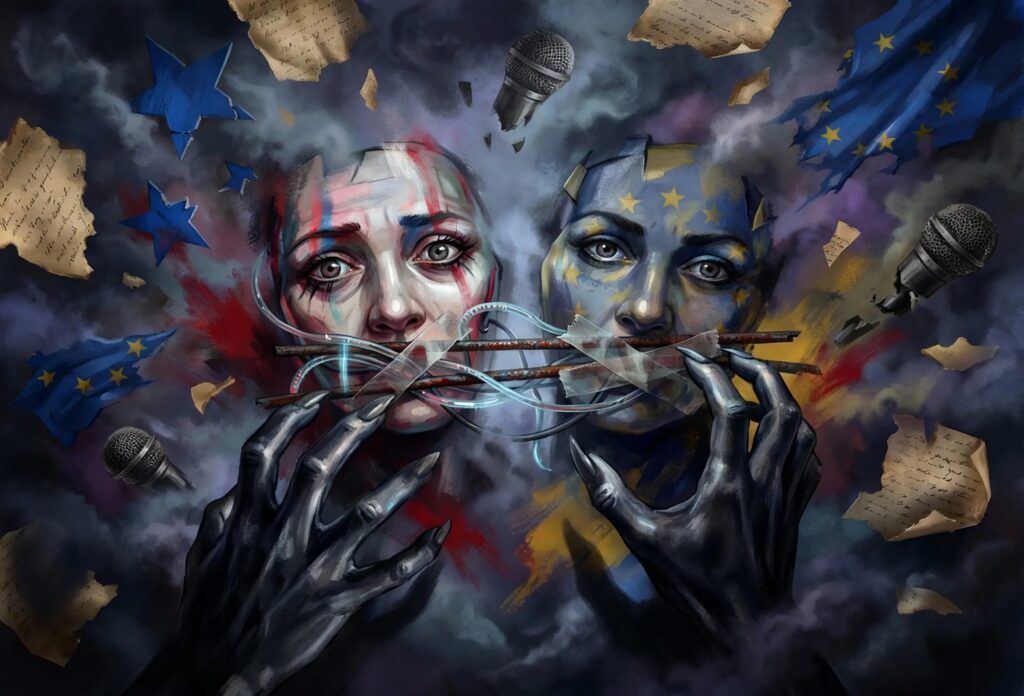
Digital Sovereignty Under Fire: How the U.S. Plays Politics with Free Speech

Freddie Ponton
21st Century Wire
On December 23, 2025, the United States imposed visa restrictions on five Europeans, including former European Commissioner Thierry Breton and senior NGO figures, claiming they engaged in “extraterritorial censorship of Americans.” According to the State Department, these individuals were targeted because they had “led organised efforts to coerce American platforms to censor, demonetise, and suppress American viewpoints they oppose,” part of what officials describe as the so‑called “global censorship‑industrial complex.” At first glance, the sanctions appear to defend free speech, but a closer look reveals a far more complex reality: these measures are less about defending expression and more a political theatre, a clever bit of “America First” gaslighting for domestic consumption, punishing inconvenient actors while ignoring domestic and allied censorship.
U.S. Under Secretary of State Sarah B. Rogers and Secretary of State Marco Rubio framed the move as an enforcement of a broader visa restriction policy announced earlier in May 2025, and that applies to foreign nationals responsible for censorship of protected expression in the United States, a policy built on immigration law authorities to deny visas where entry would have “potentially serious adverse foreign policy consequences.”
According to Rogers, these sanctions target the so‑called “censorship‑NGO ecosystem”, a network of foreign individuals and organisations alleged to pressure American platforms to suppress speech. Rogers emphasised this framing in posts on X.
These sanctions are visa-related. We aren’t invoking severe Magnitsky-style financial measures, but our message is clear: if you spend your career fomenting censorship of American speech, you’re unwelcome on American soil. https://t.co/CYvR1HFnhR
— Under Secretary of State Sarah B. Rogers (@UnderSecPD) December 23, 2025
US Secretary of State Marco Rubio additionally labelled those targeted as “radical activists” and insisted the U.S. would no longer tolerate what he described as “egregious acts of extraterritorial censorship.” He recently posted on X:
For far too long, ideologues in Europe have led organized efforts to coerce American platforms to punish American viewpoints they oppose. The Trump Administration will no longer tolerate these egregious acts of extraterritorial censorship.
Today, @StateDept will take steps to…
— Secretary Marco Rubio (@SecRubio) December 23, 2025
Hypocrisy in Action: Free Speech Under Siege
The U.S. narrative of defending speech rings hollow when compared with real‑world censorship in the US as well as in Europe. During the COVID‑19 pandemic, platforms were pressured to remove so-called “misinformation,” including lawful debate, satire, and investigative reporting, illustrating that domestic policy often mirrors the censorship the U.S. claims to oppose abroad.
In Europe, regulations like “The Digital Services Act “(DSA) and national laws such as Germany’s NetzDG compel platforms to over‑remove content to avoid penalties. EU actions against critics like Jacques Baud, a Swiss former intelligence officer sanctioned by European authorities for criticising EU/NATO military and financial support for Ukraine, highlight how enforcement can target inconvenient perspectives rather than unlawful content.
SEE MORE: NATO’s Red Pen on Ukraine: Jacques Baud and the Silencing of Dissent
Activists reporting on Gaza or advocating Palestinian’s rights to self‑determination face algorithmic suppression, shadow banning, or de‑platforming, reinforcing the selective nature of purported free‑speech defense. Incredibly, Palestine Action in the UK is now proscribed as a terrorist organisation.
MEET THE BRAVE HUNGER STRIKERS FIGHTING FOR JUSTICE IN THE PALESTINE ACTION CASE
Dive into this eye-opening clip that reveals the controversial labelling of Palestine Action as a terrorist organisation. Why would peaceful anti-war protesters be branded terrorists? This… pic.twitter.com/BiobKfcPKK
— Patrick Henningsen (@21WIRE) December 24, 2025
If the US or Europe genuinely cared about safeguarding free speech, they would have had countless chances to demonstrate genuine intent; Instead their actions clearly suggest a strategic move towards censoring dissenting voices for ideological and political purposes.
Who Was Sanctioned and Why
The individuals targeted are central figures in Europe’s digital governance and disinformation ecosystem. Thierry Breton, former European Commissioner for Internal Markets and Digital Services and architect of the Digital Services Act (DSA), has been criticised by U.S. officials for implementing European platform regulations and for pressuring platforms like X under European law.
Imran Ahmed, head of the Centre for Countering Digital Hate (CCDH), Clare Melford of the Global Disinformation Index (GDI), and Josephine Ballon from Germany’s HateAid were also banned for their roles in advocating and coordinating content moderation policies under European regulatory frameworks.
The French government reacted strongly. Foreign Minister Jean‑Noël Barrot condemned the U.S. action, arguing that the Digital Services Act was democratically adopted in Europe, has no extraterritorial reach, and does not affect the United States — asserting that Europe’s digital space should not be subject to external governance. France’s Foreign Minister Jean-Noël Barrot wrote on X
“France strongly condemns the visa restriction imposed by the United States on Thierry Breton, former minister and European Commissioner, and four other European figures. The Digital Services Act (DSA) was democratically adopted in Europe to ensure that what is illegal offline is also illegal online. It has absolutely no extraterritorial reach and in no way affects the United States. The peoples of Europe are free and sovereign and cannot let the rules governing their digital space be imposed by others upon them.”
The Online Safety Act: Safety or Suppression?
The UK’s Online Safety Act has been central in U.S. critiques. Rubio and Rogers claim it threatens American speech by compelling platforms to remove content that would be lawful in the U.S. The Online Safety Act and the DSA’s ambiguous definitions and enforcement mechanisms incentivise platforms to suppress lawful political speech in the EU. Human rights defenders documented that pro‑Palestinian content and activism have been disproportionately affected, with posts about Gaza and solidarity campaigns age‑gated or restricted, while organisations like Palestine Action faced arrests under UK anti‑terrorism frameworks. Content exposing Israel’s war crimes or criticising Western policy on Ukraine, Russia, or Venezuela is similarly vulnerable. However, similar censorship is applied across the US, which means these recent sanctions on European is not truly motivated by the noble idea of protecting Americans’ free speech, but more about asserting US global dominance in regulating free speech, and combat European political views and ideologies.
In practice, the Online Safety Act functions less as a protective measure and more as a regulatory tool that chills dissenting voices, allowing governments and platforms to suppress inconvenient political content while claiming to safeguard users. The U.S. framing of the law as a threat to U.S. free speech amplifies this narrative only for strategic and political gain.
Conclusion: Beyond Free Speech — The Real Agenda
The December 2025 visa sanctions are not simply an ad hoc defense of free expression. While the State Department frames them as addressing activities that could have “potentially serious adverse foreign policy consequences” for the United States, several underlying motivations appear more plausible. These measures likely serve as a geopolitical power play to assert U.S. dominance over Europe’s digital regulatory ambitions, deterring further enforcement of laws like the Digital Services Act that challenge American tech giants. They also protect the economic interests of U.S. platforms by shielding them from costly overseas compliance and fines. Domestically, the action appeals to conservative audiences by framing European NGOs as part of a “globalist censorship network,” bolstering the Trump administration’s image as champions of unrestricted speech. Finally, the sanctions set a deterrent precedent by warning other nations against influencing U.S. online discourse while escalating transatlantic tensions in an “America First” era.
Framed as a principled defense of free speech, the sanctions instead target inconvenient actors while ignoring similar suppression in the U.S. and Europe. Across both contexts, from COVID‑19 content moderation campaigns to the DSA, the Online Safety Act, and targeted sanctions against pro-Palestinian voices and Ukraine war analysts like Jacques Baud, constitutes solid proof that freedom of expression is increasingly instrumentalised. Governments and platforms selectively enable or suppress speech according to political expediency, cloaking strategic, fiscal, and regulatory agendas under the language of safety and human rights.
The recent visa sanctions exemplify this dynamic: freedom of expression is invoked as a narrative cover, but the true driver is political power, leverage, and geopolitical control.
READ MORE FREE SPEECH NEWS AT: 21st CENTURY WIRE FREE SPEECH FILES
SUPPORT OUR INDEPENDENT MEDIA PLATFORM – BECOME A MEMBER @21WIRE.TV
VISIT OUR TELEGRAM CHANNEL
21st Century Wire is an alternative news agency designed to enlighten, inform and educate readers about world events which are not always covered in the mainstream media.
Source: https://21stcenturywire.com/2025/12/24/digital-sovereignty-under-fire-how-the-u-s-plays-politics-with-free-speech/
Anyone can join.
Anyone can contribute.
Anyone can become informed about their world.
"United We Stand" Click Here To Create Your Personal Citizen Journalist Account Today, Be Sure To Invite Your Friends.
Before It’s News® is a community of individuals who report on what’s going on around them, from all around the world. Anyone can join. Anyone can contribute. Anyone can become informed about their world. "United We Stand" Click Here To Create Your Personal Citizen Journalist Account Today, Be Sure To Invite Your Friends.
LION'S MANE PRODUCT
Try Our Lion’s Mane WHOLE MIND Nootropic Blend 60 Capsules
Mushrooms are having a moment. One fabulous fungus in particular, lion’s mane, may help improve memory, depression and anxiety symptoms. They are also an excellent source of nutrients that show promise as a therapy for dementia, and other neurodegenerative diseases. If you’re living with anxiety or depression, you may be curious about all the therapy options out there — including the natural ones.Our Lion’s Mane WHOLE MIND Nootropic Blend has been formulated to utilize the potency of Lion’s mane but also include the benefits of four other Highly Beneficial Mushrooms. Synergistically, they work together to Build your health through improving cognitive function and immunity regardless of your age. Our Nootropic not only improves your Cognitive Function and Activates your Immune System, but it benefits growth of Essential Gut Flora, further enhancing your Vitality.

Our Formula includes: Lion’s Mane Mushrooms which Increase Brain Power through nerve growth, lessen anxiety, reduce depression, and improve concentration. Its an excellent adaptogen, promotes sleep and improves immunity. Shiitake Mushrooms which Fight cancer cells and infectious disease, boost the immune system, promotes brain function, and serves as a source of B vitamins. Maitake Mushrooms which regulate blood sugar levels of diabetics, reduce hypertension and boosts the immune system. Reishi Mushrooms which Fight inflammation, liver disease, fatigue, tumor growth and cancer. They Improve skin disorders and soothes digestive problems, stomach ulcers and leaky gut syndrome. Chaga Mushrooms which have anti-aging effects, boost immune function, improve stamina and athletic performance, even act as a natural aphrodisiac, fighting diabetes and improving liver function. Try Our Lion’s Mane WHOLE MIND Nootropic Blend 60 Capsules Today. Be 100% Satisfied or Receive a Full Money Back Guarantee. Order Yours Today by Following This Link.


| Visits: | 1,770,379,646 |
| Stories: | 8,570,676 |
Whistler Blowers, Insiders

