
South Korea on the Global Faith Map: Divine Intervention or Political Infiltration?

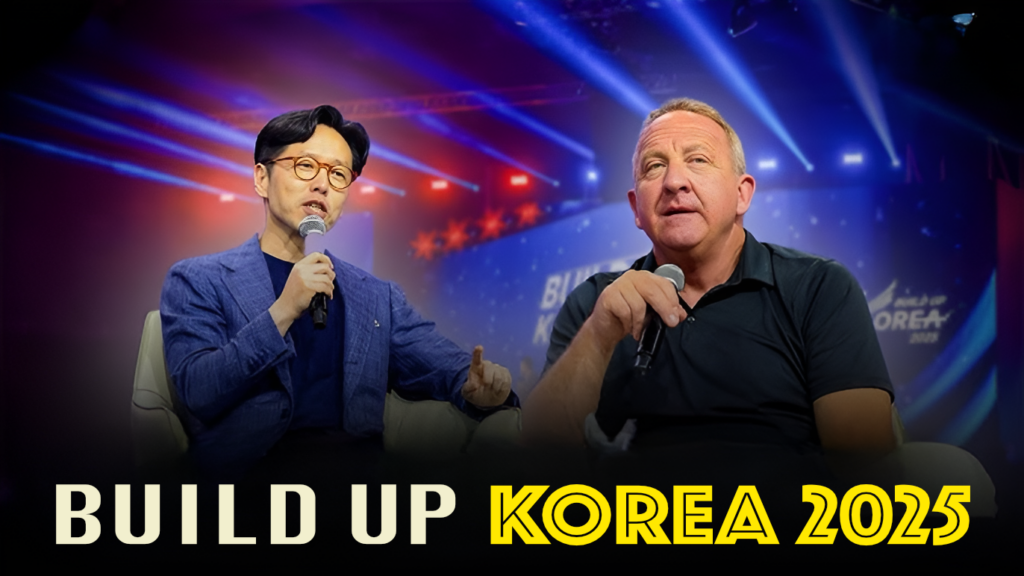
IMAGE: Self-proclaimed Co-Founder of TPUSA Faith, Rob McCoy, with Joe Ahn, Pastor at New Hope Church at Build Up Korea 2025 (Source: Build Up Korea | Youtube)
Freddie Ponton
21st Century Wire
Ever since the assassination of Charlie Kirk, attention in the United States and abroad has snapped sharply onto Turning Point USA (TPUSA) and the entanglement between church networks and political activism. Kirk’s sudden death, violent, shocking, and still only partially understood, did more than shake the conservative movement he helped build; it triggered a broader reassessment of how deeply political organisations had embedded themselves within American evangelical life, and how those same networks were extending influence across continents. What once appeared to be a youth-driven grassroots phenomenon now looks, to a growing number of observers, like a complex fusion of religion, nationalism, and geopolitical messaging.
Critics argue that TPUSA’s faith initiatives have been co-opted by state-aligned actors who view the American church as a vehicle for distributing U.S. and Israeli geopolitical narratives. The message is wrapped in revivalist-style worship, saturated with patriotic imagery, and marketed as a moral crusade, a model some describe as “flag-and-faith nationalism,” where spiritual identity merges seamlessly with political allegiance. Supporters of TPUSA reject this claim outright, framing their efforts as restoring a moral compass to public life and inspiring courage in a generation under cultural siege. But Charlie Kirk’s final engagements abroad, and the self-proclaimed Co-Chair of TPUSA Faith Rob McCoy’s participation in faith-based events overseas in the days before his death, have intensified scrutiny of how these networks operate, what messages they spread, and whose interests they ultimately serve.
SEE ALSO: Inside the United States Evangelical Power Market
The aesthetic and emotional architecture of TPUSA Faith, equal parts revival tent, megachurch spectacle, and political rally, has not remained confined to the United States. Variations of the model have appeared in Europe, Africa, and Asia. South Korea, an intensely Christian nation with an evolving relationship between church and state, has seen the arrival of Build Up Korea, an organisation that, on paper, promotes prayer and Christian unity, but in practice embodies American-style conservative evangelical activism, blending worship, ideology, and geopolitical messaging.
Build Up Korea, South Korean Crackdowns, and Financial Shadows
South Korea has been engulfed in a sweeping government crackdown on politically active churches, an unprecedented campaign that has led to police raids, investigative seizures, and high-profile arrests. The initial spark came from investigations into the Unification Church, where prosecutors alleged financial misconduct, influence-peddling, and political favouritism facilitated through gifts and donations. The investigation quickly expanded, encompassing multiple denominations and reaching into the broader Christian landscape. One evangelical megachurch was raided in a scene that startled secular and religious Koreans alike.
Declassified documents and congressional investigations reveal that the Unification Church was never merely a spiritual movement, but from its early days a political instrument cultivated by South Korea’s intelligence and later by U.S Central Intelligence Agency (CIA). After the 1961 coup, the KCIA organised the Church and used it for anti-communist propaganda and grassroots support for the Park Chung Hee regime. Abroad, the Church and affiliated foundations, like the Korean Cultural Freedom Foundation, funnelled donations, organised rallies, and lobbied U.S. officials, leveraging religion to mask political intervention. Congressional hearings in the 1970s documented members volunteering in offices and KCIA-backed demonstrations aimed at shaping both domestic and international sentiment.
Media arms of the Church, including the Washington Times, promoted conservative causes, anti-communist narratives, and support for U.S.–Korea–Israel alliances, blurring faith, media, and geopolitics. Overall, the Church functioned as a soft-power network aligned with U.S. strategic interests, designed to steer Seoul and global opinion in Washington’s preferred direction.
DOCUMENT: Investigation of Korean-American Relations (Moonies, aka Unification Church) -The Fraser Report of the subcommittee on international organizations of the committee on international relations, u.s. house of representatives (Source: Wikimedia)
Investigation of Korean-American Relations Moonies, aka Unification Church)
The arrest of Pastor Son Hyun-bo, from the Busan Segyero Church, accused of using sermons to influence electoral outcomes, intensified the controversy. Supporters argue the charges are politically motivated, highlighting a double standard in which only certain religious factions face scrutiny for political activity. Older Koreans, steeped in a tradition where Christianity represents stability and anti-communist identity, viewed the crackdown as an existential threat. Younger Koreans, increasingly secular, saw it as overdue accountability for institutions perceived as bloated, politicised, and resistant to reform.
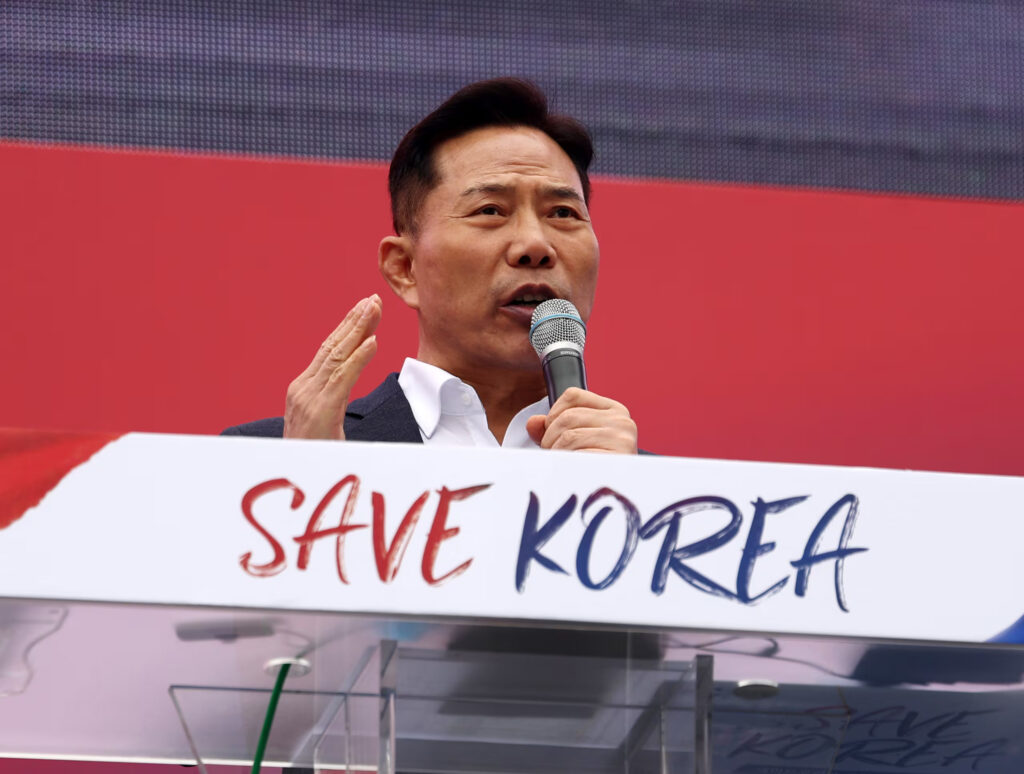
IMAGE: Pastor Son Hyun-bo of Busan Segyero Church speaks at the ‘Save Korea March 1st Independence Movement Day National Emergency Prayer Meeting’ held on Yeouido-ro, Yeongdeungpo-gu, Seoul in September 2025 (Source: Newsis)
Into this volatile environment arrived Build Up Korea. Its summit, which Charlie Kirk attended days before his death, fused dramatic production, choreographed worship, and political rhetoric warning of global threats. Anti-communist messaging, explicit pro-Israel statements, and warnings about foreign influence framed the events. The timing, followed immediately by Pastor Son’s arrest, amplified fears that foreign networks were using spiritual gatherings to exert ideological influence.
Financial dimensions complicate the picture further. Across the globe, churches and church-affiliated networks have been implicated in financial misconduct, tax evasion, and even money laundering. In the United States, federal indictments have targeted megachurch networks and independent ministries for diverting donations, establishing shell organisations, and laundering money through religious nonprofits. Similar patterns have emerged in Australia, Europe, and Africa, where sprawling evangelical networks have faced scrutiny for opaque financial flows and lavish spending. In South Korea, the Unification Church probe revealed luxury gifts and donations routed through religious channels to influence politicians and secure financial and ideological leverage.
SEE ALSO: Past as Prologue: Safari Club Illuminates Candace Owens’ Allegations
Cross-border religious networks, like Build Up Korea, are particularly susceptible to these vulnerabilities. Event fees, travel sponsorships, consulting payments, and nonprofit grants can traverse jurisdictions with minimal transparency. While most activities are legal, the potential for misuse or covert political influence grows in proportion to organizational complexity. Build Up Korea, with its American-linked advisory board and mission integrating America, Korea, and Israel, exemplifies these converging spiritual, political, and financial dimensions, raising questions about the role of faith networks as instruments of ideological and geopolitical influence.
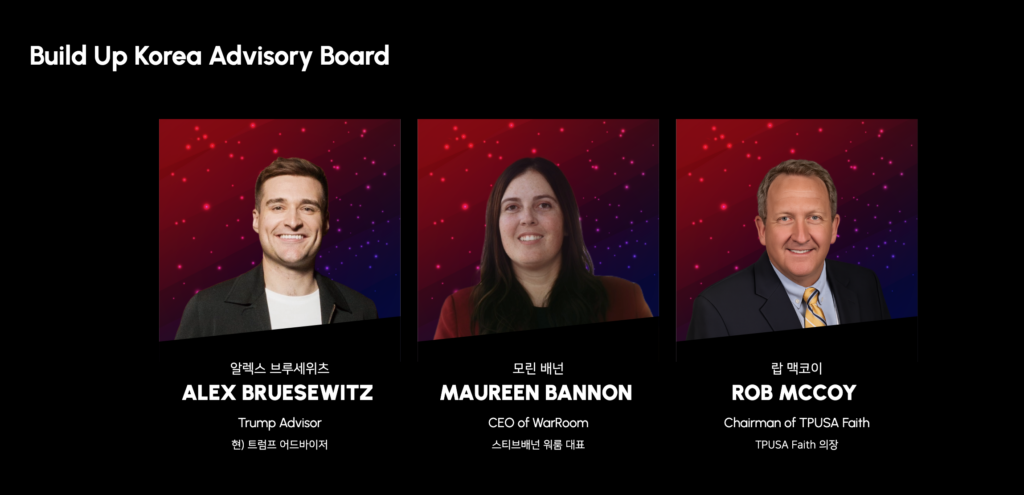
IMAGE: Chairman of TPUSA Faith is a Member of the Advisory Board of Build Up Korea (Source: Build Up Korea Website)
Israel, Geopolitics, and the Global Evangelical Map
One of the most striking features of Build Up Foundation’s mission statement is its pledge to pray “for America, Korea, and Israel.” Israel’s inclusion, particularly in a Korean context, illuminates the fusion of theology and geopolitics in contemporary evangelical networks. For U.S. and Korean evangelicals alike, Israel is not merely a geopolitical ally; it is a sacred anchor in biblical prophecy, the site where divine history unfolds, and spiritual destiny intersects with modern politics.
The Gaza conflict has further fractured the pro-Israel consensus. Accusations of war crimes and genocide have prompted younger believers, particularly in America and Europe, to question unconditional support. Organisations like Build Up Foundation Inc (USA) have intensified messaging to maintain pro-Israel loyalty, framing it as a matter of divine obedience and a cornerstone of global Christian solidarity. The theological justification dovetails with political objectives, reinforcing alliances between believers, U.S. foreign policy, and aligned conservative movements abroad.
This model has been exported globally, following a distinct pattern:
- United States: Christian Zionism, revivalist megachurch events, TPUSA Faith programming, and unwavering pro-Israel advocacy shape the evangelical-conservative identity. Gaza has challenged younger generations, leading to internal moral questioning.
- South Korea: Build Up Korea imports American worship aesthetics, revivalist rhetoric, and pro-Israel messaging into a politically and religiously charged environment, coinciding with government crackdowns on politically active churches.
- Europe: Evangelical networks and far-right parties adopt U.S.-style pro-Israel rhetoric as a civilizational narrative, blending spiritual and political allegiances while facing resistance from secular populations and youth.
Across these regions, the same structural patterns emerge: spiritual practice, political ideology, and geopolitical allegiance converge. Israel functions as both a spiritual and political linchpin, connecting geographically and culturally distant churches into a cohesive transnational movement. Yet younger generations increasingly question this fusion, troubled by the moral implications of unconditional Israel support amid civilian suffering and allegations of war crimes.
Charlie Kirk’s death accelerated awareness of this transnational network. Faith, politics, and financial flows are intertwined in ways that make it impossible to separate spiritual motivation from political influence. Churches, once considered purely sacred spaces, now serve as arenas of global ideological power, raising questions about religious autonomy, moral responsibility, and the role of faith in shaping international alliances.
SEE ALSO: Kill Lists, Covert Ops: Candace Owens’ Alarming Allegation
IMAGE: US right-wing activist and commentator Charlie Kirk was assassinated whilst speaking at Utah Valley University on September 10, 2025. (Source: The Salt Lake Tribune: Trent Nelson via Reuters)
The convergence of spirituality and geopolitics has created a global landscape in which prayer, worship, and devotion are inseparable from political and ideological commitments. For some, this represents divine destiny; for others, a cautionary tale of faith’s entanglement with power. The consequences are unfolding in real time, in Seoul, Washington, Budapest, and beyond, reminding the world that in the modern era, faith can be both profoundly spiritual and inextricably political.
SEE ALSO: Inside ‘Le Cercle’: France’s Secretive Circle Linked to Macron’s Battle with Candace Owens
READ MORE CANDACE OWENS NEWS AT: 21st CENTURY WIRE CANDACE OWENS FILES
SUPPORT OUR INDEPENDENT MEDIA PLATFORM – BECOME A MEMBER @21WIRE.TV
VISIT OUR TELEGRAM CHANNEL
21st Century Wire is an alternative news agency designed to enlighten, inform and educate readers about world events which are not always covered in the mainstream media.
Source: https://21stcenturywire.com/2025/12/09/divine-intervention-or-political-infiltration-inside-the-global-evangelical-mach/
Anyone can join.
Anyone can contribute.
Anyone can become informed about their world.
"United We Stand" Click Here To Create Your Personal Citizen Journalist Account Today, Be Sure To Invite Your Friends.
Before It’s News® is a community of individuals who report on what’s going on around them, from all around the world. Anyone can join. Anyone can contribute. Anyone can become informed about their world. "United We Stand" Click Here To Create Your Personal Citizen Journalist Account Today, Be Sure To Invite Your Friends.
LION'S MANE PRODUCT
Try Our Lion’s Mane WHOLE MIND Nootropic Blend 60 Capsules
Mushrooms are having a moment. One fabulous fungus in particular, lion’s mane, may help improve memory, depression and anxiety symptoms. They are also an excellent source of nutrients that show promise as a therapy for dementia, and other neurodegenerative diseases. If you’re living with anxiety or depression, you may be curious about all the therapy options out there — including the natural ones.Our Lion’s Mane WHOLE MIND Nootropic Blend has been formulated to utilize the potency of Lion’s mane but also include the benefits of four other Highly Beneficial Mushrooms. Synergistically, they work together to Build your health through improving cognitive function and immunity regardless of your age. Our Nootropic not only improves your Cognitive Function and Activates your Immune System, but it benefits growth of Essential Gut Flora, further enhancing your Vitality.

Our Formula includes: Lion’s Mane Mushrooms which Increase Brain Power through nerve growth, lessen anxiety, reduce depression, and improve concentration. Its an excellent adaptogen, promotes sleep and improves immunity. Shiitake Mushrooms which Fight cancer cells and infectious disease, boost the immune system, promotes brain function, and serves as a source of B vitamins. Maitake Mushrooms which regulate blood sugar levels of diabetics, reduce hypertension and boosts the immune system. Reishi Mushrooms which Fight inflammation, liver disease, fatigue, tumor growth and cancer. They Improve skin disorders and soothes digestive problems, stomach ulcers and leaky gut syndrome. Chaga Mushrooms which have anti-aging effects, boost immune function, improve stamina and athletic performance, even act as a natural aphrodisiac, fighting diabetes and improving liver function. Try Our Lion’s Mane WHOLE MIND Nootropic Blend 60 Capsules Today. Be 100% Satisfied or Receive a Full Money Back Guarantee. Order Yours Today by Following This Link.


| Visits: | 1,765,312,881 |
| Stories: | 8,560,148 |
Whistler Blowers, Insiders

