

Ethnic Cleansing of Area C And The Slow Erasure of West Bank Palestine

Freddie Ponton
21st Century Wire
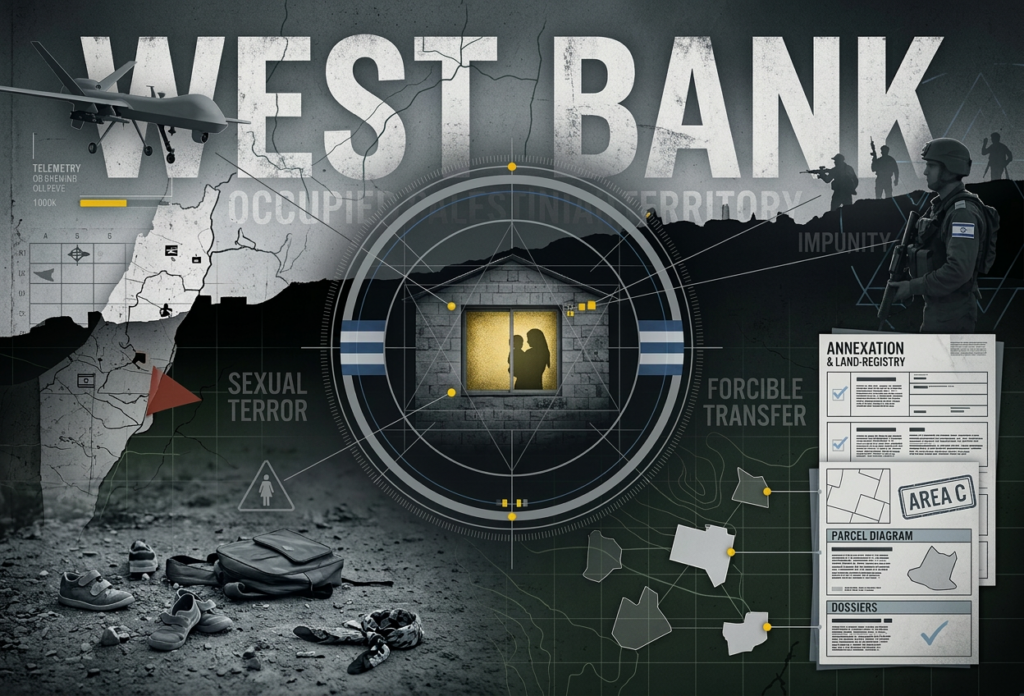
Palestinians are not leaving their villages in the West Bank because of “tensions” or “clashes.” They are being driven out through a calculated campaign that weaponises sexual terror, military impunity, and land bureaucracy to make life unlivable. This article lays bare an illegal project of forcible transfer, enabled by the Israeli state and met with open international complicity through inaction.
A Palestinian family does not abandon its home in darkness because life has become merely difficult. A mother does not send her daughter away because conditions are unpleasant. A shepherd does not give up the land that fed his family for generations because he has suddenly changed his mind about where he belongs. These are decisions made after something far more sinister has taken hold, when the home is no longer safe, when the road to school is charged with dread, when a woman fears the walk to a latrine, when a family sleeps listening for footsteps outside the shelter, and when armed settlers violate the boundaries of domestic life while Israeli soldiers stand by as if none of it concerns them.
Sexual Terror as a Tool of Removal
That is the reality laid bare by the new report from the Norwegian Refugee Council (NRC)-led West Bank Protection Consortium. It does not describe a handful of ugly incidents on the outer edge of occupation, but documents with a chilling authenticity a pattern in which sexualised violence, humiliation, invasive searches, rape threats, forced nudity, stalking, and domestic terror have become part of the coercive machinery used by Israel to expel Palestinians from Area C of the occupied West Bank.
Based on 83 in-depth interviews, 12 focus group discussions across 10 Palestinian communities, and 26 key informant interviews, the report reaches a conclusion that should have triggered an international political earthquake. More than 70 percent of displaced households interviewed said threats against women and children, especially sexualised violence, were the decisive reason they left. This article also draws on a companion documentation file curated by the 21st-century Wire editorial team that consolidates reporting from UN bodies, OCHA, OHCHR, human rights organisations, and field sources into a single record of sexual violence, impunity, and displacement patterns in Area C.
REPORT: Sexual Violence And Forcible Transfer In The West Bank, How the Exploitation of Gender Dynamics Drives Displacement, Nicola Banks and Busaina Nazzal, Norwegian Refugee Council-led West Bank Protection Consortium, April 2026 (Source: Norwegian Refugee Council | NRC)
sexual-violence-and-forcible-transfer-in-the-west-bank—final
The significance of these findings cannot be overstated. Sexual terror has become one of the most effective instruments for making Palestinian presence on the land impossible. According to a report from OCHA, the United Nations Office for the Coordination of Humanitarian Affairs, since January 2023, more than 5,600 Palestinians from 1,037 households have been displaced in the context of settler violence and access restrictions, with over 3,200 of them coming from 38 communities that have since been completely emptied of Palestinian residents. In the first three months of 2026, 1,697 Palestinians were displaced in that context, already more than in all of 2025.
The assessments of NRC and its leading agency, The West Bank Protection Consortium (WBPC), a strategic partnership of five international NGOs, formed in 2015 to prevent the forcible transfer of Palestinians in the West Bank (including Area C and East Jerusalem), indicate that 46,778 Palestinians now live in communities at high or imminent risk of displacement, and that if they are forced out, the area affected would stretch across roughly 663 square kilometers, representing 11 percent of the West Bank and 19.5 percent of Area C. While some report may preffer to describe the situation as a local humanitarian crisis, it is more accurate to describe it as a territorial reengineering of the West Bank through fear, violence, and impunity.
When the Home Turns Against You
The report is most devastating when it shows where this campaign actually lives, because it lives inside Palestinian’s home. Women and girls described settlers exposing themselves, threatening rape, stalking them on their way to latrines, watching bedrooms with drones, harassing them while hanging laundry, and approaching homes precisely when men were absent. The NRC report details how violence and intimidation have moved from public and communal spaces into courtyards, bedrooms, and the immediate surroundings of family dwellings, turning domestic space itself into a weaponised zone. In Bedouin communities, the invasion of domestic space is socially devastating because the assault on women’s dignity reverberates through the entire family and community.
A home does not need to be demolished to become unlivable. If a mother is afraid to step outside after dark, if a father leaves for work terrified of what might happen to the women he leaves behind, if children hear shouted threats at night and cannot sleep, if drones hover outside bedroom windows, then domestic life has already been invaded and broken. One woman put it with terrible precision:
We are still in our house, she said, but it is no longer a home
Men and boys are also targeted in ways meant to humiliate, break, and warn. The report documents forced stripping, forced nudity, sexualised threats, invasive searches, and assaults that turn the male body into a public message. In Wadi al-Seeq, three men reported that settlers attempted to sexually assault a blindfolded Palestinian man with a broomstick, while stripping, beating, burning, and urinating on victims before circulating images of the abuse. In other cases, adolescent boys herding cattle were beaten, blindfolded, stripped, and urinated on.
In March 2026, settlers attacked Qusai Abu al-Kebash, a 29‑year‑old shepherd who said masked men bound him, stripped him, zip‑tied his genitals, beat him, dragged him through the village, attacked his relatives, threatened to rape women, assaulted children, and stole hundreds of sheep that sustained the family’s livelihood. Sexual humiliation, family terror, and economic destruction arrive together.
Israeli soldiers are not outside this picture. The NRC report includes testimony that soldiers themselves carried out degrading treatment. One woman described female soldiers ordering her to remove her clothes, forcing a painful full‑body inspection while she was naked and touching intimate areas while making derogatory comments. These accounts align with the UN Commission of Inquiry’s findings documenting forced public stripping, sexual humiliation, rape threats, and other forms of sexual and gender-based violence by Israeli forces and settlers. In one village, a settler threatened a family by invoking Sde Teiman, showing how the notoriety of detention‑facility abuse now functions as a threat inside West Bank communities as well.
The way this unfolds on the ground follows a grimly consistent sequence. A new settler outpost appears near or inside a Palestinian community. Access to water, grazing land, and fields is restricted. Raids follow, along with livestock theft, property damage, threats, and beatings. Violence then becomes more intimate and more sexualised, targeting women in ways designed to make the home itself unbearable. Israeli forces are present and do not intervene, or they openly favour settlers. Families respond by restricting women’s movement, keeping children home, abandoning agricultural work, and sending some relatives away. One or more triggering events then break the last line of endurance, sparking overnight flight. Once the community is gone, return is blocked, the outpost expands, and the land passes into a new reality of exclusion and settler control. The compiled documentation sets out this anatomy of coercion as a regular pattern, not an exception.
Families Fractured, Livelihoods Annihilated
Displacement often begins before a community is fully emptied. Families rarely leave all at once. They fracture first. The NRC report describes partial forcible transfer, where women and children are sent to relatives or towns perceived as safer while men remain behind to guard land, homes, and livestock. A father sends his daughters away because he believes settlers will harm them. A mother sends her child to live with relatives because danger has become too intimate and constant to manage. These are not lifestyle choices. They are the first stages of expulsion.
Once women and children leave, social bonds begin to collapse. Schools falter. Informal networks of support dissolve. Men remain behind in isolation, exposed to heightened risk, trying to defend what can no longer really be defended. In communities like Wadi al-Seeq, Anata, and Ras al‑Tin, this pattern of family separation often preceded total abandonment. When women stop collecting water alone, when girls leave school, when families abandon grazing routes, when people cease using the land even before they physically leave it, displacement has already begun.
The coercion is also economic. The report found that 92 percent of displaced households lost access to grazing and agricultural land, 88 percent lost their homes or shelters, 84 percent lost furniture, livestock, or other assets, and 56 percent lost livelihood opportunities. The burden falls with special force on women. Eighty‑seven percent of women who experienced forcible transfer reported losing all sources of income. Dairy production, embroidery, foraging, beekeeping, and other income-generating work disappear when access to land and livestock is destroyed. A woman who spent years building a small business loses it overnight. A widow supporting seven children through dairy production loses animals, buyers, and market access in one stroke. This is the gendered demolition of economic life.
The psychic damage is severe. Ninety percent of women interviewed reported increased psychological stress and trauma after forcible transfer, and forty percent of children in displaced households lost access to education. Bed‑wetting, nightmares, withdrawal, aggression, and children who fear playing outside become part of everyday life. Families who relocate often end up in roadside shelters, on land owned by others, or in dense peripheral zones without privacy, infrastructure, or secure tenure, where harassment may continue. Women lose income, support networks, and influence in community life. Relocation is not refuge. It is prolonged precarity.
One of the ugliest social consequences of this sustained terror is the return of early marriage as a forced “protection” strategy. At least six families reported arranging marriages for girls aged 15 to 17 to move them into what they hoped would be safer households. These decisions are described not as cultural tradition but as fear‑driven surrender. Girls leave school, their autonomy narrows, and their futures are sacrificed to immediate survival.
Our dossier was assembled because the NRC report establishes the core finding with great force, but the wider pattern becomes even harder to deny when those findings are set alongside OCHA displacement tracking, OHCHR and UN Commission of Inquiry reporting on sexual and gender-based violence, and twenty years of Yesh Din impunity data in the West Bank.
REPORT: Compiled primary source documentation of sexual violence and gender-based abuse by Israeli settlers and soldiers in the West Bank, Area C, 2021 to April 2026, drawing on UN, OCHA, OHCHR, West Bank Protection Consortium, and Yesh Din reports (Source: produced by author with AI Computing tool support)
WestBank_GBV_Documentation_Report
Impunity, Strategic Geography, and Annexation by Paper
The entire system depends on impunity. The report repeatedly states that incidents occur in the presence of Israeli forces without intervention or effective investigation. Long‑run data from Yesh Din show that 93.6 percent of settler violence investigation files were closed without indictment, while only 3 percent led to convictions. The same dataset records dozens of incidents of organised mass violence, with soldiers or police present and assisting the attack in many cases. The justice system isn’t failing to cope with caseload; instead, it acts as a protective shield for perpetrators.
The Sde Teiman case exposes that shield in its rawest form. All charges against soldiers accused of sexually torturing a Palestinian detainee were dropped in March 2026, despite CCTV, medical reports, and polygraph evidence. Reporting on the case shows how far‑right politicians and supporters mobilised to defend the accused and attack the investigation. When a case that blatant is buried, it sends a message to every soldier and settler in the West Bank that they can act without fear. To put it bluntly, impunity is not a side effect, just an operating principle.
The territorial stakes concentrate in specific places. The Jordan Valley and the South Hebron Hills are at the heart of this campaign because they are populated largely by Bedouin and herding communities who depend on land access and are structurally vulnerable to displacement. According to a January 2026 Protection Analysis Update, over 35 percent of all settler‑violence‑related displacement since January 2023 has been concentrated in the Jordan Valley. In January 2026 alone, 600 Palestinians were displaced from Ras Ein al‑Auja, the highest single‑community displacement figure recorded in three years of OCHA monitoring. More than 90 percent of displacement in the first quarter of 2026 occurred in this region. These are the communities standing between Israel’s settlement blocs and full control of strategic corridors.
Legally, this is not a grey zone. The NRC report is explicit that forcible transfer does not require direct physical removal and occurs where coercive conditions leave civilians with no genuine choice but to flee. Sexualised harassment, threats against women and children, repeated attacks inside homes, systematic impunity, and the destruction of land‑based livelihoods are all relevant in determining whether displacement was coerced. The legal framework is set by the Hague Regulations, the Fourth Geneva Convention, customary international humanitarian law, and international criminal jurisprudence, including interpretations of Article 7(1)(d) of the Rome Statute on forcible transfer. The pattern also aligns with indicators in the UN Framework of Analysis for Atrocity Crimes, including discrimination, tolerated violence by non‑state actors, and lack of accountability.
Third‑state obligations are just as clear. Common Article 1 of the Geneva Conventions requires states not only to respect international humanitarian law but to ensure respect for it. The International Court of Justice’s 2024 advisory opinion reaffirmed that serious breaches of peremptory norms trigger duties of non‑recognition, non‑assistance, and cooperation to bring the unlawful situation to an end. Governments watching the emptying of Palestinian communities in Area C are not neutral observers. They are bound to ensure their own trade, arms transfers, political cover, and institutional ties do not help maintain this system.
This is what makes the February 2026 land registration move so dangerous. Israel’s decision to restart land registration in the West Bank extends its authority over land registries in Area C in ways that Palestinian groups warn will facilitate confiscation of Palestinian land. A detailed legal brief describes how this amounts to annexation by registry, turning emptied communities into bureaucratic opportunities. The sequence is brutally clear. First, the outpost appears, then the terror and the partial displacement, followed by the emptying and the registry. Once communities have been driven off, the land is far easier to absorb through state‑land declarations, planning rules, and settlement expansion. Violence clears the ground, whilst the administration seals the theft.
A Coherent Technology of Palestinian Removal
The report urges third states to treat sexualised intimidation, domestic‑space incursions, humiliating searches, and threats against women and children as indicators of a coercive environment contributing to forcible transfer. It calls on them to integrate these into risk frameworks and early‑warning systems, and to operationalise Common Article 1 through concrete pressure, including reviewing cooperation streams that may contribute to serious violations. It recommends robust due diligence tools to ensure that trade, public procurement, investment guarantees, and arms transfers do not support settlements, outposts, or coercive displacement. The legal roadmap exists—the facts exist, and the victims have already spoken.
What emerges from this record is not a tragic breakdown of order, but an indictment of an Israeli regime that has fused settler violence, military non‑intervention, sexual humiliation, gendered terror, economic destruction, and administrative land seizure into a coherent technology of Palestinian removal. This is not what we should expect from a state committed to law. Instead, it is what a colonising power does when it decides that Palestinian presence is the obstacle that needs to be removed.
What is being destroyed in Area C is not only housing, grazing access, or village continuity, but also the basic human architecture of life itself. Women lose privacy, safety, income, and autonomy, while men lose dignity, protection, and the ability to defend family and land. As for the children, they lose school, play, sleep, and the belief that home can protect them. Families are fractured before communities disappear. Communities are emptied before the land is seized. And once that seizure is complete, officials, settlers, and Israel’s international backers can recast a deliberate crime as an unfortunate inevitability. It was neither. It was made to happen.
READ MORE PALESTINE NEWS AT: 21st CENTURY WIRE PALESTINE FILES
SUPPORT OUR INDEPENDENT MEDIA PLATFORM – BECOME A MEMBER @21WIRE.TV
VISIT OUR TELEGRAM CHANNEL
21st Century Wire is an alternative news agency designed to enlighten, inform and educate readers about world events which are not always covered in the mainstream media.
Source: https://21stcenturywire.com/2026/04/22/ethnic-cleansing-of-area-c-and-the-slow-erasure-of-west-bank-palestine/
Anyone can join.
Anyone can contribute.
Anyone can become informed about their world.
"United We Stand" Click Here To Create Your Personal Citizen Journalist Account Today, Be Sure To Invite Your Friends.
Before It’s News® is a community of individuals who report on what’s going on around them, from all around the world. Anyone can join. Anyone can contribute. Anyone can become informed about their world. "United We Stand" Click Here To Create Your Personal Citizen Journalist Account Today, Be Sure To Invite Your Friends.
LION'S MANE PRODUCT
Try Our Lion’s Mane WHOLE MIND Nootropic Blend 60 Capsules
Mushrooms are having a moment. One fabulous fungus in particular, lion’s mane, may help improve memory, depression and anxiety symptoms. They are also an excellent source of nutrients that show promise as a therapy for dementia, and other neurodegenerative diseases. If you’re living with anxiety or depression, you may be curious about all the therapy options out there — including the natural ones.Our Lion’s Mane WHOLE MIND Nootropic Blend has been formulated to utilize the potency of Lion’s mane but also include the benefits of four other Highly Beneficial Mushrooms. Synergistically, they work together to Build your health through improving cognitive function and immunity regardless of your age. Our Nootropic not only improves your Cognitive Function and Activates your Immune System, but it benefits growth of Essential Gut Flora, further enhancing your Vitality.

Our Formula includes: Lion’s Mane Mushrooms which Increase Brain Power through nerve growth, lessen anxiety, reduce depression, and improve concentration. Its an excellent adaptogen, promotes sleep and improves immunity. Shiitake Mushrooms which Fight cancer cells and infectious disease, boost the immune system, promotes brain function, and serves as a source of B vitamins. Maitake Mushrooms which regulate blood sugar levels of diabetics, reduce hypertension and boosts the immune system. Reishi Mushrooms which Fight inflammation, liver disease, fatigue, tumor growth and cancer. They Improve skin disorders and soothes digestive problems, stomach ulcers and leaky gut syndrome. Chaga Mushrooms which have anti-aging effects, boost immune function, improve stamina and athletic performance, even act as a natural aphrodisiac, fighting diabetes and improving liver function. Try Our Lion’s Mane WHOLE MIND Nootropic Blend 60 Capsules Today. Be 100% Satisfied or Receive a Full Money Back Guarantee. Order Yours Today by Following This Link.


| Visits: | 1,803,051,225 |
| Stories: | 8,635,254 |
Whistler Blowers, Insiders

