

NAT SEC ARCHIVE – CUBA: The Bay of Pigs Never Ended, It Just Mutated

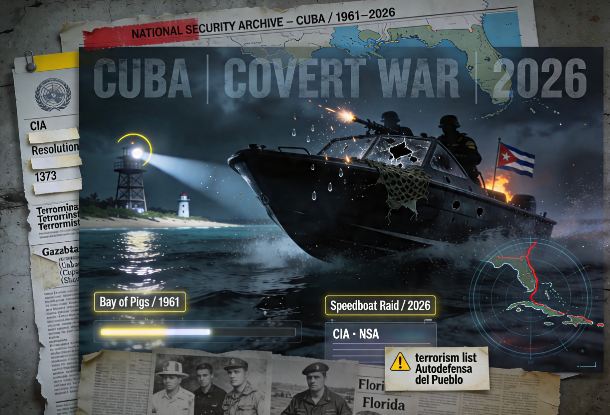
Freddie Ponton
21st Century Wire
More than a month after Cuba charged six exiles with terrorism over the attack and publicly tied at least two of them to a prior terrorism list shared with Washington, Trump’s State Department is still “reviewing” the case while FBI agents move quietly in and out of Havana. At the same time, newly declassified Bay of Pigs files from the National Security Archive (NSA) lay bare an earlier era of U.S. covert war against Cuba built on wishful thinking and deniable violence, casting a long shadow over how this latest incident is understood in Havana. In Miami and Washington, officials talk about “clarifying events.” In Cuba, people talk about a Florida based militant network that used a U.S.registered boat to launch an armed infiltration under the cover of the blockade that is choking the island.
The old war returns
A stolen speedboat left the Florida Keys before dawn, crossed into Cuban waters, and turned a quiet stretch off Villa Clara into a battlefield on 25 February 2026. Cuban authorities said the vessel carried rifles, pistols, scoped AR-style weapons, night optics, radios, body armour, a drone, and nearly 13,000 rounds of ammunition, while international outlets later confirmed the Florida origin, the stolen registration, and the presence of U.S. citizens among the dead and wounded. At least one of the dead and one of the injured were confirmed by U.S. officials as American citizens, all ten men aboard were Cuban nationals living in the United States, and an eleventh alleged accomplice was arrested on land after reportedly coming to meet them on the beach.
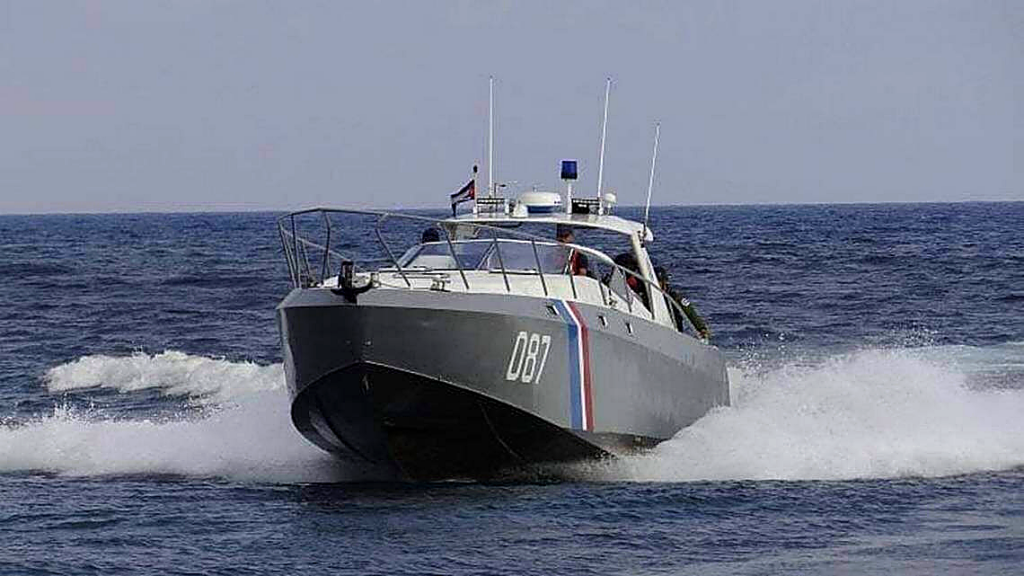
IMAGE: Cuban Coast Guard vessel (Source: El Artemiseño newspaper via Facebook)
This article places that raid beside newly released Bay of Pigs invasion records by the National Security Archive (NSA), which show how Washington’s covert war on Cuba was built on fantasy, deniability, and a willingness to gamble with Cuban lives. It also documents something more immediate and damning. Years before the Villa Clara clash, Cuba had already identified Autodefensa del Pueblo (ADP), Amijail Sánchez González, and Leordán Cruz Gómez in official counterterrorism files shared with the United States, yet the men still lived, organised, and sailed from U.S. soil.
DOCUMENT: National Security Archive – CIA, Report, “Inspector General’s Survey of the Cuban Operation and Associated Documents,” Top Secret, October 1961, and Che–Goodwin memo (Source: NSA)
CIA Report
What follows is not a nostalgic Cold War story. It is an account of how that war against Cuba shrank and mutated inside a permissive exile ecosystem in Florida, and how a country suffocating under sanctions and a de facto oil blockade became the stage for one more armed fantasy of regime change. It is also a story about ordinary Cubans paying the price for a siege they did not choose, while militants and politicians in the United States treat the island’s crisis as an opening.
What the files reveal
The new Bay of Pigs material is truly a jewel because it exposes the inner logic of the invasion more clearly than the mythology ever did. The CIA Inspector General’s survey concluded that the Agency had no solid intelligence showing that Cubans would rise up to join the invaders, that key assumptions about internal revolt were wishful thinking, and that the fantasy of plausible deniability collapsed before the first shot at Playa Girón. The report depicts an apparatus that preferred to double down on false hopes rather than admit the operation should be halted.
Arthur Schlesinger’s memoranda are just as revealing. They show that after the disaster, President John F Kennedy considered stripping the CIA of much of its covert action role, moving key functions under tighter civilian control, and separating intelligence collection from paramilitary operations because the Bay of Pigs invasion had exposed an agency acting like a state within a state. For a moment, the U.S. political establishment admitted to itself that permanent covert war-making might be incompatible with democratic accountability.
The release also exposes the moral rot beneath the operation. One highlighted document ties invasion‑period funding streams to CIA–Mafia assassination plotting against Fidel Castro, while the Guevara–Goodwin memorandum shows that Havana understood the failed invasion not just as an attack survived but as a political turning point that strengthened the revolution from within. Che Guevara told presidential adviser Richard Goodwin that the fiasco allowed Cuba to consolidate internally and to negotiate with Washington as an equal, not as a pleading victim.
For readers interested in the Bay of Pigs invasion, these details matter because they strip away the fairy tale of a bungled but benign policy. The record shows an operation driven by self-deception at the top, by exile militarism on the ground, and by a covert bureaucracy that kept feeding presidents optimism when honesty would have required killing the mission. The file trail from 1961 shows how Washington once orchestrated an invasion. The file trail from Havana shows what happened when Florida militants tried to do it themselves.
DOCUMENT: White House, “Memorandum for the President: Conversation with Commandante Ernesto Guevara of Cuba,” Secret, August 22, 1961 (Source: NSA)
00203
A boat from Florida
That culture of exile militancy reappeared in miniature off Villa Clara. Cuban and international reporting described the February 2026 group as Cuban nationals living in the United States who were tied to a small Florida-based militant network called Autodefensa del Pueblo, or People’s Self Defense, rather than to any publicly documented professional mercenary structure. Families of some participants, including U.S. citizen Misael Ortega Casanova, described them as obsessed with the idea of “liberating” Cuba and poorly trained, more like fanatics with rifles than soldiers of fortune.
Academic observers added depth to that picture. William LeoGrande, Michael Bustamante, and Quincy Institute analyst Lee Schlenker framed the raid as an echo of older exile paramilitary actions, not a serious military campaign with mass support on the island. Schlenker described the mission as a kind of armed “Freedom Flotilla” fantasy, a self‑assigned liberation voyage by fringe militants who hoped to inspire revolt or at least provoke escalation, even though their real capacity was vanishingly small.
The operational picture from Cuban disclosures is chilling. Officials displayed tubs of ammunition and racks of captured weapons, reporting that the speedboat carried 12,846 rounds, dozens of magazines, pistols, shotguns, AR-style rifles, night vision optics, communications equipment, helmets with cameras, camouflage uniforms, a drone, and insignia from exile organisations, including the November 30 Movement and People’s Self Defense. Interior Ministry officers described a firefight that began at around 185 metres and closed to roughly 20 metres, during which the boat’s commander was shot in the arm, and four attackers were killed before the engine was disabled, a sequence that Reuters and others echoed in their coverage.
VIDEO: Cuban state TV video showing the items seized from the February 2026 Florida speedboat attack (Source: @Mrgunsngear| X)
.
Cuban investigative outlet Cubadebate then reconstructed the group’s digital trail. Its report counted 114 social media posts from ADP and related accounts in the months before the raid, many featuring rifles, tactical vests, Brigade 2506 iconography, and slogans promising to “enter” and “liberate” Cuba. Videos on TikTok, Instagram, and Facebook showed Amijail Sánchez González and his network openly discussing armed infiltration and regime change, normalising sabotage and incursion in what looked less like a covert cell and more like a small online cult of liberation broadcasting from U.S. platforms.
Cuban reports and international coverage also noted that an eleventh man, a Cuban American who had allegedly flown in from the United States to meet the team on the beach, was arrested and admitted involvement in the scheme. His presence suggested an operation that did not end at the waterline but anticipated a rendezvous on Cuban soil, however small and desperate the local network may have been. Cuban spokespeople insisted the attackers fired first, while U.S. outlets stressed that the facts would be further probed by an FBI team that later travelled to Havana, a rare gesture that confirmed the seriousness of the case even as Washington denied directing the mission.
In 1961, exile fighters trained for invasion in a covert war run from Washington. In 2026, a smaller band of Florida militants armed themselves with the same old myth that one dramatic blow could trigger collapse, panic, revolt, or U.S. escalation, this time under the gaze of social media and in the midst of an economic collapse largely engineered from abroad.
Washington was warned
The most devastating evidence does not come from pundits. It comes from Cuba’s own Gazette documents (1 and 2) which show that ADP and key figures around the February raid were already inside Havana’s official counterterrorism framework long before the speedboat left Florida. Those Gazettes were issued under the legal architecture of UN Security Council Resolution 1373, which obliges states to exchange information on individuals and entities linked to terrorism and to act against financing networks.
In the December 2023 Gazette, Resolución 19/2023 placed Amijail Sánchez González on the national terrorism list under preparatory file 128/2022, tied to “promoting, financing and carrying out acts of sabotage” against the Municipal People’s Court of Central Havana and the Provincial Directorate of the Committees for the Defense of the Revolution. That same document already listed People’s Self Defense among U.S. based entities accused of organising, financing, providing resources for, and carrying out actions against Cuban state security, making clear that Cuba saw ADP itself, not only individual militants, as part of an armed threat hosted in U.S. territory.
The July 2025 update, Resolución 13/2025, went further in connecting names, places, and alleged financing from abroad. It tied Amijail Sánchez González to preparatory file 551/2023, a Matanzas case involving a Cuban resident in the United States who allegedly smuggled firearms, ammunition, and other supplies through the north coast “with the purpose of carrying out terrorist acts in military units” in plans “organised, financed and supported from North American territory by citizens residing in that country”. The same resolution listed Leordán Cruz Gómez as residing in the United States and linked him to preparatory file 698/2023 for sabotage activities in the province of Villa Clara, the same territory where the 2026 boat would be intercepted.
DOCUMENT: Gaceta Oficial No. 83 Extraordinaria de 7 de diciembre de 2023 and Gaceta Oficial de la República de Cuba – Extraordinaria, 9 de julio de 2025, where the name of Amijail Sánchez González, and Leordán Cruz Gómez appears – translated in English (Source: Cubaminrex)
Cuba Gazette Doc 1 and 2
Deputy Foreign Minister Carlos Fernández de Cossío later stated that both men were already on the national terrorism lists Cuba had transmitted to Washington in 2023 and 2025, and that ADP appeared in the same documents. He stressed that for more than sixty years, most terrorist acts against Cuba had been “organised, financed and carried out” from U.S. soil and accused anti‑Cuban groups in the United States of acting under a sense of impunity fostered by official tolerance. Cuba’s Prosecutor’s Office added that the Villa Clara case involved crimes “financed from abroad” and signalled that those responsible for funding could face terrorism‑financing charges under Cuban law.
Officials in Washington insisted that the raid was not a U.S. government operation and promised to help “clarify the events” through an FBI visit to Havana, yet they have released no public findings of their own. Senator Marco Rubio framed the affair as a private scheme by individuals acting “on their own” even as he demanded that any U.S. citizens held in Cuba be treated as hostages if not swiftly released, a position that refused to confront the question of why militants flagged by Cuba were able to raise weapons, appear all over social media, and depart from U.S. soil at all.
There is no public evidence that Washington directed the raid in the way it once directed the Bay of Pigs invasion. The record shows something else instead. Cuba warned Washington about the men, the organisation, and the pattern, and Washington failed to stop the boat. Only when Cuban border guards returned fire, and bodies fell in Cuban waters, did U.S. agencies move to investigate what had sailed out from under their noses.
A country under siege
The raid has to be read against the suffering of ordinary Cubans, because those are the lives being traded in this long war. Analysts placed the incident inside a Cuba battered by long‑running U.S. sanctions, post‑Trump tightening, and what they describe as a de facto oil blockade that deepened shortages, blackouts, and social strain, creating the sort of pressure cooker in which exile militants convince themselves that collapse is only one shove away. Tourism never fully recovered after the pandemic, remittances were hit by banking restrictions, and fuel shortfalls translated directly into queues, outages, and hospital stress.
The raid did not come out of a clear blue sky. It unfolded against a Cuba pushed to the brink by internal crisis and external siege, with sanctions and energy strangulation functioning in practice as collective punishment of a small island that has refused to bow to U.S. demands. In Miami exile circles, that misery is read as a signal. The worse life becomes on the island, the more plausible it seems to small militant groups that one armed incursion, filmed and mythologised, could be enough to tip a weakened state into open revolt or to force Washington into open confrontation.
Cuban officials, foreign correspondents, and aid organizations instead stressed how the raid would deepen a security climate already shaped by decades of confrontation and siege. The firefight unfolded against a backdrop of rolling blackouts, fuel shortages, and tightened U.S. sanctions that have pushed Cuba’s economy into crisis, leaving families to juggle food queues, transport breakdowns, and hospital strain. For ordinary Cubans with no stake in exile politics, the message was brutal but familiar: armed men had once again sailed from Florida to open fire in their coastal waters, while the same power that restricts fuel, banking, and key imports insisted the attack had nothing to do with it.
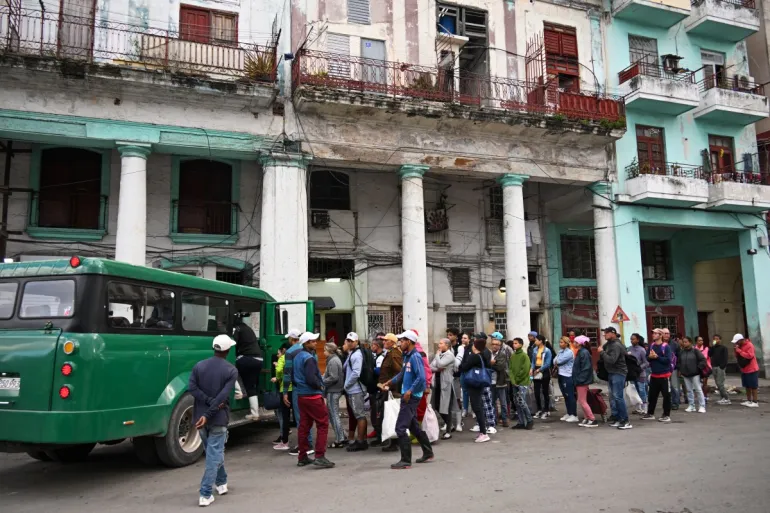
IMAGE: Cuba Food crisis and shortage (Source: Yamil Lage/AFP)
The new Bay of Pigs invasion files matter in this context. They show the original architecture of a war built on wishful thinking, exile mythology, and bureaucratic deceit, while the Villa Clara raid shows how that architecture still casts a shadow over Cuba in smaller, dirtier, and more deniable forms. From the 1960s hotel bombings in Havana and the Cubana Flight 455 bombing to later coastal raids and embassy attacks, U.S.-based exile groups have left a long trail of Cuban dead and wounded, sometimes with open U.S. connivance, sometimes under the indulgent gaze of authorities who chose not to see. The February firefight belongs to that history, even if this time the militants were fewer, poorer, and more desperate.
The eerie familiarity of armed exiles attacking Cuba from U.S. territory at a moment when Washington has tightened an economic noose has led some observers to recall the declassified Operation Northwoods proposal, in which the Pentagon once suggested staging or faking attacks blamed on Cuba to justify war, and to wonder whether today’s militants are being used as deniable instruments in a similar game, even if no public evidence yet supports that accusation.
What the public record does support is simpler and harder to excuse. The Bay of Pigs invasion was never fully buried. It survived in exile networks, in tolerated militancy on U.S. soil, in an economic siege imposed on a civilian population, and in the belief that Cuba can be broken from the outside if enough pressure is applied and enough blood is spilt.
READ MORE SOUTH AMERICA NEWS AT:21st CENTURY WIRE SOUTH AMERICA FILES
VISIT OUR TELEGRAM CHANNEL
SUPPORT OUR INDEPENDENT MEDIA PLATFORM – BECOME A MEMBER @21WIRE.TV
21st Century Wire is an alternative news agency designed to enlighten, inform and educate readers about world events which are not always covered in the mainstream media.
Source: https://21stcenturywire.com/2026/04/17/nsa-cuba-the-bay-of-pigs-never-ended-it-just-mutated/
Anyone can join.
Anyone can contribute.
Anyone can become informed about their world.
"United We Stand" Click Here To Create Your Personal Citizen Journalist Account Today, Be Sure To Invite Your Friends.
Before It’s News® is a community of individuals who report on what’s going on around them, from all around the world. Anyone can join. Anyone can contribute. Anyone can become informed about their world. "United We Stand" Click Here To Create Your Personal Citizen Journalist Account Today, Be Sure To Invite Your Friends.
LION'S MANE PRODUCT
Try Our Lion’s Mane WHOLE MIND Nootropic Blend 60 Capsules
Mushrooms are having a moment. One fabulous fungus in particular, lion’s mane, may help improve memory, depression and anxiety symptoms. They are also an excellent source of nutrients that show promise as a therapy for dementia, and other neurodegenerative diseases. If you’re living with anxiety or depression, you may be curious about all the therapy options out there — including the natural ones.Our Lion’s Mane WHOLE MIND Nootropic Blend has been formulated to utilize the potency of Lion’s mane but also include the benefits of four other Highly Beneficial Mushrooms. Synergistically, they work together to Build your health through improving cognitive function and immunity regardless of your age. Our Nootropic not only improves your Cognitive Function and Activates your Immune System, but it benefits growth of Essential Gut Flora, further enhancing your Vitality.

Our Formula includes: Lion’s Mane Mushrooms which Increase Brain Power through nerve growth, lessen anxiety, reduce depression, and improve concentration. Its an excellent adaptogen, promotes sleep and improves immunity. Shiitake Mushrooms which Fight cancer cells and infectious disease, boost the immune system, promotes brain function, and serves as a source of B vitamins. Maitake Mushrooms which regulate blood sugar levels of diabetics, reduce hypertension and boosts the immune system. Reishi Mushrooms which Fight inflammation, liver disease, fatigue, tumor growth and cancer. They Improve skin disorders and soothes digestive problems, stomach ulcers and leaky gut syndrome. Chaga Mushrooms which have anti-aging effects, boost immune function, improve stamina and athletic performance, even act as a natural aphrodisiac, fighting diabetes and improving liver function. Try Our Lion’s Mane WHOLE MIND Nootropic Blend 60 Capsules Today. Be 100% Satisfied or Receive a Full Money Back Guarantee. Order Yours Today by Following This Link.


| Visits: | 1,802,175,560 |
| Stories: | 8,633,130 |
Whistler Blowers, Insiders

