

Operation Eternal Darkness and The Ceasefire That Never Reached Beirut

Freddie Ponton
21st Century Wire
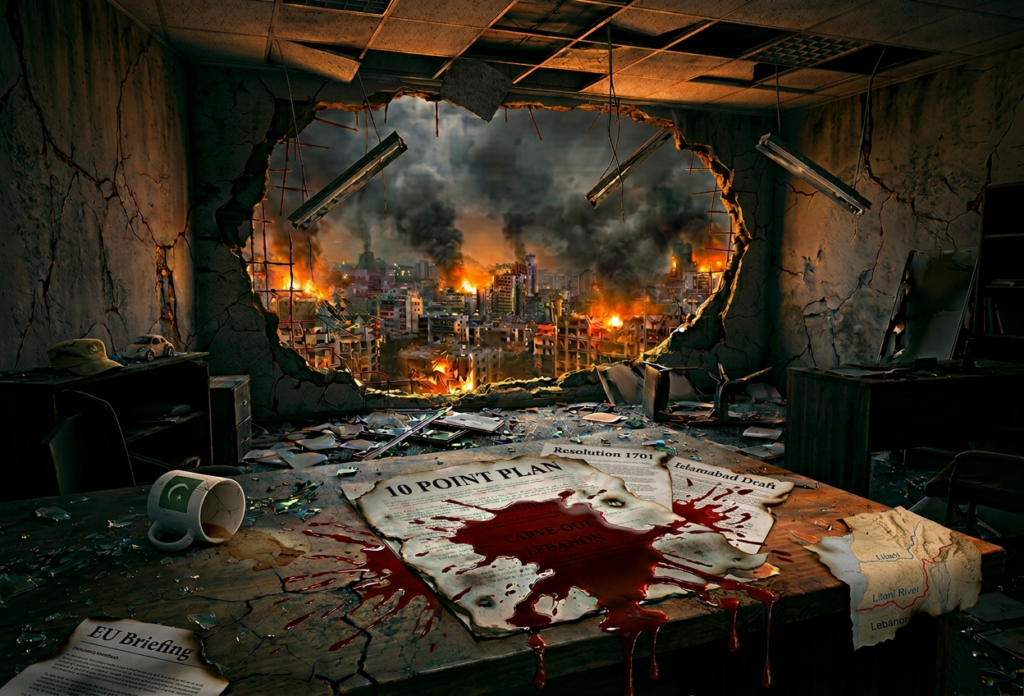
Israel didn’t just violate the ceasefire; it weaponised it, carving Lebanon out so the bombardment of an Iranian ally could continue under a US-approved diplomatic fig leaf. By torching Beirut while talks move to Islamabad, it has turned Pakistan’s mediation into a hollow spectacle and confirmed that real power still sits with those willing to bomb from outside the room. For Tehran, Lebanon is no sideshow but the red line that exposes the fraud: a “ceasefire” that shields Israel and Washington while leaving Hezbollah’s front open is not peace, but continuation of war by deception.
Within hours of a ceasefire meant to halt a regional war, Israel launched its largest airstrike campaign on Lebanon in living memory. More than 100 bombs rained down in approximately 10 minutes, targeting cities and neighborhoods far beyond Hezbollah’s known strongholds. More than 300 civilians died, according to Lebanon’s Health Ministry, while rescue teams still sift through rubble. Over 1.2 million people remain displaced.
Israel claimed it struck only Hezbollah infrastructure. Lebanese officials described indiscriminate bombing that targeted civilian areas and vital infrastructure. Pakistan, the ceasefire’s broker, said Lebanon was explicitly included. Iran said attacks on Lebanon must stop before any delegation goes to Islamabad for peace talks.
With the greatest humility, I am pleased to announce that the Islamic Republic of Iran and the United States of America, along with their allies, have agreed to an immediate ceasefire everywhere including Lebanon and elsewhere, EFFECTIVE IMMEDIATELY.
I warmly welcome the…— Shehbaz Sharif (@CMShehbaz) April 7, 2026
Netanyahu told his country there is “no ceasefire in Lebanon“ while he simultaneously announced Israel is ready for direct talks with Beirut. Smotrich insists Israel’s border must move to the Litani River. Vance tells Washington it never agreed to include Lebanon. Trump calls it a “separate skirmish.”
Europe begins to worry about another Gaza on its doorstep, and Iran smells strategic deception. Meanwhile, Pakistan’s mediation stands undermined, and Lebanon pays the price for being sacrificed so that Washington can de-escalate, while Israel preserves its freedom to expand territory and reshape the map before diplomacy can freeze the battlefield.
READ MORE: Two Occupations, One Lebanon
The Carve-Out: Lebanon Was Excluded by Design
Israel’s strike on Lebanon functioned as a way of rewriting the U.S.-Iran ceasefire by force before talks in Islamabad could give that ceasefire wider political meaning. Pakistan said Lebanon was included, but once Israel launched its assault, Trump, Vance, and Netanyahu all moved to redefine Lebanon as a separate theater, suggesting that the ceasefire was narrowed after the fact to protect Israel’s freedom of action. In that sense, Lebanon was not simply sidelined from the truce but also sacrificed to preserve an Israeli war agenda that includes continued military control in the south, and that could have been constrained by a broader U.S.-Iran understanding.

IMAGE: Emergency responders work at the site of an Israeli strike in Sidon, Lebanon, on Wednesday. (Source: Ali Hankir/Reuters)
Operation Eternal Darkness did not simply “break” a ceasefire; it exposed that the entire enforcement architecture around Lebanon had already been stripped of coercive power, allowing Israel to pick and choose which parts of the system it would obey. The November 2024 cessation of hostilities, Resolution 1701, UNIFIL monitoring, U.S.-backed enforcement mechanisms, and the new Pakistan‑brokered U.S.–Iran truce that Islamabad insisted applied to Lebanon “effective immediately”—all of it collapsed in a single wave of bombs.
The ceasefire architecture was already fractured because it rested on several overlapping layers that were not saying the same thing. When Israel launched its April 8 assault, UNIFIL was still warning that IDF movements and air activity violated Resolution 1701 and Lebanon’s sovereignty. A U.S.-led monitoring mechanism existed on paper while Israel kept bombing. Pakistan publicly defined the truce as regional, not bilateral, and tried to deny Israel the ability to keep Lebanon as a separate open front.
Israel’s carve-out of Lebanon was not only an attack on the ceasefire’s content. It was also a direct challenge to Pakistan’s authority as mediator, because a mediator who cannot define the scope of the truce is not mediating the war so much as managing its optics. Israel’s ambassador ahead of the talks said “We don’t trust Pakistan,” while Netanyahu’s office insisted that Lebanon “is not included in the two-week ceasefire,” showing that Israel wants to negotiate with Washington while denying Pakistan the role of defining the mediation’s scope.
Israel’s Foreign Minister Gideon Sa’ar publicly condemned Pakistan for claiming to mediate peace after Pakistani officials called Israel “cancerous evil,” while Netanyahu declared there is “no ceasefire in Lebanon” and insisted military operations would continue with “full force”.
Israel is not just absent from Islamabad. It is publicly calling the mediator incompetent, questioning its credibility, rejecting its language, which proves Israel is not just outside the talks but actively undermining the mediator and the scope Pakistan tried to impose.
Islamabad and the Veto Player Outside the Room
As Pakistan prepared to host U.S.-Iran talks, Netanyahu announced that Israel would open direct talks with Lebanon while continuing to bomb it, and Iranian-linked media said no delegation would go to Islamabad until attacks on Lebanon stop. The talks aim to stabilize the fragile ceasefire and explore a pathway toward a longer-term agreement after weeks of escalation across West Asia.

IMAGE: Global leaders welcome US-Iran ceasefire facilitated by Pakistan, with talks to begin in Islamabad (Source: Baluchistan Pulse)
The latest public messaging shows that the dispute is no longer only over ceasefire wording but over diplomatic legitimacy itself, with Pakistan still tied to a process whose scope Israel openly contests and Iran now treating Lebanon as a precondition for talks.
Israel is now pairing continued bombardment with talk of negotiations, while Iran is pairing willingness for diplomacy with a hard condition that Lebanon be protected first. That leaves Islamabad looking less like the start of de-escalation and more like a test of whether any diplomacy can survive while Israel keeps one front deliberately outside the ceasefire.
Israel’s absence from the Islamabad talks does not show detachment from the war’s outcome. It suggests a preference for influencing the diplomatic process from outside the room while preserving military freedom on the ground. That makes Israel less a bystander than an external veto player, able to narrow or spoil de-escalation without formally owning the negotiations.
Netanyahu welcomed the U.S. decision to halt attacks on Iran, but he made it explicit that the two-week truce “does not encompass Lebanon”, despite Pakistan’s firm position on the matter. That is a critical contradiction that cannot be ignored. He is offering talks while continuing bombardment.
From Riyadh to Damascus to Beirut, the message from Israel is unmistakable. Diplomacy must proceed on Israeli terms, and those terms include preserving the military option to reshape borders, expand so-called security zones, and punish populations while Washington negotiates with Tehran. Trump expressed that the ceasefire would be focused on Iran and America’s allies while linking it to the reopening of Hormuz. JD Vance says Washington never agreed that Lebanon was covered. This coordinative gap could suggest a serious breakdown; however, a close examination quickly reveals a hurried effort to politically ring-fence Israel’s actions after the fact.
As European countries, the UN, and rights groups focus on civilian harm, infrastructure destruction, and threats to a broader ceasefire, the narrative shifts from counter-militia warfare to regional spoiler behavior. Israel’s freedom of action depends not only on U.S. backing but also on whether European allies keep supplying diplomatic cover. The campaign may be strategically self-defeating because a war meant to weaken Hezbollah can instead weaken the Lebanese state, revive Hezbollah’s nationalist legitimacy, and narrow the diplomatic space in Europe that Israel depends on for continued political cover.
Tehran’s Red Line: Resistance Cannot Be Exchanged
If Iran believes it reached the talks from a position of endurance and deterrence, then accepting Israel’s carve-out of Lebanon would look, in Tehran’s own perspective, like surrendering one front of the resistance architecture after surviving the main war. This is clearly unacceptable for them. A red line has been drawn in the sand.
The Iranian lens does not see Lebanon as an unfortunate add-on to U.S.-Iran diplomacy. It sees Lebanon as the test of whether the ceasefire is genuine, because a ceasefire that protects Iran while leaving Hezbollah exposed would appear as strategically hollow.

IMAGE: Hezbollah supporters rally ahead of the 2022 elections, raising flags and a portrait of the group’s leader Hassan Nasrallah (Source: AFP/Getty Images)
President Masoud Pezeshkian said Israeli strikes on Lebanon violated the ceasefire and “would render negotiations meaningless,” while Iranian-linked and regional reporting said no delegation would go to Islamabad unless attacks on Lebanon stopped. Lebanon is not a secondary dispute within the peace process but a precondition for the peace process itself.
From Tehran’s perspective, Israel’s assault on Lebanon did not merely violate the spirit of the ceasefire. It has clearly exposed an attempt to preserve war through a front Washington claimed was outside the deal. The Iranian position treats Lebanon as the litmus test of U.S. good faith, because a truce that restrains Washington but leaves Israel free to hammer Hezbollah is, in Tehran’s eyes, not peace but strategic deception.
Hezbollah’s place in the crisis confirms that the so-called axis of resistance is not a rhetorical add-on to the negotiations but part of the regional balance that any durable settlement will have to reckon with. Tehran’s public line is not just that Israel violated a ceasefire. It consistently asserts the fact that Lebanon was always part of the ceasefire framework, so attacks there amount to a continuation of the war by other means.
Iranian Foreign Minister Abbas Araghchi said the ceasefire terms were “clear and explicit,” and that Washington had to choose between a real ceasefire and “continued war via Israel”. That framing matters because it casts Israel not as a separate actor with its own Lebanon file, but as the channel through which the U.S. can keep pressure on Iran while pretending to de-escalate.
Tehran repeatedly treated Lebanon as inseparable from the truce. Iranian parliament speaker Mohammad Bagher Ghalibaf said Tehran viewed Lebanon as part of the ceasefire accord. Iranian-linked reporting said halting attacks on Lebanon was one of Tehran’s key conditions for any ceasefire with Washington.
Iranian state media and public messaging framed the truce as a victory in which Washington accepted Iranian conditions, including non-aggression and broader political concessions, while street scenes in Tehran suggest celebration rather than defeat. That narrative feeds directly into the Lebanon question because if Iran believes it reached the talks from a position of endurance and deterrence, then accepting Israel’s carve-out of Lebanon would look like surrendering one front of the resistance architecture. Again, this is unacceptable for them.
The Expansion Agenda That Peace Talks Cannot Stop
Smotrich’s calls to push Israel’s border to the Litani and secure new control in Syria suggest that for influential figures inside Netanyahu’s coalition, the war is not merely about deterrence but about remaking the map before diplomacy can freeze the battlefield. Smotrich himself made the point plainly, declaring that “The Litani must be our new border” and later envisioning a “political leg” in Lebanon and Syria that would expand Israeli control beyond the current battlefield.
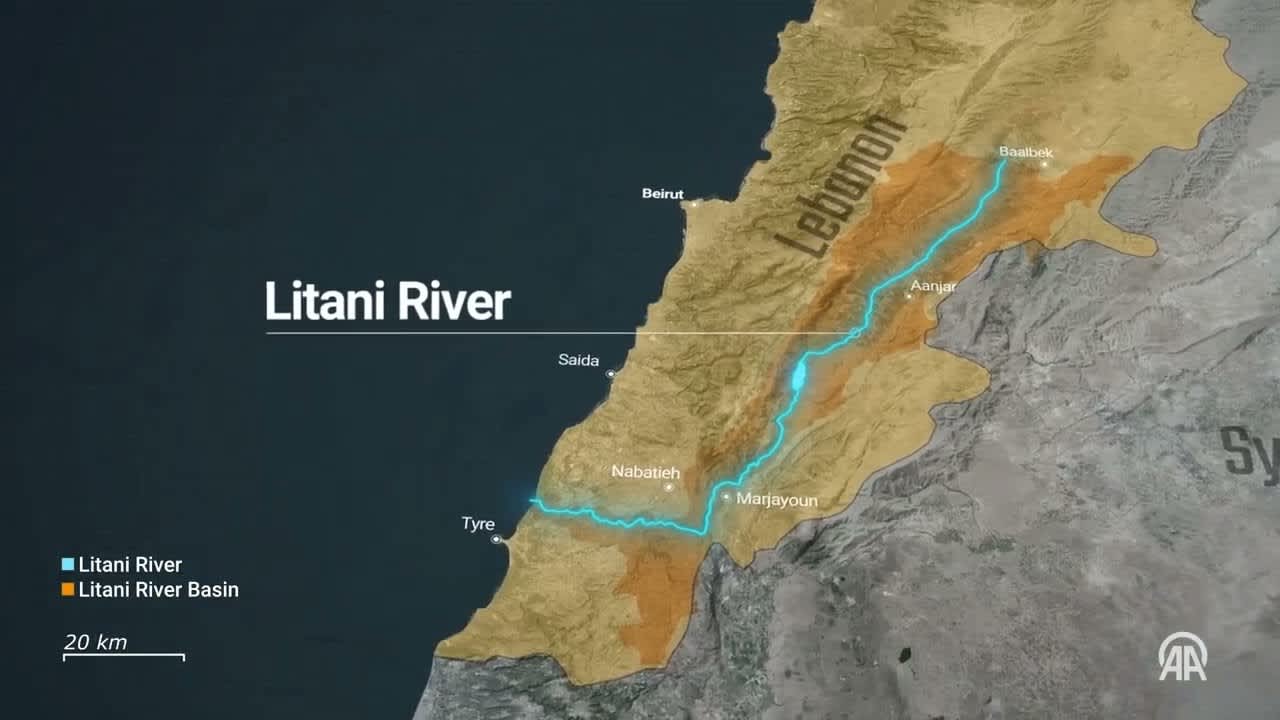
IMAGE: Litani River in southern Lebanon becomes centre of current conflict between Hezbollah and Israel(Source: Anadolu English)
Key figures in Israel’s ruling coalition appear less interested in a negotiated regional settlement than in using war to consolidate a new territorial and strategic reality in Lebanon and Syria. When a minister openly argues for moving the Lebanese border to the Litani, it becomes much harder to present Israeli operations there as purely defensive or strictly limited to neutralising Hezbollah. Who is going to believe this?
Iraq, Syria, Yemen, and Gaza all feed into this larger picture because the goal is not just to neutralize Hezbollah but to establish a new security architecture across the entire region. Netanyahu has ordered the buffer zone expanded in southern Lebanon, and Israel’s defense minister said Israel would establish a buffer zone up to the Litani River, keep security control over that area, prevent displaced Lebanese from returning south of the Litani, and demolish homes in border villages, which gives you concrete evidence of a territorial-security project extending beyond a short-term retaliatory strike.
Europe may not be nearing a moral break with Israel, but it may be nearing a cost break, where Lebanon begins to look like a “second Gaza” on Europe’s doorstep and Israel’s freedom of action starts colliding with European migration, security, and diplomatic priorities. Macron condemned the strikes “in the strongest possible terms” and called them “indiscriminate.” Belgium’s foreign minister said the ceasefire “must include Lebanon.” Spain and Slovenia, amongst others, pushed to suspend the EU-Israel Association Agreement. The European Council on Foreign Relations (ECFR) argued that the threat of a new refugee wave could push Germany and Italy toward a firmer stance.
Europe’s threshold is not primarily about moral outrage, and must be understood as the moment Israel’s Lebanon campaign begins to threaten core European interests all at once—refugee flows, the survival of the Lebanese state, the safety of UNIFIL contingents, and the viability of the U.S.–Iran ceasefire Europe is desperate to preserve.
Israel did not merely exclude Lebanon from the ceasefire. What Israel demonstrated is that every mechanism meant to protect Lebanon, from UNIFIL to Islamabad, remains subordinate to Israel’s ability to redefine the battlefield after the fact. It’s the kind of scenario that should be unthinkable, and yet it is precisely what the US and its European allies are allowing to unfold.
Lebanon’s Legitimacy Trap and Hezbollah’s Political Revival
The more Israel blurs the line between targeting Hezbollah and punishing Lebanon as a whole, the harder it becomes for the Aoun government to maintain a confrontational line against Hezbollah without undermining its own nationalist legitimacy. Israel’s conduct is creating the conditions under which Hezbollah can regain political legitimacy faster than the state can consolidate its own.
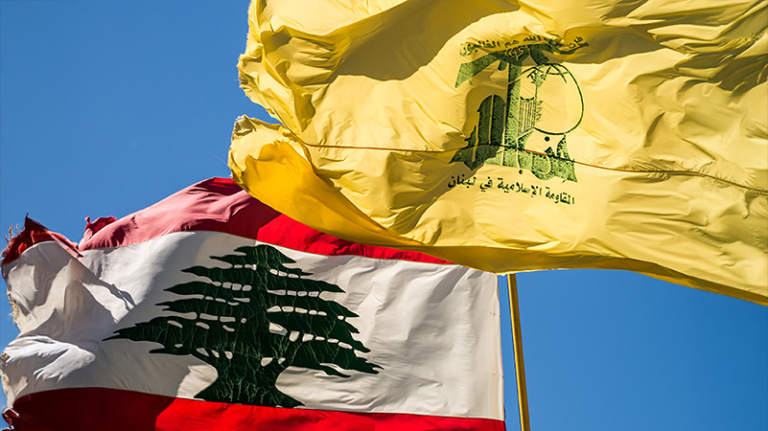
IMAGE: Lebanese flag and Hezbollah flag together, the line between state legitimacy and resistance legitimacy (Source: Arab Center Washington, D.C.)
Hezbollah said it had respected the ceasefire, described the Israeli strikes as massacres and aggression, and framed any response as a reaction to Israeli violations rather than an escalation of its own choosing. President Joseph Aoun condemned the attacks as “barbaric” and a “massacre,” while Prime Minister Nawaf Salam stressed that any ceasefire “must include Lebanon,” which places the government’s public emphasis on Israeli aggression and Lebanese protection rather than on faulting Hezbollah for provoking events. That is a notable contrast with March, when Aoun accused Hezbollah of pushing Lebanon toward state collapse and Salam described Hezbollah’s military actions as illegal acts outside state authority.
Lebanese state rhetoric and Hezbollah’s rhetoric converged far more than they did earlier because when Israel launched strikes that killed hundreds, it became harder for Beirut to foreground Hezbollah’s prior role without appearing to legitimize the assault or weaken Lebanon’s diplomatic case. In effect, the scale of Israeli violence temporarily reordered priorities. Sovereignty, civilian protection, and international intervention moved ahead of the state’s earlier effort to isolate Hezbollah politically.
But there is a trap here that cannot be escaped. Aoun’s camp was strongest when Hezbollah looked weakened, and the state looked like a plausible alternative. It becomes weaker when Israel’s war makes the state look administratively present but strategically helpless. Chatham House notes that “any Israeli occupation of southern Lebanon will work to Hezbollah’s advantage”.
The crisis is not only that Hezbollah may recover legitimacy. It is that the Lebanese state is being exposed as administratively present yet strategically absent. If it keeps foregrounding Hezbollah’s arms while failing to shield civilians from Israeli strikes, it risks looking like the custodian of a sovereignty project that cannot actually defend sovereignty. If it softens its line, it may preserve nationalist credibility in the short term, but it also hands Hezbollah a major ideological victory by implicitly validating the resistance argument.
For the Aoun government and Hezbollah, the implication is a tactical convergence without a strategic merger. The government still wants the state monopoly on arms, stronger Lebanese Armed Forces control, and international backing for sovereignty, while Hezbollah still insists on its right to resist and respond militarily. But Israel’s strikes create a short-term common front in which both can speak the language of national defense, civilian protection, and ceasefire violation.
Hundreds of thousands remain displaced. Hospitals have been bombed, bridges have been cut, and children will never know peace. The story is not just about ceasefire violations; it is also about regional power using one front to reshape an entire zone while Washington pretends to broker peace from a distance. Lebanon was sacrificed so the deal could survive. And now the deal itself is dying.
Operation Eternal Darkness did more than kill civilians. It revealed the true character of a war that never stopped, only changed partners and pretexts. Israel remains deadly serious about expansion. Washington remains deadly serious about managing decline. Iran remains deadly serious about the control of Hormuz and the safeguard of it soverignty. And Lebanon remains deadly serious about surviving it all.
READ MORE LEBANON NEWS AT: 21st Century Wire LEBANON Files
SUPPORT OUR INDEPENDENT MEDIA PLATFORM – BECOME A MEMBER @21WIRE.TV
VISIT OUR TELEGRAM CHANNEL
21st Century Wire is an alternative news agency designed to enlighten, inform and educate readers about world events which are not always covered in the mainstream media.
Source: https://21stcenturywire.com/2026/04/10/operation-eternal-darkness-and-the-ceasefire-that-never-reached-beirut/
Anyone can join.
Anyone can contribute.
Anyone can become informed about their world.
"United We Stand" Click Here To Create Your Personal Citizen Journalist Account Today, Be Sure To Invite Your Friends.
Before It’s News® is a community of individuals who report on what’s going on around them, from all around the world. Anyone can join. Anyone can contribute. Anyone can become informed about their world. "United We Stand" Click Here To Create Your Personal Citizen Journalist Account Today, Be Sure To Invite Your Friends.
LION'S MANE PRODUCT
Try Our Lion’s Mane WHOLE MIND Nootropic Blend 60 Capsules
Mushrooms are having a moment. One fabulous fungus in particular, lion’s mane, may help improve memory, depression and anxiety symptoms. They are also an excellent source of nutrients that show promise as a therapy for dementia, and other neurodegenerative diseases. If you’re living with anxiety or depression, you may be curious about all the therapy options out there — including the natural ones.Our Lion’s Mane WHOLE MIND Nootropic Blend has been formulated to utilize the potency of Lion’s mane but also include the benefits of four other Highly Beneficial Mushrooms. Synergistically, they work together to Build your health through improving cognitive function and immunity regardless of your age. Our Nootropic not only improves your Cognitive Function and Activates your Immune System, but it benefits growth of Essential Gut Flora, further enhancing your Vitality.

Our Formula includes: Lion’s Mane Mushrooms which Increase Brain Power through nerve growth, lessen anxiety, reduce depression, and improve concentration. Its an excellent adaptogen, promotes sleep and improves immunity. Shiitake Mushrooms which Fight cancer cells and infectious disease, boost the immune system, promotes brain function, and serves as a source of B vitamins. Maitake Mushrooms which regulate blood sugar levels of diabetics, reduce hypertension and boosts the immune system. Reishi Mushrooms which Fight inflammation, liver disease, fatigue, tumor growth and cancer. They Improve skin disorders and soothes digestive problems, stomach ulcers and leaky gut syndrome. Chaga Mushrooms which have anti-aging effects, boost immune function, improve stamina and athletic performance, even act as a natural aphrodisiac, fighting diabetes and improving liver function. Try Our Lion’s Mane WHOLE MIND Nootropic Blend 60 Capsules Today. Be 100% Satisfied or Receive a Full Money Back Guarantee. Order Yours Today by Following This Link.


| Visits: | 1,802,392,161 |
| Stories: | 8,633,646 |
Whistler Blowers, Insiders

