

Bolivia, Israel and the Battle for the Lithium Triangle

Freddie Ponton
21st Century Wire
Bolivia is once again at the centre of a struggle over sovereignty, resources and political power. Six months into Rodrigo Paz’s presidency, the country is being shaken by national blockades, Indigenous-led mobilisations, labour unrest, shortages, and a widening legitimacy crisis as protests have paralysed roads into La Paz, emptied markets and driven multiple sectors and unions to demand his resignation.
At the same time, Paz’s government has restored diplomatic relations with Israel, a move publicly framed as a diplomatic reset after the rupture over Gaza. Legal and business commentary has already cast that reset as a “lithium and technology alliance” between a country with vast reserves and a state marketing technological leverage in strategic sectors.

IMAGE: Argentinian President Javier Milei, Israeli Prime Minister Benjamin Netanyahu and U.S. Ambassador to Israel Mike Huckabee take part in the launch ceremony of the Isaac Accords (Source Jewish Insider)
The wider regional backdrop matters. The Isaac Accords, promoted by the Genesis Prize Foundation, are presented as a framework for deeper Israel–Latin America ties through trade, innovation and strategic cooperation. Israel also already has a foothold in Argentine lithium through XtraLit, which signed a cooperation agreement with YPF Tecnología (Y-TEC), the technology arm of Yacimientos Petrolíferos Fiscales (YPF), to analyse Argentine brines and assess direct lithium extraction projects.
Bolivia’s rightward turn and restored ties with Israel are not a routine diplomatic shift, and point to a new corridor of influence through the Lithium Triangle, where geopolitical alignment, extraction technology and control over strategic minerals now move together.
The corridor through the salt flats
Argentina, Bolivia and Chile make up the Lithium Triangle, a high-altitude belt of salt flats and basins that holds more than half of the world’s identified lithium resources according to policy and market trackers. As battery demand has surged, this geography has become a strategic battleground where states, mining firms and outside powers compete to lock in supply chains for the energy transition.
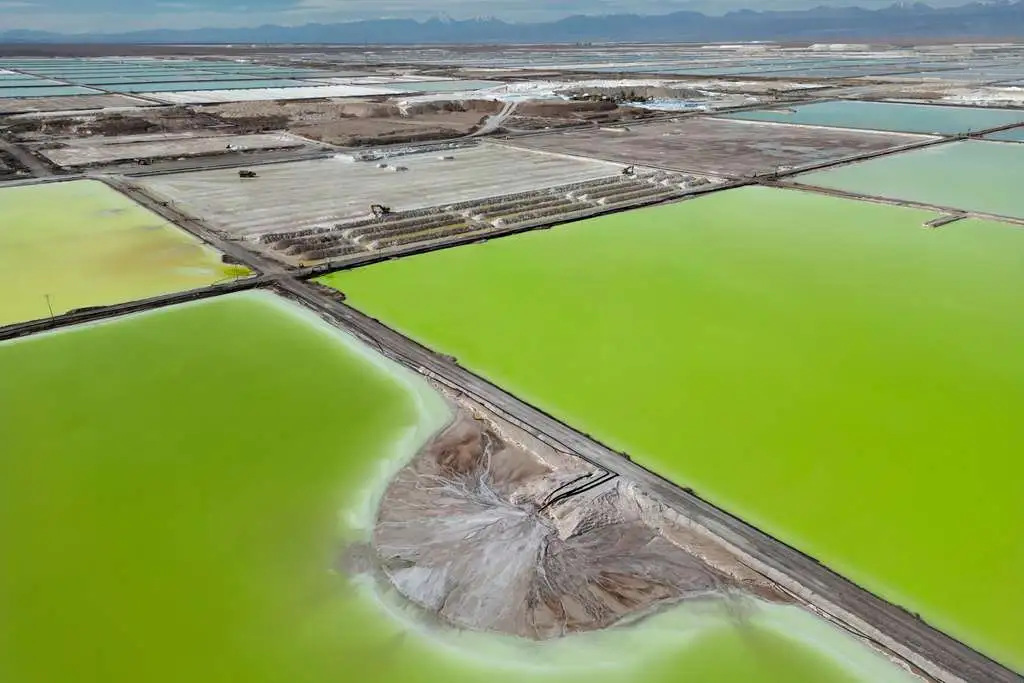
IMAGE: Brine evaporates in pools at the lithium extraction plant facilities of the SQM Lithium company near Peine, Chile, Tuesday, April 18, 2023. In the “lithium triangle” – a region spanning Argentina, Chile and Bolivia – native communities sit upon a treasure trove of the stuff: an estimated trillion dollars in lithium. (Source: AP Photo| Rodrigo Abd)
That race carries real social and ecological costs. Rights groups and legal reporting have warned that the scramble for transition minerals in the Triangle threatens water systems, fragile ecosystems and Indigenous communities whose territories are routinely treated as expendable in the push for extraction. In Bolivia, those tensions have sharpened around lithium projects challenged by Indigenous communities over environmental risk, consultation and territorial control.
Israel’s clearest entry point into this landscape runs through Argentina. In May 2025, Y-TEC and XtraLit announced a cooperation agreement to study Argentine brines and evaluate the feasibility of deploying XtraLit’s direct lithium extraction technology in the country. Argentine business coverage described the deal as part of a broader effort to scale Israeli extraction technology in Argentina’s lithium sector.
For Bolivia, the point is simple, primarily because Israel is already present in the Triangle as more than a diplomatic actor. The combination of XtraLit’s Argentine agreements, the Isaac Accords’ strategic language and Paz’s restoration of ties with Israel creates a working model of what an Israel-linked lithium relationship looks like on the ground. When later commentary described the Bolivia–Israel reset as a lithium-and-technology alliance, it was reading forward from a regional pattern that was already visible across the border.
The Isaac Accords are officially presented as a platform for deepening Israel’s ties with Latin America through trade, innovation, energy and security cooperation. Underneath that language sits a harder strategic logic: access, influence and positioning in a region that contains one of the world’s most concentrated lithium zones.
That is what makes Bolivia central to the new alignment. Once Paz restored diplomatic relations with Israel in December 2025, after Gideon Sa’ar and Fernando Aramayo signed the agreement in Washington, Bolivia ceased to be merely a holdout and became a plausible extension of the same Southern Cone corridor already taking shape in Argentina. Bolivia is not a formal signatory to the Isaac Accords, but the framework’s promoters have openly cast Latin America as an expanding field for Israel-aligned partnerships in innovation, commerce and security.
From the perspective of Indigenous communities, none of this is abstract. Each step in the corridor expands the number of outside actors seeking access to territories where battles over water, consultation and sovereignty are already underway. The corridor runs through ministries, companies and foreign-policy forums, but its endpoint lies in the salt flats themselves.
The Isaac playbook comes to Bolivia
The Isaac Accords project emerged as a political framework for presenting closer Israel–Latin America ties through the language of innovation, economic cooperation and shared strategic interests. Its backers describe it as a vehicle for trade, technology transfer and security coordination with governments seen as open to deeper alignment with Israel and the West.
Beneath that language is a harder material logic. Commentary promoting the Accords places heavy emphasis on access to resource-rich partners, supply-chain positioning and the geopolitical value of sectors tied to energy and advanced technology. In practice, the framework ties commercial, diplomatic and strategic relations more tightly in a region where minerals, infrastructure and political alignment increasingly converge.

IMAGE: Israeli Foreign Minister Gideon Sa’ar (left) and Fernando Aramayo, Bolivian foreign minister, sign an agreement to renew bilateral relations, at the Israeli ambassadorial residence in Washington, Dec. 9, 2025. (Source: Menachem Wecker)
The logic sharpens in South America’s lithium belt. The International Bar Association and industry trackers alike describe the Lithium Triangle as one of the most important reserve zones for the future battery economy. Any framework that seeks to deepen Israeli ties in that geography is therefore operating in a region whose importance goes far beyond diplomacy.
Here, the Isaac narrative merges with the lithium story. Israel is presented as a technologically advanced but resource-poor state; Latin American partners are presented as resource-rich economies that can be drawn into a common architecture of innovation, trade and strategic cooperation. Once lithium enters that equation, the language of partnership moves away from abstract diplomacy and reveals a strategic route into critical minerals positioning.
Bolivia is not a formal signatory to the Isaac Accords. Even so, the same networks promoting the framework have openly treated Paz’s rise and the restoration of ties with Israel as part of a broader regional opening. It places Bolivia inside the political horizon of the Accords even without formal accession.
Paz’s government has been positioned by Isaac backers as a future node in the same corridor, while domestically pursuing reforms that soften the ground for private and foreign penetration of strategic sectors. In that sense, Bolivia does not need to sign the Isaac Accords to begin moving inside its strategic orbit.
Washington’s reset and the men behind it
Bolivia severed diplomatic relations with Israel in 2023 after the assault on Gaza, and that freeze ended only after the election of Rodrigo Paz Pereira, who entered office promising a reopening of Bolivia to the world after nearly two decades of rule by the Movimiento al Socialismo (Movement Toward Socialism – MAS).

IMAGE: Presidents Donald Trump, right, and Rodrigo Paz pose for a photo at the“Shield of the Americas” Summit at Trump National Doral on March 7, 2026 (Source: Saul Loeb/AFP/Getty Images)
The diplomatic reset moved quickly. According to Israel’s Foreign Ministry, Sa’ar spoke with Paz the day after he was elected to open what both sides described as a new chapter in relations. In December 2025, Sa’ar and Aramayo signed the agreement in Washington, restoring ties, while Bolivia also moved to lift visa requirements for Israeli travellers.
The reset did not pass through a broad state apparatus. It was carried by a narrow cluster of political actors: Bolivian President Paz at the top, Aramayo on the diplomatic side, and a small Israeli team built around Sa’ar and Eden Bar-Tal, the director-general of Israel’s foreign ministry, who represented Israel at Paz’s inauguration. That concentration made it easier to deepen the relationship from above, through executive channels and without any broad social consensus.
Publicly, the language was conventional, sweetened by words like friendship, cooperation, reopening, and modernisation, but there was nothing neutral about the context. A government elected on a pro-business platform was rebuilding ties with Israel while also seeking deeper engagement with Washington, private capital and foreign investors across strategic sectors. The diplomatic reset sat inside a larger economic and geopolitical reorientation, and not apart from it.
The reset runs through a handful of people, not institutions. On the Bolivian side, that means Paz, foreign minister Fernando Aramayo and economy minister José Gabriel Espinoza; on the Israeli side, Gideon Sa’ar and Eden Bar-Tal. Taken together, they form the narrow interface between Bolivia’s executive and Israel’s foreign-policy machine, where talk of a “new chapter” becomes concrete channels for Israeli capital and technology in strategic sectors. These are the same actors who were hosted in Israel by AIPAC in December 2025.
We were honored to host Bolivian Foreign Minister Aramayo and Economy Minister Espinoza after Bolivia and Israel restored full diplomatic relations.
This is an important step for U.S. interests and cooperation with our allies in Latin America and the Middle East.@MRE_Bolivia https://t.co/mbc5vzTBwS
— AIPAC (@AIPAC) December 10, 2025
That wider meaning became clearer in the commentary surrounding the reset. The relationship was explicitly described in legal and business analysis as a lithium-and-technology alliance, with Bolivia cast as a resource giant and Israel as a technological partner stepping into a newly opened field. The argument relied on a familiar sequence: Bolivia has immense lithium reserves, earlier Chinese and Russian projects were suspended after Indigenous legal challenges, and the new government quickly reoriented the country toward friendlier ties with Western and Israeli partners.
Seen in that light, the move no longer appears as an organic small course correction in foreign policy; instead, it reveals the political shell for going back into lithium, this time, with another set of sponsors.
José Gabriel Espinoza’s presence at the Washington signing, alongside the foreign ministers, was one of its most revealing details. José Gabriel Espinoza, Bolivia’s economy and finance minister, was not there by accident. His inclusion showed that the reset was never only diplomatic. Economic policy sat at the centre of the relationship from the start.
Any future lithium arrangement, direct investment, technology partnership or fiscal accommodation for foreign capital runs through the state’s economic machinery. A finance minister standing inside the diplomatic choreography tells investors and foreign partners that the gatekeepers of macroeconomic policy are part of the same project. In other words, Espinoza stands at the point where foreign policy, fiscal adjustment and strategic-sector reform begin to converge. In a government promising lower taxes, investment-friendly reforms and a reopening to the world, the finance ministry becomes one of the central channels through which diplomatic alignment is translated into material opportunity.
That is what made his presence at the signing politically meaningful. It suggested that the Bolivia–Israel reset was being built not simply as a symbolic restoration of ties, but as part of a wider architecture linking diplomacy, investment climate and access to strategic sectors.
Privatisation, resistance and the battle for YLB
Paz entered office promising “capitalism for all”, but the government’s economic direction quickly aligned with a broader push to reopen strategic sectors to foreign capital and unwind Bolivia’s more protectionist approach to lithium. Reporting in early 2026 showed the new administration moving to reassure investors, honour existing energy and lithium contracts, and draft new legal frameworks to attract deeper private participation.
That shift has unfolded inside a country already under severe strain. Mass protests, blockades, fuel shortages and worsening shortages of basic goods have pushed Bolivia into a permanent state of political crisis, with La Paz repeatedly cut off and the government facing demands for resignation from a widening social coalition. The result is not simply economic instability. It is a confrontation between a government trying to reassert technocratic control from above and a social base that sees privatisation, exclusion and austerity as a direct attack on the gains of the previous era. Evo Morales, the former president of Bolivia, along with his supporters, has presented a 90-day ultimatum to President Rodrigo Paz’s government. They are calling for new elections or the resignation of the Paz administration, cautioning that they will escalate their actions if their requests are not met.

IMAGE: Work is progressing on the lithium carbonate industrial plant in Uyuni, originally planned for 2018 and built by Chinese company Beijing Maison Engineering (Source: YLB)
The sharpest challenge to Bolivia’s lithium agenda came from Indigenous communities and local organisations that took Chinese- and Russian-linked projects to court. In 2025 and 2026, legal complaints filed in the Potosí region led courts to suspend major lithium projects involving CBC, a Chinese consortium that includes battery manufacturer CATL, and Russia’s Uranium One Group, a subsidiary of Rosatom, after communities argued that the projects violated environmental rights and advanced without formal consultation or respect for free, prior and informed consent (FPIC).
Those rulings did more than delay two foreign-backed projects. They reopened the central political question of who gets to decide what happens in Bolivia’s salt flats, on whose terms, and with what protections for water, land and community life. For the communities involved, this was never a dispute over which foreign bloc should win the contract. It was a fight over whether Indigenous territory could once again be treated as an expendable zone for outside extraction.
The fight exposed how legally and environmentally fragile the state’s lithium push had become. Yacimientos de Litio Bolivianos (YLB), Bolivia’s state-owned lithium company, and the Ministry of Hydrocarbons and Energy were explicitly barred by the court from taking further administrative or operational steps on the challenged contracts while the judicial process continued. In political terms, the litigation showed that the greatest obstacle to a rapid lithium opening was not technical capacity but organised resistance from below.
In March 2026, Yacimientos de Litio Bolivianos (YLB) put Sergio Soliz Gómez in charge as executive president, a lawyer with more than two decades in hydrocarbons, mining and industrial law rather than a lithium technologist. His appointment drew immediate fire from opposition deputies and regional civic leaders, who vigorously questioned why a lawyer was running the state lithium company and accused the government of rewarding political allies instead of strengthening technical leadership.
In April 2026, Paz removed hydrocarbons minister Mauricio Medinaceli and swore in Carlos Marcelo Blanco Quintanilla as the new hydrocarbons minister, in the middle of a fuel crisis and a scandal over low‑quality imported gasoline. Blanco, previously vice-minister of Electricity and Renewable Energies, took the post with a mandate to push a new hydrocarbons law “to attract investment” and to move forward with legislation on lithium and renewables, tightening the link between energy policy and the reopening of strategic sectors to private and foreign capital.
Sergio Mario Rodrigo Soliz Gómez, the newly appointed executive president of YLB in March 2026, now reports directly to hydrocarbons minister Carlos Marcelo Blanco Quintanilla. With Espinoza at the economy ministry, Blanco over hydrocarbons and Soliz at YLB, the core of Bolivia’s energy and lithium policy now sits with a tight pro‑business circle inside Paz’s government that has already positioned itself as the main counterpart for Israel and other external partners.
Set against José Gabriel Espinoza’s role at the Washington signing and his place in the government’s investor‑reassurance drive, Soliz’s arrival at YLB makes clear that the crucial points in Bolivia’s lithium chain are being handed to trusted lawyers and macro‑managers inside Paz’s circle, the same layer that has positioned itself as Israel’s counterpart in the country. Espinoza handles the fiscal and diplomatic pitch to foreign partners, while Soliz now runs the state company that signs and executes the deals, giving this network control over both the financial and operational interface with external actors.
Control over Yacimientos de Litio Bolivianos (YLB), Bolivia’s state lithium company, is the practical hinge between diplomatic realignment and extraction on the ground. The company remains the formal public vehicle for lithium development, but the surrounding policy direction has shifted toward a more investment-friendly model in which foreign partnerships, negotiation agreements and revised legal frameworks are expected to play a larger role, and more than likely benefit Israel.
The shift is significant because YLB no longer operates in the political atmosphere that once defined Bolivia’s resource nationalism. In 2025, YLB signed deals with Chinese and Russian companies for industrial lithium carbonate plants in Potosí, but those contracts were then thrown into legal and political uncertainty by Indigenous challenges, court suspensions and the arrival of a government openly seeking a less protectionist approach. What is at stake now is not YLB’s ownership status on paper, but the way it is being used as a storefront for a new wave of external partners.
Once a state lithium company begins operating inside a framework built around investor reassurance, legal redesign and diplomatic realignment, its public status alone tells you very little about who is steering the process or in whose interests it is being steered.
Lawfare, repression and the sovereignty question
As the crisis deepened, the Paz government and its allies reframed protest as a security threat rather than a social uprising. Mainstream coverage of the unrest shows a government confronting road blockades, miners’ marches and growing mobilisation in La Paz while accusing unnamed “dark forces” and, at times, figures around Evo Morales, of trying to destabilise the state. Once dissent is coded as sabotage, insurgency or criminal conspiracy, repression can be sold as democratic defence rather than political choice. and when Israel publicly praises Paz as a “legitimate and democratically elected” leader and backs his violent repression campaign against “riots” and “road blockades” at the exact moment prosecutors are charging strike leaders with terrorism and financing terrorism, the Bolivia–Israel axis convenienly helps recast a social uprising as a security problem to be managed.

IMAGE: Followers of Bolivia’s influential ex-President Evo Morales on Monday joined a protest movement fueled by the nation’s worst economic crisis in a generation. (Source: AP Video: Carlos Guerrero)
The treatment of protest leaders and labour organisers follows the same logic. Reporting by journalist Ollie Vargas pointed to orders against strike leaders and warnings that security forces had been told to prepare live ammunition against an Indigenous long march, while social media documentation and regional reporting described arrests and terrorism-related accusations directed at sectors involved in the broader anti-government mobilisation. Even where reporting remains fragmented, the direction is disambiguous. The state is pushing social conflict out of politics and into the language of policing, emergency and counter-subversion.
Evo Morales Ayma, Bolivia’s former president, longtime coca growers’ leader and the central figure of the MAS era, still occupies a singular place in the country’s political imagination even after the fragmentation of the left and the erosion of his own national reach. He remains useful to the government precisely because he is weaker than before, but still politically useful as a target. His capacity to mobilise beyond his strongest bastions has diminished, yet he still commands a loyal base, retains symbolic authority across parts of the popular movement, and gives the ruling bloc a familiar figure onto whom it can project the entire crisis.
Reported threats against him are politically motivated, beyond his personal fate. The BBC documented the looming arrest-warrant battle around Morales and the warning from his supporters that the country could be disrupted if he were detained, while Anadolu Agency reported that his supporters vowed national “insurgency” after a 2026 arrest order. South American journalist Ollie Vargas posted on X what appears to be authentic official arrest warrants issued against strike leaders that reflect the Paz government’s real legal strategy of using terrorism-related charges against protest organisers
Bolivia’s government has ordered the arrest of all the main leaders of the indigenous movements and mineworkers unions.
They’re being charged for Terrorism for having organised the general strike against hunger. Strike continues regardless, now in day 7. pic.twitter.com/5ISk3KPb68
— Ollie Vargas (@Ollie_Vargas_) May 19, 2026
Ollie Vargas has also shared on X documents about an operation to abduct or kill Morales, which strongly suggests that for Paz, Morales is dangerous not only for what he can still organise, but because his survival as a political symbol keeps alive the memory that Indigenous and working-class sectors once governed the state and could do so again.
BREAKING: US armed forces & Bolivian police are preparing a joint operation to kidnap Evo Morales and massacre the indigenous communities in the vicinity.
Police officers opposed to the plan have leaked documents confirming the operation. pic.twitter.com/ZFvK7ggwMn
— Ollie Vargas (@Ollie_Vargas_) May 16, 2026
Sovereignty in Bolivia has never meant only formal control over territory or diplomatic recognition. It has meant the unfinished effort to build a state in which Indigenous majorities, workers and peasant communities could impose limits on elite rule and on foreign control over strategic resources. The struggle over lithium now tests whether those limits still hold under a government openly repositioning Bolivia toward private capital, Western diplomacy and a friendlier climate for foreign extraction.
All the major elements of the current alignment point in the same direction. The Isaac Accords, Israel’s foothold in Argentine lithium through XtraLit, the restoration of Bolivia–Israel ties, the legal redesign of the lithium sector and the criminalisation of protest all fit within a wider resource order in which strategic minerals are secured through a fusion of diplomacy, technology, capital and security language. In that order, Indigenous Bolivia is not meant to govern the transition. It is expected to absorb it.
If that corridor consolidates, Bolivia will not merely have changed partners. It will have moved deeper into a regional architecture in which lithium, geopolitical alignment and domestic coercion reinforce one another. The fight over Uyuni is not a local quarrel over lithium licences, but a front in a longer Indigenous struggle for territorial sovereignty and the right to defend water and habitat against yet another round of extractive “modernisation.” In this round, the risk does not come only from the usual corporations but from a new political architecture in which Israel, under US‑backed Isaac accords, moves into South America as a security and technology partner while a narrow Bolivian elite club positions itself as its broker. That alliance deserves the same scrutiny as any other project of external control, where every promise of investment sits beside the likelihood that corruption, dispossession and criminalisation of Indigenous resistance will once again be the real price of “partnership.”
21st Century Wire is an alternative news agency designed to enlighten, inform and educate readers about world events which are not always covered in the mainstream media.
Source: https://21stcenturywire.com/2026/05/21/bolivia-israel-and-the-battle-for-the-lithium-triangle/
Anyone can join.
Anyone can contribute.
Anyone can become informed about their world.
"United We Stand" Click Here To Create Your Personal Citizen Journalist Account Today, Be Sure To Invite Your Friends.
Before It’s News® is a community of individuals who report on what’s going on around them, from all around the world. Anyone can join. Anyone can contribute. Anyone can become informed about their world. "United We Stand" Click Here To Create Your Personal Citizen Journalist Account Today, Be Sure To Invite Your Friends.
LION'S MANE PRODUCT
Try Our Lion’s Mane WHOLE MIND Nootropic Blend 60 Capsules
Mushrooms are having a moment. One fabulous fungus in particular, lion’s mane, may help improve memory, depression and anxiety symptoms. They are also an excellent source of nutrients that show promise as a therapy for dementia, and other neurodegenerative diseases. If you’re living with anxiety or depression, you may be curious about all the therapy options out there — including the natural ones.Our Lion’s Mane WHOLE MIND Nootropic Blend has been formulated to utilize the potency of Lion’s mane but also include the benefits of four other Highly Beneficial Mushrooms. Synergistically, they work together to Build your health through improving cognitive function and immunity regardless of your age. Our Nootropic not only improves your Cognitive Function and Activates your Immune System, but it benefits growth of Essential Gut Flora, further enhancing your Vitality.

Our Formula includes: Lion’s Mane Mushrooms which Increase Brain Power through nerve growth, lessen anxiety, reduce depression, and improve concentration. Its an excellent adaptogen, promotes sleep and improves immunity. Shiitake Mushrooms which Fight cancer cells and infectious disease, boost the immune system, promotes brain function, and serves as a source of B vitamins. Maitake Mushrooms which regulate blood sugar levels of diabetics, reduce hypertension and boosts the immune system. Reishi Mushrooms which Fight inflammation, liver disease, fatigue, tumor growth and cancer. They Improve skin disorders and soothes digestive problems, stomach ulcers and leaky gut syndrome. Chaga Mushrooms which have anti-aging effects, boost immune function, improve stamina and athletic performance, even act as a natural aphrodisiac, fighting diabetes and improving liver function. Try Our Lion’s Mane WHOLE MIND Nootropic Blend 60 Capsules Today. Be 100% Satisfied or Receive a Full Money Back Guarantee. Order Yours Today by Following This Link.


| Visits: | 1,815,045,238 |
| Stories: | 8,660,333 |
Whistler Blowers, Insiders

