

Germany Becomes A Ukraine War Lab, and a Staging Ground For a Forever War On Russia

Freddie Ponton
21st Century Wire
In February, under the white light of a Bavarian assembly hall, Ukrainian President Volodymyr Zelensky and German Defense Minister, Boris Pistorius, walked past rows of unfinished drones. The joint venture hosting them, linking Germany’s Quantum Systems with Ukraine’s Frontline Robotics, is already producing aircraft for Ukraine, plans to scale toward 10,000 units a year, and has already sent its first batch east. This is what Berlin now calls support for Ukraine, not crates on a runway, not old equipment hauled out of Bundeswehr depots, but German soil giving Ukrainian war design an industrial home.
For years, German officials sold their Ukraine policy in the language of restraint, solidarity and defensive necessity, but today, that language is buckling under what Berlin is now doing in plain sight. Germany has signed onto Ukraine’s defence innovation platform, opened itself to battlefield-data sharing, backed joint ventures that turn Ukrainian combat know-how into German-produced drones and robots, and committed itself to work on long-range strike systems with a reach of up to 1,500 kilometres. The result is no longer the picture of a cautious donor helping from a distance. It is a state folding Ukraine’s war labs into its own industrial base and building the rear area of a long war against Russia on German territory.
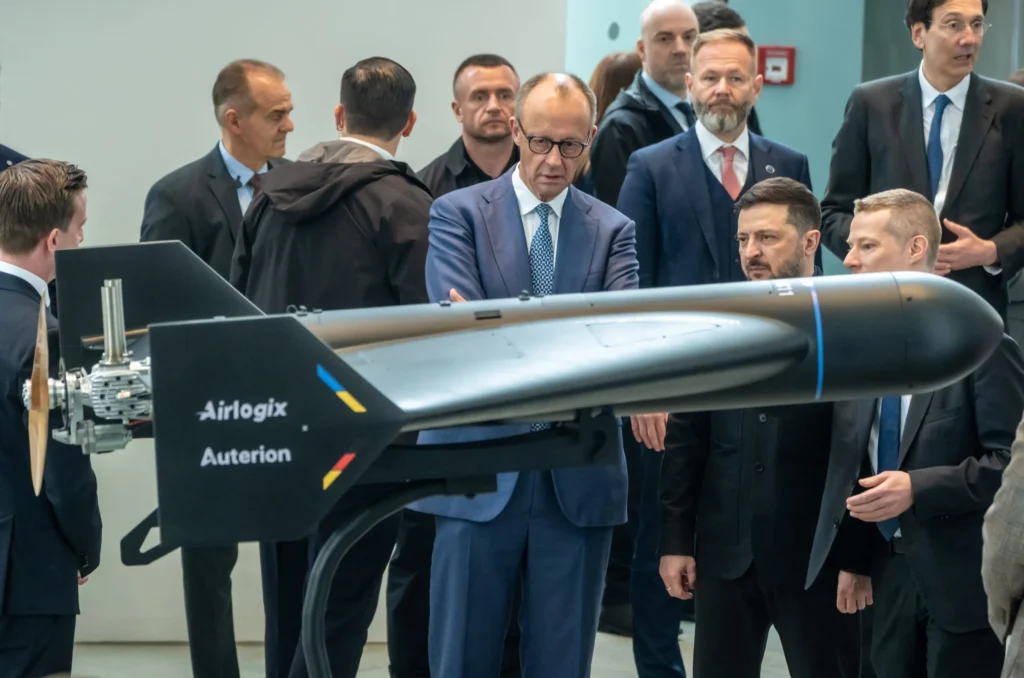
IMAGE: Auterion CEO Lorenz Meier, Airlogix CEO Vitalii Kolesnichenko, Ukrainian President Volodymyr Zelenskyy, and German Chancellor Friedrich Merz with an Airlogix autonomous strike system. (Source: Auterion)
Germany Becomes the Factory Floor
The Munich drone line strips away the euphemism. Ukraine is not simply receiving German kit from stockpiles. Ukrainian battlefield-proven designs, software and operational lessons are being fused with German capital, German factory capacity and German political cover inside ventures built to scale weapons production for a war Berlin still insists it is not fighting. The Auterion-Airlogix Joint Venture GmbH makes the point even more bluntly. Registered in Germany and launched in February, it combines Airlogix’s battle-tested Ukrainian UAV platforms with Auterion’s autonomy software and is meant to produce thousands of autonomous, combat-ready systems in Germany for the Ukrainian armed forces. Every time Ukrainian engineers find a way through Russian jamming or air defences, German industry is there to absorb the lesson and turn it into volume.
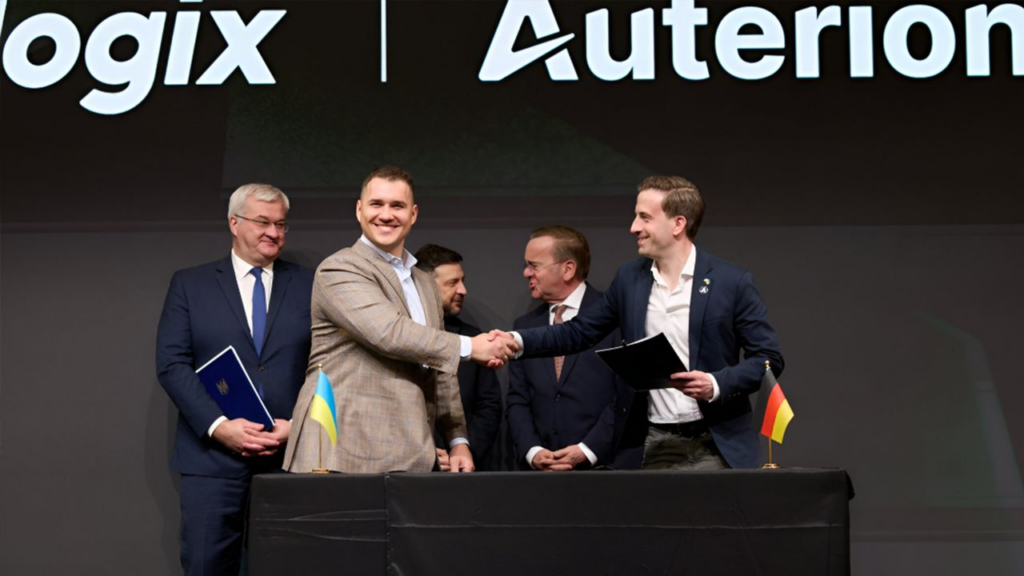
IMAGE: During the Munich Security Conference, Auterion (Germany) and Airlogix (Ukraine) announced the launch of Auterion Airlogix Joint Venture GmbH – February 2026 (Source: Airlogix)
The named systems give the arrangement a harder outline. During Zelensky’s Berlin visit in April, Germany and Ukraine signed an implementation arrangement under their October 2025 defence-industry agreement covering the joint production of the unmanned systems Anubis and Seth-X-G, with a contract value of €281 million. Anubis has been described as a heavy AI-guided deep-strike system with a range in the 1,500 to 1,600 kilometre band and a 45 kilogram warhead, while Seth-X is designed for attack missions in heavily contested environments. Production is planned in the thousands under German-backed joint-venture arrangements. Once those names are on the table, the fiction that Berlin is merely helping Ukraine hold the line becomes harder to maintain.
The War Lab Crosses the Border
Brave1 sits at the centre of this arrangement. The Ukrainian cluster was built to connect front-line units, developers, testing and procurement into a single accelerated loop, a wartime incubator where battlefield experience is turned into new weapons and quickly sent back to the field. Brave Germany is the moment that loop jumps the border. Pistorius announced that Berlin would join Brave1 to support defence innovation, while Ukraine Defense Minister Mykhailo Fedorov hailed the initiative as a deepening of a partnership that already accounts for roughly a third of the security support reaching Ukraine. The most revealing line did not come from any grand strategic declaration. Pistorius said promising systems could be funded through the platform so they could be deployed early on the battlefield to test their effectiveness. In the brochures, this is presented as innovation, but in reality, it is nothing short of a war-lab pipeline.

The April defence-data memorandum made the same reality harder to disguise. Germany and Ukraine agreed on a framework for exchanging defence-related data and cooperating on AI and weapons systems, giving German partners access to battlefield information drawn from DELTA and other Ukrainian military platforms so AI models can be trained, analytical tools refined and German systems evaluated under real combat conditions. Fedorov called it the first project of this scale in the world focused on defence-related artificial intelligence solutions. Specialist reporting on the agreement makes the picture even more concrete. The data stream includes real-time battle management inputs, strike tracking and large annotated datasets generated from thousands of combat flights and ground engagements, exactly the kind of material AI developers rarely receive in peacetime. Ministries prefer to present this as digital cooperation, but in plain language, Germany is plugging parts of its defence industry into a live feed from the war.
The venture network spreading out from that data stream already has recognizable shapes. In the air, Quantum Systems and Frontline Robotics are scaling drone production in Germany for Ukrainian use. Auterion and Airlogix are building autonomous strike systems in Germany for Ukrainian deployment. On the ground, ARX Robotics has secured a major Ukrainian order for hundreds of GEREON unmanned vehicles, multiplying Ukraine’s fleet fivefold and helping create what the company itself called the world’s largest connected military robot fleet. Quantum Systems has also announced additional German-Ukrainian ventures in interceptor drones and unmanned ground systems, widening the model beyond one class of drone and one phase of the war. The industry council in Kyiv described six such agreements as the practical implementation of the Build with Ukraine model, where Ukrainian solutions are scaled with European industry on joint production sites and with access to new manufacturing capacity. At this point, it makes less sense to speak of German aid to Ukraine than of a shared war industry with two postal codes.
Rearming the State for a Long War
On 13 April, Germany and Ukraine agreed a defence cooperation package worth around €4,7 billion, bundling several hundred Patriot missiles, 36 IRIS-T launchers, €300 million for long-range attack capabilities and the first phase of a plan to jointly produce about 5,000 AI-enabled medium-range attack drones under the Build with Ukraine initiative. Fedorov said the package rested on three key pillars: air defence, long-range capabilities and joint drone production. Berlin is financing the shield, the spear and the factory line at the same time.
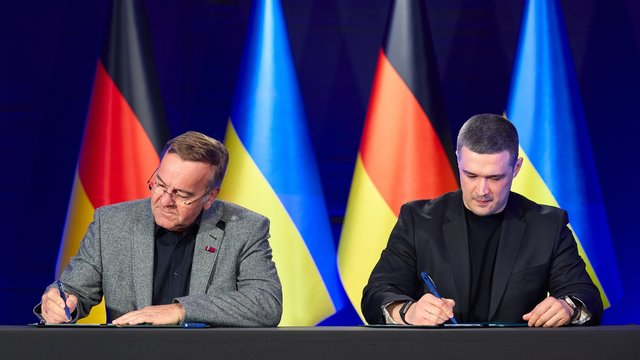
IMAGE: 11 May, 2026 – Ukrainian Defense Minister Mykhailo Fedorov and German Defense Minister Boris Pistorius signed a Letter of Intent between the ministries on cooperation in the field of defense technology innovation.
The long-range component wrecks the official fairy tale most completely. Pistorius said Germany and Ukraine intend to jointly develop and produce drones of different ranges, including long-range drones with a radius of up to 1,500 kilometres. Reporting tied the April package and the talks that followed to deep precision strike capabilities beyond 500 kilometres and to systems meant to suppress Russian air defences and hit strategic targets far behind the front. From eastern Ukraine, a 1,500 kilometre arc reaches oil terminals on the Black Sea, fuel depots deep in western Russia and air bases that once felt well outside the war’s immediate geography. Once Berlin commits money, factories and political backing to systems like that, the claim that Germany is only helping defend Ukrainian territory stops being serious.
In April, Pistorius placed state doctrine on top of this industrial shift. The new Bundeswehr military strategy, sold under the mild title Verantwortung für Europa, names Russia as the primary threat and sets a clear ambition. Germany is meant to field the strongest conventional military power in Europe. The plan calls for 260,000 soldiers in uniform and another 200,000 in reserve, roughly 460,000 combat-ready personnel in all. Its priorities are long-range precision strike, advanced air and missile defence, drone warfare, cyber operations, AI-enabled command systems and a reserve structure able to support Germany’s role as the logistical hinge for allied forces moving east in a crisis.
DOCUMENT: The overall concept of military defence – Military Strategy and Plan for the Armed Forces – Responsibility for Europe|Verantwortung für Europa) (Source Bundeswehr, Germany)
Responsibility for Europe
That logistics role is not theoretical. Reporting on Operation Plan Germany (OPLAN DEU), Germany’s 1,200-page war plan, describes Berlin as the transit and staging ground through which hundreds of thousands of NATO and U.S. troops would flow east in the event of a large war with Russia. Germany is being built not only as an industrial rear area, but as the land bridge and organisational spine of a continental conflict.
DOCUMENT: Brochure on Operation Plan Germany (OPLAN DEU / Operationsplan Deutschland) – (Source: Bundeswehr|Germany)
OPERATIONS PLAN FOR GERMANY
Seen next to this strategy, the drone ventures no longer appear as isolated contracts. Berlin is enlarging its army, rebuilding its reserve base, preserving the legal machinery of conscription, hard-wiring itself into Ukraine’s battlefield innovation loop and scaling domestic production of systems that can sustain a long confrontation with Russia. In other words, this is a rearmament that has learned the language of startups and innovation hubs.
On paper, conscription is gone, but in the law, it has been sitting there the whole time. The Library of Congress notes that conscription was suspended in 2011, not abolished, which meant there was no need to amend the Basic Law, and the system can be reactivated at any time. Article 12a still allows men over eighteen to be required to serve in the armed forces. The new military service model introduced in late 2025 keeps formal service voluntary while requiring young men to register and undergo assessment, and it was deliberately structured so compulsory service can be restored quickly if recruitment targets are missed. The legal shell is already standing, and Berlin is only arguing about when to fill it.
The numbers reinforce the point, while the opening phase of the new strategy runs through 2029 and is meant to drive rapid growth in readiness and personnel. German and foreign reporting make clear that Germany’s rearmament plan foresees growth on both the military and civilian sides of the Bundeswehr. The army is supposed to expand from roughly 186,000 troops today to at least 260,000 professional soldiers by the mid‑2030s. Over the same period, the reserve component is meant to rise from about 70,000 to no less than 200,000 people. It is no longer possible to interpret these numbers without recognizing the language of a country settling onto a war footing and teaching its public to treat that posture as normal.
Memory, Targets, and the Return of German Power
There is a reason Moscow does not read these developments as harmless bureaucracy. Sergei Lavrov called Germany’s plans to build the strongest army in Europe very worrying and tied them directly to the world wars of the twentieth century. Russia’s Defence Ministry then published lists of European drone firms and facilities, including German-linked addresses, as potential targets, while Dmitry Medvedev said those lists should be understood literally as possible targets for Russian forces depending on what came next. He had already warned that German plants producing long-range weapons for Ukraine would be legitimate targets.
In much of the Western press, this was treated as one more theatrical outburst from Moscow. However, that reading becomes harder to sustain once German factories are producing autonomous strike systems for the Ukrainian military and German ministers are publicly backing long-range drone projects measured in four digits.

IMAGE: The Banner of Victory on the Reichstag building in Berlin, May 1, 1945 (Source: Gateway to Russia)
Around 27 million people from the Soviet Union died in the Second World War, most of them civilians. Roughly 11 million of the dead wore Red Army uniforms. That number is so large that it can lose all meaning when it is dropped into Western commentary and immediately left behind. In Russia, this tragedy never became abstract and has lived in family memory, in photographs of men who never came home, in school rituals, in Victory Day parades and in the names carved onto village memorials from Smolensk to the Volga. When Russian officials look at a Bavarian factory helping scale long-range drones for use against targets on Russian territory, they are not responding to some fantasy of revived Wehrmacht columns rolling east. They are seeing German industry attached, once again, to systems designed to kill Russians on their own soil.
Berlin’s political class has no real answer to that history except evasion. It speaks in a moral dialect of innovation, solidarity, values and European responsibility, language soft enough to blur the steel underneath. Yet the structure is visible enough once the pieces are laid side by side. Germany has signed a strategic partnership with Ukraine that explicitly promotes joint ventures and expanded armaments cooperation.
DOCUMENT: April 2026 declaration on a strategic partnership between Germany and Ukraine (Source: Bundesregierung| Germany)
April 2026 declaration GER UKR
It has joined the institutions through which battlefield-tested Ukrainian systems are funded, refined and pushed back to the front. It has opened its industry to joint drone and robotics production, financed long-range strike capabilities and set its own military on a path toward 460,000 combat-ready personnel, with Russia named as the central danger. Nothing about that picture is defensive in the narrow sense Berlin still tries to sell at home.
A generation of German politicians spent years insisting that military restraint was woven into the republic’s post-war identity. What is taking shape now is colder and more systematic than the old rhetoric of emergency aid to a neighbour under siege. Ukraine’s war labs are being given German money, German data infrastructure, German industrial scale and German legal shelter. At the same time, Germany is rebuilding the army, the reserve base, the recruitment machinery and the strategic doctrine needed to sustain confrontation with Russia for years to come.
READ MORE GERMANY NEWS AT: 21st Century Wire Germany Files
SUPPORT OUR INDEPENDENT MEDIA PLATFORM – BECOME A MEMBER @21WIRE.TV
VISIT OUR TELEGRAM CHANNEL
21st Century Wire is an alternative news agency designed to enlighten, inform and educate readers about world events which are not always covered in the mainstream media.
Source: https://21stcenturywire.com/2026/05/12/germany-becomes-a-ukraine-war-lab-and-a-staging-ground-for-a-forever-war-on-russia/
Anyone can join.
Anyone can contribute.
Anyone can become informed about their world.
"United We Stand" Click Here To Create Your Personal Citizen Journalist Account Today, Be Sure To Invite Your Friends.
Before It’s News® is a community of individuals who report on what’s going on around them, from all around the world. Anyone can join. Anyone can contribute. Anyone can become informed about their world. "United We Stand" Click Here To Create Your Personal Citizen Journalist Account Today, Be Sure To Invite Your Friends.
LION'S MANE PRODUCT
Try Our Lion’s Mane WHOLE MIND Nootropic Blend 60 Capsules
Mushrooms are having a moment. One fabulous fungus in particular, lion’s mane, may help improve memory, depression and anxiety symptoms. They are also an excellent source of nutrients that show promise as a therapy for dementia, and other neurodegenerative diseases. If you’re living with anxiety or depression, you may be curious about all the therapy options out there — including the natural ones.Our Lion’s Mane WHOLE MIND Nootropic Blend has been formulated to utilize the potency of Lion’s mane but also include the benefits of four other Highly Beneficial Mushrooms. Synergistically, they work together to Build your health through improving cognitive function and immunity regardless of your age. Our Nootropic not only improves your Cognitive Function and Activates your Immune System, but it benefits growth of Essential Gut Flora, further enhancing your Vitality.

Our Formula includes: Lion’s Mane Mushrooms which Increase Brain Power through nerve growth, lessen anxiety, reduce depression, and improve concentration. Its an excellent adaptogen, promotes sleep and improves immunity. Shiitake Mushrooms which Fight cancer cells and infectious disease, boost the immune system, promotes brain function, and serves as a source of B vitamins. Maitake Mushrooms which regulate blood sugar levels of diabetics, reduce hypertension and boosts the immune system. Reishi Mushrooms which Fight inflammation, liver disease, fatigue, tumor growth and cancer. They Improve skin disorders and soothes digestive problems, stomach ulcers and leaky gut syndrome. Chaga Mushrooms which have anti-aging effects, boost immune function, improve stamina and athletic performance, even act as a natural aphrodisiac, fighting diabetes and improving liver function. Try Our Lion’s Mane WHOLE MIND Nootropic Blend 60 Capsules Today. Be 100% Satisfied or Receive a Full Money Back Guarantee. Order Yours Today by Following This Link.


| Visits: | 1,811,584,318 |
| Stories: | 8,653,003 |
Whistler Blowers, Insiders

