

The Day Saudi Arabia Quietly Vetoed an American War


Freddie Ponton
21st Century Wire
A U.S. military operation in the Gulf has just been stopped in its tracks by one of Washington’s closest Arab partners. According to NBC News, Donald Trump halted the mission to escort ships through the Strait of Hormuz after Saudi Arabia suspended the U.S. military’s ability to use its bases and airspace for the operation, forcing a retreat that exposed a fracture few in Washington like to name.
Regional and specialist outlets later echoed the same account, describing a Saudi restriction on U.S. access to Prince Sultan Air Base, along with the loss of overflight rights that the mission relied on. Riyadh was telling the United States that Saudi territory could no longer be treated as an automatic platform for a war the kingdom did not choose.
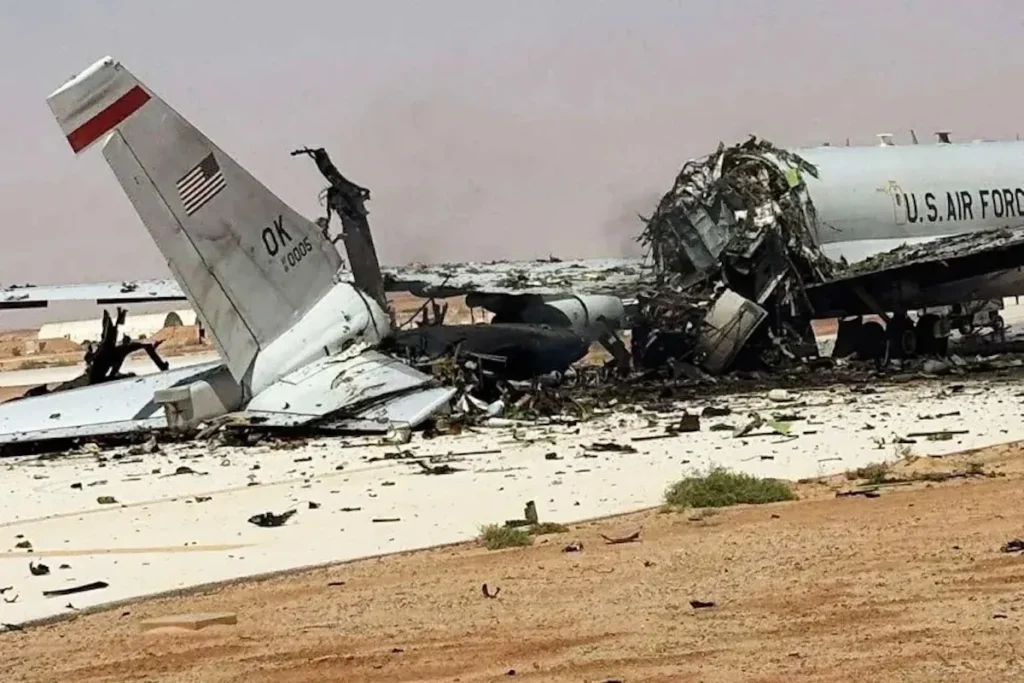
IMAGE: A damaged E-3 Sentry plane after a strike on Saudi Arabia’s Prince Sultan Air Base (Source: Asia Times)
Saudi Arabia says no
That is the real story behind the collapse of what Trump had branded “Project Freedom.” For decades, Washington assumed Gulf monarchies might complain in private, but would still facilitate U.S. operations against regional adversaries, especially Iran, when the moment came. This week suggests that assumptions can no longer be taken for granted. Saudi Arabia appears to have drawn a line, offering the clearest sign yet that Gulf states want to keep the American security umbrella while stripping Washington of the right to use it however it pleases.
The Saudi move carried weight because it cut into the operation itself. NBC’s report said access to Saudi airspace and Prince Sultan Air Base was central to the U.S. plan, because regional military aircraft and overflight routes were essential to any mission designed to protect shipping in the Strait. The operation was also unfolding inside a far larger military surge. By April, the United States had assembled a regional armada with carrier groups, destroyers, bomber support and thousands of troops in what reporting described as the biggest build-up in the area since the Iraq invasion.
Washington sold the mission as maritime security. Tehran, and many across the region, saw something much closer to a coercive blockade imposed under another name, a move Iran treated as a breach of the ceasefire and a fresh attempt to dictate the terms of trade and transit in one of the world’s most sensitive waterways. Once Saudi Arabia pulled access to the infrastructure the plan relied on, Trump was left retreating from an operation that had barely lasted more than a day.
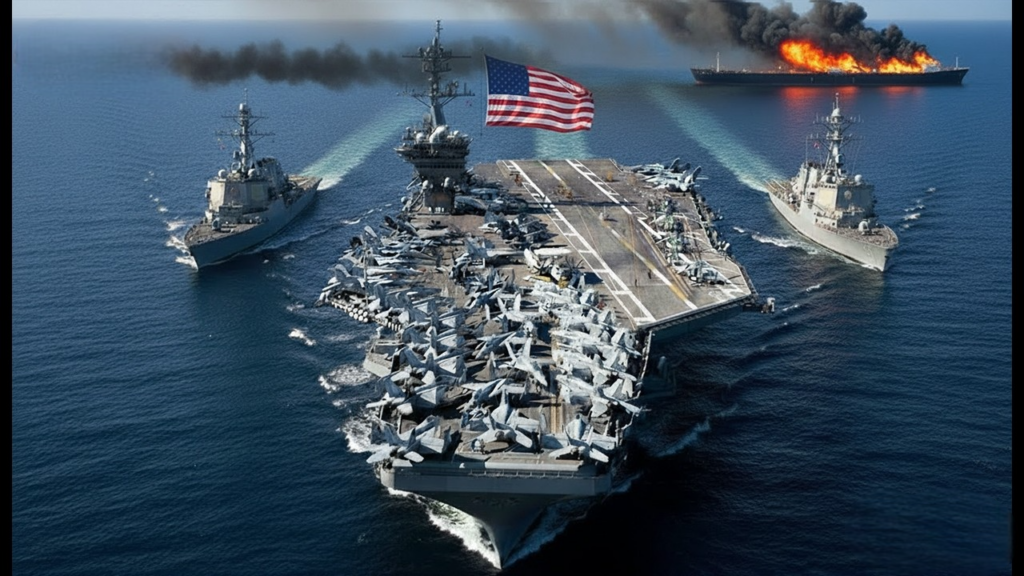
IMAGE: USS Abraham Lincoln on Full Alert in the Arabian Sea (Source: Militray Aviation)
Riyadh did not arrive at that point in a single leap. Saudi Arabia has spent months trying to avoid being dragged into a direct U.S.-Israeli war with Iran. Earlier in the year, reporting from Reuters and Gulf-based media showed that the kingdom had already assured Tehran that Saudi land, waters and airspace would not be used for military action against Iran. Even so, Saudi policy moved through several stages before it reached an outright veto. In March, as repeated Iranian strikes made Prince Sultan more dangerous, Riyadh reportedly opened King Fahd Air Base in Taif to U.S. forces as a safer western alternative, an attempt to keep Washington satisfied while reducing exposure closer to the Gulf.
What happened later over Prince Sultan and Saudi airspace reads less like a sudden break than the moment the kingdom concluded there was no workable way to keep servicing American escalation from its own soil.
Gulf rulers rethink the American shield
That conclusion had been building for a while. Hosting U.S. military infrastructure no longer looks like a simple insurance policy for Gulf monarchies. It increasingly looks like an invitation to become a battlefield. The House of Saud analysis on Prince Sultan Air Base, while best treated as interpretive rather than definitive on every empirical detail, captures the paradox and contradiction with unusual clarity. American bases in Saudi Arabia are meant to deter Iran. Yet, those same bases also provide Iran with a ready-made justification for striking Saudi territory under the pretext of targeting U.S. military assets.
The wider regional pattern gives that argument force. Bases that project security in calmer periods can, once war starts, turn the host country into the front line, thereby creating conditions where the costs are no longer abstract. Saudi reporting in March said ballistic missiles were intercepted on approach to Prince Sultan Air Base, while other reporting described Iranian attacks damaging U.S. assets and exposing vulnerabilities that years of Pentagon planning had failed to solve.
The House of Saud piece goes further and lays out detailed cost estimates for defending Prince Sultan, arguing that Saudi Arabia is effectively paying American contractors to shoot down Iranian weapons aimed at installations that primarily serve U.S. strategic purposes. Some of those figures deserve cautious handling, but the broader picture is hard to miss. The kingdom has been left carrying the political risk, the financial burden and the retaliatory blowback tied to an American military posture it does not fully control. That pressure also lands in a country with a long memory of how foreign basing can poison domestic legitimacy, from Khobar Towers to the backlash that once made the American presence near Islam’s holiest sites politically untenable.
Saudi Arabia is not alone in reaching that conclusion. Across the Gulf, the mood has shifted from dependence to conditional cooperation.
Emergency GCC diplomacy and official statements since the start of the war have stressed sovereignty, de-escalation and the protection of civilian infrastructure, not enthusiasm for a wider confrontation with Iran. Analysts at the Middle East Council on Global Affairs and other regional forums have argued that the war has accelerated a reassessment already underway inside Gulf capitals, where rulers now see U.S. protection as both indispensable and dangerous at the same time.
That shift can be traced country by country.
Qatar and Oman have kept pushing mediation and de-escalation, preferring talks and back channels to open participation in military escalation. Kuwait and Bahrain condemned Iranian attacks but also framed them as violations of sovereignty against states that had not chosen to enter the war. At the same time, some Gulf voices were pressing Washington to hit Iran hard enough to remove the threat for good, which says a great deal about the contradiction at the heart of GCC policy. Gulf rulers want Iran weakened, but not at the cost of turning their own territory into the main arena of another American war.
Even in the GCC’s collective language, support for deterrence no longer translates automatically into a willingness to become a launchpad for a fresh U.S. campaign.
The United Arab Emirates (UAE) sits somewhat apart from this pattern, though not as far apart as Washington might like. Abu Dhabi remains more closely aligned with the United States and, within the political environment shaped by the Abraham Accords, more strategically comfortable with Israeli power than some of its GCC peers. That closeness also carries its own vulnerabilities. A state that markets itself as a hub of trade, finance and regional normalization becomes acutely exposed when a confrontation with Iran spills toward ports, airports and energy infrastructure.
Reporting in 2024 indicated that Abu Dhabi had placed limits on U.S. use of its territory for certain strikes linked to the Iran axis, largely out of fear of retaliation and out of concern that it was becoming too visibly identified with U.S. and Israeli regional agendas. The result is not open dissent on the Saudi model, but it does show that even the most Washington-friendly Gulf capitals are no longer handing out blank cheques.
Tehran turns pressure into leverage
From Tehran’s point of view, the Saudi veto and Trump’s retreat over Hormuz amount to proof that Iran’s strategy is beginning to work. Iranian officials have spent months sending Gulf monarchies the same message in two registers, one conciliatory and one threatening. Saudi Arabia and other Gulf states were told that if they kept their territory out of an American war on Iran, they could avoid being treated as enemies. If they enabled U.S. strikes, then the bases, corridors and assets linked to those operations would be fair game.
Tehran had been preparing that line long before the Hormuz episode. Iranian President Masoud Pezeshkian publicly welcomed efforts to prevent war when Mohammed bin Salman said Saudi territory and airspace would not be used against Iran. Iranian coverage later highlighted Saudi adherence to that position, and Middle East Eye reported that Iran explicitly thanked Saudi Arabia for keeping its airspace closed to attacks. Iranian warnings to the rest of the Gulf were even blunter. If neighboring states failed to block U.S. operations from their soil, senior Iranian figures made clear that Washington’s military footprint across the region would remain a target.

IMAGE: Hormuz, the chokepoint hat chnages everything
When Trump paused the Hormuz escort operation, Gulf News described Iranian messaging around the decision as a sign that maritime traffic could proceed under new rules rather than beneath another American military spectacle. Seen from Tehran, Saudi Arabia had finally turned quiet diplomacy into an operational limit on Washington’s freedom of action.
That has consequences far beyond one naval plan. A Gulf monarchy does not need to tear up its alliance with Washington to constrain Washington. All it has to do is deny a runway, an overflight corridor or a basing arrangement at the moment those things become indispensable. Saudi Arabia’s reported decision appears to have done exactly that. Months of Iranian missile and drone attacks on bases, energy infrastructure and air corridors across the region seem to have left their mark. Gulf rulers no longer appear convinced that they can host or facilitate American force projection against Iran without eventually paying the price on their own territory.
None of this means the U.S.-Gulf alliance has collapsed. The American security architecture still runs deep through Gulf command structures, arms sales, intelligence systems and integrated air defense arrangements. China and Russia belong to this story, though not as substitutes for the U.S. military umbrella. China carries greater weight as a diplomatic hedge and as proof that Gulf states have alternatives to exclusive reliance on Washington, especially after Beijing helped broker the 2023 Saudi-Iran normalization. Russia functions more as a secondary channel in crisis diplomacy and as part of the multipolar setting that gives Gulf rulers extra room to maneuver.
What is changing is narrower than a rupture, but more consequential than a momentary disagreement. The old model of automatic Gulf facilitation for U.S. military escalation is breaking down. Saudi Arabia’s reported veto over Prince Sultan Air Base and Saudi airspace offered a glimpse of a different balance taking shape in the Gulf, one in which American protection is still entrenched, not necessarily embraced, Iranian power is taken more seriously than before, and local rulers are less willing to let Washington dictate the terms of regional confrontation on their behalf.
The damage to U.S. power is not measured only in ships delayed or missions paused. It lies in the precedent. A live American operation in the Gulf was told no by a US client state long treated as part of Washington’s strategic furniture.
Trump’s retreat over Hormuz may not end the war, and it may not mark a lasting Saudi break with Washington. But one of the central myths of the post-1991 order has taken a visible hit. When the costs stopped being abstract and landed on Saudi soil, the kingdom that once hosted the infrastructure of American power slowed it down instead.
READ MORE IRAN NEWS AT: 21st Century Wire IRAN Files
SUPPORT OUR INDEPENDENT MEDIA PLATFORM – BECOME A MEMBER @21WIRE.TV
VISIT OUR TELEGRAM CHANNEL
21st Century Wire is an alternative news agency designed to enlighten, inform and educate readers about world events which are not always covered in the mainstream media.
Source: https://21stcenturywire.com/2026/05/07/the-day-saudi-arabia-quietly-vetoed-an-american-war/
Anyone can join.
Anyone can contribute.
Anyone can become informed about their world.
"United We Stand" Click Here To Create Your Personal Citizen Journalist Account Today, Be Sure To Invite Your Friends.
Before It’s News® is a community of individuals who report on what’s going on around them, from all around the world. Anyone can join. Anyone can contribute. Anyone can become informed about their world. "United We Stand" Click Here To Create Your Personal Citizen Journalist Account Today, Be Sure To Invite Your Friends.
LION'S MANE PRODUCT
Try Our Lion’s Mane WHOLE MIND Nootropic Blend 60 Capsules
Mushrooms are having a moment. One fabulous fungus in particular, lion’s mane, may help improve memory, depression and anxiety symptoms. They are also an excellent source of nutrients that show promise as a therapy for dementia, and other neurodegenerative diseases. If you’re living with anxiety or depression, you may be curious about all the therapy options out there — including the natural ones.Our Lion’s Mane WHOLE MIND Nootropic Blend has been formulated to utilize the potency of Lion’s mane but also include the benefits of four other Highly Beneficial Mushrooms. Synergistically, they work together to Build your health through improving cognitive function and immunity regardless of your age. Our Nootropic not only improves your Cognitive Function and Activates your Immune System, but it benefits growth of Essential Gut Flora, further enhancing your Vitality.

Our Formula includes: Lion’s Mane Mushrooms which Increase Brain Power through nerve growth, lessen anxiety, reduce depression, and improve concentration. Its an excellent adaptogen, promotes sleep and improves immunity. Shiitake Mushrooms which Fight cancer cells and infectious disease, boost the immune system, promotes brain function, and serves as a source of B vitamins. Maitake Mushrooms which regulate blood sugar levels of diabetics, reduce hypertension and boosts the immune system. Reishi Mushrooms which Fight inflammation, liver disease, fatigue, tumor growth and cancer. They Improve skin disorders and soothes digestive problems, stomach ulcers and leaky gut syndrome. Chaga Mushrooms which have anti-aging effects, boost immune function, improve stamina and athletic performance, even act as a natural aphrodisiac, fighting diabetes and improving liver function. Try Our Lion’s Mane WHOLE MIND Nootropic Blend 60 Capsules Today. Be 100% Satisfied or Receive a Full Money Back Guarantee. Order Yours Today by Following This Link.


| Visits: | 1,811,665,584 |
| Stories: | 8,653,095 |
Whistler Blowers, Insiders

