

“I Literally Did”: Elon Musk, a Resort on the Moon, the G-Engine and the Navy’s Inertial-Mass-Reduction Patent

“I Literally Did”: Elon Musk, a Resort on the Moon, the G-Engine and the Navy’s Inertial-Mass-Reduction Patent
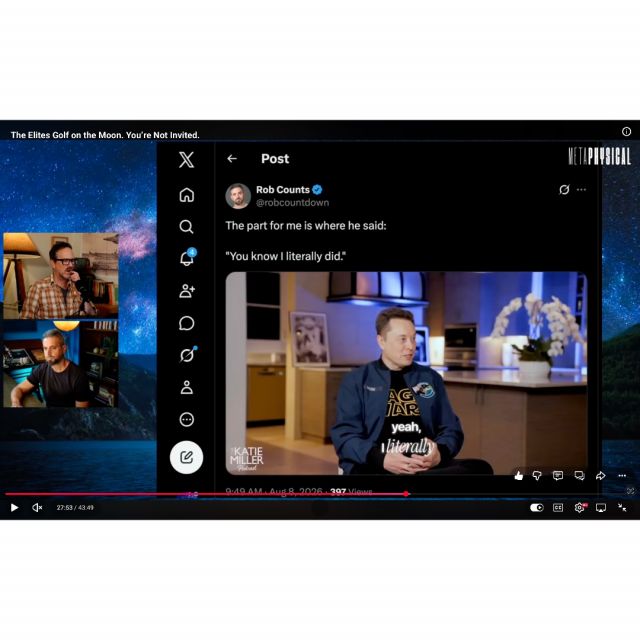
There is a strange moment in an Elon Musk interview that deserves another listen. At approximately 22:12, Musk begins talking about America’s previous trips to the Moon and says, “We went to the moon a few times, actually, and played golf on the moon.” That part is historically true: Apollo 14 astronaut Alan Shepard famously hit golf balls on the lunar surface. But then Musk appears to say something much stranger: “I literally did.”
Listen to the audio yourself. If Musk actually says “I” rather than “he,” what exactly did he mean? Maybe he was joking. Maybe he misspoke. But taken literally, Musk just spoke as though he personally had played golf on the Moon.
That comment becomes considerably more interesting when placed beside remote viewer John Vivanco’s account of a lunar remote-viewing project. Vivanco says his team was blindly tasked against a target associated with an anomalous Apollo photograph. According to him, the data consistently described a lunar environment, but the viewers also perceived humans inside a structure, a large picture window, people relaxing and drinking champagne, and an atmosphere resembling an exclusive resort or retreat. In the Before It’s News/Metaphysical presentation, the key discussion occurs at approximately 31:10–32:35.
The photograph we’ve been examining is Apollo 17 frame AS17-151-23260, taken in December 1972 and showing the Copernicus region of the Moon. It contains the area known as the “Wagon Wheels.” The photograph itself doesn’t show us a clearly identifiable luxury resort. And the remote-viewing target doesn’t necessarily have to describe the location exactly as it appeared when Apollo photographed it; the image could simply identify the location. Whatever Vivanco’s viewers perceived could therefore have existed during Apollo, been constructed later, or involved an older installation subsequently repurposed.
.png)
But suppose the remote viewers were right. If humans really have access to some kind of exclusive facility on the Moon, an obvious question follows: How the hell are they getting there?
That’s where a largely forgotten part of aerospace history becomes interesting. During 1955–1956, researchers and aerospace publications were openly discussing gravity control and electrogravitics. A February 1956 report titled Electrogravitics Systems examined unconventional propulsion concepts, while contemporary articles spoke optimistically about the possibility of manipulating gravity. One memorable headline declared: “THE G-ENGINES ARE COMING!”This was before Sputnik, before NASA and more than a decade before humans publicly walked on the Moon.
The promised gravity revolution never appeared publicly. Perhaps those researchers were simply wrong and the technology failed. But unconventional propulsion research didn’t disappear altogether. Decades later, U.S. Navy engineer Salvatore Pais became associated with several extraordinary patents, including one literally titled “Craft Using an Inertial Mass Reduction Device.” Assigned to the U.S. Department of the Navy, it proposes using extremely energetic electromagnetic fields in an attempt to alter a craft’s inertial properties.
The existence of the Pais patent does not prove that the Navy possesses a working inertial-mass-reduction spacecraft. Publicly reported experimental work has not demonstrated the extraordinary effect described in the patent. But the patent is real, and that leaves an intriguing historical gap: aerospace researchers were talking about gravity control in the 1950s, while decades later Navy researchers were still exploring radically unconventional concepts involving inertia and electromagnetic fields. What happened during all those intervening decades inside classified aerospace programs?
And that brings us back to SpaceX. What SpaceX has accomplished with reusable rockets is genuinely extraordinary engineering. But fundamentally, we’re still watching chemical propulsion: burn propellant, throw mass out the back and generate enough thrust to overcome Earth’s gravity. Seventy years after aerospace publications were talking about G-engines, the public is still watching enormous rockets sitting on launchpads loaded with tremendous quantities of fuel.
Maybe chemical rockets really are the best propulsion technology humanity possesses. But if some breakthrough involving gravity, inertia, electromagnetic fields—or physics completely unknown to the public—occurred inside a classified program, then there could effectively be two space programs: the public program of NASA, SpaceX, rockets, launch towers and livestreams, and a classified program operating technology the public never gets to see.
That wouldn’t mean SpaceX is fake. Its rockets, launches and accomplishments are obviously real. But if advanced field-propulsion technology capable of routine Earth-Moon transportation already exists, then the public rocket program starts looking like an enormous technological sideshow. We’d be celebrating increasingly sophisticated ways of burning chemicals to reach space while somebody else potentially possesses technology that makes the entire process obsolete.
And that’s why Musk’s words are so fascinating. Here is the founder of SpaceX, a major U.S. government and national-security contractor, talking about golf on the Moon—and apparently saying “I literally did.” Add Vivanco’s remote viewers describing an exclusive lunar retreat, the Apollo 17 target, the G-engine enthusiasm of the 1950s and the Navy’s much later inertial-mass-reduction patent, and an uncomfortable question emerges.
Are SpaceX rockets really the cutting edge of human spaceflight—or merely the cutting edge we’re permitted to watch?
Because if there really is a resort for the elite on the Moon, somebody has a way of getting there.
And if Elon Musk really meant what he said, perhaps he already has.
Anyone can join.
Anyone can contribute.
Anyone can become informed about their world.
"United We Stand" Click Here To Create Your Personal Citizen Journalist Account Today, Be Sure To Invite Your Friends.
Before It’s News® is a community of individuals who report on what’s going on around them, from all around the world. Anyone can join. Anyone can contribute. Anyone can become informed about their world. "United We Stand" Click Here To Create Your Personal Citizen Journalist Account Today, Be Sure To Invite Your Friends.
LION'S MANE PRODUCT
Try Our Lion’s Mane WHOLE MIND Nootropic Blend 60 Capsules
Mushrooms are having a moment. One fabulous fungus in particular, lion’s mane, may help improve memory, depression and anxiety symptoms. They are also an excellent source of nutrients that show promise as a therapy for dementia, and other neurodegenerative diseases. If you’re living with anxiety or depression, you may be curious about all the therapy options out there — including the natural ones.Our Lion’s Mane WHOLE MIND Nootropic Blend has been formulated to utilize the potency of Lion’s mane but also include the benefits of four other Highly Beneficial Mushrooms. Synergistically, they work together to Build your health through improving cognitive function and immunity regardless of your age. Our Nootropic not only improves your Cognitive Function and Activates your Immune System, but it benefits growth of Essential Gut Flora, further enhancing your Vitality.

Our Formula includes: Lion’s Mane Mushrooms which Increase Brain Power through nerve growth, lessen anxiety, reduce depression, and improve concentration. Its an excellent adaptogen, promotes sleep and improves immunity. Shiitake Mushrooms which Fight cancer cells and infectious disease, boost the immune system, promotes brain function, and serves as a source of B vitamins. Maitake Mushrooms which regulate blood sugar levels of diabetics, reduce hypertension and boosts the immune system. Reishi Mushrooms which Fight inflammation, liver disease, fatigue, tumor growth and cancer. They Improve skin disorders and soothes digestive problems, stomach ulcers and leaky gut syndrome. Chaga Mushrooms which have anti-aging effects, boost immune function, improve stamina and athletic performance, even act as a natural aphrodisiac, fighting diabetes and improving liver function. Try Our Lion’s Mane WHOLE MIND Nootropic Blend 60 Capsules Today. Be 100% Satisfied or Receive a Full Money Back Guarantee. Order Yours Today by Following This Link.


| Visits: | 1,834,733,146 |
| Stories: | 8,719,720 |
Whistler Blowers, Insiders

