

Service Pricing Math: Why You’re Probably Undercharging (And How to Fix It)

A solid service business pricing strategy starts with one number: your true cost to deliver. Most service business owners price from what they think the market will bear—or worse, what a competitor charges—rather than from their actual cost of delivery. The result is a business that looks profitable on paper and feels broke in practice.
I once worked with a web designer charging $2,500 per website. She was booked six months out. On paper, that looked like success. When we sat down and mapped out what each project actually cost her—admin time, revision rounds, client calls, software subscriptions, the hour she spent chasing invoices—her effective hourly rate was $14. She was working herself into the ground for less than minimum wage. The problem wasn’t her work ethic or her talent. It was the math she never did.
This article is that math.
A service business pricing strategy is the method you use to set prices based on your true cost of delivery, your market position, and the value you create for clients — not on what feels comfortable to charge. Most service owners skip the first part entirely. That’s where the problem starts.
Why Service Business Owners Consistently Undercharge
There are three reasons this keeps happening, and none of them are about confidence.
First, service businesses price from the outside in. You look at what the market charges, subtract a little to stay competitive, and call it a day. The problem is that you have no idea what your competitors’ actual cost structures look like. They might be losing money at that rate. Or they have overhead advantages you don’t. Pricing by comparison is like navigating by someone else’s map.
Second, most service owners only count the hours they spend doing the work—not the hours they spend managing the work. Client calls, proposal writing, contract revisions, billing follow-up, onboarding, offboarding. For most consultants and agency owners, non-billable overhead runs 30–40% of total working hours. If you charge for 20 hours of work but spend 28 hours on the engagement, your effective rate drops by a third before you even factor in expenses.
Third, there’s the psychological anchor problem. Whatever rate you started with feels like “your rate.” Raising it feels like breaking a promise. It isn’t. Your first rate was a guess. A better-informed rate is just more accurate math.
A service business pricing strategy built on your actual cost structure is the only one that holds up long-term. Everything else is a guess with a dollar sign on it.
How to Calculate Service Pricing: Your True Cost to Deliver
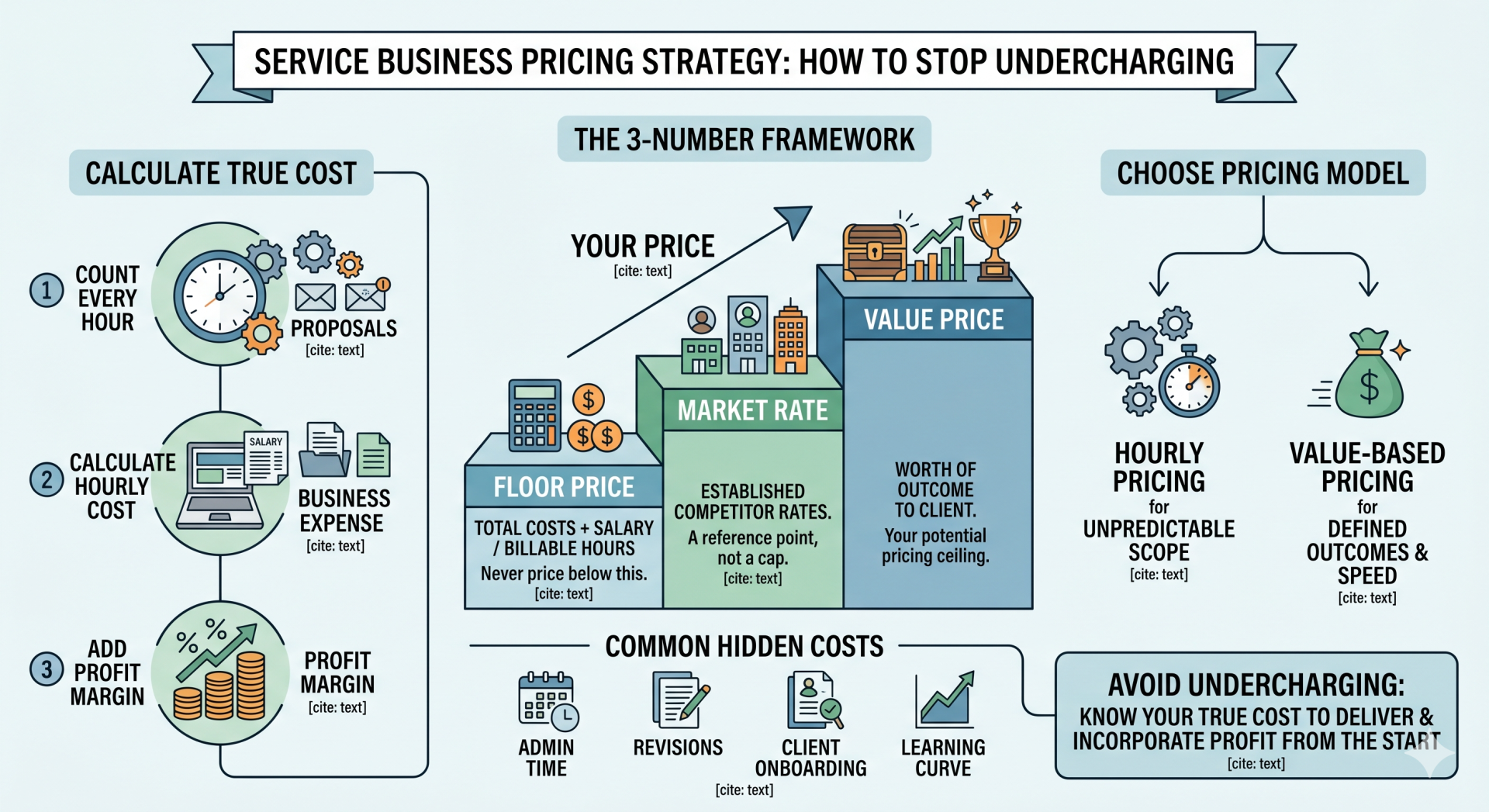
Before you set any price, you need your Cost to Deliver (CTD). Here’s the framework I walk every consulting client through.
How to calculate service pricing in three steps
Step 1: Count every hour, not just the obvious ones.
For a single client engagement, list every activity involved: the initial discovery call, proposal writing, contracting, the actual delivery work, internal review, revision rounds (assume at least two), client check-in calls, final delivery, and follow-up. Be ruthless. Add a 15% buffer for the stuff you always forget.
Step 2: Calculate your fully-loaded hourly cost.
Take your annual business expenses—software, insurance, professional development, equipment, contractor fees, anything you pay to stay operational—and add your desired salary. Divide by your actual billable hours per year. Most service owners have about 1,000–1,200 truly billable hours annually (not 2,080—you’re not working every minute of every business day).
If your total annual costs plus salary target equal $120,000, and you have 1,100 billable hours, your floor rate is $109/hour. That’s break-even. Your price needs to be above that to generate actual profit.
Step 3: Add your profit margin.
Profit isn’t what’s left over. Profit is built in from the start. A sustainable service business targets 20–30% net margin. On a $109/hour floor, that means pricing at $136–$142/hour minimum.
Run this math for your business and write the number down. Then compare it to what you’re actually charging. The gap you find is the conversation we need to have.
Hourly vs. Value-Based Pricing: Which One You Should Choose
This debate has been running for decades in the consulting world, and the answer is simpler than the argument suggests. Your service business pricing strategy has to account for both models — because different engagements call for different approaches. Hourly pricing protects you from scope creep. Value-based pricing rewards expertise and efficiency. Neither is inherently superior — the right model depends on what you’re selling and to whom.
When hourly pricing makes sense: When the scope is genuinely unpredictable. Ongoing advisory relationships, troubleshooting work, or projects where the client frequently changes direction. Hourly keeps you protected when the moving target is real.
When value-based pricing makes sense: When the outcome is defined and your speed is an asset. If you can solve in two hours what takes a junior consultant two weeks, hourly pricing penalizes your competence. Value-based pricing aligns the fee with the result, not the time spent.
A copywriter who writes a sales page that generates $200,000 in revenue isn’t charging $150/hour for four hours of work. She’s pricing based on what that outcome is worth—and charging accordingly. That’s not greed. That’s economics.
The practical test: if a client would be bothered knowing how quickly you did the work, move to value-based. If they need visibility into effort and time (government contracts, legal work, hourly advisory), stay hourly.
Fixed-Fee vs. Retainer: Where the Real Risk Hides

Fixed-fee projects feel clean. One number, one deliverable. Clients love them because predictability is its own value. But fixed-fee pricing carries all the scope risk on your side. One round of “can we just change a few things” can wipe out your margin for the entire engagement.
Protect yourself with three non-negotiable contract elements:
- Revision limits: Two rounds of revisions, in writing, defined before the project starts. Everything beyond that is billed at your hourly rate.
- Change order process: Any addition to scope triggers a written change order with a price before work begins. No exceptions.
- Assumptions listed explicitly: “This price assumes client provides all assets within 5 business days.” If they don’t, the timeline shifts—and so does the price.
Retainers are the holy grail of service business revenue. Predictable monthly income, ongoing relationship, no proposal cycle every 90 days. But retainers get abused. Clients expand scope gradually—one extra call here, a small project there—until you’re delivering $6,000 of work for a $2,500 retainer.
The fix: define deliverables, not availability. A retainer is not a subscription to your time. It’s a subscription to specific outcomes. “10 hours per month” is a recipe for entitlement. “Two strategy sessions, one content audit, and same-day email response” is a contract.
The Hidden Costs Most Service Owners Forget to Price In
You’ve counted your delivery hours. You haven’t counted these:
| Hidden Cost | What It Actually Costs | How to Price It In |
|---|---|---|
| Admin & invoicing time | 2–4 hrs/month per client | Add to project hour estimate |
| Revision rounds beyond scope | 20–40% of delivery time | Build into fixed-fee estimate |
| Client onboarding & offboarding | 3–6 hrs per engagement | Include in project setup fee |
| Learning curve on new platforms | Highly variable | Charge setup/discovery fee upfront |
| Late payment cost (net-30+) | Real cash flow impact | Require 50% deposit on all projects |
| Non-billable sales time | 5–15 hrs per client acquired | Factor into target effective rate |
The learning curve item deserves extra attention. Every new client comes with a new platform, a new process, a new set of preferences. The first three hours of any engagement are almost always slower than what follows. If you don’t price in a discovery or setup fee, you’re teaching yourself on your own dime.
What a Service Business Pricing Strategy Actually Looks Like
Stop overcomplicating this. Here’s a service business pricing strategy framework that works for consultants, agencies, and solopreneurs at every stage.
The 3-Number Framework:
The 3-Number Framework gives every service business three reference points: a floor, a market rate, and a value ceiling — and your price should always sit between the first and the last.
Floor Price: Your total annual costs + desired salary ÷ annual billable hours. This is break-even. Never price below this number.
Market Rate: What established providers in your category charge for similar work. This is context, not a ceiling.
Value Price: What the outcome is worth to the client. This is your ceiling—and most service businesses never get close to it.
Your actual price should sit between your floor and your value price, calibrated to where you are in building your track record. Early-stage consultants price closer to the floor while building case studies. Established providers with documented results price closer to the value ceiling. The goal is to move the number up as your evidence accumulates—not to stay at your “starter rate” indefinitely.
For concrete benchmarking by service type, the Bureau of Labor Statistics Occupational Employment data gives you median hourly rates for professional service categories—useful as a floor check, not a ceiling. Consulting.com’s fee research shows independent consultants charging $100–$350/hour depending on specialty and experience level.
The number that matters most is yours—calculated from your actual cost structure, not someone else’s.
If your referral relationships are strong, pricing power follows. Clients who come through word-of-mouth are already pre-sold on your value — which means they’re less price-sensitive. If you want to build the kind of referral network that supports premium pricing, here’s how to build a referral system that brings in pre-sold clients.
Frequently Asked Questions About Service Business Pricing Strategy
Calculate your effective hourly rate: divide last month’s revenue by total hours worked—including admin, client calls, and non-billable time. If that number is below your fully-loaded cost (annual expenses + salary target ÷ 1,100 billable hours), you’re undercharging. A second signal: if you never lose a client over price, your rate is probably too low. Occasional price resistance is healthy—it means you’re testing the upper edge of your value.
Hourly pricing charges for time spent and protects you when scope is variable or unpredictable. Value-based pricing charges for the outcome delivered, regardless of time spent. Value-based pricing rewards expertise and efficiency—if you can produce results faster than a less experienced provider, you shouldn’t earn less for it. Most established service businesses shift toward value-based pricing as their track record and case studies accumulate.
Define deliverables, not availability. A retainer is a subscription to specific outcomes—two strategy sessions, a monthly content audit, priority response time—not open-ended access to your calendar. Calculate the hours each deliverable requires, multiply by your target rate, and price the retainer at 10–15% above that number to account for the convenience and predictability you’re providing the client.
The most overlooked costs are admin and invoicing time (2–4 hours per client per month), revision rounds beyond the stated scope (typically 20–40% of total delivery time), client onboarding and offboarding, platform learning curves for new tools, and the time cost of late payments on net-30 or net-60 terms. Including a project setup fee and requiring a 50% upfront deposit addresses most of these directly.
A service business pricing strategy is the system you use to set prices based on three inputs: your true cost to deliver the service, what the market charges for comparable work, and the value the outcome creates for the client. A pricing strategy is not the same as a price list. The strategy is the logic behind the numbers — and it determines whether your business is actually profitable or just busy.
Additional Reading
- How to Get Referrals That Actually Convert
- How to Ask for Referrals Without Feeling Awkward
- BNI Review: Is It Worth It for Service Business Owners?
Low budget marketing strategies for CEOs with no marketing department. Join DIYMarketers.com for free marketing tips.
Source: https://diymarketers.com/service-business-pricing-strategy/
Anyone can join.
Anyone can contribute.
Anyone can become informed about their world.
"United We Stand" Click Here To Create Your Personal Citizen Journalist Account Today, Be Sure To Invite Your Friends.
Before It’s News® is a community of individuals who report on what’s going on around them, from all around the world. Anyone can join. Anyone can contribute. Anyone can become informed about their world. "United We Stand" Click Here To Create Your Personal Citizen Journalist Account Today, Be Sure To Invite Your Friends.
LION'S MANE PRODUCT
Try Our Lion’s Mane WHOLE MIND Nootropic Blend 60 Capsules
Mushrooms are having a moment. One fabulous fungus in particular, lion’s mane, may help improve memory, depression and anxiety symptoms. They are also an excellent source of nutrients that show promise as a therapy for dementia, and other neurodegenerative diseases. If you’re living with anxiety or depression, you may be curious about all the therapy options out there — including the natural ones.Our Lion’s Mane WHOLE MIND Nootropic Blend has been formulated to utilize the potency of Lion’s mane but also include the benefits of four other Highly Beneficial Mushrooms. Synergistically, they work together to Build your health through improving cognitive function and immunity regardless of your age. Our Nootropic not only improves your Cognitive Function and Activates your Immune System, but it benefits growth of Essential Gut Flora, further enhancing your Vitality.

Our Formula includes: Lion’s Mane Mushrooms which Increase Brain Power through nerve growth, lessen anxiety, reduce depression, and improve concentration. Its an excellent adaptogen, promotes sleep and improves immunity. Shiitake Mushrooms which Fight cancer cells and infectious disease, boost the immune system, promotes brain function, and serves as a source of B vitamins. Maitake Mushrooms which regulate blood sugar levels of diabetics, reduce hypertension and boosts the immune system. Reishi Mushrooms which Fight inflammation, liver disease, fatigue, tumor growth and cancer. They Improve skin disorders and soothes digestive problems, stomach ulcers and leaky gut syndrome. Chaga Mushrooms which have anti-aging effects, boost immune function, improve stamina and athletic performance, even act as a natural aphrodisiac, fighting diabetes and improving liver function. Try Our Lion’s Mane WHOLE MIND Nootropic Blend 60 Capsules Today. Be 100% Satisfied or Receive a Full Money Back Guarantee. Order Yours Today by Following This Link.


| Visits: | 1,803,963,731 |
| Stories: | 8,637,255 |
Whistler Blowers, Insiders

