

The Truth About Oil Markets

This post The Truth About Oil Markets appeared first on Daily Reckoning.
Happy St. Patrick’s Day, when everybody is at least a little bit Irish.
Meanwhile, at the local gas station a gallon of regular go-juice is $3.99, up about 30% in the past three weeks, from the good old days of… check notes… February. (And of course, this is our Western Pennsylvania price, with Keystone State fuel taxes.)
Irish or not, we all pay more for fuel, which has elicited questions from readers, such as:
- What goes into the gas station fuel price?
- How long will these price increases last?
- How will increased prices impact other parts of the economy?
- What should we do in terms of investing?
There’s plenty to discuss, so let’s dig in…
Oil’s Global Reach and Price Tag
Of course, the recent price jump at the pump is due to the war with Iran which led to closure of the Strait of Hormuz at the southeast end of the Persian (some say “Arabian”) Gulf.
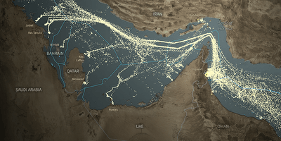
Pre-war, “normal” ship transits via Hormuz. Courtesy Reuters News.
Closing Hormuz blocked transit of thousands (yes, a big number!) of tankers that carry crude oil, refined products and much else across the world. And with tankers idle, there’s not as much oil and refined products in global commerce, so prices are rising because oil is a globally traded commodity.
Allowing for differences in chemistry and related physical properties, the price of oil is based on worldwide channels of commerce that follow classical patterns of supply and demand. But oddly enough, there’s no single, globally uniform price.
For example, a large percentage of tankers that sail through Hormuz are destined for the Indian subcontinent and Asia, and even faraway Australia and New Zealand. Indeed, these vast parts of the world obtain most of their oil from the Middle East. So, when Hormuz is blocked, India, China and many other nations must bid up the price for barrels, and this has global impact.
To illustrate, here’s a price chart for a barrel of oil on the Shanghai Exchange, in China:
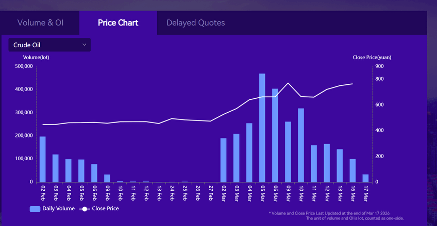
Shanghai oil price on International Energy Exchange. Courtesy INE.cn/eng/.
Today, Tuesday morning, March 17, a barrel of oil is priced at 780 yuan, which converts to about $114 dollars. But wait a minute…
Because this morning on the New York Mercantile Exchange, a barrel of oil is priced at about $95, as you can see here:
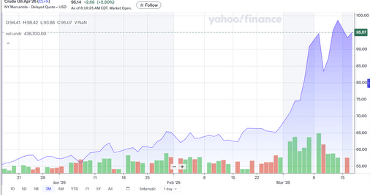
NY Merc price of oil. Courtesy Yahoo Finance.
What gives? A barrel is $114 in Shanghai and $95 in New York. Why the $19 spread?
One angle is that there’s a serious difference between buying “real” barrels and “paper” barrels. That is, China must first and foremost buy actual oil because the country is heavily dependent on imports; while the West – meaning traders in New York and London – have long had the luxury of buying and selling other people’s oil via futures contracts, with assurance that the barrels will be there when the time comes.
Or look at it this way: Chinese refineries need assured oil supplies. But China doesn’t produce much of its own oil. So, Chinese refiners must purchase imported crude and cannot risk running dry at the unloading pier. Hence, Chinese buyers bid up the price – yes, even way up – to ensure that tankers will dock at their terminals and not sail past to some other destination.
In a sense, the true price for oil is not what traders post on the boards for paper barrels; it’s what a refiner will pay right now to get a tanker full of crude oil to dock and unload. “Show me the money,” to borrow a famous phrase.
Or one could also call the higher Shanghai price a “scarcity premium” that Chinese refiners must pay because, right now, they compete against everybody else in Asia and Australasia for a smaller number of oil loads on far fewer tankers.
Whereas in the U.S., but also the Western Hemisphere in general, oil traders still have (for the time being…) the luxury of a significant supply of relatively nearby product, meaning domestic U.S. production plus significant imports from secure sources.
America the Fortunate
Indeed, the U.S. is fortunate to be the world’s leading producer of petroleum at about 13.8 million barrels per day, which is quite a bit more than Russia or Saudi Arabia (and Saudi is throttling back output due to difficulty in exporting product).
Here’s a nice graph that shows the U.S. numbers, straight from the Department of Energy:
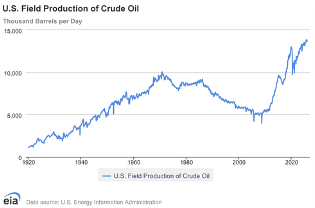
U.S. oil output since 1920. Courtesy Dept. of Energy/EIA.
What you see above is what we in the U.S. can call “energy security.” That is, since 1859 and Col. Drake at Titusville, Pennsylvania, the U.S. has developed a vast, wide, deep, technologically proficient oil (and natural gas) industry, from prospects to rigs, wells, pumps, pipelines and refineries. There’s no magic about it; just 167 years of continuous industrial effort and legacy.
Meanwhile, it’s worth noting that contrary to common misperception, the U.S. is NOT entirely self-sufficient in oil. In fact, the country produces the above-mentioned 13.8 million barrels per day but uses about 20 million barrels. And the 6-million-barrel daily difference is made up with imports from Canada, which ships about 4 million barrels per day, most of it down from Alberta. Plus, the U.S. obtains oil from other countries such as Mexico, Brazil, Nigeria, Angola, and lately even Venezuela.
Oh, and modest amounts of imported oil were (past tense) coming to the U.S. from Saudi Arabia, destined for a Saudi-owned refinery near Houston. But that’s up in the air now, and we’ll see what develops…
All this, and the U.S. exports oil too. Some oil heads out as unrefined crude petroleum, but much more hits the sea lanes as refined products. For example, most of the motor fuels and lubricants used in Central America are exported from U.S. refineries.
Plus, the U.S. has robust commerce in gasoline and diesel with Europe. And some Alaska oil goes to Japan, South Korea and other destinations in Asia.
As you can see, there’s quite a bit going on in global oil markets, back and forth. And oil pricing is dynamic, even more so now with Hormuz closed… although we actually have tales of tankers making the run and getting out to sea with loads of oil.
One way or another, though, every barrel finds a buyer at some price.
The Refinery Angle
So, oil is great, right? But really, almost nobody uses raw crude. Heck, if you had a barrel of crude oil on your front porch, you’d probably have to call a specialized company to haul it away.
Most people don’t use crude oil. But we all use products that are refined from crude oil: gasoline, diesel fuel, kerosene, jet fuel (when we fly), lubricants, and other fractions of oil like tar and asphalt, which we don’t put in the car, but which makes the ride easier.
Of course, all these products are refined from a basic barrel of oil via an industrial facility called… yes… a “refinery.” And perhaps you’ve seen a refinery as you drove down a highway, say I-95 south of Philadelphia, or around “Refinery Row” in Houston, or out in Southern California just north of Long Beach.
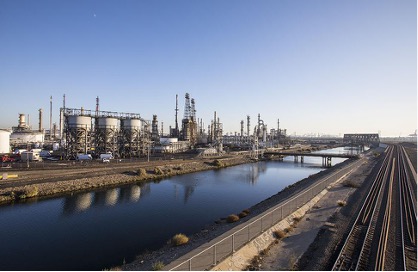
Valero refinery at Wilmington, California. Courtesy Valero Corp.
According to the EIA, the U.S. had 135 working refineries as of January 1, 2026. This is down from about 300 back in the early 1980s. Here’s that chart:
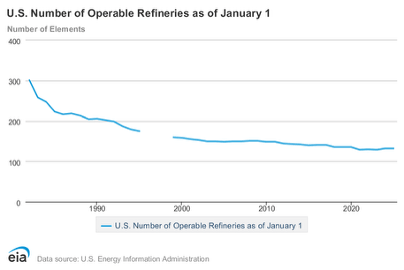
U.S. Refineries. Courtesy Dept. of Energy/EIA.
U.S. refineries are located across the country, from Alaska to Georgia, from California to New Jersey, with a heavy concentration along the Gulf Coast.
And speaking of California, the Golden State had 42 refineries back in 1982; today it has six such facilities, which is among the many reasons why California fuel availability is a national security issue, while prices out there are always among the highest in the nation, Hormuz or not.
Plus, those six California refineries are tasked to deliver a variety of fuel blends, depending on where the gallons will be sold and air emission regulations in that jurisdiction. While California taxes and litigation also add significant expense to running a fuel business, which makes it tough to operate out there.
Oh… This reminds me that the other day I saw a note from someone who said that if I was concerned with energy security, I should buy an electric vehicle. To which I replied that I was astonished that this guy had used the terms “EV” and “energy security” in the same sentence.
But back to refineries… Because frankly, 135 is not a lot for a big country like the U.S., with 350 million people. Just basic arithmetic comes up to one refinery for every about 2.6 million people, which means that any problem behind any refinery fenceline can have massive impacts.
And right now, one problem for U.S. refineries is the price of oil. Sure, as we discussed above, there’s much domestic and Canadian oil moving around our North American continent. But still, global prices affect oil prices here at home as well. So, when the price of a barrel of crude goes from last month’s $62 or so to this month’s $95, that price jump flows into the product mix down at the refinery.
Bottom line is that about half of the price you pay at the pump is for the raw crude feedstock at the refinery. The rest of the pump price is the cost to refine and transport products, then move those gallons to gas stations, and run the pumps. Plus, every state has its own level of fuel taxes (California’s are the nation’s highest; with Illinois and Pennsylvania right up there). And your humble filling station operator might make about two or three cents per gallon, so don’t blame the guys behind the counter.
Looking Ahead at Higher Fuel Prices
Per reader questions… will oil prices stay elevated, along with fuel prices at the pump? I hate to bear bad news, but yes, more than likely; certainly, as long as Hormuz is closed and probably well after the war reaches some sort of conclusion. Heck, the war could end this afternoon, and we’ll still feel the reverberations for many months at least.
Meanwhile, as U.S. motorists pay more and more for fuel, more and more money will not go to other things. That is, perhaps it’s something as simple as no candy bar at the gas station. Or maybe it’s no meal at a drive-thru or some other restaurant. Or no movie at the theater. Or fewer groceries at the supermarket. Or less stuff purchased at Walmart or Target or Costco.
You personally may or may not feel the sting of higher fuel prices; it depends where you fall on the spectrum of household earnings. Use this chart for perspective:
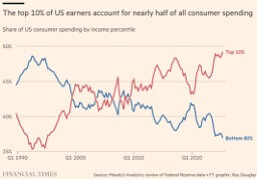
Consumer spending by income percentile. Courtesy Financial Times.
In the aggregate, higher pump prices mean that most Americans will take a noticeable hit to their wallet and standard of living. Indeed, most Americans – something like 60% of households! – live paycheck to paycheck, and extra money for gas or diesel comes straight out of the ability to run the basics of life. So, more money spent on fuel for the car means less money is available for everything else.
And sad to say, despite all the political “rah-rah” about the economy, inflation-adjusted wage levels have been stagnant in most of working-class America for 25 years and more. Plus, we now see even high-skill, high-wage jobs in tech going away, cut back via AI and cheap labor from imported visa-workers; and that’s if companies don’t just straight-up outsource work to a foreign campus on the other side of the planet.
Bottom line is that higher oil prices have raised fuel prices, the jump at the pump. More money for oil and fuel means less for everything else.
Looking ahead we’ll see inflation, lower corporate earnings outside of oil and refining companies, and likely a general down-trend in broad markets.
Investment-wise, the basic idea is to go with energy companies that have minimal exposure to the Middle East. And U.S. refiners will likely be profitable. Plus, stick with gold and silver for the long haul as inflation protection.
There’s much more, but that’s it for now, St. Patrick’s Day. Let’s find some of that Irish luck in all of this, but one way or another it helps to understand what’s happening out there, and to keep your wits as everything unfolds.
Thank you for subscribing and reading. Best wishes…
The post The Truth About Oil Markets appeared first on Daily Reckoning.
This story originally appeared in the Daily Reckoning
Source: https://dailyreckoning.com/the-truth-about-oil-markets/
Anyone can join.
Anyone can contribute.
Anyone can become informed about their world.
"United We Stand" Click Here To Create Your Personal Citizen Journalist Account Today, Be Sure To Invite Your Friends.
Before It’s News® is a community of individuals who report on what’s going on around them, from all around the world. Anyone can join. Anyone can contribute. Anyone can become informed about their world. "United We Stand" Click Here To Create Your Personal Citizen Journalist Account Today, Be Sure To Invite Your Friends.
LION'S MANE PRODUCT
Try Our Lion’s Mane WHOLE MIND Nootropic Blend 60 Capsules
Mushrooms are having a moment. One fabulous fungus in particular, lion’s mane, may help improve memory, depression and anxiety symptoms. They are also an excellent source of nutrients that show promise as a therapy for dementia, and other neurodegenerative diseases. If you’re living with anxiety or depression, you may be curious about all the therapy options out there — including the natural ones.Our Lion’s Mane WHOLE MIND Nootropic Blend has been formulated to utilize the potency of Lion’s mane but also include the benefits of four other Highly Beneficial Mushrooms. Synergistically, they work together to Build your health through improving cognitive function and immunity regardless of your age. Our Nootropic not only improves your Cognitive Function and Activates your Immune System, but it benefits growth of Essential Gut Flora, further enhancing your Vitality.

Our Formula includes: Lion’s Mane Mushrooms which Increase Brain Power through nerve growth, lessen anxiety, reduce depression, and improve concentration. Its an excellent adaptogen, promotes sleep and improves immunity. Shiitake Mushrooms which Fight cancer cells and infectious disease, boost the immune system, promotes brain function, and serves as a source of B vitamins. Maitake Mushrooms which regulate blood sugar levels of diabetics, reduce hypertension and boosts the immune system. Reishi Mushrooms which Fight inflammation, liver disease, fatigue, tumor growth and cancer. They Improve skin disorders and soothes digestive problems, stomach ulcers and leaky gut syndrome. Chaga Mushrooms which have anti-aging effects, boost immune function, improve stamina and athletic performance, even act as a natural aphrodisiac, fighting diabetes and improving liver function. Try Our Lion’s Mane WHOLE MIND Nootropic Blend 60 Capsules Today. Be 100% Satisfied or Receive a Full Money Back Guarantee. Order Yours Today by Following This Link.


| Visits: | 1,787,979,468 |
| Stories: | 8,604,561 |
Whistler Blowers, Insiders

