

When Food Goes Bad: Why Some Brands Can Trace a Problem in Hours and Others Take Weeks

We’ve all seen the stories in the papers. Some brand of lettuce, some brand of peanut butter, some brand of frozen veggie gets pulled from the shelves because of contamination. The stores remove the product, the lot numbers get published in the papers and people start going through their pantries and fridges to see if they’ve got any of the affected product.
What most people don’t see is the frantic activity going on behind the scenes. Some food producer or other is desperately trying to answer a few very pressing questions. Which batch was it? Where did the ingredients come from? Which stores, which distributors, which restaurants got it? How much of it is still out there?
Some companies can answer those questions in hours. Others take days, some even weeks. That gap is more important than most people realise as every hour that a contaminated product remains in circulation is another hour in which someone could become ill.
What Traceability Actually Means
Traceability is a simple concept. It’s the ability to trace a food product backwards to every ingredient and every supplier that it came from and forwards to every customer that it was supplied to.
In practice this is done via lot or batch numbers. Each batch of ingredients that comes into a facility is recorded. Each production run is linked to the specific lots of ingredients that it used. Each shipment out is then linked to the production runs that it came from. Once the chain is complete you can trace a single lot number on a package all the way back to where the ingredients came from and where the rest of that batch went.
When the chain is broken things get very messy indeed. If a producer can’t work out which batches used the contaminated ingredient they’re often left with no alternative but to recall a lot more product than is strictly necessary. That results in more food being wasted, more money being lost and a great deal of confusion for the consumer who is then left wondering whether the product they’ve bought is safe or not.
Why it Still Goes Wrong
You’d think every food company would have this perfected. A lot do. Many still however are reliant on paper logs, handwritten batch sheets and spreadsheets moving from one department to another. The info on the incoming ingredients is in one place, the production records in another and the shipping details in yet another.
Most days, that setup works well enough. But when there’s a recall, everything falls apart. Staff have to dig through binders and email chains to figure out where each pallet went. Mistakes happen. If a batch is mislabeled or a record is missing, a small recall can quickly turn into a much bigger problem.
There’s also the supplier issue. Modern day food products will have ingredients coming from all over the place. If the supplier has poor records then the producer is going to inherit that. A contamination issue that starts at a farm or an ingredient processor can potentially go through dozens of brands before anyone actually realises what’s happened.
What Good Traceability Looks Like
The producers who get recalls right all have a few things in common:
Every ingredient is logged on arrival. Supplier, lot number, date received and quantity are all recorded prior to anything going into storage.
Production runs are linked to specific ingredients. You don’t have to guess which flour, oil or spice lot went into any particular batch as the record is there.
Shipments are batched. The lot number goes with the product as it leaves the building, along with who it was sent to and when.
Records live in one place. Rather than having separate systems for receiving, production and shipping the information is all linked together so that a full history of a batch can be seen with a single search.
A lot of well-run facilities will run mock recalls where they pick a random lot and time how long it takes to trace it all the way through in both directions. It’s a straightforward way of identifying the weak points prior to a real recall ever occurring.
This is an area where technology has made a significant impact. More and more food and beverage manufacturers are moving away from the old way of having massive amounts of paper and towards systems which automatically track the lots as the ingredients go through the plant. Sutton is a great example of how you can have that level of record keeping as an integral part of the normal production process rather than as a separate exercise. The aim isn’t some incredibly complex software. The aim is simply to be able to answer the tough questions when they arise.
Why This Matters to You as a Shopper
Strong traceability doesn’t prevent every contamination issue. Food is grown in soil, it’s handled by people and it’s moved all over the place. Things will happen. What traceability does is to speed up the containment of a problem and to make it far more precise.
A producer with good records can isolate the affected batch and leave the rest of the product on the shelf. A producer with poor records may end up removing the entire range of product that carries that brand name. In the very worst case scenario they may take so long to work out what’s gone wrong that the contaminated product will be sitting in the kitchens for days past the point it should be.
Regulators have been driving the industry to an extremely high level of record keeping for that very reason (especially in the case of products with a history of outbreaks such as leafy greens, fresh herbs, soft cheeses and certain seafood). The rules set the minimum requirement. The companies that actually do take traceability seriously will of course go well beyond that.
A Few Things You Can Do
You can’t actually see inside a food plant, but you can certainly protect your home with a few simple habits.
Keep your packaging or receipts for any products you buy in bulk or freeze for later as the lot numbers are often only printed on the original package. Sign up for recall alerts from the food safety agencies so you’re aware of any problems as soon as they happen. When a recall does come out, check the lot numbers and dates very carefully rather than just assume your product is or isn’t affected. Also bear in mind how the brands themselves deal with recalls. The ones that are the most transparent and act swiftly are generally the ones that have their records in order.
Food safety isn’t just about what happens on the farm or in the kitchen. A huge amount of it is down to paperwork (or the lack of it). The next time you see a recall in the news, bear in mind that the speed of the response is often a good indicator of how seriously that company takes the food it puts on the table.
Anyone can join.
Anyone can contribute.
Anyone can become informed about their world.
"United We Stand" Click Here To Create Your Personal Citizen Journalist Account Today, Be Sure To Invite Your Friends.
Before It’s News® is a community of individuals who report on what’s going on around them, from all around the world. Anyone can join. Anyone can contribute. Anyone can become informed about their world. "United We Stand" Click Here To Create Your Personal Citizen Journalist Account Today, Be Sure To Invite Your Friends.
LION'S MANE PRODUCT
Try Our Lion’s Mane WHOLE MIND Nootropic Blend 60 Capsules
Mushrooms are having a moment. One fabulous fungus in particular, lion’s mane, may help improve memory, depression and anxiety symptoms. They are also an excellent source of nutrients that show promise as a therapy for dementia, and other neurodegenerative diseases. If you’re living with anxiety or depression, you may be curious about all the therapy options out there — including the natural ones.Our Lion’s Mane WHOLE MIND Nootropic Blend has been formulated to utilize the potency of Lion’s mane but also include the benefits of four other Highly Beneficial Mushrooms. Synergistically, they work together to Build your health through improving cognitive function and immunity regardless of your age. Our Nootropic not only improves your Cognitive Function and Activates your Immune System, but it benefits growth of Essential Gut Flora, further enhancing your Vitality.
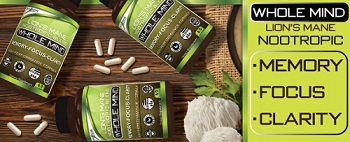
Our Formula includes: Lion’s Mane Mushrooms which Increase Brain Power through nerve growth, lessen anxiety, reduce depression, and improve concentration. Its an excellent adaptogen, promotes sleep and improves immunity. Shiitake Mushrooms which Fight cancer cells and infectious disease, boost the immune system, promotes brain function, and serves as a source of B vitamins. Maitake Mushrooms which regulate blood sugar levels of diabetics, reduce hypertension and boosts the immune system. Reishi Mushrooms which Fight inflammation, liver disease, fatigue, tumor growth and cancer. They Improve skin disorders and soothes digestive problems, stomach ulcers and leaky gut syndrome. Chaga Mushrooms which have anti-aging effects, boost immune function, improve stamina and athletic performance, even act as a natural aphrodisiac, fighting diabetes and improving liver function. Try Our Lion’s Mane WHOLE MIND Nootropic Blend 60 Capsules Today. Be 100% Satisfied or Receive a Full Money Back Guarantee. Order Yours Today by Following This Link.


| Visits: | 1,836,652,876 |
| Stories: | 8,729,694 |
Whistler Blowers, Insiders

