

President Trump's New Housing Policy Should Include Massive Privatization of Federal Land

The federal government owns approximately 640 million acres of the 2.4 billion acres that constitute the United States of America. You might be astonished to know that less than one half of that total consists of our invaluable Great National Park system, our U.S. protected forest lands, and our protected grasslands. Moreover, the federal government’s holdings are almost entirely in twelve western states, where they create weird real estate markets, for reasons that can only be characterized as an historical accident. The map below shows federally owned land in red:
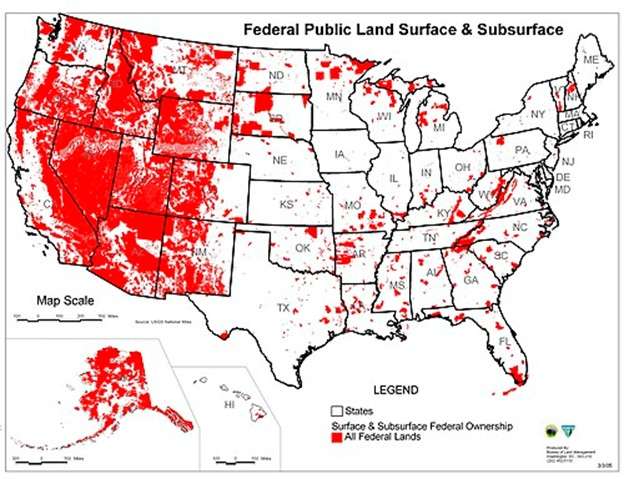 The enormous amounts of twelve western states that are federally owned are revealed again by this chart:
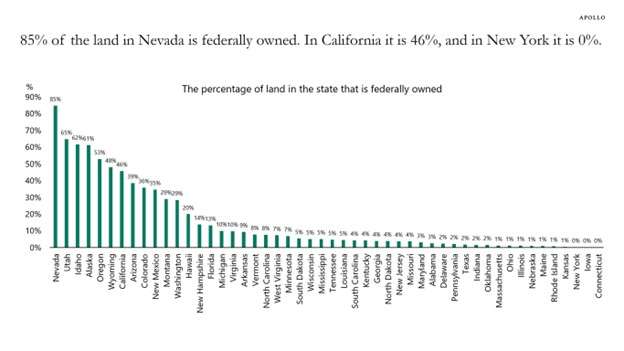
Twelve Western states account for the unequal treatment of the fifty states by the federal government, which grossly stifles private investment and skews real estate development in the States affected. The twelve Western states with skewed real estate markets include: Nevada; Utah; Idaho; Alaska; Oregon; Wyoming; California; Arizona; Colorado; New Mexico; Montana; and Washington State. 92% of the federally owned land in the United States is federally owned in these twelve Western states. There is no good policy ground for holding such huge shares of federal land in twelve states, while holding very little federal land in the other 38.
Of the 640 million acres of U.S. land, which the federal government owns, the U.S. National Parks Service manages 85 million acres, while the U.S. Forest Service manages another 193 million acres of forests and grasslands. Adding these two figures together suggests that about 278 million of the 640 million acres of federally owned land needs to be federally owned for environmental reasons.
That means, however, that 362 million acres of federal land is currently surplus government land that could be used by private people who have been squeezed out of the American dream of home ownership, suffer from a housing affordability crisis, and in the worst cases are homeless while the government squanders hundreds of millions of acres of private developable land that it owns but does not use. This crisis is especially visible in California where the federal government owns 46% of a state in which housing affordability and widespread homelessness are at crisis proportions.
To put this problem in context, the State of Texas has 172 million acres of land in total, while California has 164 million acres of land in total for a sum of 336 million acres. The federal government is thus sitting on and squandering an area of land that is 26 million acres larger than the combined size of Texas and California, which are the second and third largest states in the Union. And all of this while there is a very serious housing affordability crisis and a homelessness crisis that are separately going on.
Now it is true that some of the nationalized 362 million acres in surplus land that the federal government owns is uninhabitable because it is in Alaska, which is too cold, or in the Southwestern deserts, which are too hot for human habitation. But, having traveled to these states, I simply do not believe that 65% of Utah, 53% of Oregon, 46% of Wyoming, or 46% of California are uninhabitable, and I could go on and on down the list.
The fact is that private ownership of property under the common law yields much more efficient management of that property than does government ownership. Yale Law Professor Robert Ellickson proved as much in a famous law review article wherein he showed that the 1607 colonists of Jamestown, Virginia nearly died of starvation when all the land was all publicly owned. But they then thrived economically once the communally owned land was privatized, which saved the Jamestown colony. Ellickson, Robert C. Property in Land, 102 Yale L.J. 1315. More recently, when the Soviet Union collapsed, two-thirds of its food was being provided by the 3% of the total land in the U.S.S.R. that was privately owned. Private property owners are much better stewards of their property than is the government.
Why then did federal land not all get privatized through homesteading, which President Abraham Lincoln, after all, got enacted into law way back in 1862? The are multiple answers to that question. One is that the landowners next to federal undeveloped land want it to stay that way so they can have their own private parks in their backyards, which they pay no property taxes on, and which cost them nothing to maintain. Western hunters, hikers, miners and others have the same sort of not-in-my-backyard (NIMBY) attitude toward land privatization. Another problem is the environmental movement, which wants to reduce the human footprint on the planet more than they care about the crises of housing affordability and homelessness, which I frankly think is cruel. Finally, there is bureaucratic inertia, something a real estate developer like Donald Trump should be skilled at cutting through.
What do other nations around the world do with respect to government ownership of land? In the United Kingdom, the government own 8% of the country’s land (see the data here). In China, Vietnam, and Cuba, in contrast, the government owns nearly 100% of the land. In the United States, the federal government owns 28% of the land and the state and local governments own another 8.7% for state and local park., so in a land that prides itself on free-market capitalism 36% of the land—more than one third of the country—is government owned.
There is a reason why the homesteading privatization of federally owned land, which started in 1862, came to an end in the early 1900′s. President Theodore Roosevelt was in many ways a trust-busting advocate of progressive taxation, and he wanted the development of the Western United States to stop. A noble legacy of this effort was the creation of our great National Parks and Forests, but this came with a huge unappreciated cost—the end of privatization of more ordinary public land.
From 1901 to Margart Thatcher’s and Ronald Reagan’s Privatization Revolution of the 1980′s, Big Government in Europe nationalized healthcare, all banking in France in 1981, car production, steel mills, airline companies, electric companies, and telecommunications companies. Margaret Thatcher, Ronald Reagan, and Jacques Chirac in France reprivatized many of these industries, realizing—as President Bill Clinton famously put it in his 1996 State of the Union Address—that “the era of big government was over.” But it turned out to be much easier to privatize most industries than it was to privatize land in the United States with its NIMBY Westerners and its over-aggressive environmental lobby. This crucial sector of the economy got overlooked, contributing to the crisis in housing availability and homelessness that we see today.
We can all hope that President Trump’s housing reform policy to be announced next year takes a big look at privatizing federal land. We could use some of the proceeds to help retire the national debt. And who better than a savvy real estate investor to pull this one off. This could be the pivotal moment of the second term of Donald Trump’s presidency.
I cannot think of a better way to celebrate the 250th anniversary of the Declaration of Independence on July 4 of this year than by selling a huge amount of this excess federally owned land. Once the land is in the free market, it will naturally find its way to its highest and best use, as Professors Robert Ellickson and Richard Epstein have long argued in other contexts.
The post President Trump’s New Housing Policy Should Include Massive Privatization of Federal Land appeared first on Reason.com.
Source: https://reason.com/volokh/2026/01/05/president-trumps-new-housing-policy-should-include-massive-privatization-of-federal-land/
Anyone can join.
Anyone can contribute.
Anyone can become informed about their world.
"United We Stand" Click Here To Create Your Personal Citizen Journalist Account Today, Be Sure To Invite Your Friends.
Before It’s News® is a community of individuals who report on what’s going on around them, from all around the world. Anyone can join. Anyone can contribute. Anyone can become informed about their world. "United We Stand" Click Here To Create Your Personal Citizen Journalist Account Today, Be Sure To Invite Your Friends.
LION'S MANE PRODUCT
Try Our Lion’s Mane WHOLE MIND Nootropic Blend 60 Capsules
Mushrooms are having a moment. One fabulous fungus in particular, lion’s mane, may help improve memory, depression and anxiety symptoms. They are also an excellent source of nutrients that show promise as a therapy for dementia, and other neurodegenerative diseases. If you’re living with anxiety or depression, you may be curious about all the therapy options out there — including the natural ones.Our Lion’s Mane WHOLE MIND Nootropic Blend has been formulated to utilize the potency of Lion’s mane but also include the benefits of four other Highly Beneficial Mushrooms. Synergistically, they work together to Build your health through improving cognitive function and immunity regardless of your age. Our Nootropic not only improves your Cognitive Function and Activates your Immune System, but it benefits growth of Essential Gut Flora, further enhancing your Vitality.

Our Formula includes: Lion’s Mane Mushrooms which Increase Brain Power through nerve growth, lessen anxiety, reduce depression, and improve concentration. Its an excellent adaptogen, promotes sleep and improves immunity. Shiitake Mushrooms which Fight cancer cells and infectious disease, boost the immune system, promotes brain function, and serves as a source of B vitamins. Maitake Mushrooms which regulate blood sugar levels of diabetics, reduce hypertension and boosts the immune system. Reishi Mushrooms which Fight inflammation, liver disease, fatigue, tumor growth and cancer. They Improve skin disorders and soothes digestive problems, stomach ulcers and leaky gut syndrome. Chaga Mushrooms which have anti-aging effects, boost immune function, improve stamina and athletic performance, even act as a natural aphrodisiac, fighting diabetes and improving liver function. Try Our Lion’s Mane WHOLE MIND Nootropic Blend 60 Capsules Today. Be 100% Satisfied or Receive a Full Money Back Guarantee. Order Yours Today by Following This Link.


| Visits: | 1,774,267,652 |
| Stories: | 8,578,734 |
Whistler Blowers, Insiders

