

Don't Care Bears and Intellectual Property Law

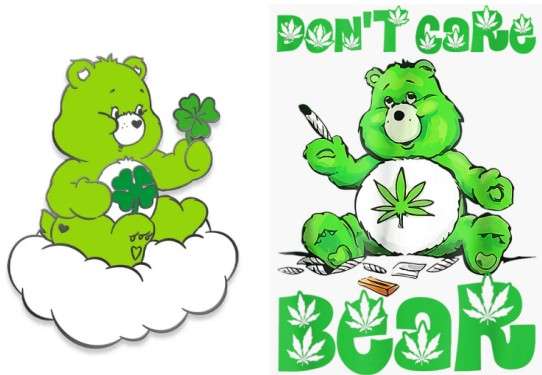
From Judge Arun Subramanian (S.D.N.Y.) Wednesday in Those Characters from Cleveland, LLC v. Schedule A Defendants:
[P]laintiff has failed to sufficiently address the potential fair use and First Amendment claims related to the products in question that use “Don’t Care Bears” (or a variation) along with marijuana imagery. Plaintiff relies heavily on the Supreme Court’s decision in Jack Daniel’s Props., Inc. v. VIP Prods. LLC (2023). There, the Supreme Court rejected a First Amendment defense to a dog toy that had the same shape and design as a bottle of Jack Daniel’s whiskey. But key to the Court’s holding was the fact that “the accused infringer ha[d] used a trademark to designate the source of its own goods—in other words, ha[d] used a trademark as a trademark.” The Court made clear that its opinion was “narrow” and its infringement holding only covered cases “when the challenged use of a mark is as a mark.”
That’s not the case here. The “Don’t Care Bears” defendants are not using the Care Bears marks as marks; unlike in Jack Daniels, for the most part, the products don’t look like the products that plaintiff sells. They don’t even use bears resembling Care Bears—some have teddy bears with bows, others have bears a-la the main character of Corduroy, still others have non-Care-Bears-looking bears that appear to have eaten too many Cheetos. For these, defendants seem to just be using “Care” and “Bear” as part of a phrase. So Jack Daniels is inapposite.
The other cases cited by plaintiff fare no better. Plaintiff first cites Cliffs Notes, Inc. v. Bantam Doubleday Dell Publishing Group, Inc. (2d Cir. 1989), for the proposition that “merely using someone else['s] trademark to promote your message is not parody.” True enough, but that doesn’t prove that using someone else’s trademark cannot be parody—or even that it isn’t in this case. Plaintiff next cites Dr. Seuss Enters., L.P. v. Penguin Books USA, Inc. (9th Cir. 1997), and Louis Vuitton Malletier S.A. v. My Other Bag, Inc. (S.D.N.Y. 2016), aff’d (2d Cir. 2017). Those cases stand for the proposition that parody must target the mark in some way, not just society as a whole. (A parody can extend beyond the mark in question, so long as it does target the mark in some way.)
Plaintiff says in conclusory fashion (with no citation to any evidence) that defendants are using plaintiff’s marks solely as “cultural commentary.” But the Court cannot conclude on the record before it that there is no commentary on plaintiff’s marks at all; the products could be seen as parodying the children’s cartoon characters as marijuana-smoking bears. After all, plaintiff itself points out how “marijuana-related imagery” contrasts with the “child focused” characters that epitomize “friendship, caring, and positivity.” the trademark infringement claims fail as well.
To be clear, the Court does not conclude definitively whether defendants would prevail on a fair use or First Amendment defense across the board. On a fuller record, plaintiff may well be correct that it is entitled to relief on its trademark infringement claims. But it has not met its burden for preliminary relief.
Finally, the Court addresses the copyright infringement claims. In the Court’s prior order, the Court noted that plaintiff had failed to rebut the argument that the products could have [been] subject to a prior authorized sale—which would mean any subsequent sale would not need any authorization. Plaintiff devotes only a few sentences to trying to rebut this potential defense, most of which are conclusory attorney argument devoid of any citation.
The only sentence with any alleged link to any evidence says that “Plaintiff has repeatedly reviewed its evidence and none of the products shown are authorized; none originate from Plaintiff.” But the evidence it cites—several paragraphs in a declaration—does not support that point. Most of the cited paragraphs are on irrelevant points. The closest the declaration gets to rebutting the defense is saying that “[n]one of the Defendants shown in Exhibit 3 has authorization or license to use the CARE BEARS IP for any purpose.” But even assuming the single conclusory statement in the declaration was enough to carry plaintiff’s evidentiary burden, the Court noted in the prior order that no authorization would be required if there was a prior sale, and plaintiff has put forward absolutely no evidence explaining why the Court could conclude on the current record that there was no prior sale.
Plaintiff must show why it can conclude from the website that the products cannot be resales. For example, if there is evidence that a particular product was never sold with the copyright owner’s permission in any country, then there might be grounds to conclude that it cannot be legitimate. But such an argument must be individualized and tie to specific products, not the blanket arguments that plaintiff has made.
Plaintiff may reapply for a temporary restraining order within 14 days. On any reapplication, plaintiff should both narrow its request to products that it can clearly show are infringing and make specific arguments as to each product listed, rather than summary arguments that do not directly reference any individual product. It should also ensure that any asserted copyrights and trademarks belong to it, rather than third parties not before the Court.
In narrowing its request, plaintiff should not include the products in its current application where there is only a trademark claim but no copyright claim. These products include the phrase “Don’t Care Bear” with a bear that does not look like a Care Bear. The Court concludes that plaintiff has not shown that it would likely succeed on its claim that a consumer would be confused since these products clearly use a bear that is not a Care Bear. Plaintiff should also consider the merits of each other claim by itself—focusing on claims strong enough to justify ex parte relief and addressing the merits of each individually….
The Court’s repeated rejection of plaintiff’s applications is not intended to be punitive. The Court realizes that many courts simply rubber stamp these applications to get them off their docket. But the relief plaintiff seeks is significant and ex parte. Under these circumstances, it’s important to enforce the rules and standards that apply to the granting of this kind of extraordinary relief….
For detailed criticism of these “Schedule A Defendants” lawsuits, which have become very common, see Eric Goldman’s A SAD Scheme of Abuse Intellectual Property Litigation and also the Zorro opinion.
The post Don’t Care Bears and Intellectual Property Law appeared first on Reason.com.
Source: https://reason.com/volokh/2026/04/27/dont-care-bears-and-intellectual-property-law/
Anyone can join.
Anyone can contribute.
Anyone can become informed about their world.
"United We Stand" Click Here To Create Your Personal Citizen Journalist Account Today, Be Sure To Invite Your Friends.
Before It’s News® is a community of individuals who report on what’s going on around them, from all around the world. Anyone can join. Anyone can contribute. Anyone can become informed about their world. "United We Stand" Click Here To Create Your Personal Citizen Journalist Account Today, Be Sure To Invite Your Friends.
LION'S MANE PRODUCT
Try Our Lion’s Mane WHOLE MIND Nootropic Blend 60 Capsules
Mushrooms are having a moment. One fabulous fungus in particular, lion’s mane, may help improve memory, depression and anxiety symptoms. They are also an excellent source of nutrients that show promise as a therapy for dementia, and other neurodegenerative diseases. If you’re living with anxiety or depression, you may be curious about all the therapy options out there — including the natural ones.Our Lion’s Mane WHOLE MIND Nootropic Blend has been formulated to utilize the potency of Lion’s mane but also include the benefits of four other Highly Beneficial Mushrooms. Synergistically, they work together to Build your health through improving cognitive function and immunity regardless of your age. Our Nootropic not only improves your Cognitive Function and Activates your Immune System, but it benefits growth of Essential Gut Flora, further enhancing your Vitality.

Our Formula includes: Lion’s Mane Mushrooms which Increase Brain Power through nerve growth, lessen anxiety, reduce depression, and improve concentration. Its an excellent adaptogen, promotes sleep and improves immunity. Shiitake Mushrooms which Fight cancer cells and infectious disease, boost the immune system, promotes brain function, and serves as a source of B vitamins. Maitake Mushrooms which regulate blood sugar levels of diabetics, reduce hypertension and boosts the immune system. Reishi Mushrooms which Fight inflammation, liver disease, fatigue, tumor growth and cancer. They Improve skin disorders and soothes digestive problems, stomach ulcers and leaky gut syndrome. Chaga Mushrooms which have anti-aging effects, boost immune function, improve stamina and athletic performance, even act as a natural aphrodisiac, fighting diabetes and improving liver function. Try Our Lion’s Mane WHOLE MIND Nootropic Blend 60 Capsules Today. Be 100% Satisfied or Receive a Full Money Back Guarantee. Order Yours Today by Following This Link.


| Visits: | 1,800,299,146 |
| Stories: | 8,628,872 |
Whistler Blowers, Insiders

