

Snubbing the Provinces to Court Xi: Is Carney in Need of Anger Management?

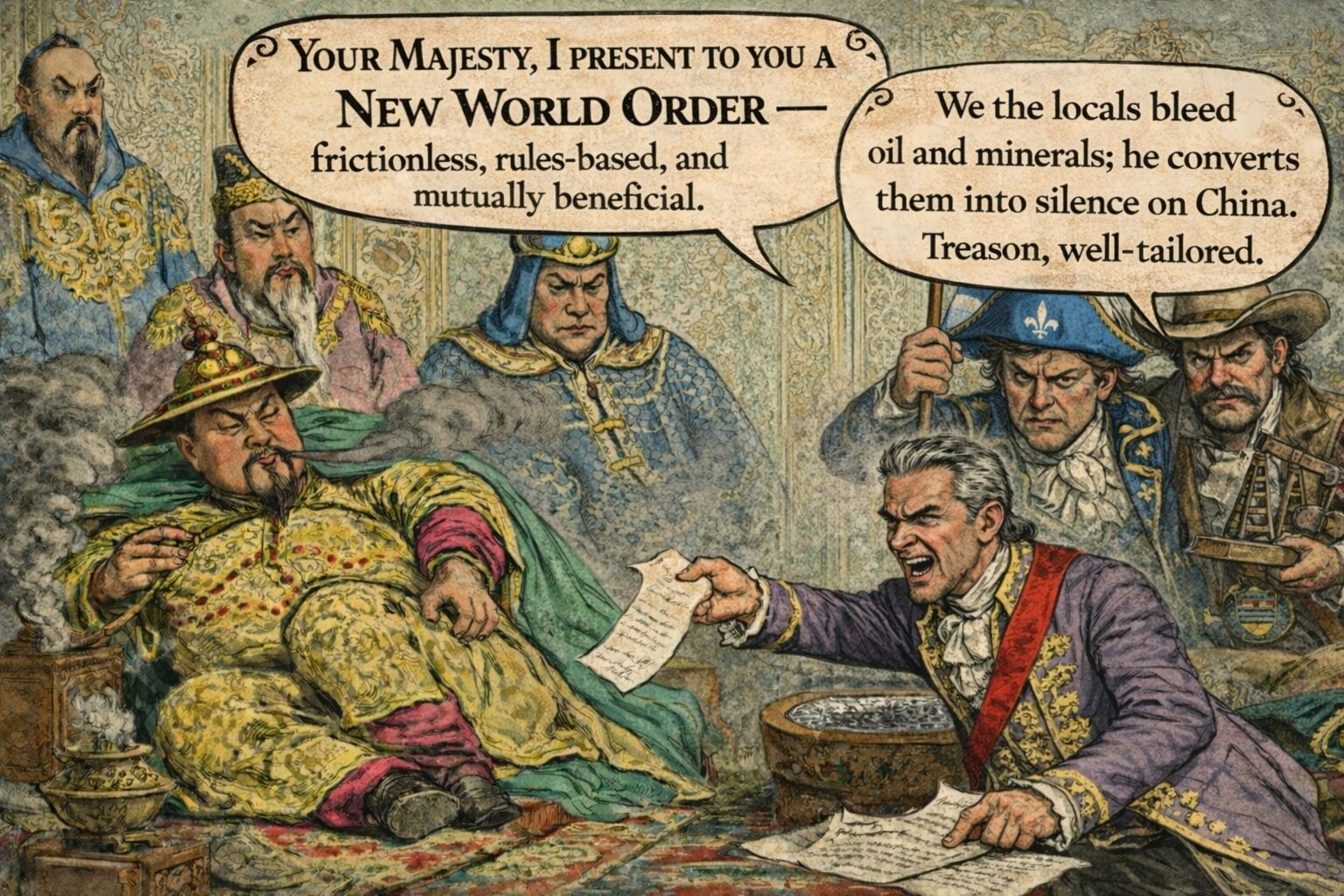
Facing Xi Jinping across a polished Beijing conference table—less a peer than a petitioner granted audience—Canadian Prime Minister Mark Carney declared that Canada was “set up well for the new world order.” The remark landed not as a strategy of trade diversification, but as a carefully choreographed kowtow, casting Canada in the obloquious role of an irritable middle power crossing the Pacific with the zeal of a court eunuch: eager to reassure an emperor while daring the prairie and Quebecer populists to absorb the snub. Carney’s January state visit to China—Canada’s first prime-ministerial foray in eight years—quickly produced headlines touting $4 billion in canola tariff relief and the announcement of a so-called ‘new strategic partnership,’ an institutionalized reset whose substance remained conspicuously thin, extending little beyond consultative dialogues and trade-facilitation committees. Yet the deeper story lay not in the press releases or handshake photos, but in the erratic motion beneath them. Canada’s foreign policy now swings like a toddler wielding scissors—so visibly that even Beijing itself declined to dignify the moment with a joint announcement. Indeed, Carney delivered the trade news alone, in a solo press appearance following the summit, a detail quietly emphasized when Global Times splashed front-page images of the Canadian prime minister speaking by himself, as if to underline who was indulging whom. The visit, then, was revealing not merely for the deals struck, but for the asymmetry it exposed: who Canada rushed to please, and whom it appeared willing to slight in exchange for short-term economic anesthesia.
Carney’s Situational Liberalism Awakens the Wrath of ‘We the Locals’ Populists in the Prairies and Quebec
In Alberta, the backlash initially assumed a sharper moral and constitutional edge—one that directly connected Ottawa’s foreign-policy posture to domestic legitimacy. Michael Kovrig, the former Canadian diplomat imprisoned in China for more than 1,000 days, warned that Carney’s Beijing visit risked squandering Canada’s hard-earned credibility on human rights. By emphasizing trade normalization while soft-pedaling issues of coercive diplomacy and political repression, Kovrig argued, Ottawa hollowed out its own claim to principled leadership, signaling that values were now negotiable when economic relief was at stake.
What Ottawa framed as pragmatic recalibration on China’s human-rights record soon collided in Alberta with long-standing anger over fiscal redistribution and energy policy, hardening a sense of alienation that fed the province’s separatist undercurrent. Weeks later, petition drives in central Alberta — including packed meetings in Red Deer — drew long lines of residents eager to sign on to a proposed independence referendum. Organizers reported strong turnout and enthusiasm, with roughly three in ten participants openly expressing support for leaving the federation altogether. The petition, if it reaches the required threshold, would force a province‑wide referendum later in the year, transforming diffuse resentment into a formal constitutional challenge
Alberta’s separatists have not limited themselves to domestic mobilization. Movement leaders have openly boasted of seeking audiences in the United States, even attempting to bend the ear of U.S. President Donald Trump and his circle to air grievances against Ottawa and to internationalize their cause. The spectacle of provincial activists shopping their complaints south of the border underscored how deeply federal authority has eroded in parts of the West. For many Alberta separatist critics, that erosion goes beyond economic decline and reflects a cumulative record of federal policy outcomes widely perceived as unfair: Alberta has been a net contributor under equalization payments since the mid‑1960s, contributing to redistribution while receiving none; pipeline conflicts culminated in the rejection of Northern Gateway (2016), the collapse of Energy East (2017), and the cancellation of Keystone XL (2021), reinforcing perceptions of federal obstruction even as Ottawa selectively intervened by purchasing and advancing Trans Mountain in 2018. Although Alberta gained three seats in the 2022 redistribution—holding 37 of 343 House seats (10.8 %) while representing roughly 11.6 % of the national population—representation debates still persist alongside ongoing economic grievances that endure even amid record oil production and profits in recent years.
Quebec’s response to Carney’s January visit to China followed a different but no less corrosive trajectory. In a January 12 social media post, Parti Québécois leader Paul St‑Pierre Plamondon denounced Carney’s “insane desire to suddenly forge an alliance with a totalitarian communist regime that already constitutes a threat to our national security, China,” while simultaneously voicing support for popular resistance against authoritarian rule elsewhere. What sovereigntist figures cast as a betrayal embedded in Carney’s China posture did not generate an entirely new grievance so much as strip the cover off a long‑simmering dispute with Ottawa over federal critical‑mineral governance—most clearly illustrated by the Barriere Lake mining case. In 2024, a Quebec court ruled that mining claims had been issued without proper consultation with the Mitchikanibikok Inik First Nation (Algonquins of Barriere Lake), reinforcing Quebec’s complaint that Ottawa’s drive to fast‑track critical‑mineral development routinely collides with constitutional consultation duties, legal predictability, and provincial authority over permitting.
Taken together, these provincial responses reveal the deeper consequence of Carney’s China gambit. What was presented as pragmatic liberal internationalism abroad has translated into fragmentation and suspicion at home—awakening resource localism both in the West and in Quebec. The visit exposed not just an asymmetry between Ottawa and Beijing, but a widening rift between Canada’s federal center and ‘We the locals’ it governs.
Source: https://foreignpolicyblogs.com/2026/02/19/snubbing-the-provinces-to-court-xi-is-carney-in-need-of-anger-management/
Anyone can join.
Anyone can contribute.
Anyone can become informed about their world.
"United We Stand" Click Here To Create Your Personal Citizen Journalist Account Today, Be Sure To Invite Your Friends.
Before It’s News® is a community of individuals who report on what’s going on around them, from all around the world. Anyone can join. Anyone can contribute. Anyone can become informed about their world. "United We Stand" Click Here To Create Your Personal Citizen Journalist Account Today, Be Sure To Invite Your Friends.
LION'S MANE PRODUCT
Try Our Lion’s Mane WHOLE MIND Nootropic Blend 60 Capsules
Mushrooms are having a moment. One fabulous fungus in particular, lion’s mane, may help improve memory, depression and anxiety symptoms. They are also an excellent source of nutrients that show promise as a therapy for dementia, and other neurodegenerative diseases. If you’re living with anxiety or depression, you may be curious about all the therapy options out there — including the natural ones.Our Lion’s Mane WHOLE MIND Nootropic Blend has been formulated to utilize the potency of Lion’s mane but also include the benefits of four other Highly Beneficial Mushrooms. Synergistically, they work together to Build your health through improving cognitive function and immunity regardless of your age. Our Nootropic not only improves your Cognitive Function and Activates your Immune System, but it benefits growth of Essential Gut Flora, further enhancing your Vitality.

Our Formula includes: Lion’s Mane Mushrooms which Increase Brain Power through nerve growth, lessen anxiety, reduce depression, and improve concentration. Its an excellent adaptogen, promotes sleep and improves immunity. Shiitake Mushrooms which Fight cancer cells and infectious disease, boost the immune system, promotes brain function, and serves as a source of B vitamins. Maitake Mushrooms which regulate blood sugar levels of diabetics, reduce hypertension and boosts the immune system. Reishi Mushrooms which Fight inflammation, liver disease, fatigue, tumor growth and cancer. They Improve skin disorders and soothes digestive problems, stomach ulcers and leaky gut syndrome. Chaga Mushrooms which have anti-aging effects, boost immune function, improve stamina and athletic performance, even act as a natural aphrodisiac, fighting diabetes and improving liver function. Try Our Lion’s Mane WHOLE MIND Nootropic Blend 60 Capsules Today. Be 100% Satisfied or Receive a Full Money Back Guarantee. Order Yours Today by Following This Link.


| Visits: | 1,796,264,355 |
| Stories: | 8,620,625 |
Whistler Blowers, Insiders

