

Why Hermeneutics is Like Interpreting ‘Sweet Home Alabama’ and ‘American Pie.’

Hermeneutics is often defined as the science and art of interpreting what people write (mostly) and speak. R.C. Sproul writes: “The purpose of hermeneutics is to establish guidelines and rules for interpretation. It is a well-developed science that can become technical and complex. Any written document is subject to misinterpretation and thus we have developed rules to safeguard us from such misunderstanding.”[1]
Milton Terry’s Biblical Hermeneutics runs 780 pages. Few Christians would ever attempt to learn how to interpret the Bible if they had to depend on such a large book to get started. The goal in learning how to interpret the Bible is to begin with what you already know about interpreting, since you have been applying hermeneutical principles all your life: Comparative literature, the works of Shakespeare, American literature, editorial writers, political candidates, movies, and even music.

With so much prophetic material in the Bible — somewhere around 25% of the total makeup of Scripture — it seems difficult to argue that an expert is needed to understand such a large portion of God’s Word and so many “experts” could be wrong generation after generation. If God’s Word is a lamp to our feet and a light to our path” (Psalm 119:105), how do we explain that not a lot of light has been shed on God’s prophetic Word and with so little accuracy? A Beginner’s Guide to Interpreting Bible Prophecy has been designed to help Christians of all ages and levels of experience to study Bible prophecy with confidence.
Consider the song “Sweet Home Alabama” by Lynyrd Skynyrd. To understand the lyrics, you will need to ask the following questions.
- Who wrote it?
- When was it written?
- Why was it written?
- What is the song’s historical context?
- What do the lyrics mean?
Are there any lyrical clues that tell the interpreter what it might be about (any mention of people, places, and events)?
-
“Well, I heard Mr. Young sing about her.” What does “her” refer to? “Her” is a reference to the South or “Southland,” a figure of speech called personification, “where a thing, quality, or idea is represented as a person.”
-
Who is “Mr. Young”? We learn later in the same stanza that “Mr. Young” has a first name — “Neil.” Neil Young is a musician who played with “Buffalo Springfield” and “Crosby, Stills, Nash and Young,” whose song “Ohio” is based on the Kent State shootings that took place on May 4, 1970. These dates and the significance of other songs might help identify Neil Young’s worldview.
-
Through some additional study, we learn that Neil Young had written two stereotypical songs about the South—“Southern Man” and “Alabama.” The song “Alabama,” less well known than “Southern Man,” helps explain why the band Lynyrd Skynyrd chose “Sweet Home Alabama,” since they are from Florida, not Alabama.
-
Further research informs us that “Sweet Home Alabama” was a response to these songs and their anti-Southern perspectives. “In his 2012 autobiography ‘Waging Heavy Peace,’ Young wrote of his role in the song’s creation, saying, ‘My own song “Alabama” richly deserved the shot Lynyrd Skynyrd gave me with their great record. I don’t like my words when I listen to it. They are accusatory and condescending, not fully thought out, and too easy to misconstrue.’”[2]
-
In addition, you will notice that “Sweet Home Alabama” includes some geography (Birmingham, Montgomery, and Muscle Shoals—all in Alabama), politics (“Watergate”), and sarcasm (“In Birmingham they love the governor … boo, boo, boo”), and a reference to “the Swampers”[3] who “have been known to pick a song or two.” Does “pick” mean “pick up” or “pick something out”? Most likely, it’s a reference to music, as in “pick the strings on a guitar,” which means play the guitar.
Who is “the governor”? Most likely a direct reference to George Wallace, who was the governor of Alabama and a staunch advocate of racial segregation during the 1960s and early 1970s. Consider Luke’s comment in Luke 2:2, “This was the first census taken while Quirinius was governor of Syria.” The governor is named. How will people 2000 years from now identify “the governor” in “Sweet Home Alabama?
- What does it mean to “feel blue”? How does one actually feel blue? Of course, “feel blue” is an idiom that has something to do with emotions. There is a music style called “the blues.”
Those who study the meaning of song lyrics follow a hermeneutical model. The events described in Billy Joel’s “We Didn’t Start the Fire” span about forty years of U.S. history. The lyrics include references to people, places, and events from four decades of world occurrences. Why did Joel write it. Now that’s a hermeneutical question.
Don McLean’s “American Pie” (what is that an allusion to?) is filled with historical references that have a specific meaning to the author of the song and are understood in terms of their historical context and their relevance to a particular era. But they are not written as a historical narrative. McLean has generally avoided responding to direct questions about the song’s lyrics. “They’re beyond analysis. They’re poetry.” McClean gave some insight into some of the song’s lyrics. He explained that the “marching band” refers to the military-industrial complex, “sweet perfume” refers to tear gas, and Los Angeles is the “coast” that the Trinity heads to (“caught the last train for the coast”), a comment that “even God has been corrupted.”
What meaning will be given to the lyrics of the song in 2000 years? The “science of interpretation” (hermeneutics) will be necessary.
History 101 is an overview course designed to help Christians understand their place in the historical timeline. With study materials in audio, video, and print, History 101 will give the student of history much to think about. This course will point the way forward by revealing how we got where we are. You will be fascinated and encouraged by the stories from ancient and not-so-ancient history.
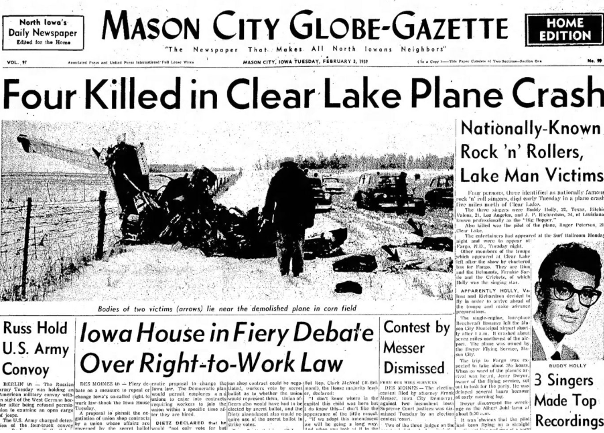
The repeated phrase “the day the music died” refers to a plane crash on February 3, 1959, that killed early rock and roll stars Buddy Holly, The Big Bopper, and Ritchie Valens, ending the era of early rock and roll; this became the popular nickname for that crash. The song’s theme goes beyond mourning McLean’s childhood music heroes, reflecting broader cultural changes and the profound disillusionment and loss of innocence of his generation. McClean was 13 years old “the day the music died.”
How does “music die”? It is a literary expression. All kinds of things die. In what way did McLean mean it? How would “February made me shiver/with every paper I’d deliver” be understood today? This was an era when newspapers were delivered to homes usually “on the doorstep.”
This is rarely done today. It would be like asking a teenager, “What were the Yellow Pages?” or “What did your grandparents mean when they talked about dialing the phone?” What’s a Rolodex?
The month of February is a cold month, but the use of “shiver” most likely refers to the front-page headline of the plane crash. The allusion to the Holy Trinity, “Father, Son, and Holy Ghost,” requires some understanding and a link to the three musicians killed in the plane crash.
Without some knowledge of the era’s history, the line “the day the music died” has no context, since Buddy Holly, Ritchie Valens, and the Big Bopper are never mentioned in the song. Knowing this helps with understanding the chronology of the other references. If we don’t understand this reference, then the entire song is an enigma.
McLean also said that the line “This’ll be the day that I die” originated in the 1956 John Wayne film The Searchers, a fantastic film, which also inspired Buddy Holly’s song “That’ll Be the Day.” Maybe it’s important to see that film for context.
Studying the Scriptures takes practice, and it’s important to put ourselves in the time when they were written to understand how the people who first read them, or had them read to them, understood the time, audience, and context.
[1] R. C. Sproul, Knowing Scripture (Downers Grove, IL: InterVarsity Press, 1977), 45.
[2] Neil Young, Waging Heavy Peace: A Hippie Dream (New York: Penguin Group, 2012), 417.
[3] The Swampers, also known as the Muscle Shoals Rhythm Section, are a legendary group of American session musicians based in Muscle Shoals, Alabama, renowned for their pivotal role in shaping the “Muscle Shoals sound”—a distinctive blend of R&B, soul, rock, and country music. The group, an all-white band, was formed in the 1960s and became one of the most influential studio bands in American music history. They provided the backing for iconic recordings by Aretha Franklin, Wilson Pickett, The Rolling Stones, Lynyrd Skynyrd, Paul Simon, Bob Dylan, and many others, contributing to over 500 recordings, including 75 gold and platinum hits. The nickname “The Swampers” was coined by producer Denny Cordell in reference to their “funky, soulful Southern ‘swamp sound,” and they were officially inducted into the Musicians Hall of Fame in 2008. See the fascinating 2013 documentary Muscle Shoals on Netflix.
American Vision’s mission is to Restore America to its Biblical Foundation—from Genesis to Revelation. American Vision (AV) has been at the heart of worldview study since 1978, providing resources to exhort Christian families and individuals to live by a Biblically based worldview. Visit www.AmericanVision.org for more information, content and resources
Source: https://americanvision.org/posts/why-hermeneutics-is-like-interpreting-sweet-home-alabama-and-american-pie-/
Anyone can join.
Anyone can contribute.
Anyone can become informed about their world.
"United We Stand" Click Here To Create Your Personal Citizen Journalist Account Today, Be Sure To Invite Your Friends.
Before It’s News® is a community of individuals who report on what’s going on around them, from all around the world. Anyone can join. Anyone can contribute. Anyone can become informed about their world. "United We Stand" Click Here To Create Your Personal Citizen Journalist Account Today, Be Sure To Invite Your Friends.
LION'S MANE PRODUCT
Try Our Lion’s Mane WHOLE MIND Nootropic Blend 60 Capsules
Mushrooms are having a moment. One fabulous fungus in particular, lion’s mane, may help improve memory, depression and anxiety symptoms. They are also an excellent source of nutrients that show promise as a therapy for dementia, and other neurodegenerative diseases. If you’re living with anxiety or depression, you may be curious about all the therapy options out there — including the natural ones.Our Lion’s Mane WHOLE MIND Nootropic Blend has been formulated to utilize the potency of Lion’s mane but also include the benefits of four other Highly Beneficial Mushrooms. Synergistically, they work together to Build your health through improving cognitive function and immunity regardless of your age. Our Nootropic not only improves your Cognitive Function and Activates your Immune System, but it benefits growth of Essential Gut Flora, further enhancing your Vitality.

Our Formula includes: Lion’s Mane Mushrooms which Increase Brain Power through nerve growth, lessen anxiety, reduce depression, and improve concentration. Its an excellent adaptogen, promotes sleep and improves immunity. Shiitake Mushrooms which Fight cancer cells and infectious disease, boost the immune system, promotes brain function, and serves as a source of B vitamins. Maitake Mushrooms which regulate blood sugar levels of diabetics, reduce hypertension and boosts the immune system. Reishi Mushrooms which Fight inflammation, liver disease, fatigue, tumor growth and cancer. They Improve skin disorders and soothes digestive problems, stomach ulcers and leaky gut syndrome. Chaga Mushrooms which have anti-aging effects, boost immune function, improve stamina and athletic performance, even act as a natural aphrodisiac, fighting diabetes and improving liver function. Try Our Lion’s Mane WHOLE MIND Nootropic Blend 60 Capsules Today. Be 100% Satisfied or Receive a Full Money Back Guarantee. Order Yours Today by Following This Link.


| Visits: | 1,784,422,709 |
| Stories: | 8,597,989 |
Whistler Blowers, Insiders

