

Hopscotching Through the Bible to Muddy the Clear Water

Jason Bradfield has written another article that mentions me and confuses me. The confusion began when he referred to “LXX Psalm 95:13” 14 times. There are only 11 verses in Psalm 95. I was thinking to myself, “What is he talking about?” After noting that this was a typo, I’m still not sure what point he is trying to make. Then I saw that he dragged me into his discussion about Matthew 24:14 and the use of oikoumenē. Then it became clear.
I was not going to bother answering it, but I had a lull in what started off as a busy day. I needed to write an article, so I decided to make a few comments. As of today, no one has commented on Bradfield’s article, and there are only two likes. I suspect he needs my name to get some traction for his articles. I’ve moved on from the Three Questions Letter controversy. There are bigger fish to fry.
There is a long history of skeptics turning to Bible prophecy to claim that Jesus was wrong about the timing of His coming at “the end of the age” (Matt. 24:3) and the signs associated with it. Noted atheist Bertrand Russell (1872-1970) is one of them and Bart Ehrman is a modern example. It’s obvious that neither Russell or Ehrman are aware of or are ignoring the mountain of scholarship that was available to them that showed that the prophecy given by Jesus was fulfilled in great detail just as He said it would be before the generation of His day passed away.
Quite a few years ago, I was teaching a Wednesday evening class in the chapel at Coral Ridge Presbyterian Church on Matthew 24. Unbeknownst to me, a woman born in Greece who spoke Greek approached me after the class. Yikes! She confirmed everything I said about Matthew 24:14. All preterists note that Jesus used the Greek word oikoumenē to describe what was going to take place in their world at that time. It’s standard preterist reasoning. The first time I saw this argument was in chapter 6 of J. Marcellus Kik’s book Matthew XXIV.
Here’s how Bradfield introduces his argument as “orthodox preterist.”
A popular interpretation, especially in orthodox and unorthodox preterist readings, limits the word to the Roman Empire, following its political usage in passages like Luke 2:1 (“a decree went out from Caesar Augustus that all the world should be registered”). On that reading, the verse was fulfilled in the apostolic age: the gospel reached the bounds of the Roman world, and then the “end” (the destruction of Jerusalem in AD 70) came.
It’s popular because that’s what the word means in this context, and that’s what his fellow “orthodox” preterists believe and teach. I could mention dozens of examples, as I have done repeatedly in the past 40 years!
Bradfield was among those who signed the “Three Questions Letter.” Kenneth Gentry also signed it. Ken wrote The Olivet Discourse Made Easy: You Can Understand Jesus’ Great Prophetic Discourse. Gentry spends four and a half pages presenting a view that is almost identical to mine. He uses the same line of reasoning in his debate with Thomas Ice in their book The Great Tribulation: Past for Future? Other signers like Douglas Wilson and Jeff Durbin would agree with Gentry, and so did R.C. Sproul. “The gospel was indeed preached in all that world in the first century, even before the fall of Jerusalem (Matthew: An Expositional Commentary, 644).
Bradfield wrote, “The lexical evidence does not merely fail to support the ‘oikoumene = Roman Empire’ reading of Matthew 24:14. It actively contradicts it.” If this is the case (and it isn’t), then he needs to get busy correcting a lot of people, not just me. He’s on a fool’s errand. Good luck.
For some reason, Bradfield goes to the Greek translation of Psalm 96:13, where he claims “the word [oikoumenē] arrives already loaded with a very different meaning. In the psalm, οἰκουμένη is not a political territory administered by Caesar.” Of course it’s not. Whoever said it is? He desperately tries to link Psalm 96:13 with Matthew 24:14. The Psalm has its own contextual meaning that the people who first read it understood it.
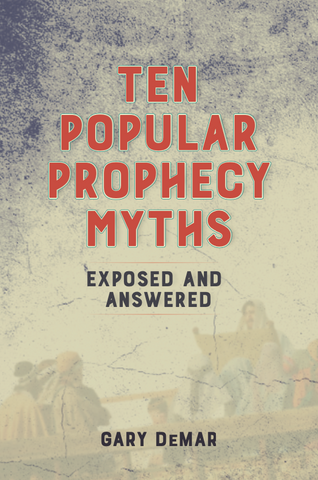
Bradfield claims that I believe and teach that oikoumenē only refers to the Roman Empire. I’ve never said any such thing. I wrote the following in chapter 8 of my book Ten Popular Prophecy Myths Exposed and Answered, which deals with every use of oikoumenē in the NT, a book Bradfield never mentions.
The English word “world” in Matthew 24:14 is based on the Greek word oikoumenē which is best translated as “inhabited earth” or “political boundary.” A number of modern translations (e.g., NASV and NIV) translate oikoumenē in Luke 2:1 as “inhabited earth,” but they don’t use the same translation in Matthew 24:14. The English Standard Version (ESV) follows the King James Version and translates oikoumenē as “world” in both cases. It’s hardly possible that Rome taxed the whole wide world or that anyone had knowledge of a famine that encompassed the entire globe (Acts 11:28). (page 130)
This is a standard preterist argument, and Gentry makes the same point in his commentary on the Olivet Discourse!
Since the reestablishment of Israel in 1948, “end-time” prophetic speculation has been on the rise. Millions of books have been sold proclaiming countless false prophecies. Many Christians are beginning to take a second look at the biblical prophetic record. A seismic shift in biblical eschatology is taking place around the world because Christians, some for the first time, are willing to challenge what they have been taught based on what the Bible actually says.
In the margin of Luke 2:1 in the NASB, where oikoumenē is translated “the inhabited earth,” there is this marginal note: “I.e., the Roman Empire.” This is from a non-preterist translation.[1]
Bradfield states the following in a note explaining “where” he’s “coming from.”
I still consider myself an orthodox preterist. I believe that some of the Olivet Discourse describes events that found fulfillment in the first century, particularly the destruction of Jerusalem in AD 70. But I also believe there are two different things at work in the discourse: the events of AD 70 and the “end” of history. The signs were for that generation; the end belongs to the unknown “that day and hour” of Matthew 24:36.
Given this explanation, Bradfield must believe that 24:14 was fulfilled based on verse 34: “This generation will not pass away until all these things take place.” That’s because verse 14 is before verse 36. One of the signs for that generation was the gospel being preached to the “whole oikoumenē.” And it was.
Bradfield omits the following verses from his article. Gentry also uses some of them in his “orthodox” preterist interpretation of Matthew 24:1-34.
• “Now there were Jews living in Jerusalem, devout men from every nation under heaven” (Acts 2:5).
• “First, I thank my God through Jesus Christ for you all, because your faith is being proclaimed throughout the world [kosmos] (Rom. 1:8).
• “But I say, surely they have never heard, have they? On the contrary: ‘THEIR VOICE HAS GONE OUT INTO ALL THE EARTH, AND THEIR WORDS TO THE ENDS OF THE WORLD [οἰκουμένης/oikoumenēs)]’” (Rom. 10:18)
• “if indeed you continue in the faith firmly established and steadfast and not shifting from the hope of the gospel that you have heard, which was proclaimed in all creation under heaven, and of which I, Paul, was made a minister” (Col. 1:23).
• “Beyond question, great is the mystery of godliness: He who was revealed in the flesh / Was vindicated in the Spirit / Seen by angels / Proclaimed among the nations / Believed on in the world [κόσμῳ, kosmō] / Taken up in glory” (1 Tim. 3:16).
• The “gospel … has been made known to all the nations, leading to obedience of faith” (Rom. 16:25).
Why doesn’t Bradfield mention these verses? Because they do not fit what he is trying to accomplish, which I’m not sure what that is. He goes hopscotching and meandering through the Bible to find verses he claims support his “orthodox” view, while ignoring verses that refute it. Whether it is oikoumenē or kosmos, what Jesus said in Matthew 24:14 was fulfilled before that generation passed away. As an “orthodox” preterist, Bradfield must also believe this.
[1] “According to TDNT: “hē oikouménē denotes the inhabited world and then comes into use for the Roman empire. In Philo it has primarily a general rather than a political sense. It is fairly common in the NT. In Mt. 24:14 the use is general; the gospel is for all nations. In Lk. 2:1, however, the reference is more political. The inhabited world is the point in Lk. 4:5 (Mt. 4:8 has kósmos) and Lk. 21:26 (cf. Acts 11:28; Rev. 3:10). Acts 17:6 and 19:27 are in accord with current Greek usage. Paul uses the term only in quoting Ps. 19:4 (Rom. 10:18). Heb. 1:6 and 2:5, however, reflect Hellenistic usage. The NT never contests the Roman claim that equates the oikouménē with the empire.”
American Vision’s mission is to Restore America to its Biblical Foundation—from Genesis to Revelation. American Vision (AV) has been at the heart of worldview study since 1978, providing resources to exhort Christian families and individuals to live by a Biblically based worldview. Visit www.AmericanVision.org for more information, content and resources
Source: https://americanvision.org/posts/hopscotching-through-the-bible-to-muddy-the-clear-water/
Anyone can join.
Anyone can contribute.
Anyone can become informed about their world.
"United We Stand" Click Here To Create Your Personal Citizen Journalist Account Today, Be Sure To Invite Your Friends.
Before It’s News® is a community of individuals who report on what’s going on around them, from all around the world. Anyone can join. Anyone can contribute. Anyone can become informed about their world. "United We Stand" Click Here To Create Your Personal Citizen Journalist Account Today, Be Sure To Invite Your Friends.
LION'S MANE PRODUCT
Try Our Lion’s Mane WHOLE MIND Nootropic Blend 60 Capsules
Mushrooms are having a moment. One fabulous fungus in particular, lion’s mane, may help improve memory, depression and anxiety symptoms. They are also an excellent source of nutrients that show promise as a therapy for dementia, and other neurodegenerative diseases. If you’re living with anxiety or depression, you may be curious about all the therapy options out there — including the natural ones.Our Lion’s Mane WHOLE MIND Nootropic Blend has been formulated to utilize the potency of Lion’s mane but also include the benefits of four other Highly Beneficial Mushrooms. Synergistically, they work together to Build your health through improving cognitive function and immunity regardless of your age. Our Nootropic not only improves your Cognitive Function and Activates your Immune System, but it benefits growth of Essential Gut Flora, further enhancing your Vitality.

Our Formula includes: Lion’s Mane Mushrooms which Increase Brain Power through nerve growth, lessen anxiety, reduce depression, and improve concentration. Its an excellent adaptogen, promotes sleep and improves immunity. Shiitake Mushrooms which Fight cancer cells and infectious disease, boost the immune system, promotes brain function, and serves as a source of B vitamins. Maitake Mushrooms which regulate blood sugar levels of diabetics, reduce hypertension and boosts the immune system. Reishi Mushrooms which Fight inflammation, liver disease, fatigue, tumor growth and cancer. They Improve skin disorders and soothes digestive problems, stomach ulcers and leaky gut syndrome. Chaga Mushrooms which have anti-aging effects, boost immune function, improve stamina and athletic performance, even act as a natural aphrodisiac, fighting diabetes and improving liver function. Try Our Lion’s Mane WHOLE MIND Nootropic Blend 60 Capsules Today. Be 100% Satisfied or Receive a Full Money Back Guarantee. Order Yours Today by Following This Link.


| Visits: | 1,795,869,598 |
| Stories: | 8,620,084 |
Whistler Blowers, Insiders

