

“Is Your Church Worth Invading?”

Albert Mohler asked this question in the July 2006 issue of TABLETALK, a monthly devotional published by Ligonier: “Is Your Church Worth Invading?” Good question. What will your church leadership do if the Federal Government and your state government and their courts tell your pastor to stop preaching against homosexuality and abortion or any other concocted political evil? Now is the time to discuss and plan for it.
In the book of Acts, the NT ekklēsia was a threat to the religious establishment and later to Rome. At one point, someone declared, “‘These men who have upset the world have come here also; and Jason has welcomed them, and they all act contrary to the decrees of Caesar, saying that there is another king, Jesus.’ They stirred up the crowd and the city authorities who heard these things. And when they had received a pledge from Jason and the others, they released them” (Acts 17:6-9).
If Christians kept the peace (and paid the fine), Rome was not concerned with them. They were not revolutionaries. The Jewish zealots were, and they paid a heavy price when they decided to go to war against Rome. But when Christians declared that Jesus was Lord, including all existing lords, trouble ensued. Nazi Germany is a perfect example. Don’t ever say it can’t happen here when it happened in Germany, where the Reformation was born.
Once we adopt a quietist and radical separationist perspective on Christ and culture, the tyrannical shoe will drop. In time, churches in Nazi Germany were “confined as far as possible to the performance of narrowly religious functions, and even within this narrow sphere [they] were subjected to as many hindrances as the Nazis dared to impose.” This assessment is from a 1945 report published by the Office of Strategic Services (OSS), the precursor to the CIA. The Nazi Master Plan: The Persecution of the Christian Churches was prepared for the War Crimes Staff. It offered the following summary: “This study describes, with illustrative factual evidence, Nazi purposes, policies and methods of persecuting the Christian Churches in Germany and occupied Europe.”
Where did the strategic plan begin? “Implementation of this objective started with the curtailment of religious instruction in the primary and secondary schools with the squeezing of the religious periods into inconvenient hours, with Nazi propaganda among the teachers in order to induce them to refuse the teaching of religion, with vetoing of . . . religious textbooks, and finally with substituting [a] Nazi Weltanschauung [worldview] and ‘German faith’ for Christian religious denominational instruction…. At the time of the outbreak of the war … religious instruction had practically disappeared from Germany’s primary schools.” This describes what has happened to our nation’s education system. A materialistic worldview and “secular” faith replaced the once Christian worldview that served as the foundation of education in America. Public (government) education in the United States is anti-Christian and anti-reason.
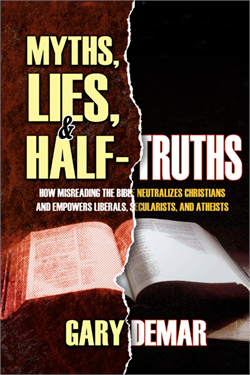
The next step was to neutralize the impact churches might have on politics. “Under the pretext that the Churches themselves were interfering in political and state matters, [the Nazis] would deprive the Churches, step by step, of all opportunity to affect German public life.” How often do we hear that the “separation between church and state” means churches must remain silent on social and political issues and that pastors cannot use their pulpits (unless they’re liberal) to influence legislation? The sad thing is many Christian pastors are OK with this and believe it’s the biblical way. See my book Myths, Lies, and Half Truths.
Like the Bereans of Paul’s day (Acts 17:11), Christians should check the veracity of all opinions against the only reliable standard of authority that God has placed in our hands: the Bible. This may mean a change in belief systems for some. There is no novelty in this. God confronted Peter directly about the inclusion of Gentiles into the household of faith (10:9–16). Paul confronted Peter “to his face” on a similar matter (Gal. 2:11–14). There are times when we all need to be knocked off our horse of mistaken opinions (Acts 9:4). “Testing” is a biblical mandate (2 Cor. 13:5; 1 John 4:1).
When Martin Niemoeller used his pulpit to expose Adolf Hitler’s radical politics, “He knew Nazi spies and secret agents reported every word spoken.”[1] Leo Stein’s book I Was in Hell with Niemoeller describes how the Gestapo gathered evidence against Niemoeller:
Now, the charge against Niemoeller was based entirely on his sermons, which the Gestapo agents had taken down stenographically. But in none of his sermons did Pastor Niemoeller exhort his congregation to overthrow the Nazi regime. He merely raised his voice against some of the Nazi policies, particularly the policy directed against the Church. He had even refrained from criticizing the Nazi government itself or any of its personnel. Under the former government his sermons would have been construed only as an exercise of the right of free speech. Now, however, written laws, no matter how explicitly they were worded, were subjected to the interpretation of the judges.[2]
In a June 27, 1937, sermon, Niemoeller made it clear that those in attendance had a sacred duty to speak out on the evils of the Nazi regime no matter the consequences: “We have no more thought of using our own powers to escape the arm of the authorities than had the Apostles of old. No more are we ready to keep silent at man’s behest when God commands us to speak. For it is, and must remain, the case that we must obey God rather than man.”[3] He was arrested a few days later. His crime? “Abuse of the pulpit.”
The “Special Courts” set up by the Nazis made claims against pastors who spoke out against Hitler’s policies. Niemoeller was not the only one singled out by the Gestapo. “Some 807 other pastors and leading laymen of the ‘Confessional Church’ were arrested in 1937, and hundreds more in the next couple of years.”[4] A group of Confessional Churches in Germany, founded by Pastor Niemoeller and other Protestant ministers, drew up a proclamation to confront the political changes taking place in Germany that threatened the people “with a deadly danger. The danger lies in a new religion,” the proclamation declared. “The church has by order of its Master to see to it that in our people Christ is given the honor that is proper to the Judge of the world…. The First Commandment says ‘Thou shalt have no other gods before me.’ The new religion is a rejection of the First Commandment.”[5] Five hundred pastors who read the proclamation from their pulpits were arrested. People protesting pro-abortion policies have been arrested in the United States while pregnancy centers have been attacked and some firebombed.
The Bible tells us that civil rulers are ministers of God. The Greek word translated as “ministers” is the same word used to describe church leaders and is often rendered as “deacon” or “servant.” Both serve as God’s servants toward the people within their jurisdictions, one civil (State) and the other ecclesiastical (Church). It is unbiblical to assume that civil rulers are autonomous and can legitimately rule independently of God’s designed limiting authority. It is a grave mistake to take Paul’s instructions in Romans 13 and claim that the citizenry cannot challenge the actions of civil rulers. James Willson makes the point in his book The Establishment and Limits of Civil Government, [6] “For surely none but an atheist can deliberately affirm that even the law of the land can set aside, weaken or nullify the authority of the law of God. To the best government, obedience can be yielded only in things lawful; for there is a ‘higher law’ to which rulers and subjects are alike amenable.”[7]
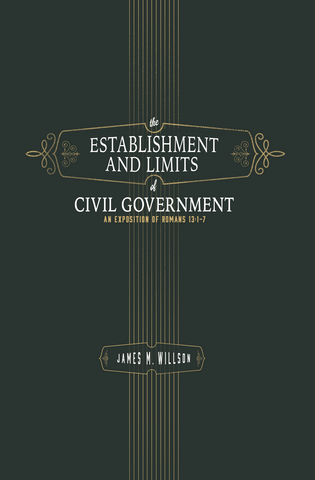
As civil government continues to increase in authority, power, and scope, too many Christians are under the false impression that they are obligated to endure the legislative acts handed down by government officials no matter how evil they may be. This is a simplistic and dangerous reading of Paul’s instructions in Romans 13. Elected officials are as equally bound to distinguish between good and evil in the area of civil government as are unelected citizens. Being a ruler offers no exemption. James Willson’s exposition of Romans 13 is a much-needed antidote to both the advocacy of passivity and rebellion that some are inclined to take.
One of the reasons King James I wanted a new English translation of the Bible was that he did not like some of the notes found in the Geneva Bible. These notes condemned rulers who adopted a divine right perspective. For example, a marginal note for Exodus 1:19 stated that the Hebrew midwives were correct to disobey the Egyptian king’s order to kill the Hebrew babies. King James reasoned that if it was legitimate to oppose a ruler in one case, then it might be legitimate to oppose him in others.
Civil authorities are to rule in terms of “good and evil.” Those who rule are bound by the same laws as the rest of us. That’s why there is no divine right of kings in the Bible. The Hebrew midwives disobeyed an order from Pharaoh (Ex. 1:17). The prophet Nathan challenged King David to do right (2 Sam. 12). Daniel was not a revolutionary when he opposed the king’s law (Dan. 6). John the Baptist rebuked King Herod for his sexual sins (Matt. 14:3-5). Jesus called Herod a “fox” (Luke 13:32). Peter continued to preach, obeying God rather than those in authority, even though he was commanded to stop by those in charge (Acts 5:29). Paul used his Roman citizenship to challenge the Roman Empire (Acts 16:22-40; 22:25-30) and even appealed to Caesar (25:11; 28:19). Paul spent a great deal of time in prison because he was seen as a possible threat to the Empire, even being bound by a chain (Acts 28:20)
To obey Romans 13 is to call our civil officials to uphold their oath of office, an oath that nearly all of them took by affirming “So help me God!” Once a civil ruler takes political office, he has the “power of the sword,” that is, he has civil authority and the claim of governmental legitimacy to enforce the law using civil sanctions. By not limiting the power of civil government with our voices and votes, we give a free hand to officials to act independently of any human restraint to tax our income at any level, confiscate our property, send our children to war, and even execute us. And who gets to determine what constitutes a crime? Civil rulers alone unless they are held accountable for their actions by the electorate. But only an informed electorate is in the position to act as a brake on the unbridled power of the State.
According to a radio editorial some years ago, “a man’s religion and the strength of his conviction are his own personal matter” and therefore “religion should not interfere with politics.”[8] Of course, this too is an expression of humanist “neutrality” designed to silence Christians but allow for every other conceivable worldview to find expression in the public and political arenas.
Let’s apply the neutrality logic to Germany in the 1930s and 1940s. Should the churches have remained neutral because they were churches, and their denouncement of Hitler and his policies would have been fundamentally religious? In fact, this is exactly what many churches did do and for what they believed were sound theological reasons. “Religion was a private matter that concerned itself with the personal and moral development of the individual. The external order—nature, scientific knowledge, statecraft—operated on the basis of its own internal logic and discernible laws.”[9]
Christians were told they had to submit to this external order because the State was seen as the autonomous authority for public order. The church’s sole concern was man’s spiritual life. The church followed one set of religious rules, while the State took a religiously “neutral” position. “The Erlangen church historian Hermann Jorda declared in 1917 that the state, the natural order of God, followed its own autonomous laws while the kingdom of God was concerned with the soul and operated separately on the basis of the morality of the gospel.”[10] It was because of this disjunction—built on the myth of neutrality—that Hitler could carry out his devilish schemes unhindered by most religious people. The “Confessional Church,” however, took a different, non-neutral, position:
[It] opposed the Nazification of the Protestant churches, rejected the Nazi racial theories and denounced the anti-Christian doctrines of Rosenberg and other Nazi leaders. In between lay the majority of Protestants, who seemed too timid to join either of the two warring groups, who sat on the fence and eventually, for the most part, landed in the arms of Hitler, accepting his authority to intervene in church affairs and obeying his commands without open protest.[11]
Those “who sat on the fence,” having fallen for the neutrality myth, supported Hitler by default. While they did not openly join with the “German Christians,” a pro-Hitler alliance of ministers and churches, their inaction “landed them in the arms of Hitler” anyway. So much for neutrality and being at peace with the world.
[1] Basil Miller, Martin Niemoeller: Hero of the Concentration Camp, 5th ed. (Grand Rapids, MI: Zondervan, 1942), 112.
[2] Leo Stein, I Was in Hell with Niemoeller (New York: Fleming H. Revell, 1942), 175.
[3] Quoted in William L. Shirer, The Rise and Fall of the Third Reich (New York: Simon and Schuster, 1960), 239.
[4] Shirer, The Rise and Fall of the Third Reich, 239.
[5] Quoted in Eugene Davidson, The Trials of the Germans: An Account of the Twenty-Two Defendants before the International Military Tribunal at Nuremberg (Columbia, MO: University of Missouri Press, [1966] 1997), 275.
[6] James Willson’s The Establishment and Limits of Civil Government was originally published in 1853 as Civil Government: An Exposition of Romans XIII. 1–7.
[7] Willson, The Establishment and Limits of Civil Government, 22
[8] Heard on WGST, Atlanta, Georgia (September 12, 1986).
[9] Richard V. Pierard, “Why Did Protestants Welcome Hitler?,” Fides et Historia (North Newton, KS: The Conference on Faith and History), X:2 (Spring 1978), 13
[10] Pierard, “Why Did Protestants Welcome Hitler?,” 14.
[11] William L. Shirer, The Rise and Fall of the Third Reich (New York: Simon and Schuster, 1960), 236. Emphasis added.
American Vision’s mission is to Restore America to its Biblical Foundation—from Genesis to Revelation. American Vision (AV) has been at the heart of worldview study since 1978, providing resources to exhort Christian families and individuals to live by a Biblically based worldview. Visit www.AmericanVision.org for more information, content and resources
Source: https://americanvision.org/posts/is-your-church-worth-invading-/
Anyone can join.
Anyone can contribute.
Anyone can become informed about their world.
"United We Stand" Click Here To Create Your Personal Citizen Journalist Account Today, Be Sure To Invite Your Friends.
Before It’s News® is a community of individuals who report on what’s going on around them, from all around the world. Anyone can join. Anyone can contribute. Anyone can become informed about their world. "United We Stand" Click Here To Create Your Personal Citizen Journalist Account Today, Be Sure To Invite Your Friends.
LION'S MANE PRODUCT
Try Our Lion’s Mane WHOLE MIND Nootropic Blend 60 Capsules
Mushrooms are having a moment. One fabulous fungus in particular, lion’s mane, may help improve memory, depression and anxiety symptoms. They are also an excellent source of nutrients that show promise as a therapy for dementia, and other neurodegenerative diseases. If you’re living with anxiety or depression, you may be curious about all the therapy options out there — including the natural ones.Our Lion’s Mane WHOLE MIND Nootropic Blend has been formulated to utilize the potency of Lion’s mane but also include the benefits of four other Highly Beneficial Mushrooms. Synergistically, they work together to Build your health through improving cognitive function and immunity regardless of your age. Our Nootropic not only improves your Cognitive Function and Activates your Immune System, but it benefits growth of Essential Gut Flora, further enhancing your Vitality.

Our Formula includes: Lion’s Mane Mushrooms which Increase Brain Power through nerve growth, lessen anxiety, reduce depression, and improve concentration. Its an excellent adaptogen, promotes sleep and improves immunity. Shiitake Mushrooms which Fight cancer cells and infectious disease, boost the immune system, promotes brain function, and serves as a source of B vitamins. Maitake Mushrooms which regulate blood sugar levels of diabetics, reduce hypertension and boosts the immune system. Reishi Mushrooms which Fight inflammation, liver disease, fatigue, tumor growth and cancer. They Improve skin disorders and soothes digestive problems, stomach ulcers and leaky gut syndrome. Chaga Mushrooms which have anti-aging effects, boost immune function, improve stamina and athletic performance, even act as a natural aphrodisiac, fighting diabetes and improving liver function. Try Our Lion’s Mane WHOLE MIND Nootropic Blend 60 Capsules Today. Be 100% Satisfied or Receive a Full Money Back Guarantee. Order Yours Today by Following This Link.


| Visits: | 1,832,705,737 |
| Stories: | 8,708,821 |
Whistler Blowers, Insiders

