

A new paper describing the feeding apparatus of Silurian cornulitids from China: More evidence supporting placement of this group in the lophophorates

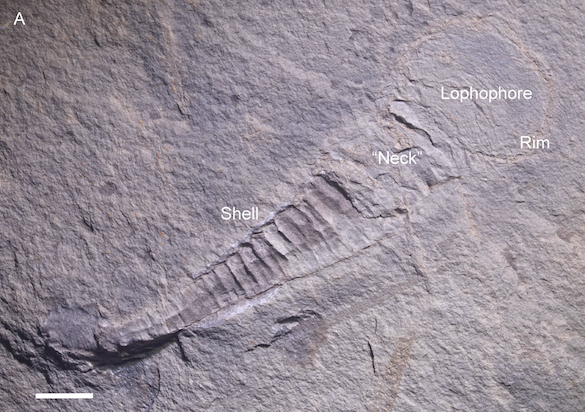 It was my privilege to join an Estonian-Polish-Chinese-American team interpreting partial soft-tissue preservation of the feeding devices of Silurian cornulitids, which are extinct Paleozoic organisms that constructed small conical, ribbed tubes. Cornulitids are very common sclerobionts (hard-substrate dwellers) in the Upper Ordovician Cincinnatian Group of Indiana, Kentucky and Ohio, so these are familiar fossils to Wooster geologists. Now we know a little bit more about their paleobiology. Our new paper can be downloaded here.
The top image is from Figure 3A of Vinn et al. (2026). It is Cornulites cf. cellulosus (HWR007a) showing a fully protracted likely lophophore (filter-feeding device). Scale bar is 5 mm.
Abstract.–Circular structures observed at the apertures of several Cornulites specimens from the earliest Silurian of China are interpreted as possible fossilized remains of a lophophore with a simple, ring-like morphology. These structures may represent partial preservation of the feeding apparatus, with the absence of tentacle preservation likely resulting from taphonomic processes. The preserved rim surrounding the circular structure likely reflects the thickness of the lophophore and its tentacles, while a neck-like extension visible in one specimen is interpreted as the basal region of the lophophore. Specimens displaying a partially extended lophophore suggest that Cornulites individuals may have been capable of retracting their lophophore entirely into the shell, between feeding episodes, although complete retraction remains speculative. These partial soft-tissue remains support the classification of cornulitids as lophophorates. However, the available evidence remains insufficient to definitively resolve whether cornulitids are more closely related to bryozoans or phoronids. As the only shelled benthic fossils in the Huangshi deposits, cornulitids seemed to have been opportunistic organisms which were able to colonize and thrive in oxygen-deficient palaeoenvironments following the Late Ordovician mass extinction.
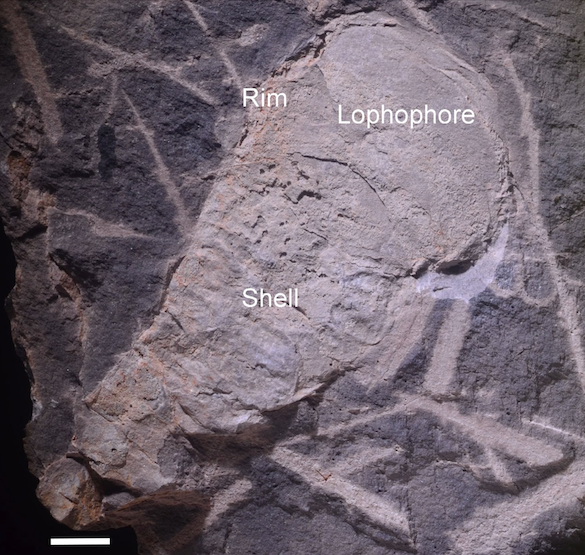 From Figure 4 of Vinn et al. (2026). Cornulites sp. (specimen HWR072a-1) interpreted as showing a partially retracted lophophore. Scale bar is 5 mm.
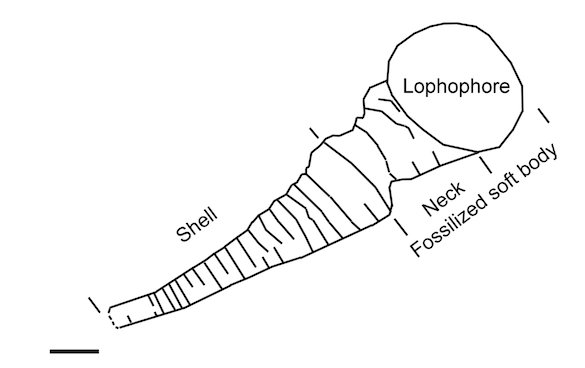 From Figure 5 of Vinn et al. (2026). Schematic line drawing of Cornulites cf. cellulosus (HWR007a) showing a fully protracted lophophore. Scale bar 5 mm.
 Cornulitids are old friends to those Wooster geologists who studied Ordovician fossils in paleo courses. This is the genus Cornulites Schlotheim 1820, specifically Cornulites flexuosus (Hall 1847). It was found in the Whitewater Formation (Late Ordovician, Katian) during a College of Wooster field trip to southeastern Indiana (C/W-148; N 39.78722°, W 84.90166°).
I thank my international co-authors for inviting me to join this team.
Reference:
Vinn, O., Zong, R., Wilson, M.A., Liu, Y. and Zatoń, M. 2026. Partially preserved cornulitid feeding apparatuses from the lowest Silurian of South China support the lophophorate affinities of this enigmatic group. Lethaia https://doi.org/10.18261/let.59.3
Source: https://woostergeologists.scotblogs.wooster.edu/2026/01/17/a-new-paper-describing-the-feeding-apparatus-of-silurian-cornulitids-from-china-more-evidence-supporting-placement-of-this-group-in-the-lophophorates/
Anyone can join.
Anyone can contribute.
Anyone can become informed about their world.
"United We Stand" Click Here To Create Your Personal Citizen Journalist Account Today, Be Sure To Invite Your Friends.
Before It’s News® is a community of individuals who report on what’s going on around them, from all around the world. Anyone can join. Anyone can contribute. Anyone can become informed about their world. "United We Stand" Click Here To Create Your Personal Citizen Journalist Account Today, Be Sure To Invite Your Friends.
LION'S MANE PRODUCT
Try Our Lion’s Mane WHOLE MIND Nootropic Blend 60 Capsules
Mushrooms are having a moment. One fabulous fungus in particular, lion’s mane, may help improve memory, depression and anxiety symptoms. They are also an excellent source of nutrients that show promise as a therapy for dementia, and other neurodegenerative diseases. If you’re living with anxiety or depression, you may be curious about all the therapy options out there — including the natural ones.Our Lion’s Mane WHOLE MIND Nootropic Blend has been formulated to utilize the potency of Lion’s mane but also include the benefits of four other Highly Beneficial Mushrooms. Synergistically, they work together to Build your health through improving cognitive function and immunity regardless of your age. Our Nootropic not only improves your Cognitive Function and Activates your Immune System, but it benefits growth of Essential Gut Flora, further enhancing your Vitality.

Our Formula includes: Lion’s Mane Mushrooms which Increase Brain Power through nerve growth, lessen anxiety, reduce depression, and improve concentration. Its an excellent adaptogen, promotes sleep and improves immunity. Shiitake Mushrooms which Fight cancer cells and infectious disease, boost the immune system, promotes brain function, and serves as a source of B vitamins. Maitake Mushrooms which regulate blood sugar levels of diabetics, reduce hypertension and boosts the immune system. Reishi Mushrooms which Fight inflammation, liver disease, fatigue, tumor growth and cancer. They Improve skin disorders and soothes digestive problems, stomach ulcers and leaky gut syndrome. Chaga Mushrooms which have anti-aging effects, boost immune function, improve stamina and athletic performance, even act as a natural aphrodisiac, fighting diabetes and improving liver function. Try Our Lion’s Mane WHOLE MIND Nootropic Blend 60 Capsules Today. Be 100% Satisfied or Receive a Full Money Back Guarantee. Order Yours Today by Following This Link.


| Visits: | 1,818,277,529 |
| Stories: | 8,665,863 |
Whistler Blowers, Insiders

