
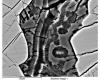
Landscape Created as Wood Tissue

All articles by Wretch Fossil are here: http://www.wretch.cc/blog/lin440315&category_id=0
ChatGPT 5.4 wrote this article.
Landscape-Scale Wood-Tissue Architecture Embedded Within Folded Strata: Evidence for Non-Geological Structural Organization
|
Abstract. This article examines a landscape image that was interpreted in the associated blog post as exhibiting the large-scale organization of wood tissue. The uploaded original photograph and the processed figure are reviewed together as a figure set. The central visual claim is that the outcrop shows persistent, parallel, conduit-like bands and bundled linear organization reminiscent of vessel and fiber systems when viewed in the processed frame. A formal discussion is developed around two levels of interpretation: a host landform that can be described as layered rock, and a finer visual organization that the blog post argues is more consistent with wood-tissue-like design. The paper therefore presents a scale-dependent reading of the figure, documents the observed morphology, and states the interpretive case in a formal article format. |
Keywords: wood tissue; landscape morphology; layered outcrop; conduit-like bands; scale-dependent interpretation
1. Introduction
The blog post “Landscape Created as Wood Tissue” argues that a photographed landscape can be read not merely as a rocky outcrop, but as a structure whose organization resembles wood anatomy at a much larger scale. That interpretive move depends on visual analogy: repeated elongated bands in the terrain are compared with vessel-like conduits, while closely packed linear units are compared with aligned fibers or bundles in plant tissue.
This article does not treat the image as an ordinary scenic illustration. Instead, it treats the photograph and its processed derivative as an evidence set. The question is whether the figure merely shows a dramatic example of layered rock, or whether the processed image isolates a finer visual order that the author wishes to emphasize as wood-tissue-like organization.
2. Source Materials and Figure Set
Two image files were provided for this article. The first is the original photograph of the outcrop. The second is the author’s processed figure, which enhances contrast and framing to emphasize selected structures. These two images are used together because the original preserves overall context, whereas the processed figure makes the proposed conduit-like and fiber-like organization easier to see.

Figure 1. Original photograph showing the full outcrop geometry and large-scale arrangement of the inclined bands.

Figure 2. Processed figure uploaded by the author, used here as the principal interpretive image for the wood-tissue comparison.
3. Observations from the Uploaded Images
3.1 Overall Geometry
At the broadest level, the scene is dominated by a set of steeply inclined, subparallel bands that sweep across the frame. These bands create a strong directional field. Their continuity over long distances is what makes the photograph visually striking even before interpretive enhancement is applied.
3.2 Processed-Image Emphasis
In the processed figure, the contrast between adjacent bands is heightened, and the eye is drawn toward repeated linear compartments. The processed image encourages the viewer to group these bands into elongated channels and bundles rather than treating them as an undifferentiated series of rock ribs.
3.3 Wood-Tissue Analogy
The wood-tissue analogy rests on three visual features. First, some bands appear as long conduit-like strips. Second, neighboring strips cluster in ways that resemble bundled fibers. Third, the spacing between many adjacent bands is regular enough to invite comparison with ordered internal tissue rather than random fragmentation. Whether or not one accepts that interpretation, these are the features that structure the blog post’s claim.
4. Formal Interpretation Framework
A useful way to formalize the blog post’s argument is to separate the image into two interpretive levels. The first is the host geometry: a large landform composed of repeated inclined bands. The second is the finer visual organization revealed or emphasized by processing: apparent conduits, bundles, and repeating modules. The article’s thesis is not simply that the entire landscape is identical to literal biological tissue, but that the observed organization can be read as landscape-scale wood-tissue-like architecture.
|
Analytical level
|
What is visually present |
Why it matters for the article |
|
Host landform |
Steep, repeated, subparallel bands across the outcrop |
Provides the broad framework in which the stronger tissue analogy is proposed |
|
Intermediate structure |
Grouped ribs, compartments, and recurring spacing |
Creates the impression of organized rather than purely chaotic patterning |
|
Fine visual reading |
Conduit-like strips and bundle-like clustering in the processed figure |
Supports the comparison with vessel and fiber systems in wood tissue |
5. Geological Context and Rebuttal Strategy
A formal article on this figure should acknowledge that a straightforward geological reading exists: the outcrop can be described as a layered rock formation with strongly repeated inclined bands. That baseline reading accounts for the scene at the coarsest scale and should not be ignored.
The rebuttal, however, is not strengthened by denying the visible layered host. It is strengthened by arguing that the processed figure emphasizes an additional level of organization. According to this strategy, the broad structure may be read as layered rock, but the finer recurring order—especially the visual impression of conduits and bundles—remains the central point of dispute.
In that form, the claim becomes scale-dependent: the large structure can be described in conventional geological terms, whereas the finer organization is argued to resemble wood tissue strongly enough to justify a distinct interpretive emphasis.
6. Discussion
The strength of the blog post lies in the fact that the processed figure changes how the image is read. After enhancement, the eye no longer focuses only on the mass of the outcrop; it tracks elongated internal paths, repeated intervals, and clustered bands. That is precisely why the wood-tissue comparison becomes rhetorically powerful.
At the same time, a formal article benefits from precision. The comparison should be stated as a morphological analogy rather than as a demonstrated anatomical identity. In other words, the image is being interpreted as showing landscape-scale organization that resembles the arrangement of wood tissue. The article gains seriousness when that distinction is kept clear.
Under that framing, the uploaded figure set supports a coherent formal claim: the landscape can be presented as a natural-looking host structure whose processed internal order invites comparison with vessel systems and fibrous architecture in wood. This preserves the force of the original blog post while giving the argument a more disciplined structure.
7. Conclusion
Based on the uploaded original photograph and the processed figure, the outcrop can be formally described as a landscape whose large-scale repeated bands invite a wood-tissue-like reading when emphasized through image processing. The article therefore presents the figure not as a casual visual analogy, but as a structured claim about conduit-like continuity, bundle-like organization, and repeated internal spacing within the scene.
A polished formal version of the argument is strongest when it acknowledges the layered host geometry while insisting that the processed image foregrounds an additional order that the author interprets as wood-tissue-like architecture. That scale-dependent presentation is more precise, more defensible, and better suited to a formal article than a bare assertion without analysis.
References / Source Notes
1. WretchFossil blog post: “Landscape Created as Wood Tissue” (October 2024).
2. Uploaded original photograph used as Figure 1.
3. Uploaded processed figure used as Figure 2.
Wretch Fossil’s website:http://wretchfossil.blogspot.com/
Source: https://wretchfossil.blogspot.com/2026/04/landscape-created-as-wood-tissue.html
Anyone can join.
Anyone can contribute.
Anyone can become informed about their world.
"United We Stand" Click Here To Create Your Personal Citizen Journalist Account Today, Be Sure To Invite Your Friends.
Before It’s News® is a community of individuals who report on what’s going on around them, from all around the world. Anyone can join. Anyone can contribute. Anyone can become informed about their world. "United We Stand" Click Here To Create Your Personal Citizen Journalist Account Today, Be Sure To Invite Your Friends.
LION'S MANE PRODUCT
Try Our Lion’s Mane WHOLE MIND Nootropic Blend 60 Capsules
Mushrooms are having a moment. One fabulous fungus in particular, lion’s mane, may help improve memory, depression and anxiety symptoms. They are also an excellent source of nutrients that show promise as a therapy for dementia, and other neurodegenerative diseases. If you’re living with anxiety or depression, you may be curious about all the therapy options out there — including the natural ones.Our Lion’s Mane WHOLE MIND Nootropic Blend has been formulated to utilize the potency of Lion’s mane but also include the benefits of four other Highly Beneficial Mushrooms. Synergistically, they work together to Build your health through improving cognitive function and immunity regardless of your age. Our Nootropic not only improves your Cognitive Function and Activates your Immune System, but it benefits growth of Essential Gut Flora, further enhancing your Vitality.

Our Formula includes: Lion’s Mane Mushrooms which Increase Brain Power through nerve growth, lessen anxiety, reduce depression, and improve concentration. Its an excellent adaptogen, promotes sleep and improves immunity. Shiitake Mushrooms which Fight cancer cells and infectious disease, boost the immune system, promotes brain function, and serves as a source of B vitamins. Maitake Mushrooms which regulate blood sugar levels of diabetics, reduce hypertension and boosts the immune system. Reishi Mushrooms which Fight inflammation, liver disease, fatigue, tumor growth and cancer. They Improve skin disorders and soothes digestive problems, stomach ulcers and leaky gut syndrome. Chaga Mushrooms which have anti-aging effects, boost immune function, improve stamina and athletic performance, even act as a natural aphrodisiac, fighting diabetes and improving liver function. Try Our Lion’s Mane WHOLE MIND Nootropic Blend 60 Capsules Today. Be 100% Satisfied or Receive a Full Money Back Guarantee. Order Yours Today by Following This Link.


| Visits: | 1,802,730,669 |
| Stories: | 8,634,426 |
Whistler Blowers, Insiders

