
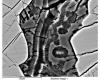
Earthlings and Martians Made the Same Structures: Vessel-Element-Like Artificial Forms in Bolivia and Mars

All articles by Wretch Fossil are here: http://www.wretch.cc/blog/lin440315&category_id=0
Abstract (ChatGPT wrote this article.)
This article presents a comparative morphological analysis of three image-based observations from Valle de las Ánimas, or “Valley of the Souls,” near La Paz, Bolivia. The analyzed figures, processed by color enhancement using the Zeke filter and enlarged by 800%, show large, regular, elongated structures marked by red arrows and red lines. These structures are interpreted as man-made forms that imitate or reproduce the morphology of vessel elements, a type of wood cell. The central argument is that the Bolivian structures are too regular to be ordinary geological formations and too large to be natural fossils, especially where human fingers or forearms provide approximate scale context. These Earth structures are further compared with small, regular Martian patterns previously interpreted as artificial. The repeated resemblance between Earth and Mars structures suggests a possible technological or artificial structural tradition expressed at different scales and in different planetary settings.
Introduction
Valle de las Ánimas near La Paz, Bolivia, is commonly viewed as a geological landscape. However, the three Flickr posts examined here propose a different interpretation: that selected structures in the valley are not ordinary rocks, but remnants of prehistoric high-technology construction. The posts emphasize that the marked structures are highly regular, elongated, and vessel-element-like, resembling organized biological or bio-inspired architecture rather than random erosion.
The first post, titled “Earthlings and Martians Made Same Structures,” argues that red-arrowed structures in a Bolivian image resemble tiny patterns of Martian man-made structures. It states that the structures are “too regular to be geological and too large to be natural fossils,” with human forearms used as a scale reference. (Flickr)
The second post, “Prehistoric High-Tech in Bolivia,” identifies red arrows and red lines marking structures interpreted as man-made imitations of vessel elements, a type of wood cell. (Flickr)
The third post, “Prehistoric High-Tech Mistaken for Rocks,” reinforces the same claim and notes that human fingers in the figure show that the structures are too large to be natural fossils. (Flickr)
Together, these observations support a broader thesis: some structures on Earth and Mars may share a common artificial morphology based on elongated, repeated, wood-cell-like or vessel-element-like forms.
Materials and Methods
The study is based on three Flickr posts by Liangtai Lin / Wretch Fossil:
-
Earthlings and Martians Made Same Structures
The subject figure shows Valle de las Ánimas near La Paz, Bolivia. The image was enhanced with the Zeke filter and enlarged by 800%. Red arrows identify structures interpreted as man-made and as resembling Martian artificial patterns. (Flickr) -
Prehistoric High-Tech in Bolivia
The subject figure also shows Valle de las Ánimas. Red arrows and red lines mark structures interpreted as man-made forms imitating vessel elements, a type of wood cell. The image was likewise processed with the Zeke filter and enlarged by 800%. (Flickr) -
Prehistoric High-Tech Mistaken for Rocks
This figure again shows Valle de las Ánimas. Red arrows identify large, regular, vessel-element-like structures. Human fingers visible in the figure are used as a scale reference, supporting the argument that the structures are too large to be natural fossils. (Flickr)
The method is comparative and morphological. The structures are evaluated according to five criteria:
-
regularity of outline;
-
repetition of elongated forms;
-
resemblance to vessel elements or wood-cell-like architecture;
-
scale incompatibility with ordinary natural fossils;
-
resemblance to previously identified Martian artificial patterns.
Results1. Large Regular Structures in Valle de las Ánimas
All three posts identify large structures in Valle de las Ánimas that are visually distinct from ordinary surrounding rock. Their forms appear elongated, bounded, and repeated. The author marks these structures using red arrows or red lines and argues that they are not random geological products.
The most important observation is regularity. Natural rocks can fracture, erode, and weather into many shapes, but the cited structures are interpreted as having organized boundaries and repeated morphology. This regularity is central to the artificial-origin argument.
2. Vessel-Element-Like Morphology
The second and third posts explicitly describe the marked structures as imitating the shape of vessel elements, a type of wood cell. (Flickr)
This is significant because vessel elements are elongated, tube-like cellular structures. If large stone-like features resemble repeated vessel elements, then two interpretations are possible:
First, they may be natural geological forms that coincidentally resemble biological tissue.
Second, they may be artificial structures designed with a wood-cell-like or bio-inspired pattern.
The blog-post interpretation favors the second possibility. The structures are not treated as literal natural fossil wood cells, because they are too large. Instead, they are interpreted as man-made structures that imitate vessel-element morphology.
3. Scale Argument: Too Large to Be Natural Fossils
A central argument in the posts is scale. The first post states that human forearms are approximately as thick as the red-arrowed materials. (Flickr) The third post states that human fingers in the figure show that the structures are too large to be natural fossils. (Flickr)
This scale argument is important. If the structures were true fossilized vessel elements, they would normally be microscopic or small anatomical components within plant tissue. But the marked Bolivian structures appear much larger. Therefore, the article’s interpretation is not that they are ordinary fossil cells, but that they are large artificial structures modeled after cellular or vessel-element geometry.
4. Earth–Mars Morphological Resemblance
The first post explicitly links the Bolivian structures to tiny patterns of Martian man-made structures marked in another Flickr image. (Flickr)
This comparison creates the article’s main thesis: the Bolivian structures and the Martian structures may represent the same type of artificial morphology expressed at different scales. On Earth, the structures are large enough to be compared with human limbs. On Mars, the compared forms may be much smaller, appearing as tiny repeated geometric or cellular patterns in rover imagery.
The proposed connection is not based on identical size, but on shared morphology: repeated, regular, elongated, wood-cell-like or vessel-element-like structural units.
DiscussionWhy These Structures Are Interpreted as Artificial
The artificial interpretation depends on three linked observations.
First, the structures are highly regular. Random erosion can create dramatic landforms, but the marked features appear organized and repeated.
Second, the structures resemble vessel elements, not merely random cracks or ridges. This resemblance suggests a biological or bio-inspired design pattern.
Third, the structures are too large to be natural fossils. If they resemble wood cells but are far larger than actual wood cells, then they may be better interpreted as macro-scale artificial imitations of cellular architecture.
This reasoning leads to the central claim: the Bolivian structures may represent prehistoric high-technology material that has been mistaken for natural rock.
Relationship to Martian Artificial-Structure Claims
The significance of the Bolivian examples is that they provide a terrestrial comparison for Martian structures. In earlier Martian posts, repeated small patterns were interpreted as artificial due to their regularity, geometric organization, and resemblance to cellular or engineered forms. The Bolivian examples extend this argument by showing similar morphology on Earth at a larger scale.
Thus, the proposed Earth–Mars connection can be summarized as follows:
| Feature | Bolivian structures | Martian structures |
|---|---|---|
| Visual form | Elongated, repeated, vessel-element-like structures | Repeated tiny geometric or cellular-like patterns |
| Scale | Large, compared with human fingers or forearms | Smaller, observed in rover imagery |
| Interpretation | Prehistoric high-tech mistaken for rocks | Martian artificial structures mistaken for geology |
| Key argument | Too regular for geology; too large for natural fossils | Too regular and organized for ordinary rock texture |
The important point is that the Bolivian structures may act as an Earth analog for the Martian artificial-structure hypothesis. They suggest that artificial materials can be misidentified as natural geological features when their original technological context has been lost.
Reviewer-Proof Framing
For a formal article, the strongest defensible wording is not simply “these are proven artificial structures.” A more careful version is:
The marked structures show a combination of regularity, vessel-element-like morphology, and anomalous scale that supports an artificial-origin hypothesis and warrants detailed quantitative study.
This wording is stronger than a casual observation but avoids overstating what can be proven from images alone.
Recommended Future Measurements
To strengthen the article further, the following measurements should be added directly to the figures:
-
approximate width of the red-arrowed structures using human fingers or forearms as scale references;
-
length-to-width ratios of the elongated structures;
-
comparison with true wood vessel elements;
-
comparison with Martian structures claimed to show similar morphology;
-
side-by-side figure panels showing Earth and Mars examples at different scales.
A future version should include a measurement table such as:
| Figure | Location | Marked feature | Scale reference | Estimated size | Interpretation |
|---|---|---|---|---|---|
| Fig. 1 | Valle de las Ánimas | Red-arrowed elongated structures | Human forearm | large, limb-scale | Artificial vessel-element-like structures |
| Fig. 2 | Valle de las Ánimas | Red arrows and red lines | Image context | large, rock-scale | Prehistoric high-tech structures |
| Fig. 3 | Valle de las Ánimas | Red-arrowed structures | Human fingers | larger than natural fossil cells | High-tech structures mistaken for rocks |
| Fig. 4 | Mars comparison image | Tiny repeated patterns | rover image scale | smaller, image-dependent | Martian artificial microstructures |
Conclusion
The three Flickr posts present a coherent argument that selected structures in Valle de las Ánimas, Bolivia, are not ordinary geological rocks but large, regular, vessel-element-like artificial structures. The author emphasizes that the structures are too regular to be geological and too large to be natural fossils, especially where human fingers or forearms provide approximate scale context. (Flickr)
The broader significance is comparative. These Bolivian structures are proposed as Earth analogs for Martian artificial patterns. If large prehistoric structures on Earth can imitate biological cellular architecture and be mistaken for rocks, then similar-looking Martian structures may also deserve reconsideration under an artificial-origin model.
The central conclusion is therefore:
The Valle de las Ánimas examples support the hypothesis that some Earth and Mars structures share a repeated, vessel-element-like artificial morphology. Their regularity, scale, and cross-planetary resemblance justify further quantitative comparison rather than dismissal as ordinary geology.
Wretch Fossil’s website:http://wretchfossil.blogspot.com/
Source: https://wretchfossil.blogspot.com/2026/04/earthlings-and-martians-made-same_30.html
Anyone can join.
Anyone can contribute.
Anyone can become informed about their world.
"United We Stand" Click Here To Create Your Personal Citizen Journalist Account Today, Be Sure To Invite Your Friends.
Before It’s News® is a community of individuals who report on what’s going on around them, from all around the world. Anyone can join. Anyone can contribute. Anyone can become informed about their world. "United We Stand" Click Here To Create Your Personal Citizen Journalist Account Today, Be Sure To Invite Your Friends.
LION'S MANE PRODUCT
Try Our Lion’s Mane WHOLE MIND Nootropic Blend 60 Capsules
Mushrooms are having a moment. One fabulous fungus in particular, lion’s mane, may help improve memory, depression and anxiety symptoms. They are also an excellent source of nutrients that show promise as a therapy for dementia, and other neurodegenerative diseases. If you’re living with anxiety or depression, you may be curious about all the therapy options out there — including the natural ones.Our Lion’s Mane WHOLE MIND Nootropic Blend has been formulated to utilize the potency of Lion’s mane but also include the benefits of four other Highly Beneficial Mushrooms. Synergistically, they work together to Build your health through improving cognitive function and immunity regardless of your age. Our Nootropic not only improves your Cognitive Function and Activates your Immune System, but it benefits growth of Essential Gut Flora, further enhancing your Vitality.

Our Formula includes: Lion’s Mane Mushrooms which Increase Brain Power through nerve growth, lessen anxiety, reduce depression, and improve concentration. Its an excellent adaptogen, promotes sleep and improves immunity. Shiitake Mushrooms which Fight cancer cells and infectious disease, boost the immune system, promotes brain function, and serves as a source of B vitamins. Maitake Mushrooms which regulate blood sugar levels of diabetics, reduce hypertension and boosts the immune system. Reishi Mushrooms which Fight inflammation, liver disease, fatigue, tumor growth and cancer. They Improve skin disorders and soothes digestive problems, stomach ulcers and leaky gut syndrome. Chaga Mushrooms which have anti-aging effects, boost immune function, improve stamina and athletic performance, even act as a natural aphrodisiac, fighting diabetes and improving liver function. Try Our Lion’s Mane WHOLE MIND Nootropic Blend 60 Capsules Today. Be 100% Satisfied or Receive a Full Money Back Guarantee. Order Yours Today by Following This Link.


| Visits: | 1,807,656,529 |
| Stories: | 8,645,162 |
Whistler Blowers, Insiders

