
Anomalous Rectilinear Microstructures in Martian Meteorite SaU 008: Evidence Against Ordinary Quench-Texture Interpretation

All articles by Wretch Fossil are here: http://www.wretch.cc/blog/lin440315&category_id=0
Abstract
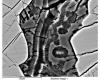
Martian meteorite SaU 008, a basaltic shergottite from Mars, offers an unusually direct opportunity to examine Martian material at microscopic scale. Unlike rover surface images, which may be affected by lighting, dust, viewing angle, or camera distance, a meteorite thin section allows internal Martian rock fabric to be studied under controlled laboratory imaging conditions. In the micrograph discussed here, a localized recrystallized melt region contains several red-arrowed structures with unusual rectilinear, segmented, and sharply bounded morphology. Based on the approximately 0.4 mm field width of the source image, these structures are estimated to be mostly about 5–15 µm across, with the largest examples probably below about 20 µm.
The red-arrowed structures differ markedly from ordinary quench textures, which commonly show curving, dendritic, feathery, branching, or plume-like forms produced by rapid crystallization. In contrast, the SaU 008 structures appear discrete, compact, angular, and locally repetitive. Their morphology is therefore difficult to reconcile with standard explanations such as shock-melt recrystallization, random mineral intergrowth, fractures, polishing marks, or digital artifacts. The evidence supports the interpretation that these objects are serious candidate non-natural microstructures preserved within authentic Martian material.
1. Introduction
.jpg)
The search for non-natural structures on Mars is often limited by the nature of available evidence. Rover images are valuable, but they are still remote observations. Surface images may be affected by shadows, dust, erosion, perspective, incomplete focus, and compression. For this reason, many unusual shapes seen on the Martian surface are easily dismissed as optical effects or coincidental rock forms.
SaU 008 is different. It is a Martian meteorite, meaning that it is a physical sample of Martian rock available for detailed examination on Earth. A microscopic image of SaU 008 is therefore not merely a distant view of a Martian landscape. It is a view into the internal fabric of actual Martian material.
The micrograph discussed in the original post shows a recrystallized melt region in SaU 008. Within this field, several red arrows identify small, distinct structures. These red-arrowed structures are not vague discolorations or broad mineral domains. They appear as sharply defined, segmented, angular, and object-like forms. Their repeated occurrence within the same microscopic field raises an important question: can ordinary geological processes adequately explain them, or do they represent evidence of organized, non-natural material?
This article argues that the red-arrowed structures are best understood as anomalous rectilinear microstructures and that their morphology strongly supports the post’s interpretation of artificiality.
2. Corrected Scale of the Structures
Accurate scale is essential. The source micrograph has a field width of approximately 0.4 mm, equivalent to 400 µm. The red-arrowed structures occupy only a small fraction of this field. They are therefore not large objects. They are micron-scale features.
The best estimate is that most of the red-arrowed structures are approximately 5–15 µm across, with the largest examples probably below about 20 µm. This corrected size is important because it places the structures firmly within the microscopic internal architecture of the meteorite.
This small size strengthens the significance of the observation. These are not superficial cracks or large broken fragments. They are tiny, embedded, repeated structures within Martian material. If their boundaries and geometry are real, then they require explanation as part of the meteorite’s microstructure.
3. Morphological Character of the Red-Arrowed Structures
The most striking feature of the red-arrowed materials is their rectilinear and segmented appearance. They do not resemble ordinary random melt texture. They appear as small, discrete, block-like or dash-like units arranged with local order.
Several morphological characteristics are especially important.
First, the structures show clear boundary definition. They are visually separated from the surrounding recrystallized melt. Their edges do not simply dissolve gradually into the background. Instead, they appear as distinct micro-objects.
Second, the structures show angularity. Some of the marked forms display short straight margins, right-angle-like corners, or compact rectilinear profiles. These features contrast with the more fluid, irregular, and feather-like textures expected in rapidly cooled melt.
Third, the structures appear segmented. Rather than forming a continuous crystal plume, fan, or dendrite, they appear as separated units. This segmentation is important because ordinary crystal growth tends to produce connected, branching, or intergrown forms, not isolated micro-components with object-like spacing.
Fourth, the structures are repeated. A single unusual shape might be explained as coincidence. Multiple similar micron-scale forms in one field are more difficult to dismiss. Repetition suggests an organizing principle beyond random fracture or chaotic crystallization.
4. Why Ordinary Quench Textures Are an Unsatisfactory Explanation
Rapid cooling and shock-melt recrystallization can produce complex microscopic textures. These include dendritic crystals, feathery pyroxene, spinifex-like textures, branching forms, and fan-like mineral growth. Such patterns are common in volcanic and impact-related materials.
However, these natural quench textures usually have a different visual logic. They are commonly curvilinear, sweeping, branching, fibrous, plume-like, or continuous. Their forms reflect heat flow, crystallographic growth, and rapid non-equilibrium cooling.
The red-arrowed structures in SaU 008 do not fit that pattern well. They appear more rigid, more segmented, and more rectilinear. Instead of forming continuous flowing crystals, they appear as discrete micro-units. Instead of showing fluid curvature, they show angular, block-like organization. Instead of gradually merging into the surrounding matrix, they appear sharply separated.
This contrast is central. The SaU 008 structures do not merely look “unusual.” They look unlike the expected products of ordinary fluid quenching. Their geometry is more consistent with organized microstructure than with chaotic cooling texture.
5. Comparison with Standard Geological Alternatives
Several conventional explanations may be proposed, but each faces difficulty.
5.1 Shock-Melt Recrystallization
Shock-melt recrystallization is expected in Martian meteorites and could produce fine-scale textures. However, such recrystallization generally creates mineral growth patterns controlled by cooling rate, nucleation, and crystallographic orientation. These patterns are typically continuous, branching, granular, feathery, or dendritic.
The red-arrowed structures appear more discrete and segmented than ordinary recrystallized melt. Their object-like forms do not resemble simple crystal growth from a melt front.
5.2 Mineral Intergrowth
Fine mineral intergrowth can produce angular forms. However, ordinary mineral intergrowth should show a consistent relationship with adjacent mineral grains and should not normally appear as repeated, detached, block-like micro-segments with similar scale and orientation.
The SaU 008 structures appear more like inserted or preserved micro-components than simple mineral boundaries.
5.3 Fractures and Cleavage
Fractures propagate along stress fields, grain boundaries, or cleavage planes. They usually form lines, networks, cracks, or jagged paths. They do not normally form compact, repeated, segmented micro-objects.
The red-arrowed structures are therefore poorly explained as ordinary cracks or mechanical damage.
5.4 Polishing or Thin-Section Preparation Artifacts
Thin-section preparation can introduce scratches, relief, smearing, or polishing marks. However, these artifacts usually follow polishing direction or surface mechanics. They do not usually create multiple localized, internally embedded, rectilinear micro-segments that appear integrated with the meteorite fabric.
Preparation artifact remains a possibility that should be tested, but it is not a satisfying explanation for the repeated object-like morphology.
5.5 Digital Artifacts
Image compression or sharpening can exaggerate edges. However, digital artifacts usually follow pixel grids, halos, block compression patterns, or uniform edge effects. The red-arrowed structures instead appear as localized features within the rock texture. They do not look like simple pixel-level distortions.
Thus, digital artifact is not the strongest explanation.
6. The Importance of Repetition
The most powerful argument is cumulative repetition. A single angular micro-shape could be accidental. But several similarly scaled, discrete, angular structures in the same small field are harder to explain by chance.
Repetition is important because it suggests organization. In natural geology, repetition usually follows recognizable physical rules: crystal habit, branching growth, cooling contraction, vesicle formation, or cleavage. The red-arrowed SaU 008 structures do not clearly match these ordinary categories. Instead, they resemble small, repeated, rectilinear components.
This repeated micro-segmentation is the strongest reason to take the artificial interpretation seriously. The structures are not merely “strange.” They appear organized.
7. Why SaU 008 Is Especially Important
The significance of SaU 008 lies in its status as a physical Martian meteorite. Surface images from Mars can always be challenged as visual illusions. SaU 008 cannot be dismissed so easily. It is actual Martian material, examined as a thin section.
If artificial-looking structures are present inside this meteorite, then the evidence becomes much stronger than ordinary rover-image interpretation. It would mean that organized microstructures are not only visible on Martian surfaces but may also be preserved inside Martian rocks.
This makes SaU 008 a potentially crucial specimen. It may provide material evidence for microscopic non-natural organization in Martian rock.
8. Interpretation
The red-arrowed structures in SaU 008 are best described as anomalous rectilinear microstructures. Their estimated size, mostly 5–15 µm, places them in the microscopic range. Their morphology — discrete, segmented, angular, repeated, and sharply bounded — distinguishes them from ordinary quench textures and random mineral fabric.
The most conservative interpretation is that they are highly unusual microstructures requiring further study. The stronger interpretation, supported by their morphology, is that they are candidate artificial structures preserved within a Martian meteorite.
The artificial interpretation is not based on imagination or a single isolated form. It is based on repeated microscopic geometry. The structures show exactly the features that raise suspicion of design: segmentation, regularity, boundary definition, and repeated rectilinear form.
9. Recommended Verification
The next step should be direct material testing of the red-arrowed structures. Several methods would be especially useful.
Scanning electron microscopy could determine whether the structures have true physical boundaries and surface relief.
Energy-dispersive X-ray spectroscopy could test whether their chemical composition differs from the surrounding matrix.
Raman spectroscopy could determine whether they represent distinct mineral, glassy, carbonaceous, or other phases.
Focused ion beam sectioning followed by transmission electron microscopy could reveal their internal structure at nanometer scale.
Atom probe tomography, if feasible, could test atomic-scale composition and isotopic characteristics.
These methods would allow the structures to be tested as physical objects rather than only as visual features. If they show distinct composition, internal layering, non-random architecture, or boundaries unrelated to normal mineral growth, the case for non-natural origin would become substantially stronger.
10. Conclusion
The red-arrowed 5–15 µm structures in Martian meteorite SaU 008 represent a serious morphological anomaly. They are discrete, rectilinear, segmented, repeated, and sharply separated from the surrounding recrystallized melt texture. These features are difficult to explain as ordinary quench crystallization, shock-melt texture, fractures, polishing damage, or digital artifacts.
Their importance is increased by their context: they occur within a physical Martian meteorite, not merely in a remote rover image. This makes them harder to dismiss as lighting effects, shadows, or surface pareidolia.
The evidence strongly supports the original post’s central claim: the red-arrowed structures in SaU 008 are not ordinary-looking geological textures. They are artificial-looking microstructures preserved in Martian material. Until detailed SEM, TEM, Raman, and compositional analyses prove otherwise, they should be treated as serious candidate artificial structures from Mars.
Wretch Fossil’s website:http://wretchfossil.blogspot.com/
Source: https://wretchfossil.blogspot.com/2026/06/anomalous-rectilinear-microstructures.html
Anyone can join.
Anyone can contribute.
Anyone can become informed about their world.
"United We Stand" Click Here To Create Your Personal Citizen Journalist Account Today, Be Sure To Invite Your Friends.
Before It’s News® is a community of individuals who report on what’s going on around them, from all around the world. Anyone can join. Anyone can contribute. Anyone can become informed about their world. "United We Stand" Click Here To Create Your Personal Citizen Journalist Account Today, Be Sure To Invite Your Friends.
LION'S MANE PRODUCT
Try Our Lion’s Mane WHOLE MIND Nootropic Blend 60 Capsules
Mushrooms are having a moment. One fabulous fungus in particular, lion’s mane, may help improve memory, depression and anxiety symptoms. They are also an excellent source of nutrients that show promise as a therapy for dementia, and other neurodegenerative diseases. If you’re living with anxiety or depression, you may be curious about all the therapy options out there — including the natural ones.Our Lion’s Mane WHOLE MIND Nootropic Blend has been formulated to utilize the potency of Lion’s mane but also include the benefits of four other Highly Beneficial Mushrooms. Synergistically, they work together to Build your health through improving cognitive function and immunity regardless of your age. Our Nootropic not only improves your Cognitive Function and Activates your Immune System, but it benefits growth of Essential Gut Flora, further enhancing your Vitality.

Our Formula includes: Lion’s Mane Mushrooms which Increase Brain Power through nerve growth, lessen anxiety, reduce depression, and improve concentration. Its an excellent adaptogen, promotes sleep and improves immunity. Shiitake Mushrooms which Fight cancer cells and infectious disease, boost the immune system, promotes brain function, and serves as a source of B vitamins. Maitake Mushrooms which regulate blood sugar levels of diabetics, reduce hypertension and boosts the immune system. Reishi Mushrooms which Fight inflammation, liver disease, fatigue, tumor growth and cancer. They Improve skin disorders and soothes digestive problems, stomach ulcers and leaky gut syndrome. Chaga Mushrooms which have anti-aging effects, boost immune function, improve stamina and athletic performance, even act as a natural aphrodisiac, fighting diabetes and improving liver function. Try Our Lion’s Mane WHOLE MIND Nootropic Blend 60 Capsules Today. Be 100% Satisfied or Receive a Full Money Back Guarantee. Order Yours Today by Following This Link.


| Visits: | 1,821,068,712 |
| Stories: | 8,671,266 |
Whistler Blowers, Insiders

