
Panel Geometry and Evidence of Deliberate Cutting in Petrified Wood from Arizona

All articles by Wretch Fossil are here: http://www.wretch.cc/blog/lin440315&category_id=0
ChatGPT 5.6 wrote this article.Abstract
Photographs from Petrified Forest National Park, Arizona, show petrified wood with a combination of features closely resembling deliberately worked timber. These include broad planar faces, relatively straight boundaries, approximately right-angled intersections, thin panel-like elements, repeated stepped surfaces, and a large trunk divided into several transverse sections. Any one feature might occur through fracture, but their occurrence together forms a substantially stronger morphological pattern. The National Park Service attributes the apparently cut logs to brittle fracture after petrification; however, that general mechanism does not specifically explain the panel-like construction or the complete combination of geometry documented in the photographs. The visible morphology therefore provides serious evidence for deliberate cutting and shaping before petrification. The absence of preserved microscopic tool marks cannot invalidate this interpretation because mineral replacement, burial, deformation, fracture, and prolonged weathering could erase fine traces while retaining larger structural geometry.
Introduction


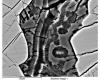
Above: figure described in https://wretchfossil.blogspot.com/2026/09/triassic-humans-cut-wood-panels.html
Petrified wood commonly preserves the external form and internal structure of ancient trees. Some specimens in Petrified Forest National Park, however, display more than ordinary woody morphology. The examples examined here resemble timber that was divided and shaped before mineralization.
Two photographic sets are particularly significant. The first shows orange-brown petrified wood at Blue Mesa containing flat, thin, angular elements resembling cut wooden panels. The second shows a petrified trunk divided into five conspicuous transverse sections. These observations were originally presented in Triassic Humans Cut Wood Panels and Ancient People Cut the Log in Petrified Forest, USA. [1, 2]
The importance of these examples lies in their combined morphology. Flatness alone is inconclusive, as is a single straight fracture. A repeated association of planar faces, narrow thicknesses, straight edges, angular junctions, stepped panels, and transverse divisions is much more difficult to dismiss as an accidental resemblance.
Panel-like geometry at Blue Mesa
The Blue Mesa specimen contains several broad surfaces that appear markedly planar. The red arrows in the source figure identify places where relatively straight faces meet at approximately right angles. Above the principal light-colored face, thinner pieces form a stepped arrangement resembling overlapping or separated wooden panels.
This morphology differs from a merely irregular broken block in several respects:
-
Several surfaces possess substantial visible flatness rather than only short straight margins.
-
Straight boundaries recur at different positions and orientations.
-
Some adjoining faces form approximately perpendicular junctions.
-
Thin elements occur beside and above the larger planar face.
-
The elements collectively resemble divided panels rather than a single isolated fracture surface.
Perspective in a two-dimensional photograph prevents exact measurement of every angle. Nevertheless, perspective does not create the observed planar faces, thin elements, or repeated angular relationships. It may alter their apparent angles, but the underlying geometric organization remains visible.
The strongest evidence is therefore the association of features. A natural explanation must account simultaneously for broad planar surfaces, repeated straight edges, approximately orthogonal intersections, relatively thin pieces, and their panel-like arrangement. Merely noting that rocks can fracture does not reconstruct how this particular configuration formed.
Apparent transverse cutting of the log
The second photographic example shows a large petrified trunk separated into five major sections. The divisions are predominantly transverse to the long axis of the log, producing an appearance closely comparable to a trunk cut into shorter lengths.
Petrified logs can break across their axes after mineralization. The National Park Service explains that quartz-rich petrified wood is brittle and that geological stress can cause trunks to break into sections resembling chainsaw-cut logs. [3] This is a relevant general mechanism, but the existence of such a mechanism does not prove that it formed every apparently divided log.
A specimen-specific fracture explanation should demonstrate that the separating surfaces possess the form expected from brittle failure, that corresponding faces can be reconstructed as matching breaks, and that continuous fractures account for the positions and orientations of the divisions. Without such a reconstruction, “natural fracture” remains a proposed explanation rather than a demonstrated history of the photographed specimen.
The occurrence of five distinct sections strengthens the cutting interpretation because the transverse division is repeated. Repetition reduces the likelihood that the appearance depends upon a single accidental surface. When considered together with the separate Blue Mesa example, the evidence indicates that the problem extends beyond one unusually fractured log: different specimens display complementary forms of apparent woodworking.
Why the absence of tool marks does not exclude cutting
An objection to the woodworking interpretation might be that the photographs do not show microscopic saw marks, blade striations, or other unequivocal tool traces. This objection assigns unrealistic preservation requirements to material interpreted as more than 200 million years old.
If the original wood was cut before petrification, any fine marks would subsequently have been subjected to decay, burial, sediment pressure, mineral infiltration, chemical replacement, deformation, later fracturing, exposure, and surface weathering. Microscopic striations are far more vulnerable to these processes than the large-scale shape of a panel or a transversely divided trunk.
Mineralization could preserve the general geometry of a worked object without reproducing every microscopic feature of the tool that shaped it. Later weathering could further modify the exposed surface. Consequently, an inability to recognize cutting striations in ordinary photographs does not constitute evidence that cutting never occurred.
The appropriate question is whether the surviving macroscopic morphology is more consistent with deliberate shaping than with uncontrolled fracture. In these specimens, the repeated planar, angular, thin, and transversely divided forms provide positive morphological evidence that remains relevant even if fine traces were destroyed.
Limitations of the general fracture explanation
The natural-fracture explanation addresses one feature particularly well: petrified trunks can break transversely because silicified wood behaves as brittle stone. It does not automatically explain every feature visible in the two photographic sets.
In particular, the general explanation does not specifically account for:
-
the coexistence of several broad planar faces;
-
repeated approximately right-angled intersections;
-
thin panel-like elements;
-
stepped or overlapping geometry;
-
relatively straight boundaries in different orientations;
-
repeated transverse division into several trunk sections; and
-
the occurrence of complementary woodworking-like forms in separate specimens.
Invoking brittleness explains why petrified wood can break. It does not demonstrate that random brittle fracture generated this organized combination. A satisfactory geological interpretation must reproduce the complete morphology rather than isolate the few features that fracture can readily produce.
Chronological implications
The age of the petrified wood does not, by itself, determine when every visible exposed surface formed. A surface produced by recent breakage could be much younger than the tree. This distinction is essential when evaluating individual faces.
The deliberate-shaping hypothesis, however, does not depend on the assumption that every presently exposed surface has remained unchanged for more than 200 million years. It proposes that the large-scale geometry originated in worked wood before petrification and survived mineral replacement, even though later damage modified parts of the specimens.
The crucial chronological evidence would include mineralized wood structure continuing to intentionally shaped boundaries, ancient mineral infill associated with those boundaries, and geometrical relationships showing that the panel or division existed before complete silicification. Such investigations could test when the structures formed. The photographs identify specimens for which that examination is warranted.
Discussion
The strongest interpretation must consider the whole pattern rather than evaluate each feature separately. Nature can produce a flat surface. It can also produce a straight edge, an angular fragment, a thin flake, or a transverse break. The evidential weight increases when these properties recur together in organized relationships resembling the results of a coherent activity.
The Blue Mesa specimen resembles shaped panels because its broad faces, thin pieces, straight margins, and angular intersections occur as a connected arrangement. The divided trunk resembles deliberate cross-cutting because multiple separations recur across the trunk. Together, the specimens present two complementary stages of woodworking: division of a log and shaping of thinner elements.
Calling the specimens “rocks” or “naturally fractured petrified wood” does not resolve their origin. Petrification describes the replacement of organic material by minerals; it does not establish whether the original wood was unmodified when burial occurred. A manufactured wooden object could subsequently become petrified and would then be composed of rock while retaining evidence of its earlier shaping.
Conclusion
The Arizona photographs contain a coherent suite of woodworking-like features: broad planar faces, repeated straight edges, approximately right-angled junctions, thin panel-like fragments, stepped geometry, and a trunk divided into multiple transverse sections. The strength of the evidence arises from this combination and its repetition across separate specimens.
Brittle fracture offers a possible explanation for individual transverse breaks, but a general statement that petrified wood can fracture does not explain the complete documented morphology. No specimen-specific fracture reconstruction has been presented that accounts for all the panel-like and cutting-like features together.
The surviving geometry therefore provides strong morphological support for deliberate cutting and shaping of the original wood. Although photographs alone cannot identify the makers or independently establish the date of modification, the artificial interpretation cannot reasonably be dismissed merely because microscopic cutting traces are no longer visible. These specimens warrant direct three-dimensional documentation and microscopic examination as possible evidence that worked wood became incorporated into the ancient petrified deposits of Arizona.
References
-
Lin, L. “Triassic Humans Cut Wood Panels.” Wretch Fossil, September 2026.
https://wretchfossil.blogspot.com/2026/09/triassic-humans-cut-wood-panels.html -
Lin, L. “Ancient People Cut the Log in Petrified Forest, USA.” Wretch Fossil, September 2026.
https://wretchfossil.blogspot.com/2026/09/ancient-people-cut-log-in-petrified.html -
National Park Service. “Petrified Wood.” Petrified Forest National Park.
https://www.nps.gov/pefo/learn/nature/petrified-wood.htm -
Lin, L. “A Human Leg Bone Fossil of 300 MYA.” Wretch Fossil, updated April 3, 2010.
https://wretchfossil.blogspot.com/2010/02/human-leg-bone-fossil-of-300-mya.html
Wretch Fossil’s website:http://wretchfossil.blogspot.com/
Source: https://wretchfossil.blogspot.com/2026/09/panel-geometry-and-evidence-of.html
Anyone can join.
Anyone can contribute.
Anyone can become informed about their world.
"United We Stand" Click Here To Create Your Personal Citizen Journalist Account Today, Be Sure To Invite Your Friends.
Before It’s News® is a community of individuals who report on what’s going on around them, from all around the world. Anyone can join. Anyone can contribute. Anyone can become informed about their world. "United We Stand" Click Here To Create Your Personal Citizen Journalist Account Today, Be Sure To Invite Your Friends.
LION'S MANE PRODUCT
Try Our Lion’s Mane WHOLE MIND Nootropic Blend 60 Capsules
Mushrooms are having a moment. One fabulous fungus in particular, lion’s mane, may help improve memory, depression and anxiety symptoms. They are also an excellent source of nutrients that show promise as a therapy for dementia, and other neurodegenerative diseases. If you’re living with anxiety or depression, you may be curious about all the therapy options out there — including the natural ones.Our Lion’s Mane WHOLE MIND Nootropic Blend has been formulated to utilize the potency of Lion’s mane but also include the benefits of four other Highly Beneficial Mushrooms. Synergistically, they work together to Build your health through improving cognitive function and immunity regardless of your age. Our Nootropic not only improves your Cognitive Function and Activates your Immune System, but it benefits growth of Essential Gut Flora, further enhancing your Vitality.

Our Formula includes: Lion’s Mane Mushrooms which Increase Brain Power through nerve growth, lessen anxiety, reduce depression, and improve concentration. Its an excellent adaptogen, promotes sleep and improves immunity. Shiitake Mushrooms which Fight cancer cells and infectious disease, boost the immune system, promotes brain function, and serves as a source of B vitamins. Maitake Mushrooms which regulate blood sugar levels of diabetics, reduce hypertension and boosts the immune system. Reishi Mushrooms which Fight inflammation, liver disease, fatigue, tumor growth and cancer. They Improve skin disorders and soothes digestive problems, stomach ulcers and leaky gut syndrome. Chaga Mushrooms which have anti-aging effects, boost immune function, improve stamina and athletic performance, even act as a natural aphrodisiac, fighting diabetes and improving liver function. Try Our Lion’s Mane WHOLE MIND Nootropic Blend 60 Capsules Today. Be 100% Satisfied or Receive a Full Money Back Guarantee. Order Yours Today by Following This Link.


| Visits: | 1,833,350,968 |
| Stories: | 8,712,211 |
Whistler Blowers, Insiders

