

Arrowhead/Wapato

Abundance: uncommon
What: tubers, young leaves, young flower stalks
How: boiled, roasted
Where: marshes, water
When: tubers all year, best in late fall and early winter; young leaves in early summer; flower stalks well before flower buds have opened.
Nutritional Value: carbohydrates
Dangers: Beware the similar-looking arrow arum, (Peltandra virginica) plant which has an arrowhead-shaped leaf and produces tubers same as Sagittaria species.
Arrowroot tuber (photo courtesy of Samuel Thayer).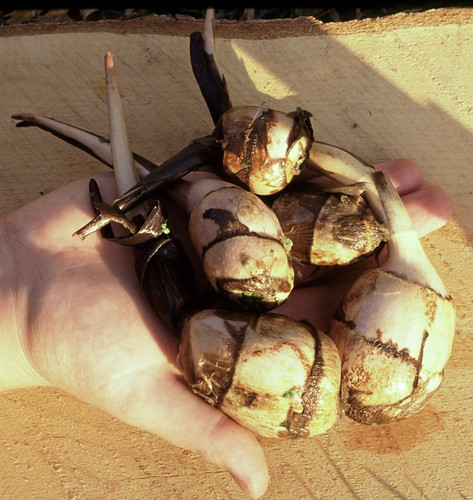
Arrowroot plants have many long veins radiating outwards from the center (palmate).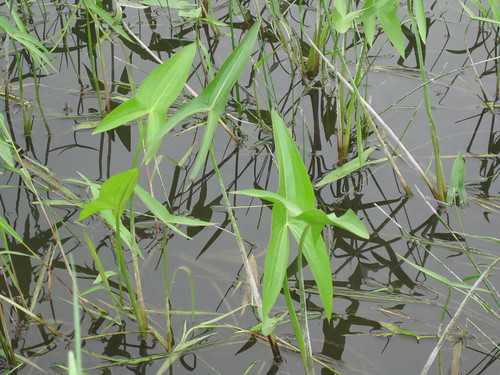
Arrowroot leaf and flower stalk with white flowers and unopened buds.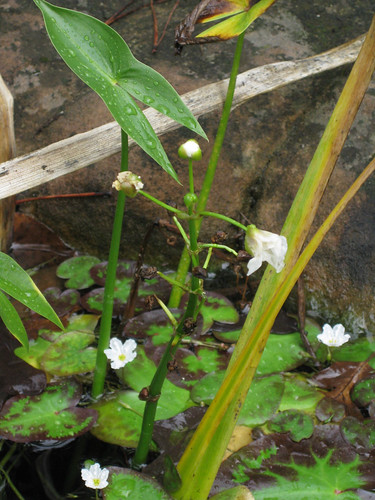
Note the spider-like (palmate) pattern of veins in the arrowhead-shaped leaves.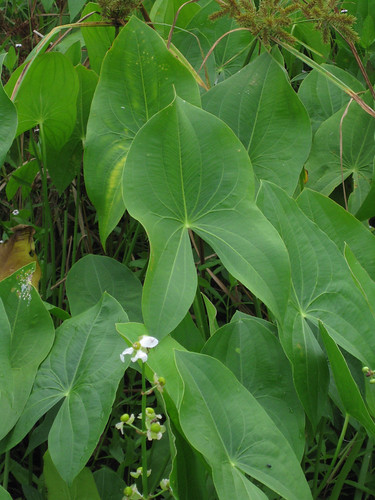
A stand of wapato plants.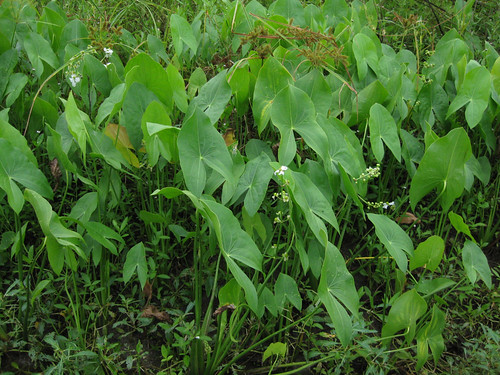
Close-up of wapato flowers.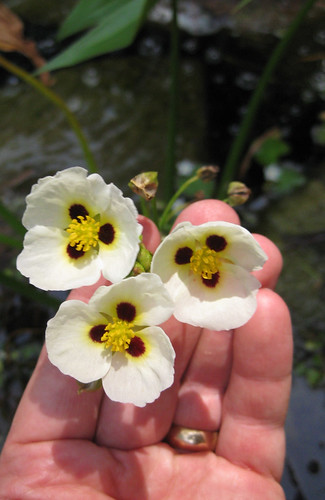
Arrowroot seedpods in the fall. One pod forms for each flower.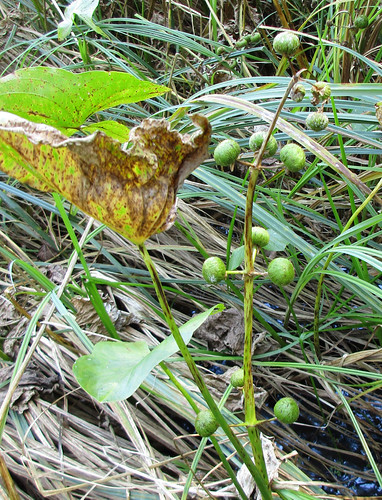
Texas distribution, attributed to U. S. Department of Agriculture. The marked counties are guidelines only. Plants may appear in other counties, especially if used in landscaping.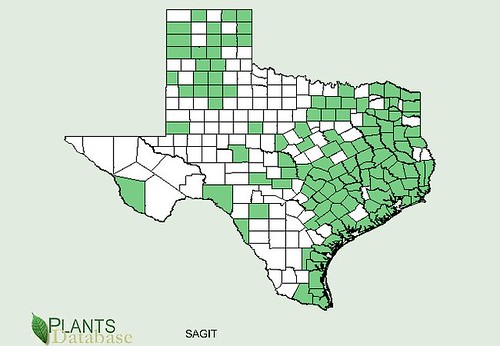
North American distribution, attributed to U. S. Department of Agriculture.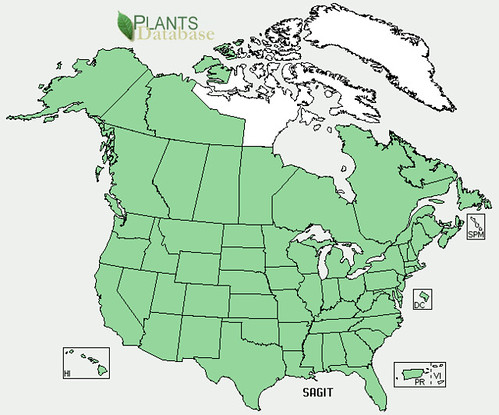
Found in marshes, rivers, lakes and ponds, the arrowhead plant’s distinctive leaf and flowers are easy to spot. Most arrowhead plants have three-pointed leaves shape like an arrowhead, with either the top point bigger and broader than or the same as the two downward pointing points. The vein pattern in the leaves of Sagittaria species is palmate, which means the leaves have numerous thick veins running from the stem out to the tips and sides. This pamate venation is important to distinguish the edible Sagittaria from toxic Arum species.
Traditionally arrowroot tubers are freed from the mud by tearing them from the roots while walking barefoot in the water. The tubers float to the surface where the can be collected. They are prepared for eating by first peeling the bitter outer skin, followed by cooking any way you would cook a potato. The young leaves are harvested and boiled before they’ve had a chance to unroll/unfurl. The flower stalk is cooked like asparagus but it must be harvested before its flower buds have opened. Note, any plants harvested from water must be cooked to avoid imbibing any toxic pathogens.
Note that arrowhead tubers do not store very well, unlike traditional potatoes. If you want to keep them make sure you are storing only perfect, undamaged tubers and place them in moist, clean sand in a cool, dark place.
Young, still curled leaves that are either above or below the surface of the water make an excellent cooked green. Treat them like spinach. The young flower stalk before the flower buds appear can be used in the same manner as the leaves.
TOXIC MIMIC: ARROW ARUM PLANT
Arrow arum plants (Peltandra virginica) grow in wetlands, and have a leaves-with the same arrowhead-shape as the edible Sagittaria, as well as similar tubers. All parts of the arum plants are filled with calcium oxalate which will cause painful burning sensations in the lips, mouth, and throat if eaten. To tell the difference between arrowhead plants and Arum arrowhead plants look at the pattern of veins in the leaves. Toxic arrow Arum leaves have only three main veins, one each running out from the center out to the points of its leaf. From these three main veins branch out smaller veins, much like you see in a “normal” leaf of other plants. The edible arrowhead leaf has many veins radiating out from the center of the leaf where it connects to the stem, making it kind of look like a spider. These veins meet up again at the tips/points of the Sagittaria leaf.
Toxic Arrow Arum leaf.

Source: http://www.foragingtexas.com/2008/08/arrowroot_20.html
Anyone can join.
Anyone can contribute.
Anyone can become informed about their world.
"United We Stand" Click Here To Create Your Personal Citizen Journalist Account Today, Be Sure To Invite Your Friends.
Before It’s News® is a community of individuals who report on what’s going on around them, from all around the world. Anyone can join. Anyone can contribute. Anyone can become informed about their world. "United We Stand" Click Here To Create Your Personal Citizen Journalist Account Today, Be Sure To Invite Your Friends.
LION'S MANE PRODUCT
Try Our Lion’s Mane WHOLE MIND Nootropic Blend 60 Capsules
Mushrooms are having a moment. One fabulous fungus in particular, lion’s mane, may help improve memory, depression and anxiety symptoms. They are also an excellent source of nutrients that show promise as a therapy for dementia, and other neurodegenerative diseases. If you’re living with anxiety or depression, you may be curious about all the therapy options out there — including the natural ones.Our Lion’s Mane WHOLE MIND Nootropic Blend has been formulated to utilize the potency of Lion’s mane but also include the benefits of four other Highly Beneficial Mushrooms. Synergistically, they work together to Build your health through improving cognitive function and immunity regardless of your age. Our Nootropic not only improves your Cognitive Function and Activates your Immune System, but it benefits growth of Essential Gut Flora, further enhancing your Vitality.

Our Formula includes: Lion’s Mane Mushrooms which Increase Brain Power through nerve growth, lessen anxiety, reduce depression, and improve concentration. Its an excellent adaptogen, promotes sleep and improves immunity. Shiitake Mushrooms which Fight cancer cells and infectious disease, boost the immune system, promotes brain function, and serves as a source of B vitamins. Maitake Mushrooms which regulate blood sugar levels of diabetics, reduce hypertension and boosts the immune system. Reishi Mushrooms which Fight inflammation, liver disease, fatigue, tumor growth and cancer. They Improve skin disorders and soothes digestive problems, stomach ulcers and leaky gut syndrome. Chaga Mushrooms which have anti-aging effects, boost immune function, improve stamina and athletic performance, even act as a natural aphrodisiac, fighting diabetes and improving liver function. Try Our Lion’s Mane WHOLE MIND Nootropic Blend 60 Capsules Today. Be 100% Satisfied or Receive a Full Money Back Guarantee. Order Yours Today by Following This Link.


| Visits: | 1,793,853,381 |
| Stories: | 8,616,320 |
Whistler Blowers, Insiders

