

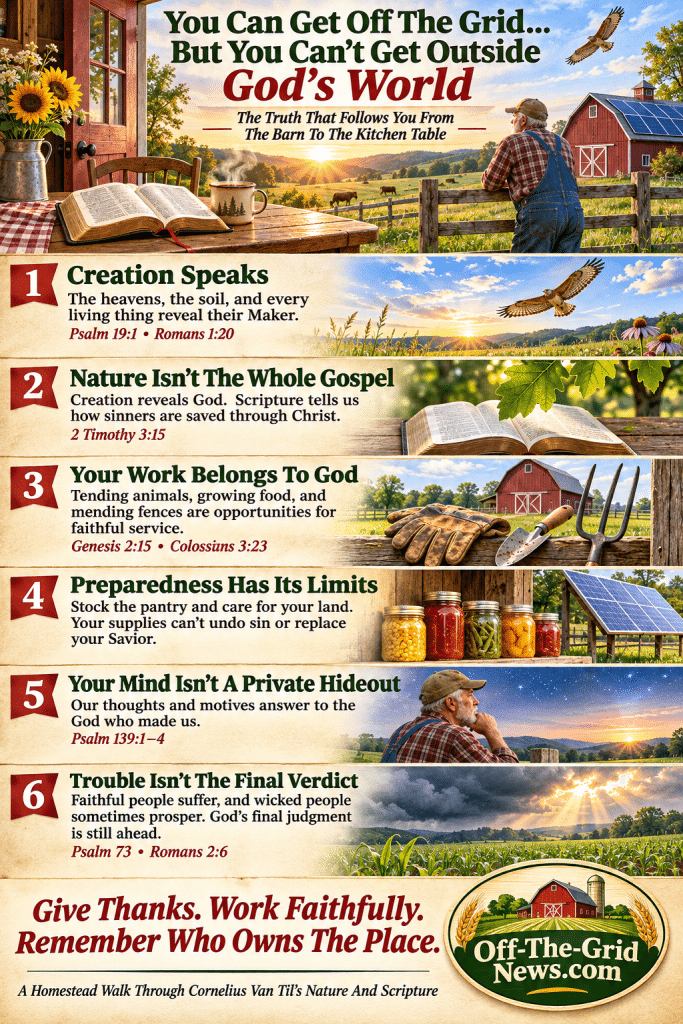
You Can Get Off The Grid… But You Can’t Get Outside God’s World

Think about walking out to a hayfield at first light. Fog lifts off the creek, dew soaks your boots, and a red-tailed hawk circles overhead like he holds the deed to the place. Before you’ve checked a gate or carried a bucket, you’re already standing in the middle of a sermon.
Now, you might call that a peaceful morning. You might even say it offers some evidence that somebody made all this. But Cornelius Van Til, the theologian behind the essay Nature and Scripture, wouldn’t let you stop there.
In his view, that hawk isn’t circling above a universe that merely suggests God. Every feather, fencepost, frost crack, and thought passing through your head belongs to a creation that reveals its Maker. Here’s the glaring problem: we want to admire the scenery while ignoring the Owner.
That’s where this walk into Off-the-Grid Theology gets interesting. We’re headed into the kind of talk that can disappear between Sunday’s opening hymn and the announcements. So give your boots a snug tug, because the fence line has a lot more to say than we usually care to hear.
God Knows How To Grab Your Attention
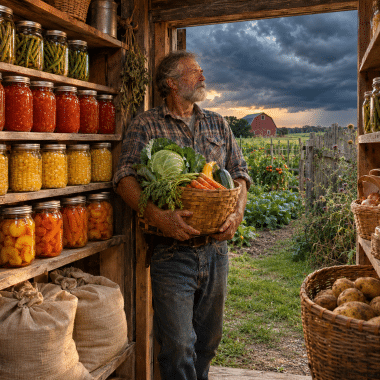
First, let’s clear away the fog. Think of nature and Scripture as two books from one Author. The comparison helps, as long as we remember that a bean field doesn’t tell us everything the Bible tells us. God’s works reveal him, while his written Word tells us things we couldn’t discover by studying the weather.
Van Til builds his argument around the Westminster Confession of Faith, a historic statement of Christian belief. Its opening chapter says creation displays God’s goodness, wisdom, and power, yet doesn’t provide the saving knowledge sinners need. Later, its chapter on the Fall describes sin as reaching through our whole being, including the minds we use to examine the evidence.
In other words, the problem isn’t simply that we need more information. We also have trouble with the information already staring us in the face. A man can recognize the neighbor’s property line down to the last crooked post and still act as though God’s ownership needs further discussion.
So Van Til asks us to consider four things: the necessity, authority, sufficiency, and clarity of revelation. Scripture has those qualities in its proper role, and natural revelation has corresponding qualities in its own role. Same Author, different purposes… one unfolding plan.
A Birch Leaf Can’t Tell You The Gospel
Now, here’s the crucial distinction worth keeping in your pocket. Nature reveals the Creator and leaves us accountable to him… but it doesn’t spell out Christ’s death and resurrection. You can’t turn over a birch leaf and find the gospel printed underneath.
Within the covenant framework Van Til follows, Adam broke God’s covenant, and salvation comes through God’s gracious provision of a Redeemer. That message requires God’s special revelation. The beauty of the world can make you stop and look, but beauty alone doesn’t explain how a guilty sinner can be forgiven.
Now, don’t imagine that nature and Scripture belong to competing departments. The God who sends rain is the God who speaks in his Word. His mercy, judgment, promises, and purposes all belong to the same history.
What this means and what follows is this… reading creation rightly means listening to what God says about it. Scripture doesn’t turn the world into something less real or less interesting. It strips away our false confidence and helps us recognize whose world we’ve been walking through all along.
An Ordinary Tree Exposes A Crucial Question
Picture an old orchard with one tree marked off by the owner. Its bark looks familiar, its branches move in the same wind, and its fruit doesn’t come wrapped in warning tape. Yet the owner has given a plain instruction: stay clear of that one.
That’s an illustration, of course; Genesis doesn’t identify the forbidden fruit as an apple. But it puts Van Til’s point about God’s command in Eden in plain English. Adam’s obligation rested on God’s word, not on whether Adam could discover something physically alarming about the tree.
For Van Til, the ordinary regularity of the garden gave the particular prohibition its setting. Adam was supposed to obey because God had spoken. He wasn’t authorized to pick apart the command and demand that the Lord make a more persuasive case. As a side note, I always wondered whether Adam pruned the tree and cared for it as part of his garden stewardship.
Anyway, that obedience reached beyond one bite of fruit. Cultivating the garden, tending its life, and learning about the created world all belonged to Adam’s service. God’s authority reached into the workday as surely as it reached into the moment of direct command.
That ought to encourage anybody heading for a cold barn before sunrise. Faithfulness includes feeding animals, mending a gate, and doing an honest day’s work. The manure fork hasn’t slipped outside God’s jurisdiction.
You Can’t Stockpile Your Way Back To Eden
After the Fall, though, the ground tells a brutal story. Thorns grow where you’d rather have tomatoes, bodies wear out, and death won’t respect the property line. Genesis 3 places that trouble inside the history of human rebellion and God’s judgment.
At the same time, mercy hasn’t gone away. God promises the continuation of seedtime and harvest in Genesis 8:22, and the rainbow becomes the sign of his covenant in Genesis 9. So here’s a joy: A fallen world still receives gifts it hasn’t earned.
Some Christians call God’s everyday kindness toward humanity… common grace. Fields produce food, neighbors help neighbors, and sunshine falls on people who never stop to give thanks. Those gifts are real, but treating them as a shortcut back to Eden is a dangerous mistake.
So put up the beans, maintain the solar equipment, and keep the root cellar in good shape. Just don’t get lured into asking your preparedness plan to become your savior. Even a pantry with beautifully straight rows can’t stock forgiveness or keep death locked outside.
Our hope reaches further. In Van Til’s account, Christ’s redeeming work has consequences for the whole creation, a hope echoed in Romans 8:19–23. We can thank God for today’s harvest while longing for the day when the creation’s groaning finally ends.
Adam Was Authorized To Work The Place
Next comes an illustration a hunter can appreciate. Van Til pictures a hunter carrying the visible number of his license. In a similar way, Adam carried God’s authorization to exercise dominion and stewardship, with the responsibility that came attached to it.
The point isn’t the details of anybody’s hunting regulations. It’s that permission comes from someone with authority to grant it. Adam didn’t find an ownerless wilderness and announce that he was taking over.
Instead, Genesis 1:26–28 gives humanity a calling under God. We can investigate, cultivate, build, and learn because we’re creatures entrusted with work. We have real authority, but we didn’t manufacture it ourselves.
That brings the question of responsibility up close and personal. Breeding livestock, grafting a fruit tree, and caring for soil require practical knowledge, but they also involve purpose and responsibility. The question of what works doesn’t erase the question of what honors the Owner.
Besides, recognizing God’s ownership should make us more careful students. A farmer who checks drainage, tests soil, and learns from a failed planting is paying attention to the world God actually made. Pious, sugary talk won’t bail us out when we refuse to learn how the ground works.
The Blind Spot Inside Your Own Head
Now the fence line turns inward, straight toward a blind spot we’d rather ignore. Van Til won’t let us treat our minds as remote cabins beyond the reach of God’s authority. Our ability to reason belongs to creation too, along with conscience and the knowledge of our dependence.
That doesn’t mean every thought in your head is a message from heaven.
We blunder, manufacture excuses, and sometimes cling to an idea because it lets us off the hook. The claim is that our thinking powers come from God and answer to him, even when we misuse them.
According to Romans 1:18–25, humanity’s trouble includes suppressing truth and exchanging the Creator’s glory for substitutes. Van Til confronts that head-on. Rebellion requires a truth to rebel against and a Lord whose claim we’re resisting.
In other words, a prodigal can get a long way down the road without becoming his own creator. He still carries the life, abilities, and obligations he received from his dad. Leaving home doesn’t make the Father’s voice any less important.
There goes the remote cabin. Not a private residence away from the Creator.
A Devastating Storm Isn’t The Final Verdict
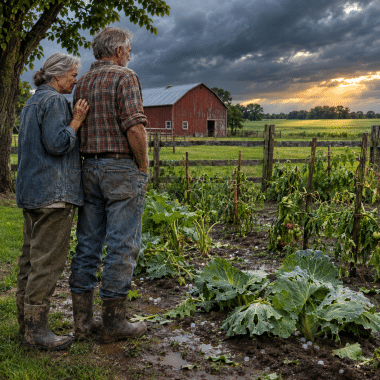
At this point, somebody usually raises a fair objection. If creation reveals a righteous God, why does a faithful family’s crop get flattened by weather while a dishonest man’s business keeps growing? Anybody who’s watched hail strip a field knows that question doesn’t belong only in a classroom.
Van Til doesn’t answer by pretending every earthly outcome is a tidy reward or punishment. The world shows God’s patience and judgment, but its present course isn’t the final settlement. You can’t inspect a neighbor’s bank balance or hospital chart and read God’s complete verdict from it.
Heck, that’s why Job’s trust amid suffering matters, and why Psalm 73 wrestles so honestly with the prosperity of the wicked. Scripture makes room for the questions that rise beside a ruined crop or an empty chair. Faith doesn’t require us to call those things pleasant.
Instead, Van Til connects the unfinished moral picture to God’s final judgment.
Present patterns point beyond themselves toward a reckoning that hasn’t arrived. The Lord hasn’t lost track of the accounts because he hasn’t closed the books today.
Meanwhile, nature remains sufficient for the purpose God gives it. It reveals him and leaves people responsible; it doesn’t supply a complete explanation of every sorrow or hardship. For the promise of redemption, we need his spoken and written Word.
The Heavens Won’t Be Silenced
Next, let’s put the question of clarity on the table. Can a world this complicated really reveal God clearly? Van Til answers by distinguishing our limited understanding from total confusion in God’s revelation when we look at the world around us.
You don’t have to understand every root beneath an oak to know you’re standing under a tree. Likewise, knowing something truly doesn’t require knowing everything about it. Our knowledge is creaturely, while God’s understanding of his creation is complete.
Notice the confidence of Psalm 19. The heavens declare God’s glory; they aren’t floating a tentative suggestion for a committee to consider. Paul likewise says creation makes God’s power known, even as people resist what they know.
So mystery doesn’t give us a loophole where God has no claim. Psalm 139 carries that truth from the heights to the depths. Van Til compresses the point into six memorable words: “Creatures have no private chambers.”
The locked door, the back forty, the unspoken thought… all of them remain within God’s world. That’s unsettling if we want somewhere to escape him. For the believer, it’s also a reason to remember that no lonely place lies beyond his presence. Not even in a whale’s or a fish’s stomach, right?
Clear Evidence Can Still Wound Our Pride
Of course, clarity doesn’t guarantee a warm reception. A posted property line can be perfectly clear to the fellow cutting the fence. His complaint may have more to do with the owner’s rights than the size of the lettering.
Here’s where Van Til’s argument gets in your face.
He believes sinners resist God’s revelation in nature for the same fundamental reason they resist Scripture: they don’t want God’s authority over them. A vague higher power can seem agreeable precisely because it leaves our pride and favorite excuses untouched.
Within his Christian framework, however, the true God isn’t an adjustable idea assembled from our favorite religious likes and churchy emotions. He’s the God revealed in Jesus Christ. Van Til’s insistence here is stronger than simply saying people ought to believe in something.
As a result, he puts the Holy Spirit’s work at the center of a sinner’s changed response. Better eyesight is needed, so to speak, as well as light. That doesn’t dismiss evidence or reasoning; it challenges the assumption that our deepest loyalties never affect how we use them.
Even Christians need correction. Old habits lure us back into reading the world as though God were absent, which is why our interpretations must keep returning to Scripture. Having a Bible on the kitchen table doesn’t mean every idea we bring to that table has already been straightened out.
When Autonomous Human Reason Demands The Deed
From there, Van Til takes readers down a crowded road through the history of philosophy.
He scrutinizes ways of reasoning that treat the human mind or the world as independent of God’s revelation. If we begin by awarding ourselves final authority, he argues, we’ll end with a god small enough to fit the award.
He traces the problem through Greek thinkers wrestling with change, permanence, and knowledge. Heraclitus emphasized change, while Parmenides pressed the claims of unchanging being. Plato and Aristotle offered different accounts of what reality is and how we know it.
Those are large subjects, and one fence-line walk can’t settle them.
That said, Van Til’s objection is easy enough to grasp: neither an old philosophical principle nor an explanation assembled from an independent universe gives us the living Creator of Scripture.
In his judgment, the starting assumptions have already steered the wagon.
Later, he directs criticism at Thomas Aquinas’s use of Aristotle and at arguments associated with Joseph Butler and William Paley. He believes their approaches give autonomous human reason an independence it shouldn’t have. His concern is what happens when a method for discussing God quietly sets the terms God must meet.
Kant Brings A Grinder To The Kitchen Table
Then Immanuel Kant enters the picture, and Van Til reaches for a kitchen image. He compares the mind’s organizing activity to a sausage grinder. What comes out has already been shaped by the machinery it passed through. Please read that again.
As an illustration of Van Til’s objection, it’s hard to forget.
If our minds supply the controlling framework for everything we can experience, how do we receive revelation that corrects the framework itself? A man who appoints himself the final inspector may keep rejecting anything that challenges his appointment.
Right here, Van Til has Kant’s philosophy nailed down pretty tight. At the end of the day, Kant makes human thought the ultimate reference point in all predication. In that arrangement, he argues, God either gets reduced to something our brains can manage, or He’s placed beyond meaningful contact and communication with us.
Van Til then gives Kant a limited, negative kind of credit: Kant says the trouble is always in the starting point. Yep, Yep, Yep. But exposing the problem doesn’t provide the Christian answer. You can’t turn an independent human mind into a faithful receiver of God’s Word merely by reserving a polite spot in the corner of your mind for religious thoughts.
Finally, Van Til extends his criticism to modern theologians, including Karl Barth and Emil Brunner, and offers related objections to Paul Tillich and Reinhold Niebuhr. Those men differ significantly, but they all seem to have made the same theological miscalculation. The crucial thread connecting his criticism is his insistence that Christianity can’t surrender God’s authority at the entrance and expect to recover it at the exit.
Face Up To The Sermon At Your Woodpile
After all those names, let’s bring this down to the cold, hard question waiting at home. Who has the final say over the world? Van Til’s answer begins with the self-sufficient God, whose creation and Word never depend on us.
That doesn’t mean you check your brain at the church door. It means putting those mental gifts to work, with enough humility to confront our mistakes. Investigate the soil, study the stars, question your assumptions, and keep listening to the God whose world makes those activities possible.
So the next time you split oak or watch a thunderhead climb over the ridge, pause and hang out in the moment. Why, you ask? Well, you’re handling more than fuel and looking at more than weather. You’re living among gifts that carry obligations, in a world whose Maker is neither absent nor silent.
The message follows you into the barn, across the garden, and back to the kitchen table. It reaches the plans nobody else knows about and the excuses you haven’t spoken aloud. There’s plenty of room to work outside, but no corner where we become our own gods. Tomorrow morning, that hawk will probably circle the hayfield again.
Let him remind you to look up, give thanks, and get on with the work you’ve been entrusted to do.
Source: https://www.offthegridnews.com/religion/you-can-get-off-the-grid-but-you-cant-get-outside-gods-world/
Anyone can join.
Anyone can contribute.
Anyone can become informed about their world.
"United We Stand" Click Here To Create Your Personal Citizen Journalist Account Today, Be Sure To Invite Your Friends.
Before It’s News® is a community of individuals who report on what’s going on around them, from all around the world. Anyone can join. Anyone can contribute. Anyone can become informed about their world. "United We Stand" Click Here To Create Your Personal Citizen Journalist Account Today, Be Sure To Invite Your Friends.
LION'S MANE PRODUCT
Try Our Lion’s Mane WHOLE MIND Nootropic Blend 60 Capsules
Mushrooms are having a moment. One fabulous fungus in particular, lion’s mane, may help improve memory, depression and anxiety symptoms. They are also an excellent source of nutrients that show promise as a therapy for dementia, and other neurodegenerative diseases. If you’re living with anxiety or depression, you may be curious about all the therapy options out there — including the natural ones.Our Lion’s Mane WHOLE MIND Nootropic Blend has been formulated to utilize the potency of Lion’s mane but also include the benefits of four other Highly Beneficial Mushrooms. Synergistically, they work together to Build your health through improving cognitive function and immunity regardless of your age. Our Nootropic not only improves your Cognitive Function and Activates your Immune System, but it benefits growth of Essential Gut Flora, further enhancing your Vitality.
Our Formula includes: Lion’s Mane Mushrooms which Increase Brain Power through nerve growth, lessen anxiety, reduce depression, and improve concentration. Its an excellent adaptogen, promotes sleep and improves immunity. Shiitake Mushrooms which Fight cancer cells and infectious disease, boost the immune system, promotes brain function, and serves as a source of B vitamins. Maitake Mushrooms which regulate blood sugar levels of diabetics, reduce hypertension and boosts the immune system. Reishi Mushrooms which Fight inflammation, liver disease, fatigue, tumor growth and cancer. They Improve skin disorders and soothes digestive problems, stomach ulcers and leaky gut syndrome. Chaga Mushrooms which have anti-aging effects, boost immune function, improve stamina and athletic performance, even act as a natural aphrodisiac, fighting diabetes and improving liver function. Try Our Lion’s Mane WHOLE MIND Nootropic Blend 60 Capsules Today. Be 100% Satisfied or Receive a Full Money Back Guarantee. Order Yours Today by Following This Link.


| Visits: | 1,840,042,965 |
| Stories: | 8,745,366 |
Whistler Blowers, Insiders

