

Is Narrative Warfare Driving Washington’s UN Pullback?

Authored by Charles Davis via The Epoch Times (emphasis ours),
Commentary
On a gray morning in Geneva, a human-rights advocate walks into the Palais des Nations and scans the room the way you’d scan a street corner for gang members in a hard neighborhood. Not for gangbangers, though; for “civil society.” For the suited delegates with NGO badges who film speakers a little too closely, who echo embassy talking points a little too faithfully, who make the room feel—subtly, persistently—less safe for anyone bringing evidence that embarrasses Beijing. Investigators have documented this pattern: government-linked “NGOs” using U.N. access to disrupt, intimidate, and drown out criticism.
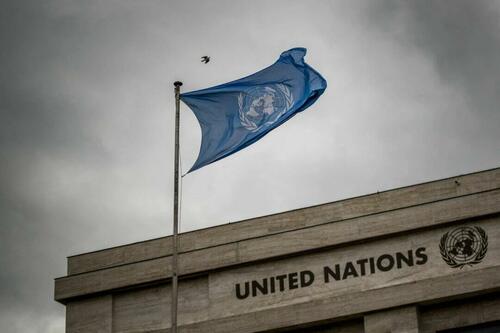
Cancel culture is alive and well in the groups and committees of the U.N. and that scene matters because it sits beneath the most consequential line in the White House’s new withdrawal memorandum: the United States will “take immediate steps” to exit a list of international organizations and U.N.-linked bodies “as soon as possible.”
The memo is anchored to an earlier directive—Executive Order 14199—which required a review of U.S. participation and support across international bodies.
The list itself is telling. It includes scientific and governance nodes like the Intergovernmental Panel on Climate Change (IPCC) and the U.N. Framework Convention on Climate Change, and also the machinery that sets development narratives and convenes states—the U.N. Department of Economic and Social Affairs and multiple U.N. Economic and Social Council regional commissions.
Critics will frame this as isolationism. Supporters will call it sovereignty. But there is another lens worth an objective look: narrative influence by adversaries—especially China—nested inside institutions that were built for cooperation, not contest.
Winning by Wearing Out
Chinese strategists continue to laud a whole-of-capabilities approach called “dissipative warfare”—a strategy of exhausting an opponent through protraction, friction, and cumulative cost rather than a single decisive blow.
You don’t need to treat that concept as doctrine to see how it can map onto global institutions. If the fight is to shape what the world believes is “responsible,” “lawful,” “sustainable,” or “legitimate,” then bodies that write standards, bless language, convene negotiations, and credential “civil society” become key influence targets. The point isn’t open control of an organization. It’s to slow, dilute, redirect, and stigmatize—until your competitor either accommodates the narrative or exits the field.
Procedural Choke Points
Start with climate and science. The IPCC’s Summaries for Policymakers are, by design, negotiated line-by-line with governments. That’s not a conspiracy; it’s written into the IPCC’s own procedures.
That model can produce robust consensus—but it also creates leverage for states skilled at procedural delay and linguistic bargaining. In a dissipation frame, the goal is not to “win” the report; it’s to grind down clarity, introduce ambiguity, and turn scientific bottom lines into endlessly contestable phrasing. In this condition, the narrative is malleable.
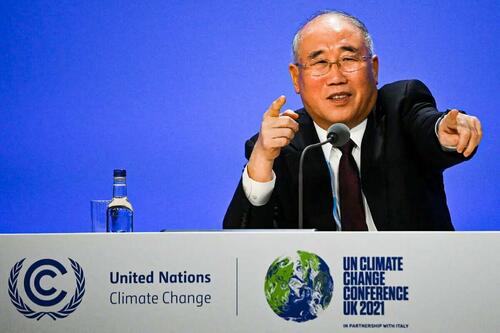
Similarly, the U.N. Framework Convention on Climate Change outcomes often hinge on consensus among nearly 200 parties. The Glasgow Climate Pact’s language calling for a “phase-down” of unabated coal power illustrates how hard-fought wording becomes the battlefield itself.
Then there is the U.N. Department of Economic and Social Affairs—on the memo’s withdrawal list—because the department doesn’t merely “do development.” It frames the development story: what counts as progress, which financing models are celebrated, what language becomes standard in global planning.
Leadership and institutional emphasis matter here. The U.N. secretary-general appointed Li Junhua of China as undersecretary-general for economic and social affairs in 2022.
U.N. development publications have treated China’s Belt and Road initiative as compatible with the U.N.’s Sustainable Development goals. That’s not proof of control. It is, however, a form of normalization—turning a contested geopolitical initiative into familiar U.N. development vocabulary. It’s a form of socializing it into acceptability.
In a dissipation strategy, this is where you make the long game feel inevitable. You bind contested geopolitics to the moral vocabulary of “sustainable development,” and you force rivals to fight uphill—arguing not only against a project, but against the institutionally blessed framing around it.
The ‘Civil Society’ Channel
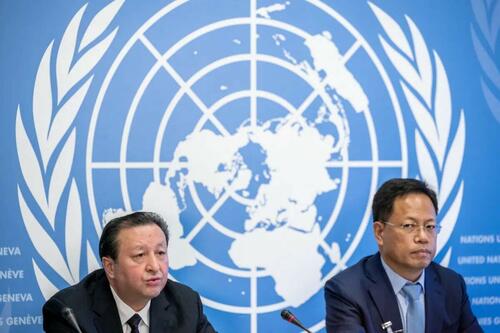
Finally: access. The U.N. system grants NGOs consultative privileges on the assumption they act independently of governments. But reporting and watchdog analysis describe a growing ecosystem of state-linked “government-organized” NGOs using that access to crowd out testimony, praise Beijing, and intimidate critics—especially in Geneva’s human-rights ecosystem.
This is dissipation in human form: make participation costly, make speaking risky, and make the room feel owned—until fewer credible witnesses show up.
Read the White House memo as a map of where narrative influence is manufactured and laundered into global “common sense.” It targets bodies that, one, negotiate language under consensus rules; two, set development and climate frames that travel into national policy; and three, credential actors who then shape discourse as “independent stakeholders.”
That does not mean every named institution is adversary-controlled. It does mean adversaries—especially China, and in some domains Russia and Iran—can apply pressure through procedure, staffing, agenda framing, and access manipulation. In that sense, withdrawal is an attempt to stop paying to stand in a room where the rules can be used to exhaust you. No one wants to sit in the dunking booth when there’s a professional pitcher holding a bucket of balls.
But here’s the hard truth: if the United States exits without a replacement strategy, the vacuum becomes its own kind of dissipation—self-inflicted. Even Reuters’ early reporting on the memo notes the scale of the pullback and the risk that others fill the gap.
If the premise is adversarial narrative warfare, then the measure of success isn’t simply to “leave.” It’s whether Washington can deny manipulation and keep shaping outcomes—by rebuilding coalitions, hardening rules for NGO access, investing in standards bodies it stays in, and treating language battles as strategic terrain rather than diplomatic housekeeping.
The memo pulls America off one battlefield, but it doesn’t end the war over perception. It simply raises a hard question: why should the United States keep paying to staff, fund, and legitimize systems whose outputs so often harden into narratives that cut against U.S. strategy? You don’t have to believe in “capture” to see misalignment. The real test now is whether Washington replaces withdrawal with an influence strategy—one that protects openness, rewards transparency, and stops underwriting language that is later used to pressure American policy and partners.
Views expressed in this article are opinions of the author and do not necessarily reflect the views of The Epoch Times.
Tyler Durden Fri, 02/06/2026 – 23:25
Source: https://freedombunker.com/2026/02/06/is-narrative-warfare-driving-washingtons-un-pullback/
Anyone can join.
Anyone can contribute.
Anyone can become informed about their world.
"United We Stand" Click Here To Create Your Personal Citizen Journalist Account Today, Be Sure To Invite Your Friends.
Before It’s News® is a community of individuals who report on what’s going on around them, from all around the world. Anyone can join. Anyone can contribute. Anyone can become informed about their world. "United We Stand" Click Here To Create Your Personal Citizen Journalist Account Today, Be Sure To Invite Your Friends.
LION'S MANE PRODUCT
Try Our Lion’s Mane WHOLE MIND Nootropic Blend 60 Capsules
Mushrooms are having a moment. One fabulous fungus in particular, lion’s mane, may help improve memory, depression and anxiety symptoms. They are also an excellent source of nutrients that show promise as a therapy for dementia, and other neurodegenerative diseases. If you’re living with anxiety or depression, you may be curious about all the therapy options out there — including the natural ones.Our Lion’s Mane WHOLE MIND Nootropic Blend has been formulated to utilize the potency of Lion’s mane but also include the benefits of four other Highly Beneficial Mushrooms. Synergistically, they work together to Build your health through improving cognitive function and immunity regardless of your age. Our Nootropic not only improves your Cognitive Function and Activates your Immune System, but it benefits growth of Essential Gut Flora, further enhancing your Vitality.

Our Formula includes: Lion’s Mane Mushrooms which Increase Brain Power through nerve growth, lessen anxiety, reduce depression, and improve concentration. Its an excellent adaptogen, promotes sleep and improves immunity. Shiitake Mushrooms which Fight cancer cells and infectious disease, boost the immune system, promotes brain function, and serves as a source of B vitamins. Maitake Mushrooms which regulate blood sugar levels of diabetics, reduce hypertension and boosts the immune system. Reishi Mushrooms which Fight inflammation, liver disease, fatigue, tumor growth and cancer. They Improve skin disorders and soothes digestive problems, stomach ulcers and leaky gut syndrome. Chaga Mushrooms which have anti-aging effects, boost immune function, improve stamina and athletic performance, even act as a natural aphrodisiac, fighting diabetes and improving liver function. Try Our Lion’s Mane WHOLE MIND Nootropic Blend 60 Capsules Today. Be 100% Satisfied or Receive a Full Money Back Guarantee. Order Yours Today by Following This Link.


| Visits: | 1,782,056,225 |
| Stories: | 8,593,309 |
Whistler Blowers, Insiders

