

“Don’t Be Evil”: Google’s Motto Becomes A Jury Verdict In California

Authored by Jonathan Turley via jonathanturley.org,
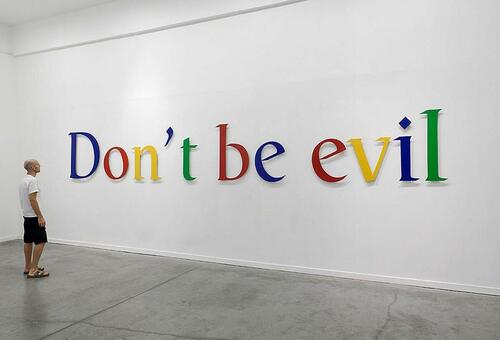
Google once had a motto: “Don’t be evil.”
In its reorganization in 2015, the motto was changed to “Do the right thing.”
According to a California jury this week, neither motto stuck.
In a historic verdict against both Google and Meta, a jury found that the companies maliciously designed their social media products to addict children, including the plaintiff, who was known only as Kaley or KGM.
The jury heard testimony of efforts to “target” young users and feed an addiction to social media and YouTube. The jury awarded Kaley $3 million in compensatory damages divided between Meta (70%) and Google (30%). It then awarded another $3 million in punitive damages.
Those damages are nothing to companies worth billions. However, the verdict was like a dinner gong for plaintiffs lawyers. There are already thousands of cases filed against social media companies. That wave is about to become a tsunami. That is particularly the case after companies like TikTok and Snap settled before trial.
In addition to this civil verdict, the New Mexico Attorney General secured a $375 million verdict the same week against Meta under the state’s consumer protection laws.
But it will be a very long time before these companies cut a check. The California case is rife with compelling appellate issues that will take years to work out.
Indeed, what makes this case so intriguing — and even more tempting for plaintiffs’ lawyers — is that it was actually not the strongest case.
The 17-year-old in California started using social media at age 6. Kaley had a troubled childhood with problems at home and bullying at school. She experienced depression, anxiety, and body dysmorphia that could be linked to other aspects of her life. Her use of social media was extreme: all-consuming and all-day.
Meta argued that it does prohibit users under 13 from using any of its platforms. YouTube offers different platforms for children, like YouTube Kids.
However, Kaley created dozens of accounts to drive her “likes” and increase her virtual interactions.
The trial showed how complex such cases are in isolating what was the most substantial factor in Kaley’s harmful childhood. The case stretched the concepts of factual and legal causation to the breaking point.
I have taught torts for over 30 years and, in my view, the causation in this case is dubious. Even with tobacco, there was protracted litigation over other sources of cancer. However, that litigation was relatively straightforward in comparison to cases seeking to assign liability for depression, anxiety, or body dysmorphia. Children are bombarded with social and media imagery and messages from myriad sources. At the same time, many (like Kaley) come from homes with troubling or abusive elements.
The companies have previously asserted immunity under Section 230 of the Communications Act of 1934. These lawyers found a creative way to evade that immunity by claiming they are challenging the design of “the product” of social media companies, not suing over the specific content that appears on their sites.
That may prove too clever by half for some judges. Product liability law has previously been used to circumvent constitutional or legal barriers, as in the unsuccessful product liability and nuisance cases against gun manufacturers. Section 230 is designed to protect internet companies that serve as platforms for third-party postings. Here, the lawyers are arguing that you have immunity for what is posted, but your system itself is a product that is subject to a lawsuit.
In finding negligence and a failure to warn, the jury clearly agreed with the complaint that the design of the sites was maliciously intended to create “a compulsion to engage with those products nonstop,” feeding “harmful and depressive content.” However, it is a difficult line between marketing and targeting.
It is not clear what warning these social media companies should offer beyond what they have previously posted. More importantly, it is unclear whether such warnings would have any impact on users.
If Meta warned that social media can be addictive or harmful, would it have deterred Kaley? Her mother already tried to block her from such usage.
There is no question that social media has a hold on children and adults because they like it. It allows them to create, observe, and communicate with an unprecedented range of people and sites. The question is whether this compulsive conduct reflects an intentional effort to addict minors or a product that is irresistible for many.
The only certainty after these verdicts is that there will be more of them. As soon as this verdict was read, the “likes” from plaintiffs’ lawyers flooded in across social media. Those trials will continue despite great uncertainty about the very foundation of any liability.
For now, it will be left to the courts, not these companies, “to do the right thing” on social media liability.
Jonathan Turley is a law professor and the best-selling author of “Rage and the Republic: The Unfinished Story of the American Revolution.”
Tyler Durden Thu, 03/26/2026 – 13:20
Source: https://freedombunker.com/2026/03/26/dont-be-evil-googles-motto-becomes-a-jury-verdict-in-california/
Anyone can join.
Anyone can contribute.
Anyone can become informed about their world.
"United We Stand" Click Here To Create Your Personal Citizen Journalist Account Today, Be Sure To Invite Your Friends.
Before It’s News® is a community of individuals who report on what’s going on around them, from all around the world. Anyone can join. Anyone can contribute. Anyone can become informed about their world. "United We Stand" Click Here To Create Your Personal Citizen Journalist Account Today, Be Sure To Invite Your Friends.
LION'S MANE PRODUCT
Try Our Lion’s Mane WHOLE MIND Nootropic Blend 60 Capsules
Mushrooms are having a moment. One fabulous fungus in particular, lion’s mane, may help improve memory, depression and anxiety symptoms. They are also an excellent source of nutrients that show promise as a therapy for dementia, and other neurodegenerative diseases. If you’re living with anxiety or depression, you may be curious about all the therapy options out there — including the natural ones.Our Lion’s Mane WHOLE MIND Nootropic Blend has been formulated to utilize the potency of Lion’s mane but also include the benefits of four other Highly Beneficial Mushrooms. Synergistically, they work together to Build your health through improving cognitive function and immunity regardless of your age. Our Nootropic not only improves your Cognitive Function and Activates your Immune System, but it benefits growth of Essential Gut Flora, further enhancing your Vitality.

Our Formula includes: Lion’s Mane Mushrooms which Increase Brain Power through nerve growth, lessen anxiety, reduce depression, and improve concentration. Its an excellent adaptogen, promotes sleep and improves immunity. Shiitake Mushrooms which Fight cancer cells and infectious disease, boost the immune system, promotes brain function, and serves as a source of B vitamins. Maitake Mushrooms which regulate blood sugar levels of diabetics, reduce hypertension and boosts the immune system. Reishi Mushrooms which Fight inflammation, liver disease, fatigue, tumor growth and cancer. They Improve skin disorders and soothes digestive problems, stomach ulcers and leaky gut syndrome. Chaga Mushrooms which have anti-aging effects, boost immune function, improve stamina and athletic performance, even act as a natural aphrodisiac, fighting diabetes and improving liver function. Try Our Lion’s Mane WHOLE MIND Nootropic Blend 60 Capsules Today. Be 100% Satisfied or Receive a Full Money Back Guarantee. Order Yours Today by Following This Link.


| Visits: | 1,790,688,108 |
| Stories: | 8,610,326 |
Whistler Blowers, Insiders

