

Germany’s Commuters Bear The Cost Of The Iran Crisis And Tax State

Submitted by Thomas Kolbe
The excessive fiscal burden on fuels has driven gasoline prices in Germany higher since the start of the Iran crisis. Yet it seems unlikely that German policymakers will ease the burden on commuters or businesses. Apart from a task force, nothing has been planned. Other regions are proving more resilient.
The Iran conflict has entered its second week, and with it, concerns are growing over the consequences of the slowly but steadily building energy crisis for the global economy.
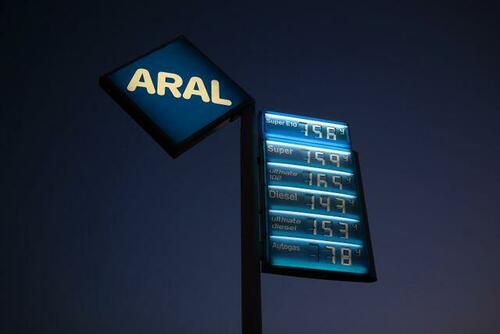
In Germany, the rise in oil prices was quickly reflected at the pumps. Prices jumped from around €1.65 per liter to over €2 – a roughly 25 percent increase in a very short period (Apollo News reported).
At the same time, suspicions arise that oil companies are securing quick profits by selling already invoiced and refined petroleum as well as existing gasoline stocks at the now significantly higher retail price, realizing excess profits.
However, this is a temporary effect, likely to be balanced quickly by market dynamics. The internationally high increase in German gasoline prices is almost entirely due to the fact that the state, through its tax policies, accounts for roughly 65 percent of the retail price. A silent profiteer in the crisis, while commuters face growing problems.
Whether CO₂ levies, fuel taxes, or VAT – the government should now act with fiscal restraint and provide significant relief to both commuters and businesses. So far, this is not the case. German politics stares like a rabbit at the snake in the Iran conflict. Slowly, it becomes clear that decades of ideologically driven energy policy were nothing more than a trillion-euro, subsidized fantasy – now turning into a nightmare.
USA Operate Autarkically
Across the Atlantic, the situation is very different. Gas prices in the United States rose by about five to ten percent. Eight months before the crucial midterm elections, this will be decisive for President Donald Trump to uphold his campaign promises and keep inflation under control.
A quick end to the Iran war is now imperative. Washington is weighing the geopolitical effects, control of global oil markets, and domestic inflation risks.
Since 2018, the United States has been the world’s largest oil producer with a daily output of 18 million barrels and is also an exporter of “black gold.” Its dominant position makes it relatively insulated from major oil price shocks while giving it significant market influence.
If the crisis persists, the global energy market risks fragmentation. Massive price hikes threaten import-dependent states, such as many European countries, while energy-autarkic nations retain pricing power and are largely shielded from extreme increases.
South Korea as a Special Case
Looking to Asia, South Korea is highly energy-dependent like Europe but boasts substantial refining capacity. Companies such as SK Energy, GS Caltex, or S-Oil typically operate on long-term supply contracts and fixed prices, while holding significant crude inventories that can be drawn down during a supply disruption.
The South Korean economy is temporarily insulated from a Hormuz blockade. Gas prices rose about 13 percent since the outbreak of the war, from €1.11 to €1.25 per liter – markedly less than in Germany.
Taxes and levies account for only around 40 percent of the retail gasoline price in South Korea, providing an advantage compared with Germany’s steadily rising mobility and energy taxes.
It may take up to three weeks for an oil shock to reach Korean gas stations. During this time, firms hedge currency and price risks on futures markets, operating largely in isolation. Refineries and storage practices act as an additional strategic oil reserve directly integrated into the processing of the economy’s key resource.
Politically, the government remains on alert. Seoul has so far refrained from temporary fuel tax cuts, a measure historically used to support the economy. Most recently, this occurred during the lockdown phase. This suggests that Korean authorities do not expect a prolonged conflict – and certainly not a ground invasion by U.S. or Israeli troops. Such a scenario would inevitably escalate, including on global commodity markets.
Crystal Ball Outlook
It is currently almost impossible to predict how the conflict will evolve. Regime change in Tehran appears to be neither a U.S. nor Israeli objective. Likewise, ground troop interventions remain highly unlikely, especially given the approaching midterms in the U.S.
This makes a short conflict duration likely. Strategic oil reserves in most EU countries cover roughly three months and have not yet been tapped. Despite rapid price increases, no acute supply shortages currently exist.
To relieve pressure at the pumps, fuel taxes would need to be cut. Yet it is unlikely that Finance Minister Lars Klingbeil will forgo the additional revenues generated by the temporary energy price spike.
Politically, the focus remains on optics: a gasoline price task force has been convened – a media maneuver during election season, a political chimera drawn reflexively from the government’s toolkit.
Structural solutions to Europe’s dangerous energy dependence would require a geopolitical reset, including a peace settlement with Russia, exploitation of domestic resources such as the continent’s immense gas reserves, and potentially a return to nuclear power in Germany.
* * *
About the author: Thomas Kolbe, a German graduate economist, has worked for over 25 years as a journalist and media producer for clients from various industries and business associations. As a publicist, he focuses on economic processes and observes geopolitical events from the perspective of the capital markets. His publications follow a philosophy that focuses on the individual and their right to self-determination.
Tyler Durden Thu, 03/12/2026 – 05:00
Source: https://freedombunker.com/2026/03/12/germanys-commuters-bear-the-cost-of-the-iran-crisis-and-tax-state/
Anyone can join.
Anyone can contribute.
Anyone can become informed about their world.
"United We Stand" Click Here To Create Your Personal Citizen Journalist Account Today, Be Sure To Invite Your Friends.
Before It’s News® is a community of individuals who report on what’s going on around them, from all around the world. Anyone can join. Anyone can contribute. Anyone can become informed about their world. "United We Stand" Click Here To Create Your Personal Citizen Journalist Account Today, Be Sure To Invite Your Friends.
LION'S MANE PRODUCT
Try Our Lion’s Mane WHOLE MIND Nootropic Blend 60 Capsules
Mushrooms are having a moment. One fabulous fungus in particular, lion’s mane, may help improve memory, depression and anxiety symptoms. They are also an excellent source of nutrients that show promise as a therapy for dementia, and other neurodegenerative diseases. If you’re living with anxiety or depression, you may be curious about all the therapy options out there — including the natural ones.Our Lion’s Mane WHOLE MIND Nootropic Blend has been formulated to utilize the potency of Lion’s mane but also include the benefits of four other Highly Beneficial Mushrooms. Synergistically, they work together to Build your health through improving cognitive function and immunity regardless of your age. Our Nootropic not only improves your Cognitive Function and Activates your Immune System, but it benefits growth of Essential Gut Flora, further enhancing your Vitality.

Our Formula includes: Lion’s Mane Mushrooms which Increase Brain Power through nerve growth, lessen anxiety, reduce depression, and improve concentration. Its an excellent adaptogen, promotes sleep and improves immunity. Shiitake Mushrooms which Fight cancer cells and infectious disease, boost the immune system, promotes brain function, and serves as a source of B vitamins. Maitake Mushrooms which regulate blood sugar levels of diabetics, reduce hypertension and boosts the immune system. Reishi Mushrooms which Fight inflammation, liver disease, fatigue, tumor growth and cancer. They Improve skin disorders and soothes digestive problems, stomach ulcers and leaky gut syndrome. Chaga Mushrooms which have anti-aging effects, boost immune function, improve stamina and athletic performance, even act as a natural aphrodisiac, fighting diabetes and improving liver function. Try Our Lion’s Mane WHOLE MIND Nootropic Blend 60 Capsules Today. Be 100% Satisfied or Receive a Full Money Back Guarantee. Order Yours Today by Following This Link.


| Visits: | 1,786,334,612 |
| Stories: | 8,601,876 |
Whistler Blowers, Insiders

