
The Settlement Number Isn't the Same as the Money in Your Pocket

Hearing that a personal injury case settled for $100,000 sounds straightforward. It’s natural to picture the injured person receiving a check for exactly $100,000. But the number used to describe a settlement and the amount ultimately available to the client can be very different.
A settlement may need to cover several obligations before the remaining funds are distributed. Medical bills may still be outstanding. An insurer may have a reimbursement claim. Attorney fees and case expenses may also need to be deducted depending on the representation agreement.
Understanding that difference is an important part of evaluating Arizona personal injury settlements. The headline number is the starting point. What ultimately matters to the injured person is the amount remaining after the applicable bills, claims, fees, and expenses have been addressed.
Start With the Number Everyone Talks About
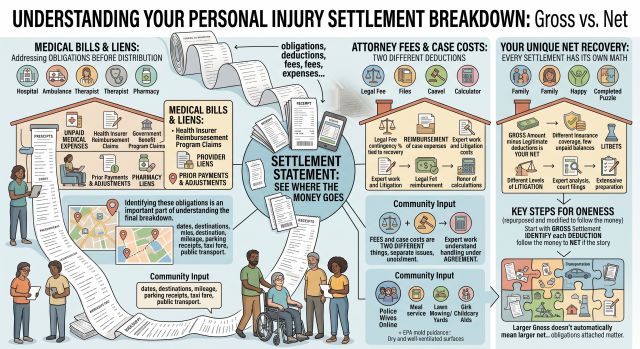
The total amount agreed upon to resolve a claim is often referred to as the gross settlement. If an insurance company agrees to pay $100,000, that $100,000 is the number most likely to be mentioned when people talk about what the case settled for.
But gross and net are two different things.
The net amount is what remains for the client after applicable deductions have been made. Exactly what those deductions include depends on the circumstances of the case.
This distinction is important because two cases with identical gross settlements can produce very different net amounts. One person may have substantial unpaid medical expenses, while another had most treatment covered through insurance. One case may have required expensive expert work and litigation, while another resolved with relatively limited costs.
The settlement amount therefore tells only part of the financial story. The breakdown underneath it tells the rest.
Medical Bills and Liens Can Affect the Final Amount
Medical treatment is often one of the largest financial consequences of a serious injury. By the time a case resolves, some bills may have been paid while others remain outstanding.
There can also be reimbursement issues. Depending on the circumstances, a health insurer or government benefit program that paid accident-related medical expenses may have a right to seek reimbursement from settlement proceeds. Medical providers or other entities may also assert liens or claims that need to be addressed before distribution.
This is why simply adding up the original medical bills doesn’t necessarily reveal what will ultimately come out of the settlement. Insurance adjustments, prior payments, negotiated balances, and reimbursement rights can change the numbers.
Identifying these obligations is an important part of understanding the final breakdown. Until it’s clear who has been paid and who may still have a valid claim against the proceeds, the gross settlement doesn’t reveal how much money will ultimately remain.
Fees and Case Costs Are Two Different Things
Legal fees are another part of the settlement breakdown. Personal injury attorneys frequently work under contingency-fee arrangements, meaning the attorney’s fee is tied to the recovery rather than being billed through a traditional hourly arrangement.
The exact percentage and how it is calculated depend on the representation agreement.
Case costs are a separate issue. Pursuing a claim may involve expenses for obtaining records, filing documents, taking depositions, hiring experts, investigating the accident, or preparing evidence. More complicated litigation can generate considerably greater costs than a claim that resolves relatively early.
Clients should understand how both categories are handled under their agreement. A contingency fee and reimbursement of case expenses aren’t necessarily the same deduction.
That distinction makes the settlement statement particularly useful. Rather than focusing only on the original settlement figure, the breakdown can show where the money is going and how the amount ultimately distributed to the client was calculated.
Every Settlement Has Its Own Math
It’s tempting to ask what percentage of a settlement the injured person normally gets to keep. The problem is that there isn’t one percentage that accurately describes every case.
Consider two people who each settle for the same amount. One may have undergone extensive treatment with substantial outstanding medical obligations. The other may have had different insurance coverage and relatively few unpaid balances.
Their cases may also have required different levels of litigation. One might resolve during negotiations, while another requires depositions, expert analysis, court filings, and extensive preparation before an agreement is reached.
Fee agreements can differ too.
All of those variables affect the final calculation. That’s why comparing the gross settlement from one person’s case with another person’s take-home amount can be misleading. The more useful comparison is between the gross amount and the specific deductions applicable to that particular case. The final number is the result of that individual financial picture.
Conclusion
A settlement can be an important milestone after a serious injury, but the amount announced at the beginning of the process isn’t necessarily the amount that eventually lands in the client’s hands.
The gross settlement may first need to account for medical obligations, reimbursement claims, liens, attorney fees, and case expenses. Which deductions apply and how large they are can vary considerably from one case to another.
That’s why understanding the settlement breakdown matters before focusing too heavily on the headline number. A larger gross settlement doesn’t automatically mean a larger net recovery if the obligations attached to the case are also greater.
The clearest picture comes from following the money from beginning to end: start with the total settlement, identify each legitimate deduction, and see what remains. That final figure, rather than the number everyone initially talks about, is what ultimately determines how much of the settlement reaches the injured person.
Anyone can join.
Anyone can contribute.
Anyone can become informed about their world.
"United We Stand" Click Here To Create Your Personal Citizen Journalist Account Today, Be Sure To Invite Your Friends.
Before It’s News® is a community of individuals who report on what’s going on around them, from all around the world. Anyone can join. Anyone can contribute. Anyone can become informed about their world. "United We Stand" Click Here To Create Your Personal Citizen Journalist Account Today, Be Sure To Invite Your Friends.
LION'S MANE PRODUCT
Try Our Lion’s Mane WHOLE MIND Nootropic Blend 60 Capsules
Mushrooms are having a moment. One fabulous fungus in particular, lion’s mane, may help improve memory, depression and anxiety symptoms. They are also an excellent source of nutrients that show promise as a therapy for dementia, and other neurodegenerative diseases. If you’re living with anxiety or depression, you may be curious about all the therapy options out there — including the natural ones.Our Lion’s Mane WHOLE MIND Nootropic Blend has been formulated to utilize the potency of Lion’s mane but also include the benefits of four other Highly Beneficial Mushrooms. Synergistically, they work together to Build your health through improving cognitive function and immunity regardless of your age. Our Nootropic not only improves your Cognitive Function and Activates your Immune System, but it benefits growth of Essential Gut Flora, further enhancing your Vitality.

Our Formula includes: Lion’s Mane Mushrooms which Increase Brain Power through nerve growth, lessen anxiety, reduce depression, and improve concentration. Its an excellent adaptogen, promotes sleep and improves immunity. Shiitake Mushrooms which Fight cancer cells and infectious disease, boost the immune system, promotes brain function, and serves as a source of B vitamins. Maitake Mushrooms which regulate blood sugar levels of diabetics, reduce hypertension and boosts the immune system. Reishi Mushrooms which Fight inflammation, liver disease, fatigue, tumor growth and cancer. They Improve skin disorders and soothes digestive problems, stomach ulcers and leaky gut syndrome. Chaga Mushrooms which have anti-aging effects, boost immune function, improve stamina and athletic performance, even act as a natural aphrodisiac, fighting diabetes and improving liver function. Try Our Lion’s Mane WHOLE MIND Nootropic Blend 60 Capsules Today. Be 100% Satisfied or Receive a Full Money Back Guarantee. Order Yours Today by Following This Link.


| Visits: | 1,831,811,940 |
| Stories: | 8,704,191 |
Whistler Blowers, Insiders