

The Day After Israel Votes

Freddie Ponton
21st Century Wire
In the summer of 2023, hundreds of thousands of Israelis demonstrated against a government dismantling the judicial restraints on its power, confronting Benjamin Netanyahu with his gravest domestic crisis. Israeli reservists, including fighter pilots, intelligence officers and members of elite units, threatened to stop volunteering rather than serve that government, while former security chiefs warned that the confrontation was damaging military readiness. Months before October 7, Israel was already struggling over who could legitimately command the state and what obligations citizens had towards it.
Whoever assembles the next coalition after the coming election will inherit a constitutional confrontation that divided society long before the war. Disputes over conscription, accountability, religious authority and the distribution of wartime sacrifice will bring that unresolved struggle back to the centre of government. Winning enough seats to govern will not make those obligations disappear.
After October 7, the IDF called up 300,000 reservists within 48 hours, interrupting the confrontation without resolving it. Reuters reported that even members of a protest group who had signed a petition against serving answered the military’s emergency requests. Mobilisation restored the capacity to act together, but not agreement on the kind of state those soldiers were defending.
The wars in Gaza, Lebanon, Syria and Iran widened the emergency, as did occupation and settlement expansion in the West Bank. Israeli analysts have described a strategic limbo in which military achievements repeatedly fail to produce durable political outcomes. The destruction and suffering inflicted on Palestinians matter in themselves, not merely for what they reveal about Israel, and did nothing to settle Israel’s constitutional struggle. War pushed that struggle beneath mobilisation, where repeated deployments, bereavement and anger gave old disputes new force.
Who Serves, Who Refuses
Coalition negotiations will immediately return to whether protecting the Haredi exemption can preserve religious-party support while asking reservists to accept unequal sacrifice. Enforcing conscription will answer that grievance, but it will also mean confronting a community that regards military integration as a threat to its autonomy.
Tzemach David Schloss served 290 reserve days during the first 19 months of the war. A week after his son was born at home, he returned to Gaza. He described living at a distance from his wife and children because another sudden call-up always seemed possible. His experience, recorded in reporting on the toll of mobilisation on reservists and their families, shows what the language of burden conceals as service removes parents from children, workers from businesses and citizens from ordinary life.
Religious Zionist communities have supplied combat soldiers and absorbed casualties, while Haredi leaders defend Torah study as their community’s contribution to national survival. Though the two camps have cooperated over judicial power, settlement and religious authority, military service exposes their incompatible ideas of citizenship. Religious Zionists bind Jewish sovereignty to bearing arms, while Haredi leaders fear that military integration will weaken the institutions and separation that preserve their way of life.
A September 2026 poll of first-time Jewish voters showed how Kahanist politics complicates that division. Among its Haredi respondents, 13% supported Itamar Ben Gvir’s Otzma Yehudit, behind United Torah Judaism at 45% and Shas at 20%. The pollster assessed that some young Haredi voters who might once have chosen Shas were moving towards Ben Gvir. Earlier reporting based on voting patterns in predominantly Haredi areas also identified a hard-right drift among younger Haredim. The movement remains a minority current, but it offers Jewish militancy without the Religious Zionist ethic of military service.
Enforcement moved beyond parliamentary argument in April 2026 when, following the arrest of yeshiva students who had evaded service, anti-draft demonstrators breached the home of the head of the military police while his family was inside. Police arrested 25 suspects. Court rulings have also narrowed the space for another temporary arrangement. In June 2024, the Supreme Court ruled unanimously that the government lacked authority to refrain from drafting eligible Haredi men after the legal basis for deferments expired. In September 2026, it struck down legislation that would have suspended enforcement against qualifying yeshiva students who failed to report.
To preserve the exemption, a coalition must evade those rulings, rewrite the law or weaken the institutions enforcing equality. To obey them, it must use state power against a community whose parties may be essential to its survival. Arrests and financial sanctions may produce enlistment, but they may also provoke organised defiance.
Sergio DellaPergola, a demographer and professor emeritus at the Hebrew University of Jerusalem, estimates average fertility at six to seven children among Haredim and slightly above two among secular Israeli Jews, a demographic gap that makes delay increasingly consequential. In his study of the Jewish population’s long-term future, he stresses that distant projections are scenarios rather than prophecies because fertility, migration, identity and policy can change. Even with that caution, the proportion of citizens educated, employed and mobilised through Haredi institutions is likely to grow, leaving arrangements created for a smaller community to weigh more heavily on the army, labour market and public finances.
The Bank of Israel calculates that one month of service by a reservist around age 30 costs the economy about NIS 38,000, making dependence on reservists an economic choice as well as a dispute over service. It estimates that adding roughly 7,500 Haredi recruits each year could eventually provide about 20,000 additional conscripts and reduce annual reserve costs by at least NIS 9 billion, equivalent to 0.4% of GDP. The figures come from the central bank’s assessment of the proposed conscription law and its analysis of the economy during the war.
Those costs do not capture the months away from work, interrupted studies, damaged relationships, bereavement and moral injury that accumulate across deployments and follow reservists home. Reservists interviewed by Reuters described growing numbers of comrades seeking release as they struggled to balance service with family, employment and education. Their accounts formed part of a wider picture of reservist burnout and diminishing appetite for renewed war. Another mobilisation would begin with people who already know what another order may cost them.
Who Judges Those Who Govern
A government asking for further service must also answer for October 7, yet three years after the attack, Israel still lacks the independent account sought by survivors, hostage families and much of the public. An October 2026 poll found that 66% supported a state commission of inquiry and 21% opposed one. The outgoing government postponed its proposed framework until after the election and resisted the established mechanism under which the president of the Supreme Court appoints commission members.
An independent commission could investigate those in power, including the officials who establish it, while a controlled inquiry might protect a coalition and confirm the suspicion that institutions shield rulers rather than judge them. That choice will shape whether another order to serve is heard as a common necessity or as a demand from leaders unwilling to face judgment.
Courts, legal advisers and police are now drawn into the same contest over the limits of power. If ministers reject oversight whenever it imposes limits, electoral victory becomes a claim to power without restraint. When judges repeatedly settle questions parliament cannot resolve, opponents can portray legal restraint as government by an unelected elite. Draft enforcement, settler violence and demonstrations bring that argument onto the street, where officials decide whose defiance is met with coercion and whose with accommodation.
Whose Citizenship Carries Power
For Palestinian citizens, coalition arithmetic turns the question of authority into one of whose votes can translate into governing power. The 2025 Israeli Democracy Index found that 77% of Arab respondents supported including Arab parties in government, while 71.5% of Jewish respondents opposed it. A centre or centre-left coalition may need Arab support, but accepting it would invite accusations of dependence on disloyal partners. Refusing it would preserve a Jewish veto over which citizens may convert votes into governing power.
The inverse problem emerges in the West Bank, where settlers beyond Israel’s recognised borders have acquired growing power to shape state policy and resist enforcement, while Palestinian citizens inside Israel struggle to make electoral participation legitimate. The UN Human Rights Office documented 1,732 incidents of settler violence causing casualties or property damage during the 12 months ending on October 31, 2025, compared with 1,400 in the preceding period. Israeli governments and advocacy organisations contest aspects of international reporting on the occupation, but the next coalition must still decide whether armed ideological communities will obey state authority when military orders, court rulings or diplomatic commitments threaten their territorial project.
As settlement expansion draws settlers further into the machinery of enforcement, restraining outposts and prosecuting attacks would require police and soldiers to confront communities represented by powerful nationalist movements and accustomed to ministerial protection. UN investigators have documented cases in which settler soldiers allegedly attacked Palestinians, as well as cases in which military forces watched settler attacks without intervening. The boundary between state force and partisan violence is becoming harder to maintain.
An aChord Centre survey in August 2025 found that 76% of Jewish Israeli respondents agreed with the claim that there were no innocent people in Gaza, reflecting how Gaza had changed the political cost of continuing war. Collective blame made Palestinian suffering easier to exclude from domestic political calculation and allowed incompatible Jewish constituencies to remain mobilised around an external enemy without resolving what they owed one another inside Israel.
Ending war would not reconcile Haredi parties seeking autonomy from military service with Religious Zionists seeking a more openly Jewish state sustained by sacrifice and territorial expansion. Liberal Israelis seek judicial restraint and a reciprocal civic bargain, while Kahanist politics seeks a harder hierarchy of belonging and coercion. External enemies allow these projects to mobilise together without agreeing on the state they will build when mobilisation recedes.
The Freedom to Leave
High technology generated 58% of Israel’s exports in 2025 while employing 11.4% of the workforce, according to the Israel Innovation Authority. High-tech employees also contributed more than 30% of income-tax payments, according to the Israel Tax Authority. That dependence on a relatively small population of highly skilled workers and taxpayers, who also have unusual freedom to relocate, leaves the state little economic margin for a prolonged withdrawal of consent.
A Tel Aviv University study using Central Bureau of Statistics data found that 268,930 Israelis left for at least three consecutive months between 2023 and 2025. The researchers used the shorter period because the standard 12-month measure for 2025 will not be available until 2027. They estimated that 45,000 to 50,000 of those who left in 2025 were likely to remain abroad for at least a year. A related study conducted by Professor Itai Ater, Professor Nittai Bergman and doctoral researcher Doron Zamir from the University of Tel Aviv counted 1,369 doctors who spent at least a year abroad between 2023 and 2025, nearly twice the comparable number a decade earlier. Time abroad does not always become permanent departure. If sustained, however, selective losses among doctors, engineers, entrepreneurs and high earners would narrow the skills and tax base on which military and social obligations depend.
Power Without Common Consent
Another right-wing and Haredi government could protect exemptions, resist an independent inquiry and continue settlement, intensifying conflict with reservists, courts and excluded minorities. A government committed to institutional repair could enforce service, empower an inquiry, restrain settlers and legitimise Arab participation, but provoke Haredi noncompliance and nationalist mobilisation in doing so. A broad compromise might distribute concessions across these groups, yet diluted promises would reinforce the belief that elections change personnel without changing the bargain. Failure to form a durable coalition would merely postpone those same decisions.
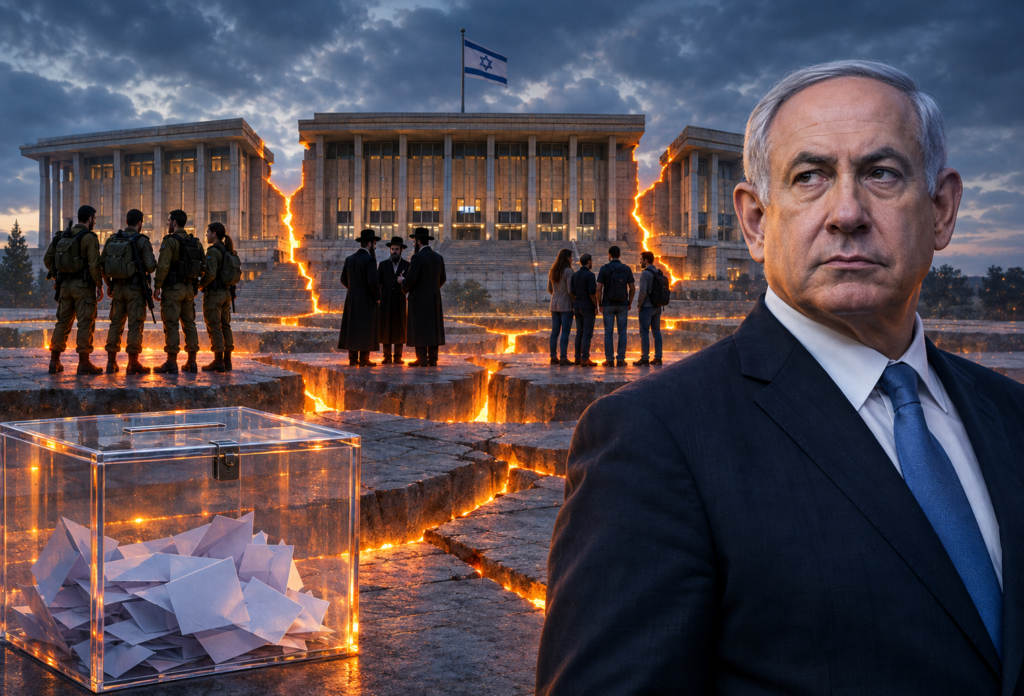
Progressive disintegration begins not with the collapse of the state or every fracture erupting at once, but when government can no longer settle common obligations through institutions accepted by those who must obey them. Elections still occur, taxes are still collected, and soldiers still report, yet service becomes conditional, enforcement uneven and departure an individual substitute for collective repair. The state remains powerful even as its authority narrows.
The ballots can determine who takes office, but they cannot decide whose children must serve, which community may refuse, whose citizenship permits participation in government or which authority must prevail when ministers reject judicial restraint. Those questions will reach the next coalition together.
Israel’s danger lies not in every fracture erupting at once, but in the institutions needed to settle them becoming objects of conflict themselves. A government formed to protect one constituency may deepen another’s withdrawal of consent, while an attempt to restore common obligations may provoke resistance from groups whose power rests on exemption.
The next election will produce a result, but the day after will expose how much governing authority that result actually carries.
READ MORE ISRAEL NEWS AT: 21st CENTURY WIRE Israel FILES
SUPPORT OUR INDEPENDENT MEDIA PLATFORM – BECOME A MEMBER @21WIRE.TV
VISIT OUR TELEGRAM CHANNEL
21st Century Wire is an alternative news agency designed to enlighten, inform and educate readers about world events which are not always covered in the mainstream media.
Source: https://21stcenturywire.com/2026/10/07/the-day-after-israel-votes/
Anyone can join.
Anyone can contribute.
Anyone can become informed about their world.
"United We Stand" Click Here To Create Your Personal Citizen Journalist Account Today, Be Sure To Invite Your Friends.
Before It’s News® is a community of individuals who report on what’s going on around them, from all around the world. Anyone can join. Anyone can contribute. Anyone can become informed about their world. "United We Stand" Click Here To Create Your Personal Citizen Journalist Account Today, Be Sure To Invite Your Friends.
LION'S MANE PRODUCT
Try Our Lion’s Mane WHOLE MIND Nootropic Blend 60 Capsules
Mushrooms are having a moment. One fabulous fungus in particular, lion’s mane, may help improve memory, depression and anxiety symptoms. They are also an excellent source of nutrients that show promise as a therapy for dementia, and other neurodegenerative diseases. If you’re living with anxiety or depression, you may be curious about all the therapy options out there — including the natural ones.Our Lion’s Mane WHOLE MIND Nootropic Blend has been formulated to utilize the potency of Lion’s mane but also include the benefits of four other Highly Beneficial Mushrooms. Synergistically, they work together to Build your health through improving cognitive function and immunity regardless of your age. Our Nootropic not only improves your Cognitive Function and Activates your Immune System, but it benefits growth of Essential Gut Flora, further enhancing your Vitality.

Our Formula includes: Lion’s Mane Mushrooms which Increase Brain Power through nerve growth, lessen anxiety, reduce depression, and improve concentration. Its an excellent adaptogen, promotes sleep and improves immunity. Shiitake Mushrooms which Fight cancer cells and infectious disease, boost the immune system, promotes brain function, and serves as a source of B vitamins. Maitake Mushrooms which regulate blood sugar levels of diabetics, reduce hypertension and boosts the immune system. Reishi Mushrooms which Fight inflammation, liver disease, fatigue, tumor growth and cancer. They Improve skin disorders and soothes digestive problems, stomach ulcers and leaky gut syndrome. Chaga Mushrooms which have anti-aging effects, boost immune function, improve stamina and athletic performance, even act as a natural aphrodisiac, fighting diabetes and improving liver function. Try Our Lion’s Mane WHOLE MIND Nootropic Blend 60 Capsules Today. Be 100% Satisfied or Receive a Full Money Back Guarantee. Order Yours Today by Following This Link.


| Visits: | 1,834,153,586 |
| Stories: | 8,716,713 |
Whistler Blowers, Insiders

