

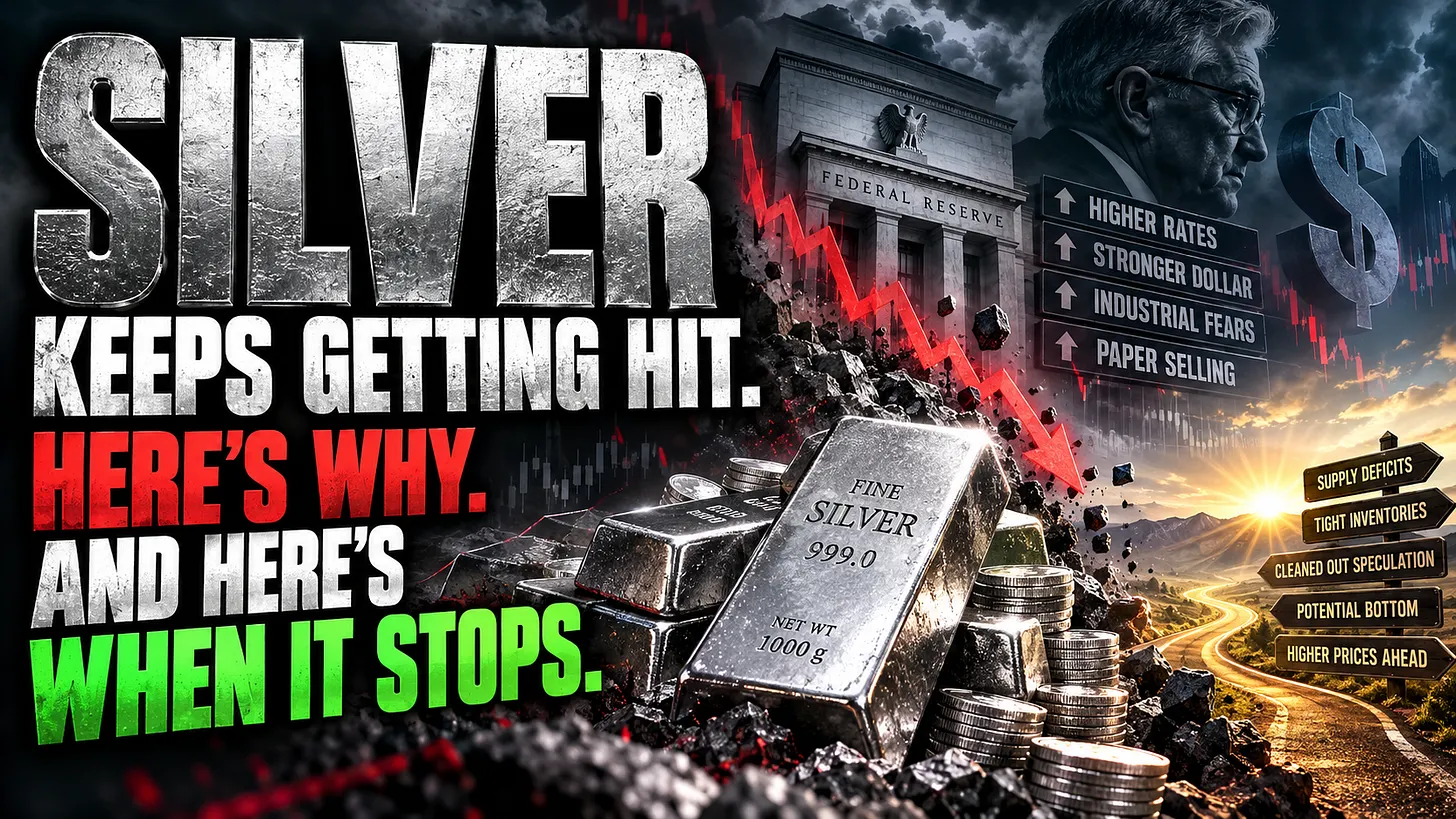
Silver Keeps Getting Hit. Here’s Why. And Here’s When It Stops.

If you only looked at the headlines, you would think silver had committed some kind of crime. It gets sold on good news. It gets sold on bad news. It gets sold when inflation is hot, and then it gets sold again when recession fears start making the rounds. For a market that is supposedly in structural deficit, silver has an amazing talent for acting like the world’s least loved asset. And with prices getting hammered repeatedly, even the most committed silver bulls are starting to wonder whether something fundamental has changed.
But that is exactly why you need to understand what’s really happening here. Because once you do, the price action starts making sense. And once it makes sense, you stop reacting emotionally and start positioning intelligently. That is where the money gets made. The biggest opportunities rarely announce themselves with favorable headlines and enthusiastic analysts. They tend to appear when the market has become so thoroughly demoralized that almost nobody wants to hear the bullish argument anymore.
Join Insider’s Advantage and Save 35%
First, Understand This: Silver Does Not Trade Like a Normal Market
Silver is not wheat. It is not copper. It is not a simple commodity where supply goes down, demand goes up, and price immediately follows. Silver is a tiny market with a giant paper overlay. That is the whole ballgame, and until you understand the implications, the price action will continue to look completely irrational. The amount of money required to push silver around in the futures market is laughably small compared to most other major asset classes.
That means it does not take a huge reallocation of capital to create massive moves. A little liquidation goes a long way. A little leverage unwinding goes even further. Add some algorithmic momentum selling, a few breached technical levels and a wave of stop-loss orders, and suddenly the chart looks like the end of civilization. Meanwhile, the people who actually use silver in manufacturing haven’t necessarily changed their purchasing plans one bit.
That is why silver so often feels disconnected from reality. In the short run, it frequently is. The physical market can be tight. Fabricators can need metal. Investors can want exposure. Mine supply can lag and industrial demand can remain robust. None of that prevents the paper market from knocking the hell out of the price for days, weeks or even months at a time. If you do not understand that distinction, silver will drive you insane, and it will probably separate you from a substantial amount of money in the process.
The Paper Market Is in Charge Right Now
That is the simplest answer to the question of why silver keeps getting hit. The paper market is pricing in a macroeconomic story that is hostile to precious metals, and silver is more vulnerable to that story than gold. Gold is treated primarily as a monetary metal. Silver is treated as a monetary metal when times are good and an industrial metal when times are bad. In other words, silver gets judged twice and usually convicted both times.
When traders believe interest rates are going higher, real yields are staying elevated and the dollar is getting stronger, that hurts precious metals broadly. When those same traders start worrying that tighter money will slow economic activity, silver takes a second hit because now its industrial side comes under suspicion too. Suddenly, it isn’t just a non-yielding monetary asset facing competition from interest-bearing securities. It is also a cyclical industrial commodity supposedly facing weaker future demand. That is a brutal combination, especially in a relatively thin market where selling tends to encourage more selling.
And this is where the economists start getting confused. They look at the fundamentals and attempt to reconcile them with current prices, often without adequately accounting for the impact of leverage, positioning and forced liquidation. But markets don’t exist to validate economic theories. In the short run, they exist to match buyers with sellers, regardless of whether those sellers are acting rationally, irrationally or because somebody in the risk department just told them to get the hell out.
Kevin Warsh Changed the Script
A lot of people still haven’t internalized how much the change in Federal Reserve leadership and monetary expectations has mattered. Earlier in the year, markets were expecting a friendlier central bank. Instead, the monetary backdrop turned harder, not easier, and that changed the psychology of the entire metals trade. Silver bulls can live with high interest rates if they believe cuts are coming. They can live with a strong dollar if they believe it is temporary. What they cannot easily live with is a market that suddenly decides the Fed is serious about keeping monetary policy tighter for longer.
That reprices everything. Higher real interest rates increase the opportunity cost of holding precious metals, while a stronger dollar makes them more expensive for buyers using other currencies. More importantly, shifting monetary expectations can force large speculative funds to unwind positions they established under an entirely different set of assumptions. When that happens, the selling has very little to do with whether the physical silver market will experience another supply deficit next year. The fund manager has a position to liquidate today, and tomorrow’s supply deficit is somebody else’s problem.
Silver, because it is smaller and more volatile than gold, gets disproportionately clubbed. The same leverage that can turn a modest upward move into a spectacular rally works just as efficiently in reverse. That is exactly what we have been watching, and it helps explain why the decline has been so persistent even as the longer-term fundamental picture remains substantially intact.
Small Market, Violent Moves
This is where most mainstream analysis completely misses the point. Economists love clean models. Silver laughs at clean models. In this market, the marginal trade matters far more than the long-term thesis over short periods. If a wave of leveraged funds has to sell, prices can get annihilated regardless of what the underlying physical fundamentals are saying. If momentum funds pile on, it gets worse. If retail investors begin panicking, you can get the final air pocket that makes even experienced investors question their sanity.
Think of silver as a small town with one main street. If five people move in, everybody notices. If ten people leave at once, it looks like a depression. That is silver. It is a relatively small market trying to absorb very large emotional and financial reactions. When you overlay futures leverage, options, stop-losses, commodity trading advisers, quantitative strategies and the endless need of traders to anticipate each other’s next move, you get exaggerated downside that looks apocalyptic right up until it doesn’t.
This is also why I have never believed you can understand silver simply by examining annual mine production and industrial consumption. Those numbers matter enormously, but they do not tell you who is being forced to sell this afternoon, which funds have breached their risk limits or how many leveraged positions will be liquidated if the price falls another dollar. The fundamentals determine the playing field. Liquidity and positioning often determine who gets carried off it.
The Industrial Narrative Is Helping Crush It
Silver’s industrial demand is real, and that is one reason the long-term thesis remains so compelling. But in the short run, the market can use that same fact against it. If traders think tighter money is going to weaken manufacturing, reduce capital spending, hurt global activity or slow certain parts of the energy transition, silver gets marked down as though demand destruction is right around the corner. Whether that demand destruction fully materializes is almost beside the point. Markets trade expectations first and reality later, sometimes much later.
There is another complication. Silver prices themselves influence industrial behavior. Manufacturers have an incentive to reduce the amount of silver used per unit of production, improve recycling and investigate substitutes when prices rise dramatically. That doesn’t eliminate demand, but it means the industrial component cannot be treated as an unlimited source of buying at any price. The silver bulls who ignore this are making the same mistake as the bears who ignore structural supply constraints. Both sides are confusing a legitimate fundamental influence with an ironclad prediction.
The result is a market where traders are simultaneously worried about tighter monetary conditions and weaker industrial demand. That double pressure can create a dramatic decline even when neither concern is sufficient to destroy the longer-term investment case. This is one reason silver can look so absurdly weak at exactly the moment its eventual recovery may be getting more attractive.
Meanwhile, the Physical Story Has Not Gone Away
Now let’s talk about the part the paper market keeps trying to ignore. Silver remains in structural supply deficit, and this is not some fringe theory put together by silver bugs in a basement. It is a recurring pattern documented in industry supply-and-demand estimates. Mine supply growth has struggled to keep pace with total demand, while recycling and above-ground inventories have helped bridge the difference. Those inventories are important because a market can remain in deficit for years without experiencing an immediate shortage or an explosive price increase.
This is the distinction that gets lost in almost every silver discussion. A structural deficit does not mean there is no silver available for delivery tomorrow morning. It means annual consumption is exceeding annual newly supplied metal under the assumptions used in the industry estimates, requiring the market to draw on existing stocks. Those stocks can be substantial, and their owners can be persuaded to sell when prices or circumstances change. But they are not an unlimited cushion, and the price eventually has to reflect the cost of attracting sufficient supply if deficits persist.
That is the disconnect. The paper market can bludgeon prices in the short run, but it cannot permanently repeal the underlying economics of production, consumption and inventory availability. Sooner or later, continued deficits must be resolved through additional mine supply, increased recycling, reduced consumption, inventory drawdowns or higher prices that help bring those adjustments about. None of this guarantees a particular price or timetable. It does, however, make the current obsession with short-term interest-rate expectations look rather incomplete.
The market can postpone an adjustment. It cannot abolish the need for one.
Speculative Froth Has Already Been Blown Out
This is the part that should make smart investors pay attention. Much of the speculative enthusiasm has already been flushed from the trade. Managed-money net long positioning in silver futures recently fell to unusually depressed levels, indicating that a substantial portion of the previously bullish speculative money has either exited or turned defensive. That is significant because markets often become most vulnerable to major reversals when positioning has already moved heavily in one direction.
It does not guarantee that the exact bottom is in. Nothing does. A market can become oversold and then become even more oversold, especially when broader financial conditions remain hostile. But declining speculative participation does tell us something important about the selling process. There are fewer enthusiastic bulls left to disappoint, fewer crowded long positions remaining to liquidate and potentially less speculative inventory waiting to be dumped on the next round of bad news.
Panic is a process. It begins with disbelief, moves to frustration and ends with exhaustion. Silver has been moving through those stages, and the key question now is how much additional selling pressure remains. The best buying opportunities in any market frequently appear when the forced sellers are nearly finished, not when the fundamentals first become favorable. By the time everyone agrees that conditions have improved, much of the easiest money has usually already been made.
So When Does the Beating Stop?
That is the real question. Not why silver is getting hit. We already know that. The real issue is when the market runs out of ammunition on the downside, and the first indication will probably not be some enormous rally that makes everybody feel good. It will be something much quieter and more revealing. Silver will simply stop collapsing on news that should have knocked it down again.
If the Fed sounds tough and silver no longer falls apart, that matters. If inflation data comes in hot and silver shrugs it off, that matters. If the dollar rallies and silver refuses to make a lower low, that matters even more. Markets often bottom when bad news stops working because the participants most inclined or compelled to sell have already acted. At that point, the market is no longer reacting primarily to the news itself. It is reacting to the absence of additional sellers.
I would be watching for exactly that behavior. Afterward, I want to see silver reclaim important technical levels and hold them. With silver recently trading around $53, the $50 to $52 region deserves close attention as a potential support zone rather than some magical line in the sand. A sustained recovery above $55 would offer the first indication that sellers are losing control. A move through $60 to $62 would be considerably more encouraging because it would suggest the market is doing more than staging another temporary relief rally.
And then there is $70. That level would tell me the market has regained much of the momentum lost during the correction and that buyers are once again willing to pay progressively higher prices. The trip back toward $100 would begin to look much more plausible at that point, although getting there will require more than enthusiastic predictions from the usual silver promoters. It will require actual buying, improving market structure and a monetary environment that stops fighting the trade.
Could Silver Go Lower First? Absolutely.
Silver is perfectly capable of overshooting on the downside. This market specializes in that sort of emotional vandalism. If another liquidation wave hits, the dollar strengthens further or the market becomes even more convinced that interest rates are staying high, a break below $50 would not be shocking. That could trigger another round of algorithmic selling and technical liquidation before the market finally finds its footing. Anyone who has owned silver for more than five minutes knows how quickly seemingly reasonable price targets can become irrelevant during a genuine washout.
But that is very different from saying the bull case is dead. A temporary paper-market massacre and a permanent breakdown in the silver thesis are not the same thing. In my view, too many investors are confusing one for the other, which is precisely what tends to happen near major turning points. The news gets worse, sentiment deteriorates, forecasts become increasingly pessimistic and investors begin extrapolating the latest decline indefinitely into the future.
We’ve seen this movie before. The characters change, the headlines change and the excuses change, but the underlying market psychology remains remarkably consistent. Investors who were delighted to buy at much higher prices suddenly become terrified of buying at lower ones. The same people who confidently projected triple-digit silver begin explaining why it might never recover. Nothing has necessarily changed except the price, but that alone is often enough to completely reverse the crowd’s convictions.
Here’s the Deeper Lesson
Silver teaches the same lesson over and over again: price is not truth, at least not in the short run. Price is frequently just pressure. Forced selling, leverage unwinds, changing monetary expectations, macroeconomic crosscurrents and short-term fear can overwhelm the fundamentals for surprisingly long periods. That does not make price irrelevant. It makes understanding the forces behind price absolutely essential.
The people who do best in silver are not necessarily those who never experience fear. They are the ones who understand the market’s structure well enough to distinguish between a liquidity-driven liquidation and a lasting deterioration in the investment thesis. They recognize that silver’s volatility is both its greatest attraction and its most formidable psychological obstacle. The same market that can destroy years of gains in weeks can recover those losses with breathtaking speed once capital begins moving in the opposite direction.
And that is where we are now. Silver keeps getting hit because the paper market is pricing in tight money, slower growth and a hostile macroeconomic backdrop. The selling stops when that pressure exhausts itself, when bad news stops producing lower lows and when buyers once again become willing to challenge the prevailing pessimism. The physical supply-and-demand picture may eventually provide the foundation for the next major advance, but the immediate turning point will probably be signaled by the behavior of prices rather than another bullish report about deficits.
The Bottom Line
I suspect we’re considerably closer to the end of this liquidation cycle than the prevailing sentiment would suggest. That doesn’t mean I’m calling an exact bottom or promising silver will be back at $100 by Christmas. It means the speculative excess has been substantially reduced, the physical fundamentals have not disappeared and the market is approaching price levels where the balance between potential reward and additional downside begins to look increasingly interesting. My working expectation is that a bottoming process could develop between now and year-end, with a more durable recovery becoming possible as we move into 2027, particularly if monetary expectations begin to stabilize.
The most revealing development may come when the next supposedly bearish announcement fails to produce another major decline. That is when I’ll start paying very close attention. Markets have an uncanny ability to make the maximum number of participants miserable before reversing direction, and silver has perfected the art. It can spend months convincing everyone that the bull market is over, then recover a substantial portion of its losses before most investors realize the game has changed.
The question isn’t whether silver will ever return to $100. The question is whether the market is creating another major buying opportunity at these levels or whether it still needs one final capitulation to finish the job. I lean toward the former, but I’m watching the market’s response to bad news rather than trusting a calendar or a price prediction.
Silver isn’t being beaten up because the world suddenly stopped needing it. It’s being beaten up because the marginal seller currently has more urgency than the marginal buyer. That is a temporary condition, not an economic law.
And if you want the next big move, you don’t buy silver because it feels good. You buy it when everybody else feels sick.
That’s when the real money is made.
Get Ahead of the Next Move
The biggest profits in precious metals rarely go to investors who wait for the financial media to announce that it’s safe to buy. By then, the opportunity has often passed. At Financial Survival Network, our Insider’s Advantage subscribers get deeper market analysis, special reports and the contrarian perspective needed to recognize major opportunities before they become consensus opinion.
We’re currently offering 35% off an Insider’s Advantage subscription, along with our collection of special reports and ebooks. If you’re serious about understanding what comes next for silver, gold, inflation and the dollar, this is where you want to be.
Join Insider’s Advantage and Save 35%
The next major silver move won’t wait for the crowd to get comfortable. Neither should you.
Source: https://www.financialsurvivalnetwork.com/p/silver-keeps-getting-hit-heres-why
Anyone can join.
Anyone can contribute.
Anyone can become informed about their world.
"United We Stand" Click Here To Create Your Personal Citizen Journalist Account Today, Be Sure To Invite Your Friends.
Before It’s News® is a community of individuals who report on what’s going on around them, from all around the world. Anyone can join. Anyone can contribute. Anyone can become informed about their world. "United We Stand" Click Here To Create Your Personal Citizen Journalist Account Today, Be Sure To Invite Your Friends.
LION'S MANE PRODUCT
Try Our Lion’s Mane WHOLE MIND Nootropic Blend 60 Capsules
Mushrooms are having a moment. One fabulous fungus in particular, lion’s mane, may help improve memory, depression and anxiety symptoms. They are also an excellent source of nutrients that show promise as a therapy for dementia, and other neurodegenerative diseases. If you’re living with anxiety or depression, you may be curious about all the therapy options out there — including the natural ones.Our Lion’s Mane WHOLE MIND Nootropic Blend has been formulated to utilize the potency of Lion’s mane but also include the benefits of four other Highly Beneficial Mushrooms. Synergistically, they work together to Build your health through improving cognitive function and immunity regardless of your age. Our Nootropic not only improves your Cognitive Function and Activates your Immune System, but it benefits growth of Essential Gut Flora, further enhancing your Vitality.

Our Formula includes: Lion’s Mane Mushrooms which Increase Brain Power through nerve growth, lessen anxiety, reduce depression, and improve concentration. Its an excellent adaptogen, promotes sleep and improves immunity. Shiitake Mushrooms which Fight cancer cells and infectious disease, boost the immune system, promotes brain function, and serves as a source of B vitamins. Maitake Mushrooms which regulate blood sugar levels of diabetics, reduce hypertension and boosts the immune system. Reishi Mushrooms which Fight inflammation, liver disease, fatigue, tumor growth and cancer. They Improve skin disorders and soothes digestive problems, stomach ulcers and leaky gut syndrome. Chaga Mushrooms which have anti-aging effects, boost immune function, improve stamina and athletic performance, even act as a natural aphrodisiac, fighting diabetes and improving liver function. Try Our Lion’s Mane WHOLE MIND Nootropic Blend 60 Capsules Today. Be 100% Satisfied or Receive a Full Money Back Guarantee. Order Yours Today by Following This Link.


| Visits: | 1,836,236,663 |
| Stories: | 8,727,344 |
Whistler Blowers, Insiders

