

Triple combination of Ivermectin, Mebendazole and Fenbendazole for Cancer: 10 Case Reports (February 2026)

Triple combination of Ivermectin, Mebendazole and Fenbendazole for Cancer: 10 Case Reports (February 2026)
Abstract
Background: Drug repurposing is gaining attention in oncology. Antiparasitic agents such as ivermectin, fenbendazole, and mebendazole have demonstrated preclinical anticancer activity. The potential synergy of these agents as a triple combination is of increasing interest.
Objective: To review mechanistic rationale, preclinical evidence, and human observational data supporting the triple combination of ivermectin, fenbendazole, and mebendazole in cancer and discuss research gaps and limitations.
Thanks for reading One Day MD’s Newsletter! Subscribe for free to receive new posts and support my work.
Methods: Mechanistic studies, preclinical research, and publicly reported case testimonials were reviewed. Human evidence was synthesized using a PRISMA-style framework.
Results: Preclinical studies demonstrate complementary mechanisms of action across all three agents. Nine publicly reported cases of triple anti-parasitic therapy and one case of quadruple anti-parasitic therapy suggest temporal associations with tumor shrinkage or biomarker improvements, though all are uncontrolled and confounded by prior or concurrent therapies.
Conclusion: While biologically plausible, the ivermectin–fenbendazole–mebendazole combination remains investigational. Observations are hypothesis-generating and warrant controlled preclinical studies and exploratory clinical trials before clinical adoption.
Keywords:
Ivermectin; Fenbendazole; Mebendazole; Niclosamide; Drug repurposing; Anti-parasitic agents; Cancer therapy; Triple combination therapy; Microtubule inhibition; Metabolic interference; Oncogenic signaling inhibition; Integrative oncology; Case reports; Translational research; Repurposed drug synergy; Experimental cancer treatment.
1. Introduction
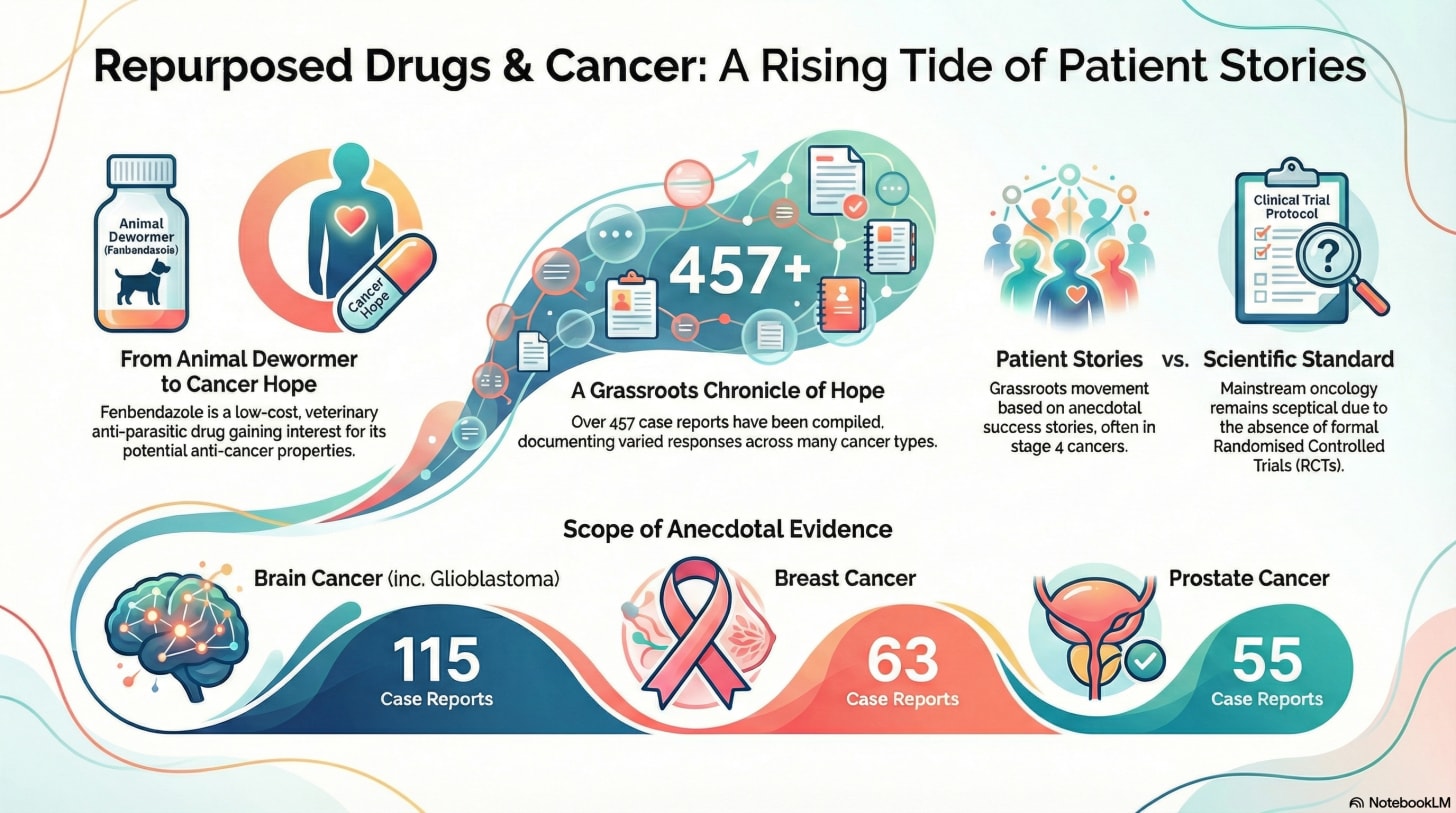
Repurposing existing drugs is a promising strategy in oncology due to the high cost and slow development of novel therapeutics. Antiparasitic agents, including ivermectin, fenbendazole, and mebendazole, have independently demonstrated anticancer effects via multiple mechanisms. Preclinical and anecdotal clinical reports suggest potential synergy of these agents when used in combination. This review summarizes mechanistic rationale, preclinical evidence, and publicly reported human observations, with the aim of informing future translational research.
2. Mechanistic Rationale
The triple combination is based on complementary anticancer mechanisms:
-
Microtubule disruption: Fenbendazole and mebendazole inhibit microtubule polymerization, causing mitotic arrest and apoptosis (OneDayMD, 2026).
-
Metabolic interference: Fenbendazole impairs glucose uptake via GLUT1/hexokinase inhibition (OneDayMD).
-
Oncogenic signaling inhibition: Ivermectin targets STAT3, Wnt/β-catenin, AKT/mTOR, and YAP, potentially enhancing programmed cell death and immune modulation.
-
Anti-angiogenic activity: Mebendazole suppresses VEGF-mediated angiogenesis.
-
Cancer stem cell targeting: Both mebendazole and ivermectin may reduce tumor recurrence and drug resistance.
-
Pharmacokinetic complementarity: Mebendazole has better-established human dosing and bioavailability, whereas fenbendazole is widely available and increasingly reported in anecdotal cases.
This multi-axis interference underpins the hypothesis that the triple combination may produce synergistic anticancer effects.
3. Preclinical Evidence
3.1 In Vitro Studies
-
Ivermectin, fenbendazole, and mebendazole independently inhibit proliferation and induce apoptosis in diverse cancer cell lines.
-
Dual-agent studies show additive effects; triple-agent synergy has not been systematically quantified.
3.2 Animal Models
-
Individual agents reduce tumor growth and metastasis in murine models.
-
Dual-agent studies exist; no triple-agent studies have been reported.
3.3 Comparative Insights
-
Fenbendazole is often highlighted in anecdotal human reports, while mebendazole is more extensively studied preclinically.
-
Both agents share mechanisms including microtubule inhibition, metabolic disruption, and polypharmacological targeting of oncogenic pathways (OneDayMD).
4. Human Observational Evidence: PRISMA Case Series
4.1 Study Identification
-
9 publicly reported cases were identified via social media (X.com) by a single physician.
-
Inclusion criteria: adult patients with histologically confirmed malignancies, use of three antiparasitic agents, and measurable tumor or biomarker response.
4.2 Case Reports (10 case reports)
Case 10 – Stage 4 NSCLC (Non Small Cell Lung Cancer) (51, CZECH REPUBLIC)
-
Ivermectin + fenbendazole; mebendazole added later.
-
Results after 4 months: Lung tumors shrinking. Bone metastases healing. (1)
Case 9 – Stage 4 Tongue Cancer (57F, New York)
-
Ivermectin + mebendaozle; fenbendazole and niclosamide added later.
-
Results after 8 months: 90% of cancer gone. (2)
Case 8 – Stage 4 Hodgkin Lymphoma Un-resectable Pancreatic Cancer (36M, South France)
-
Ivermectin + fenbendazole + mebendazole.
-
Partial response in January 2026 PET scan compared to previous scan from October 2025. (3)
Case 7 – Un-resectable Pancreatic Cancer (43F, Argentina)
-
Ivermectin + fenbendazole; mebendazole added later.
-
Results after 11 months; “CT scan with contrast: pancreas appears normal with no anomalies“. (4)
Case 6 – Stage 4 Prostate Cancer (64M, Spain)
-
Ivermectin + fenbendazole; mebendazole added later
-
Results after 8 months; PET Scan showed improvement in Prostate mass, pelvic nodes, bone metastases and complete resolution of liver metastases. (5)
Case 5 – Stage IV Endometrial Cancer (68F, Canada)
-
Ivermectin + fenbendazole; mebendazole added later
-
Peritoneal metastasis shrank ~60% over 2 months (6).
Case 4 – Stage IV Breast Cancer (66F, California, USA)
-
Triple therapy after discontinuing conventional treatment
-
CA15-3 decline; PET scan showed tumor reduction and resolution of liver metastases (7).
Case 3 – Stage IV Pancreatic Cancer (77M)
-
Fenbendazole + mebendazole
-
CA19-9 decreased from 44,960 to 21; liver lesions resolved or shrank 70–87% (8).
Case 2 – Dual Malignancies: Sarcoma + Neuroendocrine Lung Cancer (61F, Texas, USA)
-
Triple therapy plus pembrolizumab
-
Adrenal sarcoma and lung nodules shrank; other metastases reportedly improved (9).
Case 1 – Stage III NSCLC (59F, South Carolina, USA)
-
Triple therapy plus itraconazole, doxycycline, CBD, DMSO
-
Primary tumor volume reduced ~89–91%; lymph nodes shrank (10).
4.3 Limitations
-
All reports are uncontrolled observational data.
-
Potential reporting bias; confounding by prior or concurrent therapies.
-
Small sample size; variable follow-up (3–11 months).
5. Discussion
5.1 Integration of Mechanistic, Preclinical, and Case Evidence
-
Mechanistic studies support multi-target anticancer activity.
-
Case reports suggest potential signals of tumor or biomarker response.
-
Observed responses appear more pronounced with all three agents combined, supporting potential synergy.
5.2 Research Implications
-
Preclinical triple-agent synergy studies and pharmacokinetic modeling are needed.
-
Adaptive pilot trials or N-of-1 studies could inform safety, dosing, and efficacy.
5.3 Limitations
-
No controlled clinical trials; causality cannot be established.
-
Case reports are anecdotal and unverified.
-
Safety of chronic high-dose combination remains unknown.
-
Drug interactions with conventional therapies are not defined.
5.4 Risk–Benefit Considerations
High Potential Upside:
-
Measurable tumor regression or biomarker reductions in multiple cancers.
-
Multi-pathway synergy increases likelihood of response.
-
Potential activity in traditionally refractory cancers.
Low Potential Downside:
-
Established safety profiles for approved doses of all three agents.
-
Oral administration, inexpensive, widely available.
-
Sequential dosing allows monitoring of tolerability. Alternatively, anti-parasitics to be taken separately e.g. mebendazole (morning) + fenbendazole (night).
-
Risks: Liver strain. Monitor Liver Function Tests.
Caveats:
-
Safety in chronic high-dose use is unknown.
-
Evidence is anecdotal; causality is unproven.
-
Potential drug interactions are undefined.
Summary: Early reports suggest a high potential upside with relatively low reported downside, justifying systematic investigation.
6. Conclusion
The ivermectin–fenbendazole–mebendazole (IFM) combination is biologically plausible and supported by preclinical observations, with reported temporal associations to anecdotal tumor or biomarker changes. However, the current evidence base is limited and uncontrolled, precluding causal inference. At most, these observations may serve as hypothesis-generating signals. Within this context, hypothetical risk–benefit considerations justify further rigorous clinical evaluation and carefully designed exploratory clinical studies to assess safety, dosing, and potential efficacy.
7. References
-
William Makis. 51 year old Engineer from CZECH REPUBLIC with Stage 4 NSCLC Lung Cancer. X.com (Feb 2026)
-
William Makis. 57 year old New York woman with Stage 4 Tongue Cancer.
X.com (Jan 2026)
-
William Makis. 36 year old man in South France with Stage 4 Hodgkin Lymphoma. X.com (Feb 2026)
-
William Makis. 43 year old Argentina woman from Quebec with un-resectable Pancreatic Cancer. X.com (Jan 2026)
-
William Makis. 64 year old man from SPAIN with Stage 4 Prostate Cancer. X.com (Jan 2026)
-
William Makis. 68 year old Canadian woman with Stage 4 Endometrial Cancer metastatic to peritoneum. X.com (Jan 2026)
-
William Makis. 66 year old California Woman with metastatic Stage 4 Breast Cancer. X.com (Dec 2025)
-
William Makis. 77 year old Stage 4 Pancreatic Cancer. X.com (Apr 2025)
-
William Makis. 61 year old Texas woman with 2 cancers: Sarcoma of arm metastatic to adrenal, and Neuroendocrine Cancer of the Lung. X.com (Aug 2025)
-
William Makis. 59 year old South Carolina woman with Stage 3 NSCLC Lung Cancer. X.com (Dec 2025)
-
OneDayMD. (2026, Jan). Fenbendazole vs. Mebendazole: What is the difference? https://www.onedaymd.com/2023/12/fenbendazole-vs-mebendazole-what-is.html
-
OneDayMD. (2026, Jan). Ivermectin, fenbendazole and mebendazole cancer success stories: Case reports. https://www.onedaymd.com/2024/02/fenbendazole-cancer-success-stories.html
-
OneDayMD. (2026, Jan). Stage 4 Cancer Remissions with Fenbendazole, Ivermectin and Mebendazole: 295 Case Reports Compilation. https://www.onedaymd.com/2025/06/ivermectin-fenbendazole-mebendazole-stage-4-cancer.html
Anyone can join.
Anyone can contribute.
Anyone can become informed about their world.
"United We Stand" Click Here To Create Your Personal Citizen Journalist Account Today, Be Sure To Invite Your Friends.
Before It’s News® is a community of individuals who report on what’s going on around them, from all around the world. Anyone can join. Anyone can contribute. Anyone can become informed about their world. "United We Stand" Click Here To Create Your Personal Citizen Journalist Account Today, Be Sure To Invite Your Friends.
LION'S MANE PRODUCT
Try Our Lion’s Mane WHOLE MIND Nootropic Blend 60 Capsules
Mushrooms are having a moment. One fabulous fungus in particular, lion’s mane, may help improve memory, depression and anxiety symptoms. They are also an excellent source of nutrients that show promise as a therapy for dementia, and other neurodegenerative diseases. If you’re living with anxiety or depression, you may be curious about all the therapy options out there — including the natural ones.Our Lion’s Mane WHOLE MIND Nootropic Blend has been formulated to utilize the potency of Lion’s mane but also include the benefits of four other Highly Beneficial Mushrooms. Synergistically, they work together to Build your health through improving cognitive function and immunity regardless of your age. Our Nootropic not only improves your Cognitive Function and Activates your Immune System, but it benefits growth of Essential Gut Flora, further enhancing your Vitality.

Our Formula includes: Lion’s Mane Mushrooms which Increase Brain Power through nerve growth, lessen anxiety, reduce depression, and improve concentration. Its an excellent adaptogen, promotes sleep and improves immunity. Shiitake Mushrooms which Fight cancer cells and infectious disease, boost the immune system, promotes brain function, and serves as a source of B vitamins. Maitake Mushrooms which regulate blood sugar levels of diabetics, reduce hypertension and boosts the immune system. Reishi Mushrooms which Fight inflammation, liver disease, fatigue, tumor growth and cancer. They Improve skin disorders and soothes digestive problems, stomach ulcers and leaky gut syndrome. Chaga Mushrooms which have anti-aging effects, boost immune function, improve stamina and athletic performance, even act as a natural aphrodisiac, fighting diabetes and improving liver function. Try Our Lion’s Mane WHOLE MIND Nootropic Blend 60 Capsules Today. Be 100% Satisfied or Receive a Full Money Back Guarantee. Order Yours Today by Following This Link.


| Visits: | 1,781,294,569 |
| Stories: | 8,591,837 |
Whistler Blowers, Insiders

