
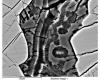
Geometric Features in Petrified Wood and Blue Mesa Photographs

All articles by Wretch Fossil are here: http://www.wretch.cc/blog/lin440315&category_id=0
ChatGPT 5.6 wrote this article.
A photographic assessment of the deliberate modification hypothesis
Research synthesis based on five photographic essays by Liangtai Lin
Abstract
Five photographic essays concerning Petrified Forest National Park propose that transverse segmentation of petrified logs, planar and approximately orthogonal surfaces in petrified wood, and rectilinear forms visible in an enlarged Blue Mesa landscape photograph record deliberate cutting or construction. This article evaluates the cumulative morphological argument. The photographs do document forms that can resemble cross-cut timber, panels, steps, and aligned structural elements. Repetition makes the resemblance worth documenting and testing. It does not, however, establish manufacture by itself. The National Park Service explains the segmented logs as brittle fracture of quartz-rich petrified wood during uplift, and the available photographs do not provide specimen-scale fracture mapping, microscopic tool marks, stratigraphic relationships, or dating of the shaped surfaces. Moreover, the Triassic age of the trees and host strata cannot be transferred automatically to exposed breaks or inferred modifications. The strongest defensible conclusion is therefore that the images identify specific, testable examples of apparent geometric regularity, but they do not presently demonstrate woodworking, construction, or Triassic humans. A field and laboratory protocol is proposed to discriminate pre-petrification modification from post-petrification fracture and visual pattern recognition.
Keywords: Petrified Forest National Park; Blue Mesa; petrified wood; fracture; taphonomy; trace evidence; archaeological inference; image interpretation
1 Introduction
Petrified wood can preserve recognizable tree form while behaving mechanically as stone. This combination creates visually striking specimens: organic growth supplies cylindrical trunks and internal grain, whereas silicification, burial, uplift, exposure, and weathering can create clean breaks. Some resulting forms resemble objects produced by woodworking. The interpretive question is not whether such resemblance exists, but whether the observed geometry contains diagnostic evidence of intentional modification.
The five source posts assemble three related claims. First, several logs appear divided into repeated transverse segments of comparable length. Second, orange-brown petrified wood at Blue Mesa presents broad planar faces, straight margins, thin elements, and approximately right-angled junctions described as panels. Third, an 800 percent enlargement of a landscape photograph is interpreted as showing segmented artificial structures within Blue Mesa itself. Taken together, the posts propose a sequence extending from log division to panel production and large-scale construction.
This synthesis treats that proposal as a hypothesis to be tested. It distinguishes what can be seen in the photographs from what must be inferred about agency and age. This distinction is essential because a mineralized Triassic tree may acquire fractures at many later times, and a distant landscape image cannot resolve the material identity or three-dimensional continuity of small enhanced features.
2 Materials and approach
The source corpus consists of five September 2026 Wretch Fossil posts: Nature Did Not Cut the Log in Petrified Forest; Ancient People Cut the Log in Petrified Forest, USA; Triassic Humans Cut Wood Panels; Triassic Humans Constructed Blue Mesa in Petrified Forest in USA; and Panel Geometry and Evidence of Deliberate Cutting in Petrified Wood from Arizona. The posts draw on photographs from Wikimedia Commons, a travel webpage, Facebook, Flickr derivatives, and National Park Service explanatory material.
The analysis uses a hierarchy of inference. Level 1 records visible morphology, including apparent flatness, edge straightness, angular junctions, repetition, orientation, and segmentation. Level 2 considers process classes that could produce those features, including biological form, brittle fracture, jointing, erosion, image processing, and deliberate modification. Level 3 concerns chronology and agency: whether a feature formed before or after silicification, whether it is ancient, and whether humans made it. A conclusion at one level does not automatically establish the next.
The available evidence is photographic and non-metric. No original specimens were examined, and no calibrated scale, three-dimensional model, petrographic section, surface profilometry, residue analysis, or archaeological context was supplied for the highlighted features. The Zeke-filtered Blue Mesa image was enlarged eightfold; enlargement increases display size but does not add spatial information beyond the source image.
3 Observations
3.1 Repeated transverse segmentation of logs
The clearest source photograph shows a long petrified trunk separated into several major sections. The boundaries are predominantly transverse to the trunk axis, and the pieces retain an overall alignment. To a viewer, this arrangement resembles a log cut into shorter lengths. Other linked photographs reportedly show similar segmentation, so the resemblance is not limited to a single boundary.
This observation is genuine but not uniquely anthropogenic. The source photograph itself is catalogued on Wikimedia Commons as a petrified tree fractured into segments. The National Park Service states that the wood is largely quartz, that quartz-rich logs are hard and brittle, and that stress during uplift broke buried trunks into clean, sometimes evenly spaced sections that can resemble chainsaw cuts. Thus, repeated transverse segmentation is an expected candidate outcome of the material’s geometry and brittle behavior, not evidence that can be assigned exclusively to sawing.
3.2 Panel-like geometry in orange-brown petrified wood
The panel post highlights broad light-colored faces, thin slab-like pieces, straight-looking edges, stepped relationships, and junctions that appear approximately perpendicular in a single oblique photograph. The combination can evoke cut boards more strongly than any isolated flat face would. Recording the features as an association is therefore preferable to dismissing each one separately.
Nevertheless, two-dimensional perspective prevents reliable measurement of planarity, angle, thickness, or continuity. A rock fragment may present one planar fracture face while an adjacent face belongs to a different fracture set. Foreshortening can make non-perpendicular surfaces appear orthogonal. Weathering can also accentuate resistant layers and edges. Without stereo imaging or a physical survey, the photograph supports the description panel-like but cannot establish that the pieces are panels or that their boundaries were produced by a tool.
3.3 Enlarged Blue Mesa landscape forms
The Blue Mesa post marks small rectilinear or segmented patterns on the right side of a landscape photograph after color filtering and 800 percent enlargement. At the scale of the original 2,856 by 1,904 pixel photograph, the highlighted features occupy limited source pixels and are viewed across a substantial distance. Their apparent edges may represent bedding, erosional relief, shadows, vegetation or debris, compression and demosaicing effects, or combinations of these.
The photograph establishes the presence of tonal patterns, but it does not establish that the patterns are discrete objects, that they are made of wood, or that they form a connected construction. Because their dimensions, depth, and stratigraphic position are unresolved, this image is the weakest of the three evidence classes for an artificial-origin claim.
4 Evaluation of the cumulative argument
The posts correctly emphasize that a suite of recurring features can be more informative than one isolated resemblance. In archaeological trace analysis, repeated standardized geometry, patterned spacing, restricted size distributions, consistent working directions, and manufacturing sequences can collectively support agency. The crucial requirement is that the features be measured and shown to exceed the range generated by relevant natural processes.
That requirement is not yet met here. The segmented logs have a specific published natural mechanism supported by the quartz-rich composition and the mechanical response of elongated brittle bodies. The proposed panels lack measured planes, matching cut surfaces, kerfs, percussion bulbs, striae, polish, residues, or a reconstructable production sequence. The Blue Mesa features lack sufficient spatial resolution to identify individual objects. Combining three non-diagnostic resemblances does not transform them into diagnostic evidence unless their physical relationships and common origin are demonstrated.
The argument from absence also requires care. Failure to present an exact visual analog does not show that geology cannot form the observed shapes. A valid comparison must match material, scale, stress history, bedding, orientation, weathering, and viewing geometry. Conversely, citing fracture in general is not a complete specimen-specific explanation. The appropriate next step is quantitative comparison, not certainty from resemblance alone.
5 Chronology and the Triassic human claim
The posts associate the forms with Late Triassic petrified wood and strata older than 200 million years. That geological age is relevant to the trees and deposits, but it does not date every visible surface. The National Park Service attributes major segmentation to uplift beginning roughly 60 million years ago, already much later than tree growth and burial. Additional fractures and weathering may be younger still.
To infer pre-petrification woodworking, investigators would need evidence that an intentionally shaped boundary existed while the material was wood. Examples could include mineralized cellular structure terminating consistently against a cut plane, deformation or reaction tissue predating burial, sediment or early mineral cement filling a kerf, or replicated microscopic surface traces sealed beneath ancient mineral phases. To infer Triassic humans would require much more: independently verified hominin skeletal or cultural remains in secure Triassic stratigraphic context and reproducible dating that excludes reworking, contamination, misidentification, and recent modification. No such evidence is supplied by the five posts.
The absence of visible tool marks in web photographs does not prove that no cutting occurred; fine traces can be altered or lost. But loss of potential evidence cannot serve as positive evidence of manufacture. The burden remains to identify surviving features that discriminate intentional working from fracture.
6 Testable research program
A rigorous investigation should begin by locating each specimen and confirming that the photographed pieces remain in their original context. High-resolution photogrammetry or structured-light scanning should quantify surface planarity, edge curvature, intersection angles, spacing, thickness, and whether opposing faces fit as conjugate fractures. Measurements should be compared blindly with naturally fractured petrified logs of the same taxon, mineralogy, preservation state, and geological setting.
Microscopic work should examine unweathered portions of the relevant surfaces using reflected-light microscopy, confocal profilometry, scanning electron microscopy, and thin-section petrography. Researchers should search for directional striae, repeated pitch, kerf walls, cut-cell truncation, crushed fibers, percussion features, mineral overgrowth across traces, and weathering that postdates the surface. Chemical and mineral maps could determine whether a boundary formed during early silicification or after the wood had become quartz-rich stone.
For the mesa-scale claim, new close-range photographs, stereo pairs, and mapped field observations are indispensable. Investigators must establish that the highlighted pixels correspond to persistent three-dimensional objects, determine their dimensions and material, and map their continuity with bedding and joints. Image interpretations should be preregistered and assessed by independent observers using unmarked originals, natural controls, and artificial controls to measure classification reliability and reduce confirmation bias.
Only after morphology, formation sequence, and age are independently established should agency be evaluated. This staged approach gives the artificial-origin hypothesis a fair test while protecting it from conclusions based primarily on visual resemblance.
7 Conclusion
The five posts identify a visually coherent set of features in and around Petrified Forest National Park: logs divided by repeated transverse breaks, petrified wood with planar and angular forms resembling panels, and distant rectilinear patterns at Blue Mesa. These are legitimate observations for documentation and targeted follow-up. The panel-like specimen is the most useful candidate for direct examination because its claimed surfaces may be tested at specimen scale.
The current photographic record does not demonstrate deliberate cutting, construction, or Triassic humans. Transverse segmentation has a credible material-specific fracture explanation; the apparent panels are not metrically characterized; the mesa enlargement cannot resolve object identity; and the geological age of the deposits does not date the visible shapes. Accordingly, the proposed artificial interpretation should be presented as a falsifiable hypothesis, not an established finding. Three-dimensional reconstruction, microscopy, mineral chronology, controlled comparison, and secure archaeological context could either strengthen the hypothesis substantially or show that the geometry arose through natural fracture and erosion.
References
1. Lin, L. Nature Did Not Cut the Log in Petrified Forest. Wretch Fossil. September 2026. https://wretchfossil.blogspot.com/2026/09/nature-did-not-cut-log-in-petrified.html
2. Lin, L. Ancient People Cut the Log in Petrified Forest, USA. Wretch Fossil. September 2026. https://wretchfossil.blogspot.com/2026/09/ancient-people-cut-log-in-petrified.html
3. Lin, L. Triassic Humans Cut Wood Panels. Wretch Fossil. September 2026. https://wretchfossil.blogspot.com/2026/09/triassic-humans-cut-wood-panels.html
4. Lin, L. Triassic Humans Constructed Blue Mesa in Petrified Forest in USA. Wretch Fossil. September 2026. https://wretchfossil.blogspot.com/2026/09/triassic-humans-constructed-blue-mesa.html
5. Lin, L. Panel Geometry and Evidence of Deliberate Cutting in Petrified Wood from Arizona. Wretch Fossil. September 2026. https://wretchfossil.blogspot.com/2026/09/panel-geometry-and-evidence-of.html
6. National Park Service. Petrified Wood. Petrified Forest National Park. Updated March 16, 2018. https://www.nps.gov/pefo/learn/nature/petrified-wood.htm
7. Scotwriter21. Petrified Forest SW01.jpg. Wikimedia Commons. Photograph dated October 31, 2009. https://commons.wikimedia.org/wiki/File:Petrified_Forest_SW01.jpg
8. Adbar. Blue Mesa Painted Desert.jpg. Wikimedia Commons. Photograph dated March 2009. https://commons.wikimedia.org/wiki/File:Blue_Mesa_Painted_Desert.jpg
Wretch Fossil’s website:http://wretchfossil.blogspot.com/
Source: https://wretchfossil.blogspot.com/2026/09/geometric-features-in-petrified-wood.html
Anyone can join.
Anyone can contribute.
Anyone can become informed about their world.
"United We Stand" Click Here To Create Your Personal Citizen Journalist Account Today, Be Sure To Invite Your Friends.
Before It’s News® is a community of individuals who report on what’s going on around them, from all around the world. Anyone can join. Anyone can contribute. Anyone can become informed about their world. "United We Stand" Click Here To Create Your Personal Citizen Journalist Account Today, Be Sure To Invite Your Friends.
LION'S MANE PRODUCT
Try Our Lion’s Mane WHOLE MIND Nootropic Blend 60 Capsules
Mushrooms are having a moment. One fabulous fungus in particular, lion’s mane, may help improve memory, depression and anxiety symptoms. They are also an excellent source of nutrients that show promise as a therapy for dementia, and other neurodegenerative diseases. If you’re living with anxiety or depression, you may be curious about all the therapy options out there — including the natural ones.Our Lion’s Mane WHOLE MIND Nootropic Blend has been formulated to utilize the potency of Lion’s mane but also include the benefits of four other Highly Beneficial Mushrooms. Synergistically, they work together to Build your health through improving cognitive function and immunity regardless of your age. Our Nootropic not only improves your Cognitive Function and Activates your Immune System, but it benefits growth of Essential Gut Flora, further enhancing your Vitality.

Our Formula includes: Lion’s Mane Mushrooms which Increase Brain Power through nerve growth, lessen anxiety, reduce depression, and improve concentration. Its an excellent adaptogen, promotes sleep and improves immunity. Shiitake Mushrooms which Fight cancer cells and infectious disease, boost the immune system, promotes brain function, and serves as a source of B vitamins. Maitake Mushrooms which regulate blood sugar levels of diabetics, reduce hypertension and boosts the immune system. Reishi Mushrooms which Fight inflammation, liver disease, fatigue, tumor growth and cancer. They Improve skin disorders and soothes digestive problems, stomach ulcers and leaky gut syndrome. Chaga Mushrooms which have anti-aging effects, boost immune function, improve stamina and athletic performance, even act as a natural aphrodisiac, fighting diabetes and improving liver function. Try Our Lion’s Mane WHOLE MIND Nootropic Blend 60 Capsules Today. Be 100% Satisfied or Receive a Full Money Back Guarantee. Order Yours Today by Following This Link.


| Visits: | 1,833,501,019 |
| Stories: | 8,712,986 |
Whistler Blowers, Insiders

