

How to Practice Golf with Purpose: The Mental Architecture of Improvement

The most dangerous place for your golf game isn’t the water hazard or the out-of-bounds stakes; it’s the center of the practice range where you’ve spent hours hitting balls without a plan. You’ve likely experienced the deep frustration of a “good” range session that vanishes the moment you step onto the first tee. This disconnect exists because most golfers train their muscles while leaving their minds completely idle. It’s a common trap to believe that more volume equals more improvement, but hitting a hundred balls with no consequence only reinforces a lack of focus and discipline.
If you want to stop wasting time, you must learn how to practice golf with purpose by building a mental architecture for every shot. This guide will show you how to transform “junk” range sessions into high-performance training that translates directly to lower scores without changing your swing. We’ll explore how to simulate on-course pressure, implement a disciplined pre-shot routine, and focus on the process rather than the result. By the end of this article, you’ll have a structured system to cultivate the calm confidence and internal resilience required to perform under pressure in 2026 and beyond.
- Distinguish between mindless repetition and deliberate practice by shifting your focus from physical volume to specific cognitive goals.
- Discover how to practice golf with purpose by integrating course simulation and artificial pressure into every range session to bridge the gap to the first tee.
- Transition from tracking ball flight results to a “Process Scorecard” that rewards the quality of your pre-shot routine and mental discipline.
- Implement structured challenges like the Virtual 9-Hole or the Pressure Ladder to build resilience and consistency under conditions that mirror actual play.
- Move beyond isolated drills by adopting a comprehensive mental architecture that provides a repeatable blueprint for high performance under pressure.
What is Purposeful Practice in Golf?
Purposeful practice is the intentional application of focus toward a specific cognitive goal. In the study of high performance, this is often defined as deliberate practice. It requires you to step away from the mindless repetition of “junk practice,” where the only objective is to empty a bucket of balls as quickly as possible. When you beat balls without intent, you’re merely exercising your muscles. To understand how to practice golf with purpose, you must adopt the mindset of a mental architect. You aren’t just hitting shots; you’re designing a psychological structure that can withstand the pressure of the first tee and the unpredictability of the back nine.
The “Range to Course Disconnect” is rarely a physical issue. It’s a failure of practice intent. If your practice sessions don’t mirror the cognitive demands of the course, you shouldn’t be surprised when your skills vanish under pressure. If you’re struggling to identify these specific mental hurdles, a free 15-minute consultation can help you pinpoint where your focus is breaking down during your training.
The Difference Between Block and Performance Practice
Block practice involves hitting the same club to the same target repeatedly. While this helps refine a specific movement, it’s often a trap. It provides a false sense of mastery because your brain eventually stops engaging with the task. Performance practice, however, demands that you change your club, target, and intent on every shot. This forces your brain to stay awake. By introducing variety, you simulate the actual demands of a round where you never hit the same shot twice in a row. It’s the difference between memorizing a script and learning how to hold a conversation.
Why Your Brain Needs a ‘Problem’ to Solve
Golf is a game of recovery and adaptation, not just repetition. If your practice doesn’t present problems to solve, you won’t be prepared when a real challenge arises on the course. You can’t just aim at a general area and hope for the best. Instead, set a “Micro-Goal” for every ball. This might be a specific trajectory, a landing spot, or a commitment to a full pre-shot routine. Learning how to practice golf with purpose means moving from result-oriented thinking to process-oriented thinking. This shift ensures that every swing serves a higher purpose. It builds the mental resilience needed to recover from a poor shot and stay present in the moment.
The 3 Pillars of a Purposeful Practice Session
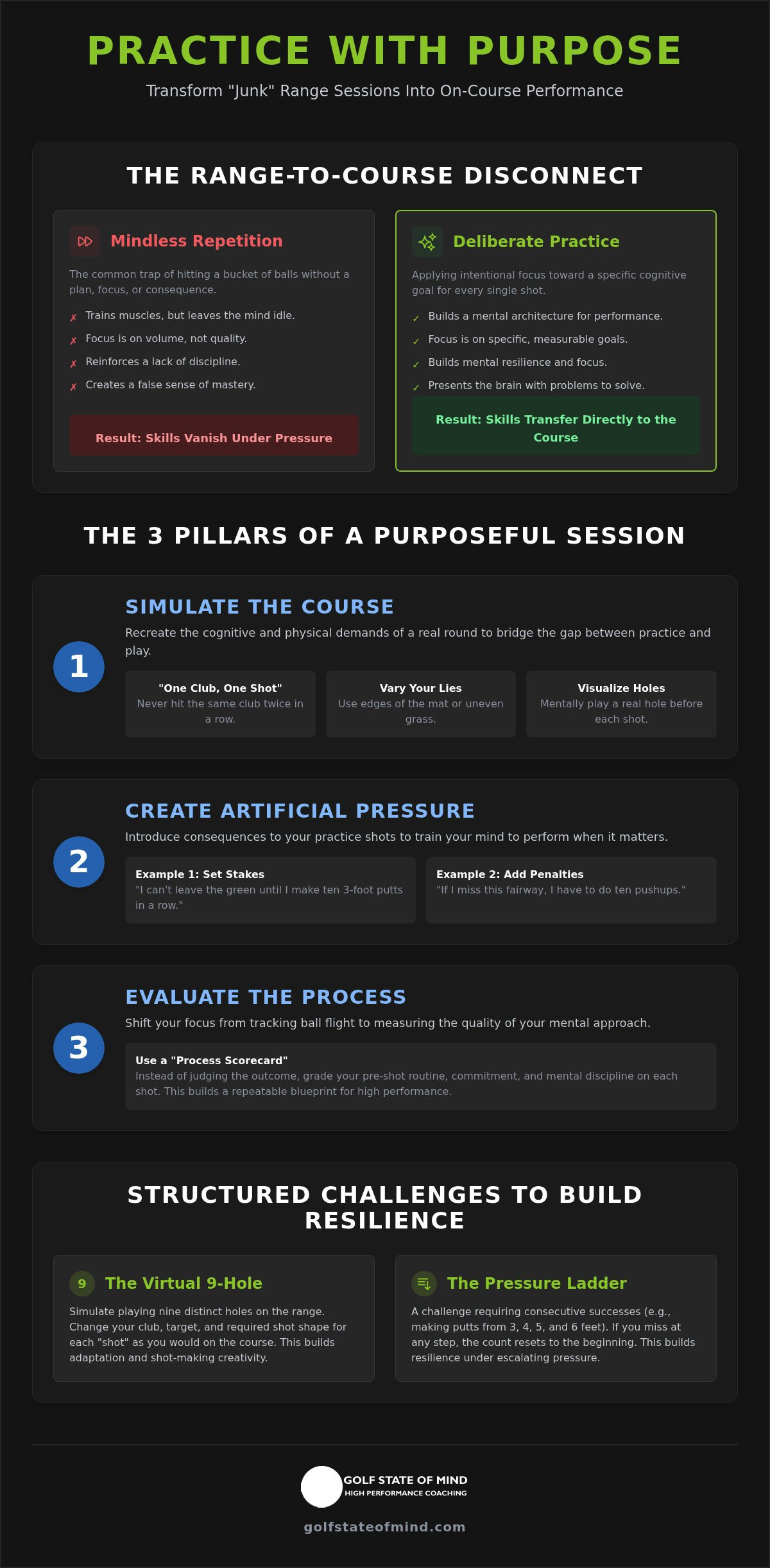
To master how to practice golf with purpose, you must move beyond the arbitrary metric of time and focus on the intensity of your cognitive engagement. Intentionality is the cognitive bridge that connects the sterile environment of the practice range to the dynamic reality of the golf course. Without it, your skills remain tethered to the range. A truly effective session is built on three specific pillars: Simulation, Pressure, and Evaluation. These pillars ensure that your practice is not just a physical workout, but a mental rehearsal for the challenges ahead.
Simulating the Course Environment
The range is often too comfortable. To prepare for the course, you must introduce the variability you’ll face during a round. Stop hitting every ball from a perfect, flat lie in the center of the mat. Instead, find the edges of the mat or seek out uneven patches of grass to simulate side-hill or down-hill lies. Follow the “One Club, One Shot” rule: never hit the same club twice in a row. This prevents your brain from falling into a rhythmic, mechanical trance. Before each shot, visualize a specific hole from your home course. See the bunkers, feel the wind, and commit to the target as if the score mattered.
Creating Artificial Pressure
Consequence is the missing ingredient in most practice sessions. On the course, every shot has a price. On the range, a poor shot is often immediately followed by another ball with no penalty. This lack of stakes prevents you from building the mental architecture needed for tournament play. You must create artificial pressure. Set a rule: “I can’t leave the green until I make ten three-footers in a row,” or “If I miss this fairway, I have to do ten pushups.” These small stakes force your brain to engage with the same emotional intensity you feel on the first tee. This type of training is a core component of the blueprint for high performance, ensuring your mind remains stable when the stakes are real.
Evaluation: Measuring Quality Over Result
The final pillar is evaluation. Most golfers judge a session by how well they hit the ball. This is a mistake. A purposeful practitioner judges a session by the quality of their focus and the discipline of their routine. Did you commit to every shot? Did you maintain your pre-shot routine even when you were tired? By tracking the quality of your mental process rather than the flight of the ball, you reinforce the habits that actually lower scores. This shift in perspective transforms the range from a place of exercise into a laboratory for mental mastery. It’s about building a mind that survives the first tee, not just a swing that looks good on camera.
The Mental Scorecard: Tracking Quality Over Quantity
Most golfers leave the range with a vague feeling of success or failure based entirely on how many shots looked “good.” This is a trap. If you want to understand how to practice golf with purpose, you must stop tracking the flight of the ball and start tracking the quality of your internal state. In the 2026 landscape of performance coaching, we use focus metrics to predict course performance. This shift from result-scoring to process-scoring allows you to build a reliable mental architecture that doesn’t crumble just because you hit one thin iron shot.
A Mental Scorecard is your tool for objective self-assessment. It requires you to grade your performance on a binary scale: did you execute the mental task, or did you fail? By the end of a session, your “score” isn’t determined by your greens in regulation, but by the percentage of shots where you maintained total focus duration. If your mind wandered during 40% of your swings, that’s a clear indicator of why your range game doesn’t travel to the course. High-performance golf requires the discipline to stay present from the moment you pull a club until the ball comes to rest.
Grading Your Pre-Shot Routine
For every practice ball, you should ask yourself three specific questions. First, was the visualization clear? You must see the shot in your mind before you try to produce it. Second, did you commit 100% to the chosen target and club? Any shred of doubt in the “Play Box” will lead to physical tension. Finally, did you respect the boundary between the “Think Box” and the “Play Box”? The Think Box is for gathering data and making decisions. Once you step across that line into the Play Box, all analysis must stop. If you can’t answer “yes” to all three, the shot is a mental failure, regardless of where the ball landed.
Analyzing the ‘Post-Shot’ Reaction
Your practice isn’t over when the ball is in the air. The post-shot reaction is where you train your brain to handle adversity. Learning how to recover from a bad golf shot starts on the range, not the tournament tee. We implement the “10-Step Rule” during practice: you have exactly ten steps to feel any emotion related to the shot. Once you reach that tenth step, you must return to a neutral emotional state. This prevents a “junk” shot from turning into a “junk” session. By practicing neutrality, you ensure that your emotional stability remains a constant, even when your ball flight is variable.
3 Drills to Practice Golf with Purpose
Applying the theory of mental architecture requires practical application. These specific drills are designed to bridge the gap between technical ability and on-course execution. By moving away from static targets, you force your brain to remain active and engaged. These drills train the neural pathways of focus, ensuring that your mind remains a stable asset when you transition from the range to the scoreboard. They transform the range into a laboratory where you can test your resilience before it’s required in a competitive setting.
The Virtual 9-Hole Challenge
Select a course you know intimately and play the first nine holes entirely in your mind while standing on the driving range. This drill is a cornerstone of learning how to practice golf with purpose because it eliminates the rhythm of block practice. If the first hole is a par 4, hit your driver. If you visualize the ball landing in the right fairway, pull the 7-iron you’d typically use for the approach. Should you “miss” the imaginary green, your next shot must be a chip or a pitch. This constant variety prevents the mechanical “sleep” that occurs when hitting the same club repeatedly. It forces you to commit to a new target and a new intent with every single swing.
The First Tee Simulation
The most stressful shot of the day is often the first one, yet most golfers only practice it after hitting fifty warm-up balls. To simulate this pressure, arrive at the range and hit your “First Tee” shot with zero warm-up. Pull your driver, go through your full pre-shot routine, and execute. Analyze the physical sensations of “cold” nerves and the internal chatter that arises. This drill is essential for managing first tee nerves by exposing you to the discomfort of performing without a safety net. It teaches you to rely on your process rather than your physical rhythm. When you can execute this shot cold on the range, the actual first tee loses its power over you.
The Pressure Ladder for Putting
Putting is where the mental game is most visible. The Pressure Ladder involves placing markers at three, six, and nine feet. You must make three consecutive putts from the first marker before moving back. If you miss at any stage, you must start again from the beginning. This escalating difficulty creates a genuine sense of consequence. As you reach the final stage, you’ll feel the same physiological response as a birdie putt on the 18th hole. Practicing in this state of heightened awareness is the only way to build true consistency. To integrate these drills into a comprehensive routine, consider adopting the Ultimate Mental Game Training System as your daily blueprint for improvement.
Integrating a Proven Mental Training System
Individual drills provide the essential building blocks for improvement, but they often fail to deliver lasting results without a cohesive framework. Learning how to practice golf with purpose is not a series of isolated events; it’s a commitment to a structured philosophy. You’ve likely seen the “range pro” who looks like a master in a vacuum but struggles when the environment becomes unpredictable. This happens because they’ve mastered the art of practicing, but not the art of performing. To bridge this gap, you need a system that aligns your cognitive efforts with the specific demands of competitive play.
Transitioning from a practicer to a performer requires a fundamental shift in how you view your time on the range. It’s no longer about hitting a certain number of balls or finding a “feeling” in your swing. Instead, it’s about the deliberate construction of a mind that can navigate the emotional highs and lows of a round. When you have a proven system in place, you stop guessing and start training with the calm confidence that your preparation will hold up under the heat of competition.
The Ultimate Mental Game Training System
As we move through 2026, The Ultimate Mental Game Training System has become the definitive standard for golfers seeking high-performance results. This step-by-step framework moves beyond the “what” of practice and dives deep into the “how.” It prioritizes mastery of the self as the primary driver of lower scores. By aligning your practice sessions with your on-course goals, you ensure that every minute spent on the range contributes to a more stable, resilient mind. It provides the architectural blueprint required to build a game that thrives under pressure, ensuring your skills are accessible when they matter most.
Personalized 1:1 Coaching for Practice Discipline
Even with a proven system, individual psychological hurdles can impede progress. These mental blocks often manifest as a lack of focus during practice or a persistent range-to-course disconnect that feels impossible to solve alone. This is why elite players invest in 1:1 Mental Coaching to structure their training sessions. A professional mentor can identify specific patterns in your cognitive process that you might miss. They provide a bespoke practice plan tailored to your unique psychological profile, ensuring you’re training for the specific pressures you face. If you’re ready to move beyond generic advice and understand how to practice golf with purpose at an elite level, book a free 15-minute consultation to discuss your path to disciplined, high-performance practice.
Build Your Foundation for On-Course Success
Mastery on the golf course is not an accident. It’s the result of a deliberate mental architecture built during every practice session. By shifting your focus from the volume of balls hit to the quality of your cognitive intent, you bridge the gap between the range and the first tee. You must prioritize course simulation, introduce artificial pressure, and use a mental scorecard to track your discipline rather than your ball flight. These shifts ensure that your skills remain accessible when the stakes are real.
Learning how to practice golf with purpose is the first step toward becoming a performer rather than just a practicer. To fully integrate these principles into your game, you can transform your practice with The Ultimate Mental Game Training System. This digital system is used by professionals on the PGA and European Tours to master the 90% of the game that is mental. It allows you to train your mind anywhere, at any time, with proven strategies. Trust in your process, remain patient with your progress, and watch as your scores reflect the quiet strength of a prepared mind.
Frequently Asked Questions How often should I practice the mental game compared to my swing?
You should integrate mental training into every single practice session rather than treating it as a separate discipline. While you may spend dedicated time on technical refinements, every shot on the range is an opportunity to strengthen your focus. A balanced approach involves using the first portion of your session for specific drills and the remainder for performance-based simulation. This ensures you’re building a mind that can actually use the swing you’ve developed.
What is the best way to practice golf at home without a range?
Visualization and routine rehearsal are the most effective ways to understand how to practice golf with purpose at home. You don’t need a hitting net to refine your pre-shot routine or your ability to commit to a target. Spend ten minutes a day vividly imagining a specific hole and walking through your full mental process. This type of dry training builds the neural pathways necessary for consistency when you return to the grass.
How do I stop overthinking my swing during a practice session?
Isolate your technical thoughts by using the “Think Box” and “Play Box” concept. All swing-related analysis must stay behind an imaginary line before you address the ball. Once you step into the Play Box, your only job is to focus on an external target or a specific feel. If a technical thought creeps in, step back and reset immediately. This discipline prevents the paralysis by analysis that often ruins on-course performance.
Can I practice with purpose if I only have 20 minutes?
You can absolutely achieve a high-quality session in just 20 minutes by focusing on intensity over volume. Instead of hitting a full bucket, take ten balls and treat each one like a tournament shot. Go through your full routine and apply a consequence for every miss. This condensed format forces your brain to engage immediately. It’s a far more effective way to learn how to practice golf with purpose than aimless hitting.
How do I know if my practice session was actually successful?
A successful session is defined by the quality of your focus and your adherence to your pre-shot routine. Use the Mental Scorecard to grade yourself on every shot. If you committed to your targets and stayed present for the majority of the session, you’ve succeeded. The flight of the ball is secondary to the stability of your process. High-performance practice is about training the mind, not just the muscles.
Should I practice my weaknesses or my strengths more often?
While you must address technical flaws, you should spend a significant portion of your time practicing your strengths under pressure. This builds the mental resilience and confidence required for competitive play in 2026. If you only practice your weaknesses, you risk entering a round with a mindset of repair rather than performance. Use performance drills to test your best clubs, ensuring they remain reliable assets when you’re under the gun.
What happens if I lose focus halfway through a bucket of balls?
If your focus wavers halfway through a session, step away from the hitting bay immediately. Continuing to hit balls while distracted only reinforces the habits of “junk practice.” Take a three-minute walk, reset your breathing, and return only when you’re ready to commit to your process. If you can’t regain your focus, it’s better to end the session early. Quality always trumps quantity when you’re building a stable mental architecture.
How do I simulate the pressure of a tournament while practicing alone?
Simulating pressure alone requires you to create tangible stakes for your performance. Use consequence-based games where a failure to meet a goal results in a penalty, such as starting a drill over or performing a physical task. You can also share your practice goals with a coach or peer to create a sense of social accountability. These small stressors train your nervous system to remain calm and functional when real tournament pressure arrives.
The post How to Practice Golf with Purpose: The Mental Architecture of Improvement appeared first on Instruction For The Mental Game of Golf.
Source: https://golfstateofmind.com/how-to-practice-golf-with-purpose-the-mental-architecture-of-improvement/
Anyone can join.
Anyone can contribute.
Anyone can become informed about their world.
"United We Stand" Click Here To Create Your Personal Citizen Journalist Account Today, Be Sure To Invite Your Friends.
Before It’s News® is a community of individuals who report on what’s going on around them, from all around the world. Anyone can join. Anyone can contribute. Anyone can become informed about their world. "United We Stand" Click Here To Create Your Personal Citizen Journalist Account Today, Be Sure To Invite Your Friends.
LION'S MANE PRODUCT
Try Our Lion’s Mane WHOLE MIND Nootropic Blend 60 Capsules
Mushrooms are having a moment. One fabulous fungus in particular, lion’s mane, may help improve memory, depression and anxiety symptoms. They are also an excellent source of nutrients that show promise as a therapy for dementia, and other neurodegenerative diseases. If you’re living with anxiety or depression, you may be curious about all the therapy options out there — including the natural ones.Our Lion’s Mane WHOLE MIND Nootropic Blend has been formulated to utilize the potency of Lion’s mane but also include the benefits of four other Highly Beneficial Mushrooms. Synergistically, they work together to Build your health through improving cognitive function and immunity regardless of your age. Our Nootropic not only improves your Cognitive Function and Activates your Immune System, but it benefits growth of Essential Gut Flora, further enhancing your Vitality.

Our Formula includes: Lion’s Mane Mushrooms which Increase Brain Power through nerve growth, lessen anxiety, reduce depression, and improve concentration. Its an excellent adaptogen, promotes sleep and improves immunity. Shiitake Mushrooms which Fight cancer cells and infectious disease, boost the immune system, promotes brain function, and serves as a source of B vitamins. Maitake Mushrooms which regulate blood sugar levels of diabetics, reduce hypertension and boosts the immune system. Reishi Mushrooms which Fight inflammation, liver disease, fatigue, tumor growth and cancer. They Improve skin disorders and soothes digestive problems, stomach ulcers and leaky gut syndrome. Chaga Mushrooms which have anti-aging effects, boost immune function, improve stamina and athletic performance, even act as a natural aphrodisiac, fighting diabetes and improving liver function. Try Our Lion’s Mane WHOLE MIND Nootropic Blend 60 Capsules Today. Be 100% Satisfied or Receive a Full Money Back Guarantee. Order Yours Today by Following This Link.


| Visits: | 1,831,956,557 |
| Stories: | 8,705,022 |
Whistler Blowers, Insiders

